
BuddhistCatholicContemplativeEvangelicalGeneral ChristianHinduJewishLatter-day SaintMuslimNew VisionsProgressive Christian
Beliefs
- Buddhist
- Catholic
- Contemplative
- Evangelical
- General Christian
- Hindu
- Jewish
- Latter-day Saint
- More Voices
- Muslim
- New Visions
- Pagan
- Progressive Christian
Topics
- Religion News
- Food and Religion
- Sports and Religion
- Religious Art
- Religious Music and Entertainment
- Religious Events
- History and Religion
- Style and Religion
- Politics and Religion
- Women in Religion
- Recreation Outdoors and Religion
- Business Finance and Religion
- Careers Workplace and Religion
- Education and Religion
- Family Parenting and Religion
- Health Fitness and Religion
- Home and Religion
- Relationships and Religion
- Technology and Religion
- Travel and Religion
Columnists
- Buddhist Columnists
- Business Finance and Religion Columnists
- Careers Workplace and Religion Columnists
- Catholic Columnists
- Contemplative Columnists
- Education and Religion Columnists
- Evangelists Columnists
- Family Parenting and Religion Columnists
- General Christian Columnists
- Health Fitness and Religion Columnists
- Hindu Columnists
- History and Religion Columnists
- Home and Religion Columnists
- Jewish Columnists
- More Voices Columnists
- Latter Day Columnists
- Muslim Columnists
- New Visions Columnists
- Nonreligious Columnists
- Pagan Columnists
- Politics and Religion Columnists
- Progressive Columnists
- Recreation Outdoors and Religion Columnists
- Relationships and Religion Columnists
- Religion News Columnists
- Religious Art Columnists
- Religious Events Columnists
- Religious Music and Entertainment Columnists
- Sports and Religion Columnists
- Style and Religion Columnists
- Technology and Religion Columnists
- Travel and Religion Columnists
- Women in Religion Columnists
Resource Library
- 2026 Calendar
- Library of World Religions
- The 100 Most Holy Places on Earth
- Patheos Answers
- Podcasts
- Videos
- Faith Leaders Database
- Anglican Episcopalian
- Bahai
- Baptist
- Buddhism
- Christianity
- Confucianism
- Eastern Orthodoxy
- Hinduism
- Holiness and Pentecostal
- ISKCON
- Islam
- Judaism
- Lutheran
- Methodist
- The Church of Jesus Christ of Latter-day Saints
- New Age
- Paganism
- Presbytarian and Reformed
- Protestantism
- Religion Behind the Scenes
- Roman Catholic
- Scientology
- Shia Islam
- Sikhism
- Sufism
- Sunni Islam
- Taoism
- Zen
- See all religions
Research Tools
 Ad-Free & Subscriber Log-In Subscription Support
Ad-Free & Subscriber Log-In Subscription Support
Follow Patheos 

- Trending:
- Forgiveness
- |
- Marriage
- |
- Consciousness
- |
- Death Penalty
- |
- Election
- |
- Halloween

- Home
- Catholic
- Politics and Religion
- The German Reformation, Part 2?
The German Reformation, Part 2?
Last updated on: March 21, 2019 at 3:07 pm by Jane the Actuary
The German Reformation, Part 2? 2019-03-21T15:07:32-06:00 Jane the Actuary
Patheos Explore the world's faith through different perspectives on religion and spirituality! Patheos has the views of the prevalent religions and spiritualities of the world.
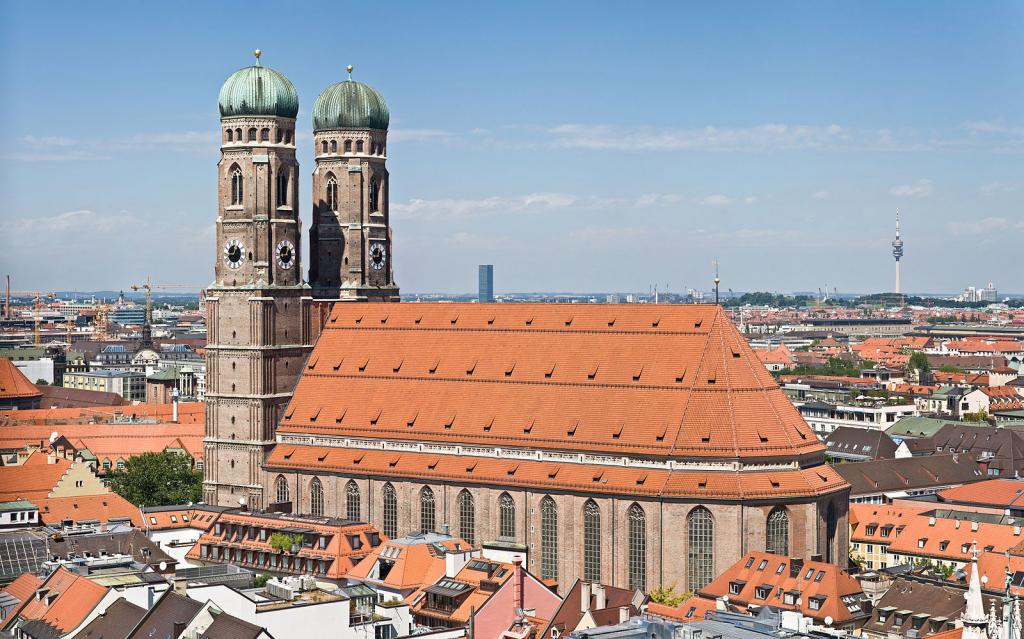
https://en.wikipedia.org/wiki/File:Frauenkirche_Munich_-_View_from_Peterskirche_Tower2.jpg; Photo by DAVID ILIFF. License: CC-BY-SA 3.0
On October 31, 1517, Martin Luther famously nailed his 95 theses to the church door at Wittenberg.
On April 17 – 18, 1521, Luther appeared before the Diet of Worms and refused to recant. (See this Reformation timeline.)
On April 17, 2021, in commemoration of the 500th anniversary of the latter event (having missed the first 500th anniversary), the bishops of the German Catholic Church declared themselves to be independent of Rome, changing their doctrine and practices as they believed necessary to conform to German cultural norms and expectations, with the primary goal of meeting the spiritual needs of German church-tax-payers. They promised a revised catechism as soon as a working group completed its task and the full document was brought up for a vote by a conference of clerical and lay delegates, periodic gatherings of which would in the future determine any further changes. From Rome, Pope Francis welcomed the new ecclesial body as colleagues, expressing his hopes for greater synodality in the future, while a minority of churchgoers expressed bewilderment at the proclamation that the new church would authorize same-sex marriages and post-divorce remarriages, and would no longer consider non-marital relationships or contraceptive use to be a topic of any relevance to Catholic teachings on morality. (It was unclear what stand the new body would take on abortion or assisted suicide.)
OK, we don’t know whether that will actually happen. But if it did, it would be in in with what’s going on in Germany and Rome right now.
Here’s an English-speaking report, from the Catholic Herald, “German bishops announce ‘synodal process’ on celibacy, sexual morality,” as the German bishops were finishing up their bishop’s conference, at which observers were waiting for news on actions they would take in light of last summer’s report on past abuse cover-ups. And the announcement came from Cardinal Reinhard Marx of Munich and Freising. (Freising, incidentally, is a small town outside Munich, known now for being the site of its airport but once upon a time significant enough that the diocese was named after both. It’s annoying, though, that they never renamed the diocese.)
Cardinal Reinhard Marx of Munich and Freising has announced that the Catholic Church in Germany is embarking on a “binding synodal process” to tackle what he says are the three key issues arising from the clerical abuse crisis: priestly celibacy, the Church’s teaching on sexual morality, and a reduction of clerical power.
Speaking at the conclusion of the plenary session of the German bishops’ conference on Thursday, Marx told reporters that the bishops had unanimously decided these three topics would be subject to a process of “synodal progression” that could lead to a binding, but as yet undetermined, outcome.
“The Church needs synodal progress,” the president of the German bishops’ conference asserted. “Pope Francis encourages this.” . . .
Addressing journalists on the final day, Marx said the Church’s teaching on sexual morality has yet to account for significant recent discoveries from theology and the humanities. Also, he said, the significance of sexuality to personhood has not yet received sufficient attention from the Church.
Bishops “feel we often are unable to speak on questions of present-day sexual behavior,” Marx said.
The cardinal also said that the German bishops appreciate priestly celibacy as an “expression of the religious bond to God” and do not simply want to give up on it. But to what extent celibacy should always be an element of priestly witness is a question “we will determine” through the “synodal process,” Marx told the press.
Furthermore, Marx said clerical abuse of power constitutes a betrayal of the trust of people in need of stability and religious orientation. Therefore, the “synodal process” would be charged with identifying what measures must be taken to achieve “the necessary reduction of [clerical] power.”
So, with respect to the first two items, at least, this sounds like everything we’ve been told is not true about sexual abuse: there are so many abusers to be found among the ranks of married and those in relationships that it’s not about mandatory celibacy. And we are just as relentlessly told that child sexual abuse is not about homosexuality, or some sort of forced repression of homosexuality resulting in the abuse of children. So what gives?
I’ve been trying to find out what this means, and in particular, what “recent discoveries from theology and the humanities” could mean for sexual morality and what the possible range of outcomes on this topic is envisioned to be. Marx has, after all, in the past been vocal about making changes such as same-sex blessings in the name of “pastoral care” and, according to a National Catholic Reporter report on his most recent New Year’s homily, put forth a vague call for “new thinking” and said that “Truth is not final.” In the original German, he calls for “”>eine Vertiefung und Weiterentwicklung der Lehre der Kirche, die immer wieder neu in einer konkreten Situation zur Sprache gebracht werden muss” — which means something like, “we need a deepening and a further development of church teachings, which must change in response to new situations.”
But what’s going on?
In part, reading the report of the German version of the Catholic News Agency, this still seems to be coming from a sense of “we f***ed up royally and need to fix it.” But it seems like more: it appears to be, on the one hand, a handing-over of the reins to a “reformist” segment as a sort of atoning for sins; at the same time, it’s not clear to me to what degree Marx and others have decided that they can use the scandal to further their agenda. Maybe it’s both.
The Sueddeutsche Zeitung, in fact, reported on the situation on Sunday, and made it clear that Marx considers the way forward, the way to, well, at least slow the church’s decline, to be an agenda of “reform” both in terms of the church’s organizational structure and revisions to sexual moral teachings.
Als einzelne Diözesanratsmitglieder den Reformeifer bremsen wollen und etwa sagen, die Lösung liege einfach darin, mehr zu beten und den Glauben in die Familien zurückzubringen, da antwortet der Kardinal: Man müsse dafür Sorge tragen, dass die frohe Botschaft des christlichen Glaubens für die Menschen überhaupt eine frohe sei und keine der Angst, der Langeweile oder schlicht der Vergangenheit. “Früher war alles besser: Wer das denkt, gewinnt die Zukunft nicht.”
When individual members of the diocesan council want to slow down the reform zeal and say that the solution is simply to pray more and bring families back to the faith, the cardinal replies: we must ensure that the good news of the Christian faith brings the people happiness, and not fear, boredom or simply memories of the past. “Everything used to be better: if you think that, you will not win the future.”
And here’s a sentence I’m not sure how to interpret, in discussing church administrative changes:
Und künftig wolle man bei der Zuweisung von Seelsorgern nicht mehr nur auf die Katholikenzahl in einer Gemeinde sehen, sondern auf alle Menschen, erklärt der kirchliche Personalchef Klaus Peter Franzl.
And in the future, one would no longer want to look at the number of Catholics in a congregation when assigning pastors, but instead the total population, explains church director Klaus Peter Franzl.
So what does Marx believe?
Here’s a recent report from his diocese’s website: “Marx: ‘Church must clear up and throw off ballast’.”
After some of the same sorts of calls to get rid of the “ballast” that is holding the church back, he says that the church must march out with a “liberating message” such as that of Pope Francis, that “the one human family belongs together,” that we should overcome hatred and help the poor and oppressed.
Here’s what he had to say at his Easter sermon last year, according to the Abendzeitung:
The encounter with Christ empowers believers in the “hope that a coexistence of people of different beliefs and cultures can succeed, because we are human together.”
Did they just cherry-pick the several sentences they thought would be of most interest to their secular readers? A collection of Easter homilies at katholisch.de reports similar vague themes of love, peace, hope, and justice.
And this seems to be the key:
The gathered bishops do not appear to regard themselves as the successors of the apostles, chosen to hand down the deposit of the faith to the next generation. Instead, rather, they believe that what they have been entrusted with is the spiritual well-being of the German people, in some broader sense, and that their obligation is to maximize well-being among Germans in whatever way they believe they can best achieve that goal, without regard to any sort of doctrine or truth, but merely with a more pragmatic and secular assessment of the situation. One senses that they do not actually believe in — well, in any of it, really, but that they have simply said, “spiritual well-being is an important component of overall well-being so let’s dive in and see what the best way of providing that is, in 2019.”
And this is, I suppose, one of the consequences of a “state church” (though in this case there are two state-churches, but each dominates particular regions of Germany); if one is religiously-inclined, whether that means believing in a particular doctrine or in the importance of spirituality more generally speaking, there is a singular career-path. And Marx appears to believe that the GCC is, or could be, “a force for good,” if it could just shed everything that people don’t like about it, and become, say, a Unitarian church with historical buildings.
And here’s something else that’s not clear to me: what do those German Catholics who remain in the pews believe?
Previous Post

March 21, 2019
A squandered inheritance
Browse Our Archives
Select a Category Actuarial/Retirement Issues Politics Uncategorized
Select a Month September 2026 August 2026 July 2026 June 2026 April 2026 March 2026 February 2026 January 2026 December 2025 November 2025 October 2025 July 2025 June 2025 May 2025 April 2025 March 2025 February 2025 January 2025 December 2024 November 2024 October 2024 September 2024 August 2024 July 2024 June 2024 May 2024 April 2024 March 2024 February 2024 December 2023 November 2023 October 2023 September 2023 August 2023 July 2023 December 2022 September 2022 August 2022 July 2022 June 2022 May 2022 February 2022 January 2022 December 2021 August 2021 June 2021 April 2021 February 2021 January 2021 December 2020 November 2020 October 2020 September 2020 August 2020 July 2020 June 2020 May 2020 April 2020 March 2020 February 2020 January 2020 December 2019 November 2019 October 2019 September 2019 August 2019 July 2019 June 2019 May 2019 April 2019 March 2019 February 2019 January 2019 December 2018 November 2018 October 2018 September 2018 August 2018 July 2018 June 2018 May 2018 April 2018 March 2018 February 2018 January 2018 December 2017 November 2017 October 2017 September 2017 August 2017 July 2017 June 2017 May 2017 April 2017 March 2017 February 2017 January 2017 December 2016 November 2016 October 2016 September 2016 August 2016 July 2016 June 2016 May 2016 April 2016 March 2016 February 2016 January 2016 December 2015 November 2015 October 2015 September 2015 August 2015 July 2015 June 2015 May 2015 April 2015 March 2015 February 2015 January 2015 December 2014 November 2014 October 2014 September 2014 August 2014 July 2014 June 2014 May 2014 April 2014 March 2014 February 2014 January 2014 December 2013 November 2013 October 2013 September 2013 August 2013 July 2013
Follow Us!
TAKE THE
Religious Wisdom Quiz
I am the wage you've earned through sin, but my opposite is a gift freely given. What am I?
Select your answer to see how you score.
Separation Death Punishment Hell
Related posts from Jane the Actuary

"Make Germany Great Again"? Or maybe just "Married...
Do you understand the Synod on Youth?
On trust: German parenting and Megan McArdle's trip...

From the library: Actung Baby, An American Mom...
TRENDING AT PATHEOS Catholic

Letters on Living the Faith by C.S. Lewis
Most of us met C.S. Lewis as a public intellectual. Mere Christianity....

When Halloween Unmasks Married Hearts
Written by Dr. David K. Ewen from Eternal Truth Bible College Behind...

Aristotle. He’s been called the father of logic, the father of the...

Methodist Central Hall and Westminster Abbey
Situated on the same square is Methodist Central Hall and Westminster Abbey. ...

57th Dove Awards Honor Dolly Parton, Crown New...
On gospel music’s biggest night, the 57th annual GMA Dove Awards honored...

The First Eucharistic Controversy: Christ’s Real Presence
For Catholics, the Eucharist is the source and summit of the Christian...
view all Catholic blogs
Ad-Free & Subscriber Log-In Subscription Support
- About Us
- 2026 Calendar
- Videos
- Podcasts
- Library of World Religions
- Faith In Media Tracker
- Advertise With Us
- Write for Us
- Privacy Policy
- Terms of Service
- Do Not Sell My Data
- Contact Us
- Radiant Digital
- Manage Newsletter Subscriptions
- Unsubscribe From Notifications
- Sitemap
Copyright 2008-2026, Patheos. All rights reserved.
Subscription Support Ad-Free & Subscriber Log-In
Follow Patheos