
BuddhistCatholicContemplativeEvangelicalGeneral ChristianHinduJewishLatter-day SaintMuslimNew VisionsProgressive Christian
Beliefs
- Buddhist
- Catholic
- Contemplative
- Evangelical
- General Christian
- Hindu
- Jewish
- Latter-day Saint
- More Voices
- Muslim
- New Visions
- Pagan
- Progressive Christian
Topics
- Religion News
- Food and Religion
- Sports and Religion
- Religious Art
- Religious Music and Entertainment
- Religious Events
- History and Religion
- Style and Religion
- Politics and Religion
- Women in Religion
- Recreation Outdoors and Religion
- Business Finance and Religion
- Careers Workplace and Religion
- Education and Religion
- Family Parenting and Religion
- Health Fitness and Religion
- Home and Religion
- Relationships and Religion
- Technology and Religion
- Travel and Religion
Columnists
- Buddhist Columnists
- Business Finance and Religion Columnists
- Careers Workplace and Religion Columnists
- Catholic Columnists
- Contemplative Columnists
- Education and Religion Columnists
- Evangelists Columnists
- Family Parenting and Religion Columnists
- General Christian Columnists
- Health Fitness and Religion Columnists
- Hindu Columnists
- History and Religion Columnists
- Home and Religion Columnists
- Jewish Columnists
- More Voices Columnists
- Latter Day Columnists
- Muslim Columnists
- New Visions Columnists
- Nonreligious Columnists
- Pagan Columnists
- Politics and Religion Columnists
- Progressive Columnists
- Recreation Outdoors and Religion Columnists
- Relationships and Religion Columnists
- Religion News Columnists
- Religious Art Columnists
- Religious Events Columnists
- Religious Music and Entertainment Columnists
- Sports and Religion Columnists
- Style and Religion Columnists
- Technology and Religion Columnists
- Travel and Religion Columnists
- Women in Religion Columnists
Resource Library
- 2026 Calendar
- Library of World Religions
- The 100 Most Holy Places on Earth
- Patheos Answers
- Podcasts
- Videos
- Faith Leaders Database
- Anglican Episcopalian
- Bahai
- Baptist
- Buddhism
- Christianity
- Confucianism
- Eastern Orthodoxy
- Hinduism
- Holiness and Pentecostal
- ISKCON
- Islam
- Judaism
- Lutheran
- Methodist
- The Church of Jesus Christ of Latter-day Saints
- New Age
- Paganism
- Presbytarian and Reformed
- Protestantism
- Religion Behind the Scenes
- Roman Catholic
- Scientology
- Shia Islam
- Sikhism
- Sufism
- Sunni Islam
- Taoism
- Zen
- See all religions
Research Tools
 Ad-Free & Subscriber Log-In Subscription Support
Ad-Free & Subscriber Log-In Subscription Support
Follow Patheos 

- Trending:
- Forgiveness
- |
- Marriage
- |
- Consciousness
- |
- Death Penalty
- |
- Election
- |
- Halloween

- Home
- Catholic
- Politics and Religion
- Secularism and community: a few words on Alienated America
Secularism and community: a few words on Alienated America
Last updated on: March 5, 2019 at 11:06 pm by Jane the Actuary
Secularism and community: a few words on Alienated America 2019-03-05T23:06:11-06:00 Jane the Actuary
Patheos Explore the world's faith through different perspectives on religion and spirituality! Patheos has the views of the prevalent religions and spiritualities of the world.
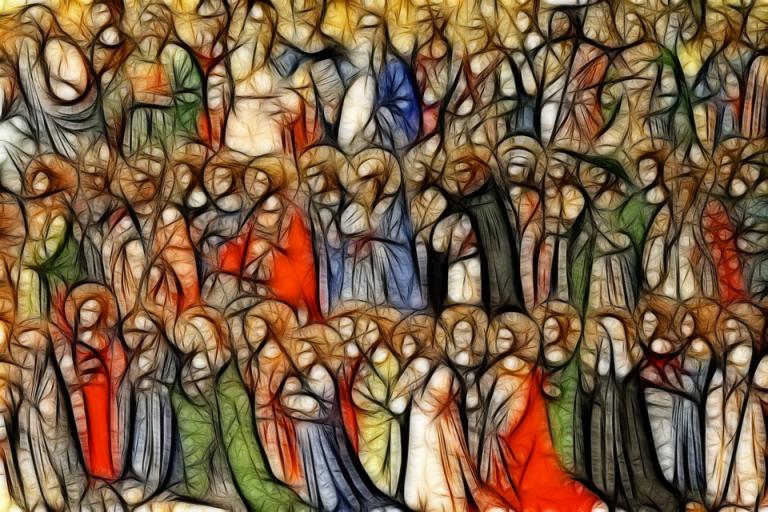
https://pixabay.com/en/all-saints-christian-holy-faith-2887463/
So I just finished Tim Carney’s Alienated America, and have a few rambly thoughts.
To begin with, it’s very good. Here’s the book in a nutshell:
When you look at the localities which supported Trump in the primaries, and which continue to be his core supporters now, they’re not the evangelicals which gave him their votes in the general election — they were faced with the binary choice of Trump vs. Clinton, which really was a choice between a professed pro-life candidate who would appoint originalist Supreme Court justices vs. a candidate with no limit to the extent of her support for abortion rights. Instead, his supporters were actually less likely to be religious, and in particular, less likely to be affiliated with religious institutions (though they might well profess that God/religion was “important” to them in a vaguer sort of way) than supporters of other candidates. What’s more, when those Trump supporters expressed that “the American dream is dead,” or found Trump’s message to that effect persuasive, it was because, in their experience, that was true — and not because of their personal financial situation, but because they lived in communities which had, well, lost their community-ness, and because having community ties is actually essential to “living the American dream” and overall well-being (e.g., social capital).
In contrast, in places like uber-wealthy Chevy Chase or uber-Dutch towns in Michigan and Iowa, voters chose otherwise; both these areas had in common strong community ties, though it the former case it’s through swim clubs and book clubs and children’s sports teams and in the latter, it’s through churches. Likewise, among immigrant groups, however much they may be struggling, as long as they are connected through their religious communities (whether churches of compatriots, or mosques or synagogues), they still have a sense of American dream-ness. But outside wealthy communities, it is the church/house of worship which is the key source of community-building, and the decline of churches and religious affiliation (which, contrary to stereotypes, is actually occurring more generally among the working class than the upper class) is hitting these communities hard. What’s more, when working class folk have no source of community identification, or even a sense of ethnic identification, they’re more prone to see their primary identification with their race, that is, being “white.”
Carney’s prescriptions: well, given that the issue is the loss of community institutions, his prescription is not some sort of big government program. The role of the government is, at best, to stay out of the way to a greater degree than it has done in the past. Instead, he calls on readers to take steps as individuals to help develop community institutions where they live (though, let’s face it, Carney’s readers most likely live in areas where community institutions are doing just fine).
And I’ve been mulling over his book, and his ideas have been sitting in a draft ever since I first came across them in the various articles which previewed the book, such as this one at The American Conservative.
Heck, I actually purchased the book, rather than just waiting for it to come off hold at the library. (Conveniently, my husband’s workplace is a short drive from one of the few indepedent bookstores in the area, so I didn’t even need to buy it from Amazon (or Barnes and Noble, which is the only other alternative, and there are fewer and fewer such outlets around here).
And there are two directions to my train of thought.
The first is personal:
Last weekend, while I was at the Scout outing, the school my son attends, my parish’s parochial school, had its annual gala. Now, I’m not a big fan of auctions, especially when it comes to the solicitation of donations where prospective donors are asked to just go out to the store and make a purchase at retail price. Maybe the atmosphere of the gala, and the open bar and the general having-a-fun-time atmosphere means that people are willing to bid over and above what they know to be the retail price. Maybe it’s important to the overall long-term success of the event to have enough “stuff” available to bid on.
But that’s neither here nor there.
What did bug me over the past week was all the social media sharing of everyone smiling, groups of 10 or 20 women in their shimmery evening gowns. My husband and I went a couple times, and it just wasn’t for us; too much time spent trying to find shoes and a dress that worked for me and in any case, I’m just not the sort of person with dozens of friends to talk to there.
So reading over the past week about the importance of community connections was challenging for me as an introvert. And at the same time, given that the way our church “does community” is with a lot of cliques, I wish there was a better way.
But my second line of thinking is more historical/cross-cultural. It goes like this:
There are a lot of authors whose overall approach to the “rise of the nones” in the United States is that the U.S. is just catching up to Europe. Secularism is just an inevitable outcome of modernity and the U.S., once an outlier in this regard, is simply no longer an outlier, in the same way as we are no longer an outlier with respect to birth rates.
I don’t buy that.
My working hypothesis is different: we may appear superficially to be on the same path as Europe, but “secularism” is not a uniform monolitic form of society, and the path we as a country are taking is really a quite different one. In the United States, the “rise of the nones” has a lot more to do with the decline of social institutions, and churches in America, as Carney so profoundly observes, function (or functioned) as social institutions to a much greater degree than in Europe. In the United States, churchgoing had as much to do with simply being a part of the churchgoing community as it did with expressing a belief or finding great meaning in Sunday services.
In Europe, in contrast — or, rather, in Germany, since that’s what I know at least a bit of something about, community life is not centered around churches, and, it seems to me, never was. Sure, back in the day, people went to church. But communities had Vereins — the Turn und Sport Verein offered, and offers the equivalent of what American park districts have, plus the team sports of high schools, and fitness classes for adults; a Blaskapelle for music, others for preserving local culture. My hunch, at least, is that European towns could lose their religious practice without it affecting community life because whatever element of community life that was connected up with church (maybe a religious procession, for example) was only a small part.
Now, that being said, I don’t have a sense of how strong (or weak) community ties in 2019 Germany, say, are. And I haven’t really dug that deeply into the story behind the collapse of religious belief, except that I have the impression that the devastation of World War II played a role.
But in the United States, two things happened.
In the first place, yes, many of the early immigrants had religious motivations, but that was really only a small piece of the history of American immigration. Outside of the Puritians, most immigrants were just coming to seek their fortune. I’m kind of just guessing a bit here, but I would presume that those immigrants were not necessarily disproportionately religious, and one can imagine that actually being comparatively more religious leads one to stay at home, where you’ll have the certainty of being able to practice your religion. But at the same time, the need to reconstruct institutions upon arriving here lent itself to the church becoming the primary social institution and the primary way that its members accessed social capital.
At the same time, you had these multiple cycles of revival. The First Great Awakening, the Second Great Awakening, the church tent revivals — I’ve even read statements that the rise of born-again Christianity in the 80s was a Third Great Awakening. Did these periods of revival exist in Europe? I have the feeling that revivalism is a part of “American exceptionalism” — and, heck, a lot of the Wokism that’s going on among young people now has the characteristics of revivalism, doesn’t it?
But in any event, if what caused the decline in religious affiliation in America is really the decline of church as a community institution, then that means that America is still “exceptional” and is still following a different path than Europe. It doesn’t necessarily mean that we can shrug off the implications of none-ism; in fact, it means that we cannot use the model of Europe and say, “they abandoned religion and seem to be doing just fine.”
Consider the Benedict Option. Yes, I have yet to read the book and only know its general outline, that is, I understand that its general premise is that a smaller church which is still a church holding to its beliefs is better than trying to preserve an institution with larger number of members at the cost of abandoning its theology for a Spong-like message of “church as community engaged in humanitarianism,” a sort of Reform (or Reconstructionist) Judaism-like version of Christianity. And maybe this is true, but I’m not so comfortable with abandoning the idea of the church as a form of community (which, incidentally, the evangelical/mega-churches do much better than Catholic churches these days, with their Small Groups and support groups of all stripes), given that the church as sponsor of community life is probably the best hope of such, especially to the extent that, depending on the particulars of a given church community, it offers, to a greater degree than Carney’s Chevy Chase swim clubs, some hope of inclusion of all social classes, depending on how economically integrated or segregated the wider area is, and from how wide an area that church draws its membership.
Previous Post

March 1, 2019
What I'm writing elsewhere
Next Post
March 15, 2019 In which, no, I am not a New Zealander
Browse Our Archives
Select a Category Actuarial/Retirement Issues Politics Uncategorized
Select a Month September 2026 August 2026 July 2026 June 2026 April 2026 March 2026 February 2026 January 2026 December 2025 November 2025 October 2025 July 2025 June 2025 May 2025 April 2025 March 2025 February 2025 January 2025 December 2024 November 2024 October 2024 September 2024 August 2024 July 2024 June 2024 May 2024 April 2024 March 2024 February 2024 December 2023 November 2023 October 2023 September 2023 August 2023 July 2023 December 2022 September 2022 August 2022 July 2022 June 2022 May 2022 February 2022 January 2022 December 2021 August 2021 June 2021 April 2021 February 2021 January 2021 December 2020 November 2020 October 2020 September 2020 August 2020 July 2020 June 2020 May 2020 April 2020 March 2020 February 2020 January 2020 December 2019 November 2019 October 2019 September 2019 August 2019 July 2019 June 2019 May 2019 April 2019 March 2019 February 2019 January 2019 December 2018 November 2018 October 2018 September 2018 August 2018 July 2018 June 2018 May 2018 April 2018 March 2018 February 2018 January 2018 December 2017 November 2017 October 2017 September 2017 August 2017 July 2017 June 2017 May 2017 April 2017 March 2017 February 2017 January 2017 December 2016 November 2016 October 2016 September 2016 August 2016 July 2016 June 2016 May 2016 April 2016 March 2016 February 2016 January 2016 December 2015 November 2015 October 2015 September 2015 August 2015 July 2015 June 2015 May 2015 April 2015 March 2015 February 2015 January 2015 December 2014 November 2014 October 2014 September 2014 August 2014 July 2014 June 2014 May 2014 April 2014 March 2014 February 2014 January 2014 December 2013 November 2013 October 2013 September 2013 August 2013 July 2013
Follow Us!
TAKE THE
Religious Wisdom Quiz
Blessed is the one who perseveres under trial because, having stood the test, that person will receive the ____ of life that the Lord has promised to those who love him.
Select your answer to see how you score.
Blessing Gift Reward Crown
Related posts from Jane the Actuary
Six "Blasphemous Olympics Opening Ceremony" Comments

A visibility day (or week or month) we...
What do we do when coronavirus lockdowns destroy...

So let's talk about anti-vaxxers, shall we?
TRENDING AT PATHEOS Catholic

The Iron Gates and the Lion of the...
Yesterday, I didn't finish my report about, well, yesterday. So I'll...

Dolly Parton’s Last Song Wins Dove Award with...
Bluegrass band The Grascals, speaking on the red carpet at the 57th...

The Image: On the Horror of Capitalism and...
The Image Then went the Pharisees, and took counsel how they might...

We are approaching the date of our new American national holiday: October...

Letters on Living the Faith by C.S. Lewis
Most of us met C.S. Lewis as a public intellectual. Mere Christianity....

When Halloween Unmasks Married Hearts
Written by Dr. David K. Ewen from Eternal Truth Bible College Behind...
view all Catholic blogs
Ad-Free & Subscriber Log-In Subscription Support
- About Us
- 2026 Calendar
- Videos
- Podcasts
- Library of World Religions
- Faith In Media Tracker
- Advertise With Us
- Write for Us
- Privacy Policy
- Terms of Service
- Do Not Sell My Data
- Contact Us
- Radiant Digital
- Manage Newsletter Subscriptions
- Unsubscribe From Notifications
- Sitemap
Copyright 2008-2026, Patheos. All rights reserved.
Subscription Support Ad-Free & Subscriber Log-In
Follow Patheos