
BuddhistCatholicContemplativeEvangelicalGeneral ChristianHinduJewishLatter-day SaintMuslimNew VisionsProgressive Christian
Beliefs
- Buddhist
- Catholic
- Contemplative
- Evangelical
- General Christian
- Hindu
- Jewish
- Latter-day Saint
- More Voices
- Muslim
- New Visions
- Pagan
- Progressive Christian
Topics
- Religion News
- Food and Religion
- Sports and Religion
- Religious Art
- Religious Music and Entertainment
- Religious Events
- History and Religion
- Style and Religion
- Politics and Religion
- Women in Religion
- Recreation Outdoors and Religion
- Business Finance and Religion
- Careers Workplace and Religion
- Education and Religion
- Family Parenting and Religion
- Health Fitness and Religion
- Home and Religion
- Relationships and Religion
- Technology and Religion
- Travel and Religion
Columnists
- Buddhist Columnists
- Business Finance and Religion Columnists
- Careers Workplace and Religion Columnists
- Catholic Columnists
- Contemplative Columnists
- Education and Religion Columnists
- Evangelists Columnists
- Family Parenting and Religion Columnists
- General Christian Columnists
- Health Fitness and Religion Columnists
- Hindu Columnists
- History and Religion Columnists
- Home and Religion Columnists
- Jewish Columnists
- More Voices Columnists
- Latter Day Columnists
- Muslim Columnists
- New Visions Columnists
- Nonreligious Columnists
- Pagan Columnists
- Politics and Religion Columnists
- Progressive Columnists
- Recreation Outdoors and Religion Columnists
- Relationships and Religion Columnists
- Religion News Columnists
- Religious Art Columnists
- Religious Events Columnists
- Religious Music and Entertainment Columnists
- Sports and Religion Columnists
- Style and Religion Columnists
- Technology and Religion Columnists
- Travel and Religion Columnists
- Women in Religion Columnists
Resource Library
- 2026 Calendar
- Library of World Religions
- The 100 Most Holy Places on Earth
- Patheos Answers
- Podcasts
- Videos
- Faith Leaders Database
- Anglican Episcopalian
- Bahai
- Baptist
- Buddhism
- Christianity
- Confucianism
- Eastern Orthodoxy
- Hinduism
- Holiness and Pentecostal
- ISKCON
- Islam
- Judaism
- Lutheran
- Methodist
- The Church of Jesus Christ of Latter-day Saints
- New Age
- Paganism
- Presbytarian and Reformed
- Protestantism
- Religion Behind the Scenes
- Roman Catholic
- Scientology
- Shia Islam
- Sikhism
- Sufism
- Sunni Islam
- Taoism
- Zen
- See all religions
Research Tools
 Ad-Free & Subscriber Log-In Subscription Support
Ad-Free & Subscriber Log-In Subscription Support
Follow Patheos 

- Trending:
- Forgiveness
- |
- Marriage
- |
- Consciousness
- |
- Death Penalty
- |
- Election
- |
- Halloween

- Home
- Catholic
- Politics and Religion
- Pot, qat, and normalization
Pot, qat, and normalization
Last updated on: September 28, 2018 at 10:14 am by Jane the Actuary
Pot, qat, and normalization 2018-09-28T10:14:49-06:00 Jane the Actuary
Patheos Explore the world's faith through different perspectives on religion and spirituality! Patheos has the views of the prevalent religions and spiritualities of the world.

First, some marijuana-use statistics, from a 2017 Marist poll, as featured originally in a Washington Post article:
When asked by phone about pot use, 52% of American adults reported having tried pot. 22% report that they are “current” users (within last year). 14% describe themselves as “regular” users (within last month).
Of current and regular users, 52% are Millennials (defined here as 18 – 34 years old). (Yes, the same prevalence is true of each category). Or, put another way,
33% of Millennials are yearly users, and
21% of Millennials are monthly users.
Are these statistics something to be concerned about? Is this no different than the fondness many young adults have for going out to bars and getting drunk, something they grow out of in time? Proponents of pot say that getting high is better than getting drunk; after all, there’s no stereotype the equivalent to an “angry drunk” and someone who’s high is less likely to take the wheel than someone who’s drunk. There’s also an active push for people who would otherwise be abusing (or just using, that is, medically, for pain treatment) opioids to switch to using pot (this was just approved in Illinois, for example, though studies on its effectiveness are not conclusive).
But consider that, with respect to alcohol, however prevalent binge drinking may be in practice, there is general societal disapproval. Even alcohol manufacturers are obliged to add to their advertising the admonition to “drink responsibly” and to state that, of course, they do not intend for their products to be used to the point of drunkenness, but rather simply for the purpose of enjoying the taste of the beverage. And, of course, as I write this in September 2018, Brett Kavanaugh is being criticized for his drinking habits as a teen and young adult, with significant numbers of those opposing him considering it a given that the alcohol-heavy parties of those years are enough to remove credibility from his denials of sexual assault.
What we’re seeing with pot is quite the opposite. The drive towards decriminalizing pot was originally about “harm reduction” and concerns that young black men were being incarcerated at high rates, and that this was doing a great deal of harm to them and their communities. What we’re seeing now is something far beyond decriminalization and far beyond “harm reduction” (as exists, for instance, in the Netherlands, where pot is decriminalized but receives strong societal disapproval) to active normalization and commercialization. It’s being treated as the next big growth industry; according to a Forbes article, North American sales are projected to increase from $9.2 billion in 2017 to $47.3 billion a decade later, and, separately, a marijuana trade group forecasts sales of as much as $15 billion in recreational pot by 2022, a tripling of current numbers. That’s massive. To be sure, their statistics don’t attempt to determine to what extent forecast sales are based on existing users switching to legal sources but it’s hard to believe that all we’re seeing here is a matter of users coming out of the shadows, especially when the marketing of pot is the new hot career move and when companies are working at branding their products, and recruiting celebrities. One suspects that underlying their marketing studies are projections of growth in their user base that they don’t want to broadcast to the rest of us.
But it’s all based on a narrative that pot supporters are telling the rest of us: people who are predestined to misuse substances will do so one way or another; that’s a fixed percentage of a population, absent some unusual situation such as the current opioid crisis. Everyone else can be relied on to add pot consumption to their spare-time recreational activities, enjoyed in moderation, in terms of frequency, even if the act of getting high isn’t something that can be done moderately, and with no ill-effects in terms of their ability to manage their personal lives, employment, and so forth. If people can add some pot-smoking enjoyment to their lives as an occasional spare-time activity, you’ve improved the overall quality of life of Americans, boosted the economy, and remedied high incarceration rates.
But there’s a counter-example: qat. It’s ubiquitous in places like Yemen. According to an Economist article from earlier this year, it’s a key contributor to the hunger crisis in that country: 90% of men chew qat, and a third of women. And
Men spend far more feeding their addiction than their families: sometimes $800 a month. Rather than searching for weapons and other contraband, soldiers extort bribes at checkpoints to pay for their habit, jacking up transport costs. And while the country runs out of basics, such as wheat, its best farmland is devoted to producing the crop, which is more lucrative. Cultivation of qat is said to be increasing by 12% a year.
Officials refer to it as Yemen’s Viagra and encourage its use. Taher Ali al-Auqaili, the army’s chief of staff, says it is “our whisky” and claims it gives his men strength to fight (see article). Both sides feed it to their child soldiers.
What’s more, in a country which is forecast to be on its way to using up its entire water supply (which comes from aquifers rather than from rivers or lakes), qat is a primary culprit. Here’s Wikipedia, distilling multiple sources:
Khat is so popular in Yemen that its cultivation consumes much of the country’s agricultural resources. An estimated 40% of the country’s water supply goes towards irrigating it, with production increasing by about 10% to 15% every year. One “daily bag” of khat requires an estimated 500 litres (130 US gal) of water to produce. Water consumption is high and groundwater levels in the Sanaa basin are diminishing, so government officials have proposed relocating large portions of the population of Sana’a to the coast of the Red Sea.
One reason for khat being cultivated in Yemen so widely is the high income it provides for farmers. Some studies done in 2001 estimated that the income from cultivating khat was about 2.5 million Yemeni rials per hectare, while fruits brought only 0.57 million rials per hectare. Between 1970 and 2000, the area on which khat was cultivated was estimated to have grown from 8,000 to 103,000 hectares. In 2000, according to a World Bank estimate, khat accounted for 30% of Yemen’s economy.
Now, in an ordinary state of affairs, it’s not unheard of for a cash crop to dominate a country’s agriculture, even if it needs to import other foodstuffs, but Wikipedia separately links to sources stating that the country is at risk of simply running out of water.
So to what degree persistent qat/khat usage keeps Yemenis in poverty (even notwithstanding the current civil war) and puts their very existence in peril, I can’t say. But it’s clearly a problem, and it suggests strongly to me that there’s no “natural” level at which a society will level off its consumption of such substances, and that we don’t really know what the long-term effect of normalizing pot will be.
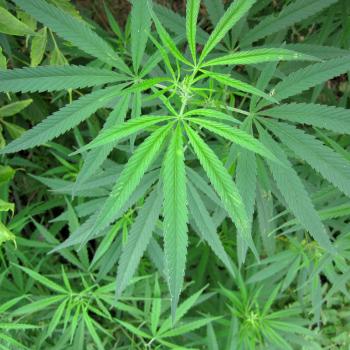
Image: from pixabay.com; https://pixabay.com/en/foliage-cannabis-marijuana-lush-1157792/
Previous Post

September 26, 2018
The Pope, the cardinal, the twitter feed
Next Post
September 30, 2018 Kavanaugh, Ford, and Things That Can Both Be True
Browse Our Archives
Select a Category Actuarial/Retirement Issues Politics Uncategorized
Select a Month September 2026 August 2026 July 2026 June 2026 April 2026 March 2026 February 2026 January 2026 December 2025 November 2025 October 2025 July 2025 June 2025 May 2025 April 2025 March 2025 February 2025 January 2025 December 2024 November 2024 October 2024 September 2024 August 2024 July 2024 June 2024 May 2024 April 2024 March 2024 February 2024 December 2023 November 2023 October 2023 September 2023 August 2023 July 2023 December 2022 September 2022 August 2022 July 2022 June 2022 May 2022 February 2022 January 2022 December 2021 August 2021 June 2021 April 2021 February 2021 January 2021 December 2020 November 2020 October 2020 September 2020 August 2020 July 2020 June 2020 May 2020 April 2020 March 2020 February 2020 January 2020 December 2019 November 2019 October 2019 September 2019 August 2019 July 2019 June 2019 May 2019 April 2019 March 2019 February 2019 January 2019 December 2018 November 2018 October 2018 September 2018 August 2018 July 2018 June 2018 May 2018 April 2018 March 2018 February 2018 January 2018 December 2017 November 2017 October 2017 September 2017 August 2017 July 2017 June 2017 May 2017 April 2017 March 2017 February 2017 January 2017 December 2016 November 2016 October 2016 September 2016 August 2016 July 2016 June 2016 May 2016 April 2016 March 2016 February 2016 January 2016 December 2015 November 2015 October 2015 September 2015 August 2015 July 2015 June 2015 May 2015 April 2015 March 2015 February 2015 January 2015 December 2014 November 2014 October 2014 September 2014 August 2014 July 2014 June 2014 May 2014 April 2014 March 2014 February 2014 January 2014 December 2013 November 2013 October 2013 September 2013 August 2013 July 2013
Follow Us!
TAKE THE
Religious Wisdom Quiz
For what occasion were unleavened breads eaten?
Select your answer to see how you score.
Feast of Dedication Sabbath Day of Atonement Passover
Related posts from Jane the Actuary
Decriminalization, normalization, celebration?


Pretending correlation is causation: pot and babies
TRENDING AT PATHEOS Catholic

When Halloween Unmasks Married Hearts
Written by Dr. David K. Ewen from Eternal Truth Bible College Behind...

Aristotle. He’s been called the father of logic, the father of the...

Methodist Central Hall and Westminster Abbey
Situated on the same square is Methodist Central Hall and Westminster Abbey. ...

57th Dove Awards Honor Dolly Parton, Crown New...
On gospel music’s biggest night, the 57th annual GMA Dove Awards honored...

The First Eucharistic Controversy: Christ’s Real Presence
For Catholics, the Eucharist is the source and summit of the Christian...

What a Stop Sign Can Teach Us About...
How to Make a Decision When You Can't Hear God Main point:...
view all Catholic blogs
Ad-Free & Subscriber Log-In Subscription Support
- About Us
- 2026 Calendar
- Videos
- Podcasts
- Library of World Religions
- Faith In Media Tracker
- Advertise With Us
- Write for Us
- Privacy Policy
- Terms of Service
- Do Not Sell My Data
- Contact Us
- Radiant Digital
- Manage Newsletter Subscriptions
- Unsubscribe From Notifications
- Sitemap
Copyright 2008-2026, Patheos. All rights reserved.
Subscription Support Ad-Free & Subscriber Log-In
Follow Patheos