
BuddhistCatholicContemplativeEvangelicalGeneral ChristianHinduJewishLatter-day SaintMuslimNew VisionsProgressive Christian
Beliefs
- Buddhist
- Catholic
- Contemplative
- Evangelical
- General Christian
- Hindu
- Jewish
- Latter-day Saint
- More Voices
- Muslim
- New Visions
- Pagan
- Progressive Christian
Topics
- Religion News
- Food and Religion
- Sports and Religion
- Religious Art
- Religious Music and Entertainment
- Religious Events
- History and Religion
- Style and Religion
- Politics and Religion
- Women in Religion
- Recreation Outdoors and Religion
- Business Finance and Religion
- Careers Workplace and Religion
- Education and Religion
- Family Parenting and Religion
- Health Fitness and Religion
- Home and Religion
- Relationships and Religion
- Technology and Religion
- Travel and Religion
Columnists
- Buddhist Columnists
- Business Finance and Religion Columnists
- Careers Workplace and Religion Columnists
- Catholic Columnists
- Contemplative Columnists
- Education and Religion Columnists
- Evangelists Columnists
- Family Parenting and Religion Columnists
- General Christian Columnists
- Health Fitness and Religion Columnists
- Hindu Columnists
- History and Religion Columnists
- Home and Religion Columnists
- Jewish Columnists
- More Voices Columnists
- Latter Day Columnists
- Muslim Columnists
- New Visions Columnists
- Nonreligious Columnists
- Pagan Columnists
- Politics and Religion Columnists
- Progressive Columnists
- Recreation Outdoors and Religion Columnists
- Relationships and Religion Columnists
- Religion News Columnists
- Religious Art Columnists
- Religious Events Columnists
- Religious Music and Entertainment Columnists
- Sports and Religion Columnists
- Style and Religion Columnists
- Technology and Religion Columnists
- Travel and Religion Columnists
- Women in Religion Columnists
Resource Library
- 2026 Calendar
- Library of World Religions
- The 100 Most Holy Places on Earth
- Patheos Answers
- Podcasts
- Videos
- Faith Leaders Database
- Anglican Episcopalian
- Bahai
- Baptist
- Buddhism
- Christianity
- Confucianism
- Eastern Orthodoxy
- Hinduism
- Holiness and Pentecostal
- ISKCON
- Islam
- Judaism
- Lutheran
- Methodist
- The Church of Jesus Christ of Latter-day Saints
- New Age
- Paganism
- Presbytarian and Reformed
- Protestantism
- Religion Behind the Scenes
- Roman Catholic
- Scientology
- Shia Islam
- Sikhism
- Sufism
- Sunni Islam
- Taoism
- Zen
- See all religions
Research Tools
 Ad-Free & Subscriber Log-In Subscription Support
Ad-Free & Subscriber Log-In Subscription Support
Follow Patheos 

- Trending:
- Forgiveness
- |
- Marriage
- |
- Consciousness
- |
- Death Penalty
- |
- Election
- |
- Halloween

- Home
- Catholic
- Politics and Religion
- From the library, “To Change the Church,” by Ross Douthat
From the library, “To Change the Church,” by Ross Douthat
Last updated on: July 15, 2018 at 9:41 am by Jane the Actuary
From the library, “To Change the Church,” by Ross Douthat 2018-07-15T09:41:18-06:00 Jane the Actuary
Patheos Explore the world's faith through different perspectives on religion and spirituality! Patheos has the views of the prevalent religions and spiritualities of the world.
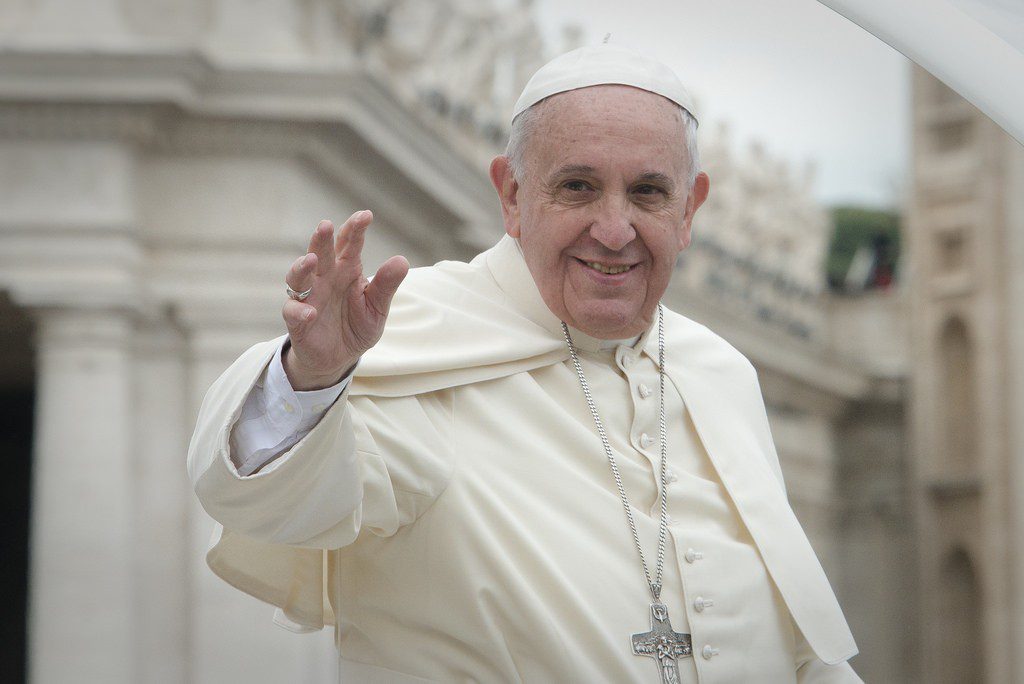
One thing is clear: Ross Douthat does not like Pope Francis. He believes that his actions regarding the question of remarriage among Catholics, and his “my way or the highway” attitude mocking traditional Catholics and reassigning/demoting conservative/traditionalists (or nonliberals), have already caused and will cause further conflicts and confusion, and are leading the Catholic church into an unknown, but potentially much less small-c catholic future.
It is also clear that I’ve blown past the library renewals and grace period and need to get this book returned even though there’s a lot going on here to think about, so some of what I type will be choppy and there’ll be a fair amount of stringing together of quotes.
Douthat starts with a bit of personal history and context: the fact that he came to Catholicism as a teenager, along with his formerly-Episcopalian family, so that he fits neither in the cradle-Catholic nor the Catholic-convert worlds. He describes his inner conflict:
Unlike many Catholics I knew who were loyal to the church as a community but doubtful of its doctrines, I did not want this tension to be smoothed away by understanding priests and broad-minded theologians,; indeed, the conflict between what I professed and how badly I fell short was part of what made the profession seem plausible, because a religion that just confirmed me in my early-twenty-first-century way of life couldn’t possibly be divinely revealed. (p. XIV)
More setting the context — Episcopalians are nominally a single united church under the Archbishop of Canterbury, but there are vast difference between the very liberal Americans and very conservatives Africans, so much so that some American congregations are now connecting up with African bishops. Catholics, on the other hand, are nominally united.
And the issues which divide Catholics now are seemingly narrow and isolated — abortion, contraception, euthanasia, same-sex marriage, married or female priests.
But those issues, important as they are, are not the real roots of the debate. What lies beneath often larger and more comprehensive disagreements: about the purpose of the church, the authority of the Bible, the nature of the sacraments, the definition of sin, the means of redemption, the true identity of Jesus, the very nature of God.
Chase the debate about same-sex marriage down far enough and it becomes an argument about the authority of Scripture generally, and whether the church’s past teachings on any moral issue can be considered permanently reliable, or whether all things Catholic are subject to Holy Spirit-driven change. Pursue the debate about divorce and remarriage long enough and it becomes a discussion about whether Jesus’s words in the New Testament are definitely his words, whether the gospels are reliable, whether Jesus could have made mistakes, and other questions that are foundational to Christology, theology, the church. Chase debates about abortion and euthanasia downward and you find yourself debating the essential questions of Christian ethics — are some acts intrinsically evil, or is everything a matter of relativized, situational perspective? . . .
The liberalizing tendency in Catholicism wants most immediately and intensely to adapt to the sexual revolution. But its adaptationist, evolutionist spirit is older than today’s controversies, and its premises often point toward a more fundamental sort of change. They would make Catholic Christianity open ot substantial reinterpretation in every generation, and transform many of its doctrines into the equialent of a party’s platform or a republic’s constitution — whcih is to say, binding for the moment but constantly open to revision based on democratic debate (p. 9 – 10).
Douthat then moves on to some historical context, namely, Vatican II, where disagreements about the extent of reform/change ultimately ended in an “uneasy truce” in which official teaching was unchanged but there was enough room for dissent as to keep liberals accepting of a status quo while they believed that ultimately that which they believed would ultimately prevail. But the reality of the 70s and subsequent years was that the liberalizing factions (dioceses, religious orders, universities) experienced decline (loss of Catholic identity in the case of universities). At the country level:
In the heartland of “spirit of Vatican II” Catholicism, the Northern European nations whose theologians contributed so much to the council’s liberal voice, the church’s collapse was swift, steep, and stunning. (p 27)
In Latin America, with its liberation theology, “the masses turned instead to Pentecostalism.” Only in conservative Africa did the church grow. But it’s not as if conservative Catholics saw spectacular growth — they just didn’t flail as badly.
Benedict, in the meantime, had to deal with structural problems at the Vatican itself, misgovernment, draining the swamp, as well as what was hoped to be a “post-Vatican II course correction” (p. 45), and thought he had accomplished that, or at least thought he had put things in a good position for his successor to continue the project.
Which brings us to Francis. In Douthat’s telling, he ended up as pope partly because of the clever strategic moves of the “St. Gallen mafia,” a group who did have as the objective, putting in a liberalizing pope, but also because cardinals genuinely believed he would reinvigorate the church and imbue it with a spirit of evangelization, without any agenda of doctrinal changes.
And, indeed, in the initial years, conservatives were able to tell themselves that, however much Francis’s emphases were different than his predecessors, and however often he said worrying off-the-cuff things, he wasn’t making any changes in doctrine, and, indeed, he said words that comforted them:
If we do not profess Jesus Christ . . . we may become a charitable N.G.O., but not the Church, the Bride of the Lord. (p 71)
What Francis was, it seemed, trying to do, is “rebuild the center.”
But at the same time,
among conservative and traditionalist Catholics, where John Paul had Benedict had seen the seeds of a renewed and vigorous church, the new pope saw a great many Pharisees and scribes. (p. 74)
Which brings us to “The Marriage Problem” — the desire of liberals such as Kasper of Munich to open up communion to the remarried by effectively “taking it off the sin list” (among other goals), a goal which Francis seemed to share. In the US, the solution to this dilemma has been to make annulments much easier to obtain, in a “no true Scotsman” sort of way (that is, divorce can be presumed to be an indicator that the couple was too immature to marry, or hadn’t made a true lifelong commitment, or the like), but Kasper and others wanted to turn things around, and deem that the “sin” was in the divorce or failing to support the children left behind or the like, but that a remarriage was nonetheless a true marriage so that there was no sin in being in that state.
Francis tried to create this state of affairs by calling the Synod on the Family and stacking the deck in terms of the bishops attending, who had positions of drawing up the official conclusions, and so forth, but in the end, the propositions arguing for this and other changes couldn’t get sufficient votes, and the power plays that Francis seemed poised to make, he was forced to backtrack on.
So he made an end run around the whole thing with Amoris Laetitia, its ambiguous language around reception of communion by the remarried, and his refusal to clarify or correct bishops who took the language as an invitation to tell their flocks that it was up to them to make their own decision about whether they wished to receive communion. At the same time, he became more aggressive about appointing liberals as cardinals and passing over conservatives (e.g., Chaput of Philly and Gomez of LA), and demoted conservatives from prominent Vatican positions.
And not only did the Catholic church divide in its bishops’ interpretations of the document, but this spurred additional divisions: Kasper predicted that the pope would open up the opportunity for intercommunion with Protestants (since publication, Kasper has now done that of his own accord), and the Maritime Provinces’ bishops decided that it was OK to give last rights to people just before they killed themselves with the advent of assisted suicide in Canada.
Douthat then provides two possible historical precedents for a “what comes next?” First, he cites the Athanasians and Arians in the early church; these two groups had a protracted struggle, in which the Arians’ idea that Jesus was more godlike than actually God was appealing to large numbers of people, including Emperors, who didn’t like the idea of the Trinity. It took a century or more for belief in the Trinity to win the day — something that may provide comfort to worried Catholics now. But his other potential example, of the Jansenists and Jesuits, is not so comforting: in the 1700s, the Jansenists were “moral rigorists” (p. 164) who accused Jesuits of, in the name of evangelization, signing off on all manner of sins, especially by the nobility — adultery, corruption, and so forth. The Jesuits won the day, and the Jansenists were consigned to the dustbin of history, and no one today really knows the difference. But, Douthat says, it’s an imperfect analogy because, in addition to their battles against the Jesuits in the area of moral rigor vs. accommodation, they were actually also heretics, and the accommodationism of some Jesuits was not reflected in official church teaching.
So where does that leave us? But he observes that the much-vaunted “Francis effect” isn’t having a concrete impact in terms of actual Catholics’ actions — there is no increase in mass attendance, church vocations, or other indicators of renewal. It is also still the case that, of those who remain in the church, the younger generation is more conservative than their elders, and certainly the growth of the church in Africa will increase the proportion who are conservative. For all that Francis seems to dislike traditionalism (he’s quoted as having said, “when they tell me that there is a congregation that draws so many vocations, I must confess that I worry” — p. 192), Douthat considers it likely that we’ll see a “new impasse,” this time between liberal bishops/powerbrokers and conservative faithful.
In addition, rather than having a moment of synthesis, Francis pushed liberal theology and liberal politics (“German theological premises, Argentine economics, and liberal-Eurocrat assumptions on borders, nations, and migrations” p. 202), with his response to conservatives one of scolding.
Douthat doesn’t conclude with an agenda, a proposal to Make Catholicism Great Again, but rather just with extreme pessimism of our current state. And his final quote, from a Latin American Jesuit, made before Francis became pope, leaves no doubt as to Douthat’s opinion:
He has an aura of spirituality which he uses to obtain power It will be a catastrophe for the Church to have someone like him in the Apostolic See.
And now I’m off to the library.
Image: from Flickr: https://www.flickr.com/photos/113018453@N05/14037472464
Previous Post
July 12, 2018
Vacation Church Prizewinner: St. Cecilia's, Wisconsin Dells
Next Post

July 16, 2018 Tennessee "free pre-K" update: from no effects to worse effects
Browse Our Archives
Select a Category Actuarial/Retirement Issues Politics Uncategorized
Select a Month September 2026 August 2026 July 2026 June 2026 April 2026 March 2026 February 2026 January 2026 December 2025 November 2025 October 2025 July 2025 June 2025 May 2025 April 2025 March 2025 February 2025 January 2025 December 2024 November 2024 October 2024 September 2024 August 2024 July 2024 June 2024 May 2024 April 2024 March 2024 February 2024 December 2023 November 2023 October 2023 September 2023 August 2023 July 2023 December 2022 September 2022 August 2022 July 2022 June 2022 May 2022 February 2022 January 2022 December 2021 August 2021 June 2021 April 2021 February 2021 January 2021 December 2020 November 2020 October 2020 September 2020 August 2020 July 2020 June 2020 May 2020 April 2020 March 2020 February 2020 January 2020 December 2019 November 2019 October 2019 September 2019 August 2019 July 2019 June 2019 May 2019 April 2019 March 2019 February 2019 January 2019 December 2018 November 2018 October 2018 September 2018 August 2018 July 2018 June 2018 May 2018 April 2018 March 2018 February 2018 January 2018 December 2017 November 2017 October 2017 September 2017 August 2017 July 2017 June 2017 May 2017 April 2017 March 2017 February 2017 January 2017 December 2016 November 2016 October 2016 September 2016 August 2016 July 2016 June 2016 May 2016 April 2016 March 2016 February 2016 January 2016 December 2015 November 2015 October 2015 September 2015 August 2015 July 2015 June 2015 May 2015 April 2015 March 2015 February 2015 January 2015 December 2014 November 2014 October 2014 September 2014 August 2014 July 2014 June 2014 May 2014 April 2014 March 2014 February 2014 January 2014 December 2013 November 2013 October 2013 September 2013 August 2013 July 2013
Follow Us!
TAKE THE
Religious Wisdom Quiz
Who was the Roman emperor when Jesus was crucified?
Select your answer to see how you score.
Caligula Augustus Tiberius Nero
Related posts from Jane the Actuary

From the library: Believe, by Ross Douthat
How smart is the Pope, really?

What does the Pope really think about "just...
TRENDING AT PATHEOS Catholic

'Super Scam Me' Exposes AI Jon Bon Jovi...
Leslie Pickett believed she was in a relationship with Jon Bon Jovi....

The Brazilian Remake of Kendricks' 'Flywheel' Opens in...
“Flywheel,” the story that launched the Kendrick Brothers’ filmmaking career is getting...

The Dangers of Gradual Accommodation (Winking at Sin)
Recently, the “law of gradualness” resurfaced during the opening of a weeklong,...

The Iron Gates and the Lion of the...
Yesterday, I didn't finish my report about, well, yesterday. So I'll...

The Image: On the Horror of Capitalism and...
The Image Then went the Pharisees, and took counsel how they might...

We are approaching the date of our new American national holiday: October...
view all Catholic blogs
Ad-Free & Subscriber Log-In Subscription Support
- About Us
- 2026 Calendar
- Videos
- Podcasts
- Library of World Religions
- Faith In Media Tracker
- Advertise With Us
- Write for Us
- Privacy Policy
- Terms of Service
- Do Not Sell My Data
- Contact Us
- Radiant Digital
- Manage Newsletter Subscriptions
- Unsubscribe From Notifications
- Sitemap
Copyright 2008-2026, Patheos. All rights reserved.
Subscription Support Ad-Free & Subscriber Log-In
Follow Patheos