
BuddhistCatholicContemplativeEvangelicalGeneral ChristianHinduJewishLatter-day SaintMuslimNew VisionsProgressive Christian
Beliefs
- Buddhist
- Catholic
- Contemplative
- Evangelical
- General Christian
- Hindu
- Jewish
- Latter-day Saint
- More Voices
- Muslim
- New Visions
- Pagan
- Progressive Christian
Topics
- Religion News
- Food and Religion
- Sports and Religion
- Religious Art
- Religious Music and Entertainment
- Religious Events
- History and Religion
- Style and Religion
- Politics and Religion
- Women in Religion
- Recreation Outdoors and Religion
- Business Finance and Religion
- Careers Workplace and Religion
- Education and Religion
- Family Parenting and Religion
- Health Fitness and Religion
- Home and Religion
- Relationships and Religion
- Technology and Religion
- Travel and Religion
Columnists
- Buddhist Columnists
- Business Finance and Religion Columnists
- Careers Workplace and Religion Columnists
- Catholic Columnists
- Contemplative Columnists
- Education and Religion Columnists
- Evangelists Columnists
- Family Parenting and Religion Columnists
- General Christian Columnists
- Health Fitness and Religion Columnists
- Hindu Columnists
- History and Religion Columnists
- Home and Religion Columnists
- Jewish Columnists
- More Voices Columnists
- Latter Day Columnists
- Muslim Columnists
- New Visions Columnists
- Nonreligious Columnists
- Pagan Columnists
- Politics and Religion Columnists
- Progressive Columnists
- Recreation Outdoors and Religion Columnists
- Relationships and Religion Columnists
- Religion News Columnists
- Religious Art Columnists
- Religious Events Columnists
- Religious Music and Entertainment Columnists
- Sports and Religion Columnists
- Style and Religion Columnists
- Technology and Religion Columnists
- Travel and Religion Columnists
- Women in Religion Columnists
Resource Library
- 2026 Calendar
- Library of World Religions
- The 100 Most Holy Places on Earth
- Patheos Answers
- Podcasts
- Videos
- Faith Leaders Database
- Anglican Episcopalian
- Bahai
- Baptist
- Buddhism
- Christianity
- Confucianism
- Eastern Orthodoxy
- Hinduism
- Holiness and Pentecostal
- ISKCON
- Islam
- Judaism
- Lutheran
- Methodist
- The Church of Jesus Christ of Latter-day Saints
- New Age
- Paganism
- Presbytarian and Reformed
- Protestantism
- Religion Behind the Scenes
- Roman Catholic
- Scientology
- Shia Islam
- Sikhism
- Sufism
- Sunni Islam
- Taoism
- Zen
- See all religions
Research Tools
 Ad-Free & Subscriber Log-In Subscription Support
Ad-Free & Subscriber Log-In Subscription Support
Follow Patheos 

- Trending:
- Forgiveness
- |
- Marriage
- |
- Consciousness
- |
- Death Penalty
- |
- Election
- |
- Halloween

- Home
- Catholic
- Politics and Religion
- Cardinal McCarrick and the future of the church
Cardinal McCarrick and the future of the church
Last updated on: July 25, 2018 at 8:39 pm by Jane the Actuary
Cardinal McCarrick and the future of the church 2018-07-25T20:39:45-06:00 Jane the Actuary
Patheos Explore the world's faith through different perspectives on religion and spirituality! Patheos has the views of the prevalent religions and spiritualities of the world.
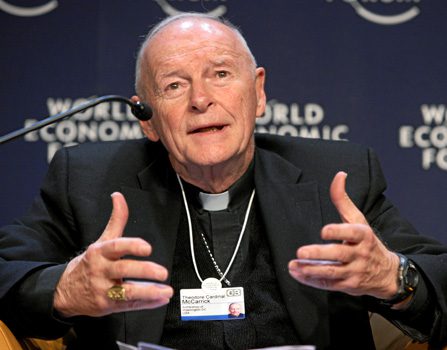
Not long ago, Theodore Cardinal McCarrick, the former archbishop of Washington, D.C., was accused of child sexual abuse, and gave one of those sorts of apology/non-apologies: “I’m sorry, and, also, I didn’t do anything.” As skeevy as I thought the pseudo-apology was, I hesitated to jump into the reports headlong, recalling that Chicago’s Cardinal Bernardin was accused of abuse, and his accuser eventually retracted (this being at a time when “recovered memories” were still considered credible) and there was a very public retraction/reconciliation.
But now further reports are coming out that are very damning — in particular, an article by Rod Dreher at The American Conservative which details very disturbing, very credible accusations. In prior articles, he’s written that he’s followed the issue for many years, and knew that McCarrick was an abuser but could never find anyone who was willing to state this publically, and Dreher wasn’t willing to publish anonymous accusations. Dreher and others are writing that the rot goes very deep, that the abuse was not something that happened in secret, but was, instead, an open secret, with McCarrick’s abuse being well-known — but no one was willing to risk their clerical career, or even just their social standing, by exposing him and holding him to account.
Dreher also links to a National Review article by Michael Brendan Dougherty that discusses the “biological solution”:
Roughly speaking, it meant that priests attached to the reforming visions and the theological fads of mid 20th century would, by the simple process of aging and dying, be replaced by the younger, more tradition-minded, and less morally lax generation. The heavy implication was that the problem of moral cronyism in the Church, in which sexually compromised priests cover and cover-up for one another, would mostly solve itself over time.
Dougherty then goes on to say that the “biological solution” is really no solution at all. Tradition-minded young Catholics hoping it goes away are being thwarted by Francis’s appointment of liberal bishops, potentially a new generation of McCarricks, and in any case, are failing to recognize the damage that these bishops have caused in the meantime.
Dreher in a separate article links to a Ross Douthat column which carries another demand that the bishops be held to account for any degree whatsoever in which they knew, or heard rumors of abuse or misconduct and ignored it. Here’s Douthat, as quoted by Dreher:
In other words, two decades after McCarrick should have been removed from his offices, defrocked and handed over to the civil authorities, he was instead wielding remarkable influence in the church … right up until the moment when a lifetime’s worth of crimes were finally dragged into the light.
I think this long and sickening narrative should clarify why the McCarrick case, though “only” about one abuser, merits an expansive and public accounting of the facts. Over the course of multiple decades, across a period in which not just crimes but cover-ups devastated the moral credibility of the church’s hierarchy, many important figures in Rome and the United States must have known that a man who embodied the official response to the scandal was as guilty as any of the priests whose conduct he pretended to deplore. . . .
But bishops, Douthat says, have essentially become irrelevant, making this reckoning less likely:
The lukewarm in their flock simply ignore them; the zealous build new institutions specifically designed to evade their oversight. Their political interventions go unheeded by Catholic Democrats and Catholic Republicans alike. In far too many cases an office that once bestrode entire cities now belongs to invisible company men, embarrassed phantoms materializing via videotape for the annual appeal.
Is Cardinal Cupich irrelevant? Certainly, as far as the Catholic Church is concerned, he is exactly this administrator speaking on CD (not even videotape!) for the appeal; what Cupich cares about far more deeply are social issues such as amnesty and aid for immigrants and solutions to urban gun violence.
Douthat calls for an impartial inquest into “who knew what, when,” though with considerable skepticism that such a thing might take place. McCarrick was elevated under John Paul II despite accusations, and Francis has held him in high regard:
The choice, says Douthat, lies now with Pope Francis — who, we have been told, in the past considered McCarrick a “hero,” and has certainly given him his way regarding the appointment of new cardinals. Three US cardinals — Tobin, Cupich, and Farrell — owe their appointments in part to McCarrick’s influence.
It strikes me that my reaction is different this time around than in the prior instances of abuse cases. I think I felt more defensiveness then than now: “it was only a small minority of priests. There are abusers from all walks of life, but the Catholic Church’s prominence makes these cases more visible. It won’t happen any longer because everyone knows to listen to children. Let’s just get this over with and hope people overcome their anger and come back to church.” Etc.
But coming on the heels of Douthat’s book To Change The Church, and with the examples of Francis and Cupich and the German cardinals, I think I’ve been much more primed to think of this as an era in which we see the fallibility of the church’s leaders exposed, and in which we have to think of the future of the church in a long-term, Benedict-Option sort of manner (even though I’m too introverted and not spiritual enough to find my way into such a community). And if some members of the church hierarchy are exposed as having feet of clay, so be it — but at the same time, I say this knowing that I’m still harboring a hope that the “bad” liberal bishops will be exposed, and the “good” traditional bishops will be proven to be blameless and out-of-the-loop.
Image: https://commons.wikimedia.org/wiki/File:Theodore_Cardinal_McCarrick.jpg; By Copyright World Economic Forum (www.weforum.org)www.swiss-image.ch/Photo by Andy Mettler [CC BY-SA 2.0 (https://creativecommons.org/licenses/by-sa/2.0)], via Wikimedia Commons
Previous Post

July 20, 2018
Does God maybe not care so much whether we strive to be holy?
Next Post
July 30, 2018 What can the laity actually do, post-McCarrick?
Browse Our Archives
Select a Category Actuarial/Retirement Issues Politics Uncategorized
Select a Month September 2026 August 2026 July 2026 June 2026 April 2026 March 2026 February 2026 January 2026 December 2025 November 2025 October 2025 July 2025 June 2025 May 2025 April 2025 March 2025 February 2025 January 2025 December 2024 November 2024 October 2024 September 2024 August 2024 July 2024 June 2024 May 2024 April 2024 March 2024 February 2024 December 2023 November 2023 October 2023 September 2023 August 2023 July 2023 December 2022 September 2022 August 2022 July 2022 June 2022 May 2022 February 2022 January 2022 December 2021 August 2021 June 2021 April 2021 February 2021 January 2021 December 2020 November 2020 October 2020 September 2020 August 2020 July 2020 June 2020 May 2020 April 2020 March 2020 February 2020 January 2020 December 2019 November 2019 October 2019 September 2019 August 2019 July 2019 June 2019 May 2019 April 2019 March 2019 February 2019 January 2019 December 2018 November 2018 October 2018 September 2018 August 2018 July 2018 June 2018 May 2018 April 2018 March 2018 February 2018 January 2018 December 2017 November 2017 October 2017 September 2017 August 2017 July 2017 June 2017 May 2017 April 2017 March 2017 February 2017 January 2017 December 2016 November 2016 October 2016 September 2016 August 2016 July 2016 June 2016 May 2016 April 2016 March 2016 February 2016 January 2016 December 2015 November 2015 October 2015 September 2015 August 2015 July 2015 June 2015 May 2015 April 2015 March 2015 February 2015 January 2015 December 2014 November 2014 October 2014 September 2014 August 2014 July 2014 June 2014 May 2014 April 2014 March 2014 February 2014 January 2014 December 2013 November 2013 October 2013 September 2013 August 2013 July 2013
Follow Us!
TAKE THE
Religious Wisdom Quiz
I am the final plague that caused Pharaoh to finally let the Israelites go. What am I?
Select your answer to see how you score.
Death of the firstborn The plague of locusts The plague of blood The plague of darkness
Related posts from Jane the Actuary
Portland Parish Protests POC Priest
What next on the Catholic sexual abuse crisis?
Happy Elizabeth Ann Seton Day! (with discussion questions)
TRENDING AT PATHEOS Catholic

The Dangers of Gradual Accommodation (Winking at Sin)
Recently, the “law of gradualness” resurfaced during the opening of a weeklong,...

The Iron Gates and the Lion of the...
Yesterday, I didn't finish my report about, well, yesterday. So I'll...

Dolly Parton’s Last Song Wins Dove Award with...
Bluegrass band The Grascals, speaking on the red carpet at the 57th...

The Image: On the Horror of Capitalism and...
The Image Then went the Pharisees, and took counsel how they might...

We are approaching the date of our new American national holiday: October...

Letters on Living the Faith by C.S. Lewis
Most of us met C.S. Lewis as a public intellectual. Mere Christianity....
view all Catholic blogs
Ad-Free & Subscriber Log-In Subscription Support
- About Us
- 2026 Calendar
- Videos
- Podcasts
- Library of World Religions
- Faith In Media Tracker
- Advertise With Us
- Write for Us
- Privacy Policy
- Terms of Service
- Do Not Sell My Data
- Contact Us
- Radiant Digital
- Manage Newsletter Subscriptions
- Unsubscribe From Notifications
- Sitemap
Copyright 2008-2026, Patheos. All rights reserved.
Subscription Support Ad-Free & Subscriber Log-In
Follow Patheos