
BuddhistCatholicContemplativeEvangelicalGeneral ChristianHinduJewishLatter-day SaintMuslimNew VisionsProgressive Christian
Beliefs
- Buddhist
- Catholic
- Contemplative
- Evangelical
- General Christian
- Hindu
- Jewish
- Latter-day Saint
- More Voices
- Muslim
- New Visions
- Pagan
- Progressive Christian
Topics
- Religion News
- Food and Religion
- Sports and Religion
- Religious Art
- Religious Music and Entertainment
- Religious Events
- History and Religion
- Style and Religion
- Politics and Religion
- Women in Religion
- Recreation Outdoors and Religion
- Business Finance and Religion
- Careers Workplace and Religion
- Education and Religion
- Family Parenting and Religion
- Health Fitness and Religion
- Home and Religion
- Relationships and Religion
- Technology and Religion
- Travel and Religion
Columnists
- Buddhist Columnists
- Business Finance and Religion Columnists
- Careers Workplace and Religion Columnists
- Catholic Columnists
- Contemplative Columnists
- Education and Religion Columnists
- Evangelists Columnists
- Family Parenting and Religion Columnists
- General Christian Columnists
- Health Fitness and Religion Columnists
- Hindu Columnists
- History and Religion Columnists
- Home and Religion Columnists
- Jewish Columnists
- More Voices Columnists
- Latter Day Columnists
- Muslim Columnists
- New Visions Columnists
- Nonreligious Columnists
- Pagan Columnists
- Politics and Religion Columnists
- Progressive Columnists
- Recreation Outdoors and Religion Columnists
- Relationships and Religion Columnists
- Religion News Columnists
- Religious Art Columnists
- Religious Events Columnists
- Religious Music and Entertainment Columnists
- Sports and Religion Columnists
- Style and Religion Columnists
- Technology and Religion Columnists
- Travel and Religion Columnists
- Women in Religion Columnists
Resource Library
- 2026 Calendar
- Library of World Religions
- The 100 Most Holy Places on Earth
- Patheos Answers
- Podcasts
- Videos
- Faith Leaders Database
- Anglican Episcopalian
- Bahai
- Baptist
- Buddhism
- Christianity
- Confucianism
- Eastern Orthodoxy
- Hinduism
- Holiness and Pentecostal
- ISKCON
- Islam
- Judaism
- Lutheran
- Methodist
- The Church of Jesus Christ of Latter-day Saints
- New Age
- Paganism
- Presbytarian and Reformed
- Protestantism
- Religion Behind the Scenes
- Roman Catholic
- Scientology
- Shia Islam
- Sikhism
- Sufism
- Sunni Islam
- Taoism
- Zen
- See all religions
Research Tools
 Ad-Free & Subscriber Log-In Subscription Support
Ad-Free & Subscriber Log-In Subscription Support
Follow Patheos 

- Trending:
- Forgiveness
- |
- Marriage
- |
- Consciousness
- |
- Death Penalty
- |
- Election
- |
- Halloween

- Home
- Catholic
- Politics and Religion
- Are Roe & Obergefell a new generation’s Marbury v. Madison?
Are Roe & Obergefell a new generation’s Marbury v. Madison?
Last updated on: July 4, 2018 at 10:11 am by Jane the Actuary
Are Roe & Obergefell a new generation’s Marbury v. Madison? 2018-07-04T10:11:03-06:00 Jane the Actuary
Patheos Explore the world's faith through different perspectives on religion and spirituality! Patheos has the views of the prevalent religions and spiritualities of the world.
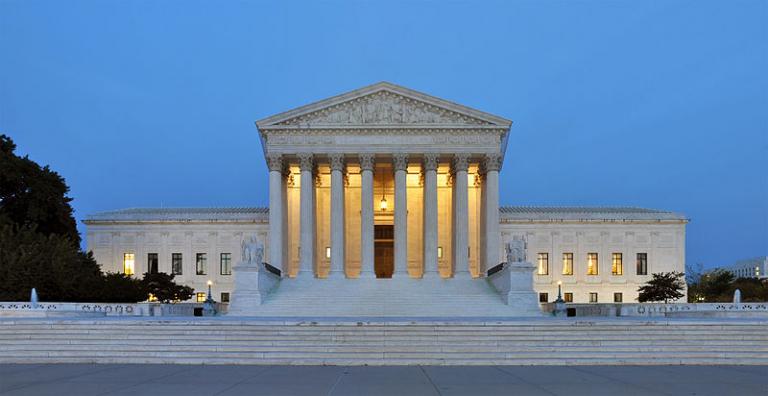
You remember Marbury v. Madison, don’t you? Whether you learned about it in your government class or your history class, you learned that this was the foundational Supreme Court case in which the court established the principle that the job of the Supreme Court is to interpret the Constitution, and, in particular, to determine when a particular act of Congress violates the Constitution, either some aspect of the original text of the Constitution setting out the structure of the government or the Bill of Rights and subsequent amendments.
Hence, in the recent batch of Court decisions, the Court decided that forcing a public employee to pay fees to a union violated the First Amendment because those mandated fees were a form of compelled speech; the Court determined that “warrantless seizure and search of historical cell-phone records, which shows the location and movements of a cell-phone user over a period of more than four months” violated the Fourth Amendment; decided that a California law requiring crisis pregnancy centers to post information on the availability of free Medicaid abortions violated the First Amendment; and determined that the Trump administration’s “order barring most foreign travelers from five Mideast nations with mostly Muslim populations” was within the administration’s powers as defined by the Constitution. The Court also made decisions determining whether certain state actions violated federal laws, for instance, Ohio’s process for removing inactive, apparently-moved voters from its voter registration rolls.
But Roe v. Wade and Obergefell v. Hodges, in which the Court declared that rights to abortion and to same-sex marriage, respectively, are protected by the Constitution, are of an entirely different character. Here’s the rationale for the former:
Roe . . . was based on the right of privacy. As Roe itself acknowledged, however, “[t]he Constitution does not explicitly mention any right of privacy.” Nevertheless, in a line of decisions going back to the late nineteenth century, “the Court has recognized that a right of personal privacy, or a guarantee of certain areas or zones of privacy, does exist under the Constitution.” This right of privacy, “founded in the Fourteenth Amendment’s concept of personal liberty,” the Court in Roe held, “is broad enough to encompass a woman’s decision whether or not to terminate her pregnancy.”
The reasoning behind Obergefell is even more tortured, drawing on Equal Protection and Due Process clauses and, when I read it at the time, really gave me the feeling that Kennedy was working backwards from his preferred result, finding same-sex marriage to be protected by the Constitution, to finding proof-texts in the Constitution and precedent cases. Consider his closing paragraph:
No union is more profound than marriage, for it embodies the highest ideals of love, fidelity, devotion, sacrifice, and family. In forming a marital union, two people become something greater than once they were. As some of the petitioners in these cases demonstrate, marriage embodies a love that may endure even past death. It would misunderstand these men and women to say they disrespect the idea of marriage. Their plea is that they do respect it, respect it so deeply that they seek to find its fulfillment for themselves. Their hope is not to be condemned to live in loneliness, excluded from one of civilization’s oldest institutions. They ask for equal dignity in the eyes of the law. The Constitution grants them that right
Which is why I’m inclined to think that what we’re really seeing, both in terms of the justices making these decisions, and the (portion of) the public responding favorably to those decisions, and now seeing them as nothing other than the recognition of inalienable human rights, is an entirely different way of viewing the Supreme Court. The Court’s job is not something as old-fashioned and stuffy as interpreting a document written over 200 years ago, neither strictly nor trying to take into account 21st century norms and expectations. Instead, they believe, the Court’s job is to make decisions based on universal norms of justice and fairness, whether or not the Founding Fathers wrote them into the Constitution or an amendment to the effect had been passed in the meantime. It’s a new Marbury v. Madison, taken together, a declaration that the Court makes its decisions based on its interpretation of universal principles rather than Constitutional text.
Unions are important, so nothing should stand in their way.
At the same time, Corporate money is bad, so the government should stand in its way.
Gerrymandering is unfair, so it must be stopped regardless of whether the Constitution has anything to say about it or whether, according to definitions of “standing,” anyone is in a position to object.
The entire structure of the election system, in which districts are apportioned in ways that concentrations of a given party in urban areas “naturally” disadvantage them, and, for that matter, small states have the same representation in the Senate as large states, is unjust.
etc.
And, relevant for the present case of Justice Kennedy’s pending departure and the appointment of a new justice to replace him, is the right to abortion a Supreme Court precedent, vulnerable to being overturned if a new Court finds that its predecessor exceeded its authority in defining such a right, when such legislation would ordinarily be handled at the state level, or was it the recognition of a fundamental human right which cannot be removed without perpetrating a monumental injustice on women?
Of course, Roe’s supporters are not willing to come out and say that they believe that the Supreme Court’s role is far more expansive than deciding whether laws follow the U.S. Constitution. They talk about “equal protection” instead (because, the rationale goes, women need abortion in order to attain full equality with men), but the hysteria we’re now witnessing with respect to Trump’s potential nominees, and demands that the Democrats in some way force a delay in the appointment process until they are again able to control it, certainly seems to me to come out of an unspoken greatly expanded role of the Court that only makes sense if you view it as a complete shift in function.
This is no longer a matter of bemoaning or celebrating whether the next justice is conservative or liberal, but a matter of two completely different visions for what the Court is about. To be sure, it looks like, what with Trump, the traditionalist version has the upper hand, for now at least. But whether the expansive vision even truly protects human rights isn’t itself obvious, in the long run, considering that many European courts (and that of Canada) feel that their mission to protect some universal rights (e.g., to a notion of “human dignity”) requires them to curtail other rights (e.g., when individual speech is deemed to violate the “human dignity” of a person or a religious or social group).
So, hey, at the end of this rambling post, Happy Independence Day!
(And here I apologize; as I typed this it felt more and more familiar, and it turns out I had written something similar a couple years ago.)
Image: https://commons.wikimedia.org/wiki/File:Panorama_of_United_States_Supreme_Court_Building_at_Dusk.jpg; Joe Ravi [CC BY-SA 3.0 (https://creativecommons.org/licenses/by-sa/3.0)], from Wikimedia Commons
Previous Post

June 28, 2018
Summer Reading Choices - Yikes!
Next Post

July 5, 2018 A Compromise For Illinois
Browse Our Archives
Select a Category Actuarial/Retirement Issues Politics Uncategorized
Select a Month September 2026 August 2026 July 2026 June 2026 April 2026 March 2026 February 2026 January 2026 December 2025 November 2025 October 2025 July 2025 June 2025 May 2025 April 2025 March 2025 February 2025 January 2025 December 2024 November 2024 October 2024 September 2024 August 2024 July 2024 June 2024 May 2024 April 2024 March 2024 February 2024 December 2023 November 2023 October 2023 September 2023 August 2023 July 2023 December 2022 September 2022 August 2022 July 2022 June 2022 May 2022 February 2022 January 2022 December 2021 August 2021 June 2021 April 2021 February 2021 January 2021 December 2020 November 2020 October 2020 September 2020 August 2020 July 2020 June 2020 May 2020 April 2020 March 2020 February 2020 January 2020 December 2019 November 2019 October 2019 September 2019 August 2019 July 2019 June 2019 May 2019 April 2019 March 2019 February 2019 January 2019 December 2018 November 2018 October 2018 September 2018 August 2018 July 2018 June 2018 May 2018 April 2018 March 2018 February 2018 January 2018 December 2017 November 2017 October 2017 September 2017 August 2017 July 2017 June 2017 May 2017 April 2017 March 2017 February 2017 January 2017 December 2016 November 2016 October 2016 September 2016 August 2016 July 2016 June 2016 May 2016 April 2016 March 2016 February 2016 January 2016 December 2015 November 2015 October 2015 September 2015 August 2015 July 2015 June 2015 May 2015 April 2015 March 2015 February 2015 January 2015 December 2014 November 2014 October 2014 September 2014 August 2014 July 2014 June 2014 May 2014 April 2014 March 2014 February 2014 January 2014 December 2013 November 2013 October 2013 September 2013 August 2013 July 2013
Follow Us!
TAKE THE
Religious Wisdom Quiz
What is the last word in the Bible?
Select your answer to see how you score.
Jesus Hallelujah Amen Forever
Related posts from Jane the Actuary

In which I comment on the Supreme Court...
Actually, The Bostock Supreme Court Ruling Reaffirmed A...

Remember Marbury vs. Madison? A question for readers

Why not Merrick Garland? Separation of powers
TRENDING AT PATHEOS Catholic

The First Eucharistic Controversy: Christ’s Real Presence
For Catholics, the Eucharist is the source and summit of the Christian...

What a Stop Sign Can Teach Us About...
How to Make a Decision When You Can't Hear God Main point:...

Archdiocese Hosts Military Marriage Retreat in Germany
RASTATT, Germany — The transient military lifestyle, with its frequent deployments and...

Nearly every morning, I make the drive to Detroit with my high-school-age...

The Real AI Story Is Adoption Without Trust
Artificial intelligence has crossed a political threshold. It is no longer a...

A new article, written by Jeff Lindsay and Gale L. Pooley,...
view all Catholic blogs
Ad-Free & Subscriber Log-In Subscription Support
- About Us
- 2026 Calendar
- Videos
- Podcasts
- Library of World Religions
- Faith In Media Tracker
- Advertise With Us
- Write for Us
- Privacy Policy
- Terms of Service
- Do Not Sell My Data
- Contact Us
- Radiant Digital
- Manage Newsletter Subscriptions
- Unsubscribe From Notifications
- Sitemap
Copyright 2008-2026, Patheos. All rights reserved.
Subscription Support Ad-Free & Subscriber Log-In
Follow Patheos