
BuddhistCatholicContemplativeEvangelicalGeneral ChristianHinduJewishLatter-day SaintMuslimNew VisionsProgressive Christian
Beliefs
- Buddhist
- Catholic
- Contemplative
- Evangelical
- General Christian
- Hindu
- Jewish
- Latter-day Saint
- More Voices
- Muslim
- New Visions
- Pagan
- Progressive Christian
Topics
- Religion News
- Food and Religion
- Sports and Religion
- Religious Art
- Religious Music and Entertainment
- Religious Events
- History and Religion
- Style and Religion
- Politics and Religion
- Women in Religion
- Recreation Outdoors and Religion
- Business Finance and Religion
- Careers Workplace and Religion
- Education and Religion
- Family Parenting and Religion
- Health Fitness and Religion
- Home and Religion
- Relationships and Religion
- Technology and Religion
- Travel and Religion
Columnists
- Buddhist Columnists
- Business Finance and Religion Columnists
- Careers Workplace and Religion Columnists
- Catholic Columnists
- Contemplative Columnists
- Education and Religion Columnists
- Evangelists Columnists
- Family Parenting and Religion Columnists
- General Christian Columnists
- Health Fitness and Religion Columnists
- Hindu Columnists
- History and Religion Columnists
- Home and Religion Columnists
- Jewish Columnists
- More Voices Columnists
- Latter Day Columnists
- Muslim Columnists
- New Visions Columnists
- Nonreligious Columnists
- Pagan Columnists
- Politics and Religion Columnists
- Progressive Columnists
- Recreation Outdoors and Religion Columnists
- Relationships and Religion Columnists
- Religion News Columnists
- Religious Art Columnists
- Religious Events Columnists
- Religious Music and Entertainment Columnists
- Sports and Religion Columnists
- Style and Religion Columnists
- Technology and Religion Columnists
- Travel and Religion Columnists
- Women in Religion Columnists
Resource Library
- 2026 Calendar
- Library of World Religions
- The 100 Most Holy Places on Earth
- Patheos Answers
- Podcasts
- Videos
- Faith Leaders Database
- Anglican Episcopalian
- Bahai
- Baptist
- Buddhism
- Christianity
- Confucianism
- Eastern Orthodoxy
- Hinduism
- Holiness and Pentecostal
- ISKCON
- Islam
- Judaism
- Lutheran
- Methodist
- The Church of Jesus Christ of Latter-day Saints
- New Age
- Paganism
- Presbytarian and Reformed
- Protestantism
- Religion Behind the Scenes
- Roman Catholic
- Scientology
- Shia Islam
- Sikhism
- Sufism
- Sunni Islam
- Taoism
- Zen
- See all religions
Research Tools
 Ad-Free & Subscriber Log-In Subscription Support
Ad-Free & Subscriber Log-In Subscription Support
Follow Patheos 

- Trending:
- Forgiveness
- |
- Marriage
- |
- Consciousness
- |
- Death Penalty
- |
- Election
- |
- Halloween

- Home
- Catholic
- Politics and Religion
- It’s expensive to be poor, part 1: rent
It’s expensive to be poor, part 1: rent
Last updated on: January 29, 2018 at 8:35 am by Jane the Actuary
It’s expensive to be poor, part 1: rent 2018-01-29T08:35:03-06:00 Jane the Actuary
Patheos Explore the world's faith through different perspectives on religion and spirituality! Patheos has the views of the prevalent religions and spiritualities of the world.
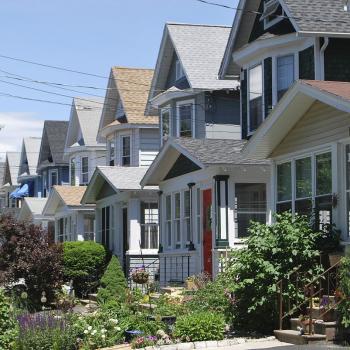
![https://commons.wikimedia.org/wiki/File%3AWalkers_point_neighborhood_milwaukee.jpg; By Flickr user compujeramey [CC BY 2.0 (http://creativecommons.org/licenses/by/2.0)], via Wikimedia Commons](https://wp-media.patheos.com/blogs/sites/533/2018/01/Walkers_point_neighborhood_milwaukee-1024x683.jpg)
Or, “From the library: Evicted: Poverty and Profit in the American City, by Matthew Desmond.”
The book takes the form of a prologue with context, a long narrative telling the stories of the poor tenants of Milwaukee, and of their landlords, based on ethnographic fieldwork, and an epilogue with proposals. By “ethnographic fieldwork” I mean that the author, a Harvard professor, spent time living in a trailer park and in an inner city apartment, spending copious amounts of time with the individuals he profiled. He also spearheaded a detailed study of poor renters in Milwaukee. Oddly, the ethnographic research took place in 2008 – 2009, and tenant study from 2009 – 2011, but the book wasn’t published until 2016; maybe there’s an explanation that I’ve missed in the book, or maybe he just got delayed with the additional research and wasn’t able to complete it until he had more time available (he was, according to the book jacket, given a MacArthur “Genius” grant in 2015). Is the material invalid due to the delay in publication? I don’t know, but it seems likely that the initial post-recession time period might have been more extreme in the situations families faced.
In any case, any time we see the reports comparing the median rent to the income of low-income families, I’m always skeptical. “Of course, you can’t expect the lowest-decile workers to be able to afford median-priced rents; I’ll believe there’s a housing-cost crisis when you compare lowest-decile household incomes to lowest-decile rents.” But what Desmond reported is that the rents that the very poorest pay are not dramatically lower than everyone else’s, even though their apartments are generally (or often) in far worse condition, with broken or missing appliances, clogged sinks, leaking pipes, broken windows, and the like. They get the dregs of apartment buildings because of their conviction and eviction histories, lack of credit and work histories, and so on. Having multiple children makes apartment-hunting even harder, say, if a family is limited to two-bedroom units because of finances but they have more children than occupancy limits provide for, or if landlords simply don’t want children, or many children, in their buildings (regardless of the law on the matter).
And they are evicted frequently — partly because their extreme poverty means that they pay nearly all of their cash income (or welfare/SSI benefits) in rent; though food stamps cover their food costs, they have little left over for unexpected needs. (This also means that, in some instances, they sell food stamps to get cash, then get their food from food pantries until the next month comes.) They also get evicted after complaining about the condition of the apartment — either because the landlord accuses the tenant of being at fault for the claimed damage, like clogging the sink, or because the landlord decides to no longer let late rent slide after a complaint. And they get evicted in efforts to keep crime out of the units — whether the tenants are perpetrators (e.g., drug users), family members of druggies, or victims (e.g., of domestic abuse, with a boyfriend coming by and kicking down a door), or if there are police or ambulance calls for entirely unrelated reasons (e.g., an ambulance/fire visit for an asthmatic child). In some cases, they are compelled by the police to evict — presumably (though the book doesn’t state this) as an outcome of efforts to punish landlords for “harboring” criminals.
Desmond further profiles the difficulties the evictees have in trying to find new housing, as one woman calls 90-some-odd units before finding a landlord willing to take her on, in the meantime bouncing from one friend or relative or shelter to another, furniture and belongings in storage. Multiple generations squeeze into small apartments, sleeping on couches or on the floor. A woman turns tricks, leading johns into the bedroom and past the children in the living room.
Some of the individuals she profiles are addicted to drugs. Others receive SSI (due to mental health disabilities such as depression) or welfare. Some make their way with little more than food stamps and under the table work. One woman had a steady job at Old Country Buffet but spiraled into homelessness after having her hours cut. I don’t quite know what to make of the fact that none of the people Desmond profiles are the “working poor” whose paychecks, despite their steady jobs, aren’t enough to keep them stably-housed; maybe, no matter their troubles, they just aren’t as dramatic as these “worst-case” stories.
But what are Desmond’s solutions?
The first of these is simply to provide tenants with free attorneys to even their odds against landlords, who he believes make far more money than they “deserve.” He cites a program that provided such legal aid and prevented eviction in 86% of cases — though it’s not clear if 86% of all potential evictees won their cases, or if legal aid screened clients for their likelihood of success. His second proposal is far bigger: making housing vouchers as universally-available as food stamps are, with households qualifying solely based on income cut-offs. Call them “house stamps” — but instead of having the allotment based on the average cost of the “thrifty” meal plan, scaled to result in recipients hypothetically paying 30% of their income on food, the government would calculate a “fair” rent for a given apartment based on its particulars (presumably size, location, condition, and so forth), would calculate, for a given family, the level of apartment they are eligible for, and then require (as is already the case for Section 8 vouchers) that the recipient pay 30% of income, and the government would pay the rest. In order to ensure that enough apartments are available for recipients, the government would require all landlords to accept these vouchers, much as they already require that they comply with anti-discrimination laws.
So easy-peasy, right? Well, other than the cost, which he pegs at $22.5 billion, based on a 2013 study on housing vouchers for everyone below the 30th percentile in income. He proposes funding that by eliminating mortgage interest deductions and the capital-gains exclusion.
But Desmond assumes that landlords are making money hand-over-fist and these are somehow “excess” profits that can be easily removed. But if being a landlord was so immensely profitable and landlords are making far more money than they “deserve,” then you’d think that there would be far more landlords in the business, competing for the business of the poor and ultimately, by the greater number of available units, bringing quality up or prices down, or both. But how many landlords are there who want to deal with poor people, nagging them to pay up, dealing with unpaid rents, and with the crime that occurs, and the damage, whether intentional or the result of the chaotic lives of the poor (e.g., 8 people living in a home the plumbing of which was designed for a fraction of that number)?
To be sure, a part of the reason for the high rents, relative to the condition of the homes, and the difficulty the poor in having finding units, is their risk of nonpayment; having reliably-paying tenants would solve this part of the problem. But would the government manage to set the voucher amounts at the right level for prospective landlords to start up a property-rental business, especially given the risk that those bureaucrats could decide, in the future, to reduce the voucher amounts by redefining “fairness.”
So there’s not really an easy answer. It’s a chicken-and-egg issue: the chaotic lives of the poor make them unreliable tenants, but their propensity to get expelled prevents them from turning their lives around. Of course, at the same time, Desmond is perhaps too sunny about the ability of the poor to improve their lot in life if only they had stable housing, when, in reality, “the projects” (that is, public housing) is chock full of people whose protection against high rents does not bring them any closer to the ideal of jobs, education, self-improvement, and raising a generation of children who are able to move off welfare.
In fact, Desmond closes his narrative with two individuals he cites has having received/found housing, then being able to turn their lives around, but the cases don’t actually prove his point. In the one case, “Scott” kicked his heroin habit by daily visits to a methadone clinic while living at a homeless shelter at which he eventually became a resident manager; only after he was on a path to recovery and stability did he have the opportunity for subsidized housing. In the other case, he reports that a single mother of multiple children moved out of Milwaukee to a small town in Tennessee where she “found a nice three-bedroom place” and earned her GED and started at community college — but the cause of her success isn’t clear: did her SSI money stretch further in a small town? Did leaving the dysfunctions of her old neighborhood help her make a fresh start? It’s as clear as mud.
Image: Walker’s Point neighborhood, Milwaukee. https://commons.wikimedia.org/wiki/File%3AWalkers_point_neighborhood_milwaukee.jpg; By Flickr user compujeramey [CC BY 2.0 (http://creativecommons.org/licenses/by/2.0)], via Wikimedia Commons
Previous Post

January 26, 2018
Jane the Actuary solves illegal immigration!
Next Post

January 29, 2018 It's expensive to be poor, part 2: banking
Browse Our Archives
Select a Category Actuarial/Retirement Issues Politics Uncategorized
Select a Month September 2026 August 2026 July 2026 June 2026 April 2026 March 2026 February 2026 January 2026 December 2025 November 2025 October 2025 July 2025 June 2025 May 2025 April 2025 March 2025 February 2025 January 2025 December 2024 November 2024 October 2024 September 2024 August 2024 July 2024 June 2024 May 2024 April 2024 March 2024 February 2024 December 2023 November 2023 October 2023 September 2023 August 2023 July 2023 December 2022 September 2022 August 2022 July 2022 June 2022 May 2022 February 2022 January 2022 December 2021 August 2021 June 2021 April 2021 February 2021 January 2021 December 2020 November 2020 October 2020 September 2020 August 2020 July 2020 June 2020 May 2020 April 2020 March 2020 February 2020 January 2020 December 2019 November 2019 October 2019 September 2019 August 2019 July 2019 June 2019 May 2019 April 2019 March 2019 February 2019 January 2019 December 2018 November 2018 October 2018 September 2018 August 2018 July 2018 June 2018 May 2018 April 2018 March 2018 February 2018 January 2018 December 2017 November 2017 October 2017 September 2017 August 2017 July 2017 June 2017 May 2017 April 2017 March 2017 February 2017 January 2017 December 2016 November 2016 October 2016 September 2016 August 2016 July 2016 June 2016 May 2016 April 2016 March 2016 February 2016 January 2016 December 2015 November 2015 October 2015 September 2015 August 2015 July 2015 June 2015 May 2015 April 2015 March 2015 February 2015 January 2015 December 2014 November 2014 October 2014 September 2014 August 2014 July 2014 June 2014 May 2014 April 2014 March 2014 February 2014 January 2014 December 2013 November 2013 October 2013 September 2013 August 2013 July 2013
Follow Us!
TAKE THE
Religious Wisdom Quiz
What does "Gospel" mean?
Select your answer to see how you score.
God's Truth Holy Word Good News Sacred Story
Related posts from Jane the Actuary
Is there a housing shortage in America?
Will the "Rent Relief Act" relieve renters?

SROs and the line between fit and unfit...

Today's nonsense: "Affordable housing" politics in Detroit
TRENDING AT PATHEOS Catholic

When Halloween Unmasks Married Hearts
Written by Dr. David K. Ewen from Eternal Truth Bible College Behind...

Aristotle. He’s been called the father of logic, the father of the...

Methodist Central Hall and Westminster Abbey
Situated on the same square is Methodist Central Hall and Westminster Abbey. ...

57th Dove Awards Honor Dolly Parton, Crown New...
On gospel music’s biggest night, the 57th annual GMA Dove Awards honored...

The First Eucharistic Controversy: Christ’s Real Presence
For Catholics, the Eucharist is the source and summit of the Christian...

What a Stop Sign Can Teach Us About...
How to Make a Decision When You Can't Hear God Main point:...
view all Catholic blogs
Ad-Free & Subscriber Log-In Subscription Support
- About Us
- 2026 Calendar
- Videos
- Podcasts
- Library of World Religions
- Faith In Media Tracker
- Advertise With Us
- Write for Us
- Privacy Policy
- Terms of Service
- Do Not Sell My Data
- Contact Us
- Radiant Digital
- Manage Newsletter Subscriptions
- Unsubscribe From Notifications
- Sitemap
Copyright 2008-2026, Patheos. All rights reserved.
Subscription Support Ad-Free & Subscriber Log-In
Follow Patheos