
BuddhistCatholicContemplativeEvangelicalGeneral ChristianHinduJewishLatter-day SaintMuslimNew VisionsProgressive Christian
Beliefs
- Buddhist
- Catholic
- Contemplative
- Evangelical
- General Christian
- Hindu
- Jewish
- Latter-day Saint
- More Voices
- Muslim
- New Visions
- Pagan
- Progressive Christian
Topics
- Religion News
- Food and Religion
- Sports and Religion
- Religious Art
- Religious Music and Entertainment
- Religious Events
- History and Religion
- Style and Religion
- Politics and Religion
- Women in Religion
- Recreation Outdoors and Religion
- Business Finance and Religion
- Careers Workplace and Religion
- Education and Religion
- Family Parenting and Religion
- Health Fitness and Religion
- Home and Religion
- Relationships and Religion
- Technology and Religion
- Travel and Religion
Columnists
- Buddhist Columnists
- Business Finance and Religion Columnists
- Careers Workplace and Religion Columnists
- Catholic Columnists
- Contemplative Columnists
- Education and Religion Columnists
- Evangelists Columnists
- Family Parenting and Religion Columnists
- General Christian Columnists
- Health Fitness and Religion Columnists
- Hindu Columnists
- History and Religion Columnists
- Home and Religion Columnists
- Jewish Columnists
- More Voices Columnists
- Latter Day Columnists
- Muslim Columnists
- New Visions Columnists
- Nonreligious Columnists
- Pagan Columnists
- Politics and Religion Columnists
- Progressive Columnists
- Recreation Outdoors and Religion Columnists
- Relationships and Religion Columnists
- Religion News Columnists
- Religious Art Columnists
- Religious Events Columnists
- Religious Music and Entertainment Columnists
- Sports and Religion Columnists
- Style and Religion Columnists
- Technology and Religion Columnists
- Travel and Religion Columnists
- Women in Religion Columnists
Resource Library
- 2026 Calendar
- Library of World Religions
- The 100 Most Holy Places on Earth
- Patheos Answers
- Podcasts
- Videos
- Faith Leaders Database
- Anglican Episcopalian
- Bahai
- Baptist
- Buddhism
- Christianity
- Confucianism
- Eastern Orthodoxy
- Hinduism
- Holiness and Pentecostal
- ISKCON
- Islam
- Judaism
- Lutheran
- Methodist
- The Church of Jesus Christ of Latter-day Saints
- New Age
- Paganism
- Presbytarian and Reformed
- Protestantism
- Religion Behind the Scenes
- Roman Catholic
- Scientology
- Shia Islam
- Sikhism
- Sufism
- Sunni Islam
- Taoism
- Zen
- See all religions
Research Tools
 Ad-Free & Subscriber Log-In Subscription Support
Ad-Free & Subscriber Log-In Subscription Support
Follow Patheos 

- Trending:
- Forgiveness
- |
- Marriage
- |
- Consciousness
- |
- Death Penalty
- |
- Election
- |
- Halloween

- Home
- Catholic
- Politics and Religion
- American (Religious) Exceptionalism
American (Religious) Exceptionalism
Last updated on: December 18, 2017 at 9:18 am by Jane the Actuary
American (Religious) Exceptionalism 2017-12-18T09:18:51-06:00 Jane the Actuary
Patheos Explore the world's faith through different perspectives on religion and spirituality! Patheos has the views of the prevalent religions and spiritualities of the world.
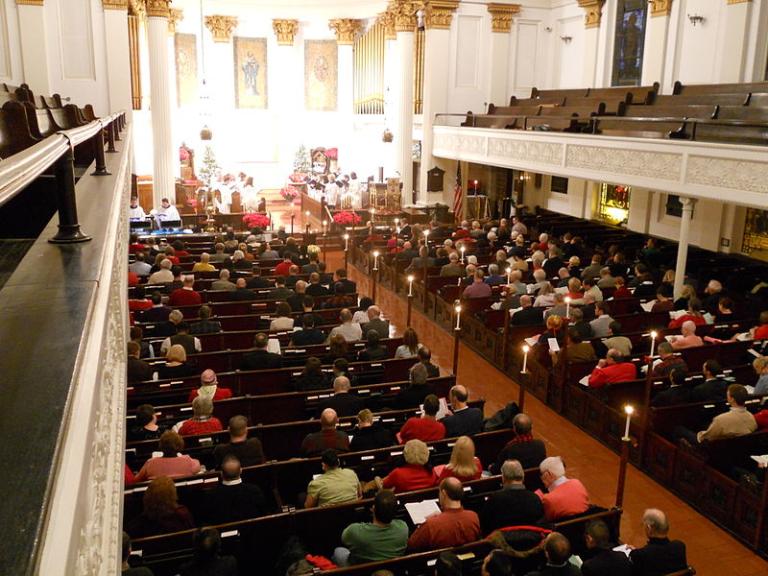
Well, what do you know? I’m not the only one staring at GSS data on religious observance.
There’s a paper out that came to my notice by means of a link in an article somewhere, “The Persistent and Exceptional Intensity of
American Religion: A Response to Recent Research,” by Landon Schnabel and Sean Bock, which, as its title suggests, proposes that religion on America remains exceptionally more intense than elsewhere.
Given that this is a scholarly paper, it references a thesis among scholars, the “secularization thesis”:
The secularization thesis asserts that as a result of ongoing modernization and the advance of science, religion will become increasingly irrelevant in public and private life. This pattern appears to be borne out in several advanced industrial societies where religion has grown increasingly irrelevant in the public sphere and in people’s everyday lives, but whether the United States fits this pattern is less clear.
This thesis is likely something that you’ve heard before, as have I, just not with the scholarly language surrounding it. But what Schnabel and Bock propose is that, rather than religion in general declining, what’s really happening is that
the politicization of American religion in the late 1980s following the rise of the Christian Right . . . may have, as Hout and Fischer (2002, 2014) suggested, driven moderates out of religion but not necessarily decreased the intensity of American religion.
In fact, moderates leaving religion in America could be, at least in part, a reaction against high-intensity American religionists, strict religion, and the contemporary link between religion and right-wing politics in the United States (Djupe, Neiheisel, and Sokhey 2017; Hout and Fischer 2002, 2014).
They look at the General Social Survey on the most intense displays of religion, without regard to particular religious group. They find that, while the percent of Americans saying they had “no affiliation” increased, and those saying “not a strong affiliation” decreased, the percent of Americans reporting a “strong” affiliation stayed constant. In fact, looking at the source data, the rates at the beginning and end of this date range were exactly the same, at 37%. For the younger set, it’s always been lower than average, but, again, in 1990, it was 29% and now it’s 26%. Do those three percentage points mean something crucial? Is 1990 the right year to start measuring? I couldn’t say.
Likewise, they report that the percent of those reporting that they pray “sometimes” is decreasing, but that those who pray “multiple times a day” is increasing, from 23% to 29% in that time period. Among the kiddos, 18 – 34, the figure increased from 14% to 19%.
They also report that sometimes-attenders are decreasing, never-attenders are growing, but the percent attending multiple times a week is increasing — though this isn’t as impressive a piece of evidence, as this is only 7% of the population. But they report that belief in the literalism of the Bible, and similar markers have stayed constant.
They further compare the U.S. to various other wealthy historically Christian countries. In 2008, twice as many Americans reported praying multiple times per day as the next most “prayerful” country, the Netherlands. Similar differences were found in all similar categories, and in many instances, when compared over time, the other countries saw dramatic drop-offs — e.g., in Ireland, the percent praying multiple times per day dropped from 22.4% in 1991 to 10.5% in 2008; in Norway, the rates dropped from 8.7% to 0%.
The data comes from a survey called the International Social Survey Programme, and the data is accessible online. Going back to the church attendance statistic, in 2008, the most recent available year, 25.5% of Americans attended weekly or more, and 7.8% attended more than once a week according to the GSS, and 29.4%/7.9% according to the ISSP. The comparable figures were 7%/1.5% in Germany, 12.4%/4.7% for the Netherlands, 3.2%/1.2% in Sweden, and 8.4%/0.8% in France — all of which includes their respective Muslim populations, which increases attendance rates, as the responses include 14.8% weekly+ attendance in the Netherlands, 30.8% in Sweden, and 16.7% France, among Muslims. (One caveat: this is contingent on my having interpreted the data correctly — but, on the other hand, it looks like a pretty cool data set to explore.)
Now, this paper was already in the process of being published when the Roy Moore scandal erupted. How this will impact perceptions of evangelicals is anyone’s guess — but, on the other hand, as the Babylon Bee reported in satirical form, modern evangelical churches are keeping their denominational identity hidden, so it may well be that even Christians who meet the objective definition of “evangelical” perceive of Roy Moore support as an issue with “those other Christians” and not “Christians like them.”
So it’s all very interesting food for thought.
Image: Church of St. Luke and the Epiphany, Philadelphia (public domain via Wikipedia)
Previous Post

December 14, 2017
Enough with the Net Neutrality Chicken Littles!
Next Post

December 20, 2017 Let's not demonize private schools
Browse Our Archives
Select a Category Actuarial/Retirement Issues Politics Uncategorized
Select a Month September 2026 August 2026 July 2026 June 2026 April 2026 March 2026 February 2026 January 2026 December 2025 November 2025 October 2025 July 2025 June 2025 May 2025 April 2025 March 2025 February 2025 January 2025 December 2024 November 2024 October 2024 September 2024 August 2024 July 2024 June 2024 May 2024 April 2024 March 2024 February 2024 December 2023 November 2023 October 2023 September 2023 August 2023 July 2023 December 2022 September 2022 August 2022 July 2022 June 2022 May 2022 February 2022 January 2022 December 2021 August 2021 June 2021 April 2021 February 2021 January 2021 December 2020 November 2020 October 2020 September 2020 August 2020 July 2020 June 2020 May 2020 April 2020 March 2020 February 2020 January 2020 December 2019 November 2019 October 2019 September 2019 August 2019 July 2019 June 2019 May 2019 April 2019 March 2019 February 2019 January 2019 December 2018 November 2018 October 2018 September 2018 August 2018 July 2018 June 2018 May 2018 April 2018 March 2018 February 2018 January 2018 December 2017 November 2017 October 2017 September 2017 August 2017 July 2017 June 2017 May 2017 April 2017 March 2017 February 2017 January 2017 December 2016 November 2016 October 2016 September 2016 August 2016 July 2016 June 2016 May 2016 April 2016 March 2016 February 2016 January 2016 December 2015 November 2015 October 2015 September 2015 August 2015 July 2015 June 2015 May 2015 April 2015 March 2015 February 2015 January 2015 December 2014 November 2014 October 2014 September 2014 August 2014 July 2014 June 2014 May 2014 April 2014 March 2014 February 2014 January 2014 December 2013 November 2013 October 2013 September 2013 August 2013 July 2013
Follow Us!
TAKE THE
Religious Wisdom Quiz
Which prophet challenged the prophets of Baal on Mount Carmel?
Select your answer to see how you score.
Isaiah Jonah Elijah Elisha
Related posts from Jane the Actuary

Is there a secularism tipping point?
New Pew data: despite rise of "nones," church...

Church and community, and a circular issue

Parking a link: "Catholics at a Crossroads"
TRENDING AT PATHEOS Catholic

The Pillar of the Boatmen: the Ancient Monument...
The Pillar of the Boatmen is a Romano-Gaulish sculpture that dates from...

In one sense walking into Westminster Abbey is like walking down the...

'Super Scam Me' Exposes AI Jon Bon Jovi...
Leslie Pickett believed she was in a relationship with Jon Bon Jovi....

The Brazilian Remake of Kendricks' 'Flywheel' Opens in...
“Flywheel,” the story that launched the Kendrick Brothers’ filmmaking career is getting...

The Dangers of Gradual Accommodation (Winking at Sin)
Recently, the “law of gradualness” resurfaced during the opening of a weeklong,...

The Iron Gates and the Lion of the...
Yesterday, I didn't finish my report about, well, yesterday. So I'll...
view all Catholic blogs
Ad-Free & Subscriber Log-In Subscription Support
- About Us
- 2026 Calendar
- Videos
- Podcasts
- Library of World Religions
- Faith In Media Tracker
- Advertise With Us
- Write for Us
- Privacy Policy
- Terms of Service
- Do Not Sell My Data
- Contact Us
- Radiant Digital
- Manage Newsletter Subscriptions
- Unsubscribe From Notifications
- Sitemap
Copyright 2008-2026, Patheos. All rights reserved.
Subscription Support Ad-Free & Subscriber Log-In
Follow Patheos