
BuddhistCatholicContemplativeEvangelicalGeneral ChristianHinduJewishLatter-day SaintMuslimNew VisionsProgressive Christian
Beliefs
- Buddhist
- Catholic
- Contemplative
- Evangelical
- General Christian
- Hindu
- Jewish
- Latter-day Saint
- More Voices
- Muslim
- New Visions
- Pagan
- Progressive Christian
Topics
- Religion News
- Food and Religion
- Sports and Religion
- Religious Art
- Religious Music and Entertainment
- Religious Events
- History and Religion
- Style and Religion
- Politics and Religion
- Women in Religion
- Recreation Outdoors and Religion
- Business Finance and Religion
- Careers Workplace and Religion
- Education and Religion
- Family Parenting and Religion
- Health Fitness and Religion
- Home and Religion
- Relationships and Religion
- Technology and Religion
- Travel and Religion
Columnists
- Buddhist Columnists
- Business Finance and Religion Columnists
- Careers Workplace and Religion Columnists
- Catholic Columnists
- Contemplative Columnists
- Education and Religion Columnists
- Evangelists Columnists
- Family Parenting and Religion Columnists
- General Christian Columnists
- Health Fitness and Religion Columnists
- Hindu Columnists
- History and Religion Columnists
- Home and Religion Columnists
- Jewish Columnists
- More Voices Columnists
- Latter Day Columnists
- Muslim Columnists
- New Visions Columnists
- Nonreligious Columnists
- Pagan Columnists
- Politics and Religion Columnists
- Progressive Columnists
- Recreation Outdoors and Religion Columnists
- Relationships and Religion Columnists
- Religion News Columnists
- Religious Art Columnists
- Religious Events Columnists
- Religious Music and Entertainment Columnists
- Sports and Religion Columnists
- Style and Religion Columnists
- Technology and Religion Columnists
- Travel and Religion Columnists
- Women in Religion Columnists
Resource Library
- 2026 Calendar
- Library of World Religions
- The 100 Most Holy Places on Earth
- Patheos Answers
- Podcasts
- Videos
- Faith Leaders Database
- Anglican Episcopalian
- Bahai
- Baptist
- Buddhism
- Christianity
- Confucianism
- Eastern Orthodoxy
- Hinduism
- Holiness and Pentecostal
- ISKCON
- Islam
- Judaism
- Lutheran
- Methodist
- The Church of Jesus Christ of Latter-day Saints
- New Age
- Paganism
- Presbytarian and Reformed
- Protestantism
- Religion Behind the Scenes
- Roman Catholic
- Scientology
- Shia Islam
- Sikhism
- Sufism
- Sunni Islam
- Taoism
- Zen
- See all religions
Research Tools
 Ad-Free & Subscriber Log-In Subscription Support
Follow Patheos 

- Trending:
- Advent
- |
- Forgiveness
- |
- Thanksgiving
- |
- Election
- |
- Seasonal Holidays
- |
- Marriage

- Home
- Catholic
- Politics and Religion
- Fact-checking Emma Lazarus
Fact-checking Emma Lazarus
Last updated on: March 3, 2017 at 9:20 am by Jane the Actuary
Fact-checking Emma Lazarus 2017-03-03T09:20:21-06:00 Jane the Actuary
Patheos Explore the world's faith through different perspectives on religion and spirituality! Patheos has the views of the prevalent religions and spiritualities of the world.
Give me your tired, your poor,
Your huddled masses yearning to breathe free,
The wretched refuse of your teeming shore.
Send these, the homeless, tempest-tost to me,
I lift my lamp beside the golden door!
From The New Colossus by Emma Lazarus.
That’s the story we learn in school, isn’t it?
Immigrants were destitute and persecuted, and would have starved had they stayed in their home countries, but the United States offered them refuge.
What’s more, we’re told, whenever one expresses concerns about assimilation of our current cohort of immigrants, that the native born have always feared lack of assimilation, but each successive cohort of immigrants landed at the bottom, and worked their way up, to be replaced by a new cohort of immigrants at the bottom, a new wave from a new country, now feared and disdained by the very sons-of-immigrants who had forgotten about their roots.
Which is all a very moving story, and suggests that the morally right thing for we Americans who are descendants of immigrants to do, is to continue to allow new waves of immigrants in, with as much generosity as in the past, knowing that history “proves” that our fears are misguided. We should also think back in our family history and know that it’s hypocritical to object to the entry of largely poor and uneducated workers, because our ancestors came under similar circumstances.
Here’s another document, the “official” Catholic “social teaching” on immigration:
First Principle: People have the right to migrate to sustain their lives and the lives of their families. . . .
When a person cannot achieve a meaningful life in his or her own land, that person has the right to move. . . .
While individuals have the right to move in search of a safe and humane life, no country is bound to accept all those who wish to resettle there. By this principle the Church recognizes that most immigration is ultimately not something to celebrate. Ordinarily, people do not leave the security of their own land and culture just to seek adventure in a new place or merely to enhance their standard of living. Instead, they migrate because they are desperate and the opportunity for a safe and secure life does not exist in their own land. Immigrants and refugees endure many hardships and often long for the homes they left behind. As Americans we should cherish and celebrate the contributions of immigrants and their cultures; however, we should work to make it unnecessary for people to leave their own land.
Now, there’s a sleight of hand in the move from “right to migrate to sustain life” to a right to a “meaningful life,” and from the “right to migrate” as a right to leave one’s home country, into a right to move to the particular country of one’s choice, but, apart from that, the clear expectation is that, by the very fact that they are migrants, all migrants are compelled to leave their home countries because of the utter misery there, so that it’s not even open to discussion whether they “needed” to migrate or not.
But what if that’s not true?
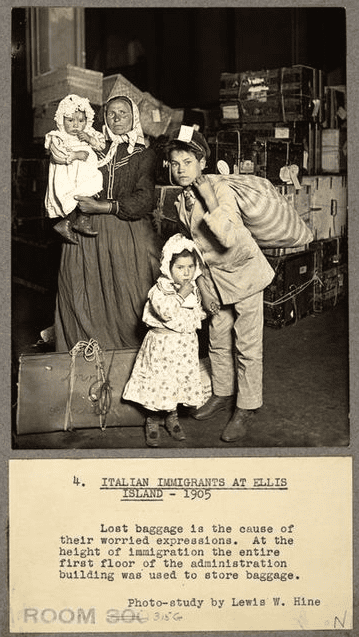
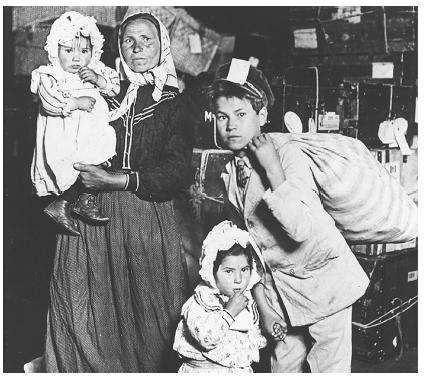
I’ve been reading a book that I dug out of my basement, The Transplanted, A History of Immigrants in Urban America, by John Bodnar. Like most such books in my basement, it dates to my college/grad school days, and, in particular, was published in 1985, so I can’t attest to the degree to which his ideas have held up or been supplanted by new scholarship (and whether that new scholarship is credible or just new). Fun fact: the image above, from the Wikipedia entry on Italians in the United States, is also the cover photo; I find it interesting that this photograph, at least to me, produces a sense that these people are destitute and downcast but the caption says they’ve got more luggage than the few items in the photo, lost in the Ellis Island version of baggage-claim.
Anyway: the first chapters of the book talk about the circumstances in which immigrants came to the United States. There were a number of factors, among them the population growth in any given country, and the inheritance patterns — whether the farm is divided among all children/sons, or passed on to the firstborn — but also the impact of the industrial revolution and capitalism (in the sense that historians use the term, to talk about the advent of factories owned by capitalists — men with capital — replacing small family workshops) and large-scale “capitalist” agriculture; all of these, as well as specific political events (e.g., the impact of the unification of Italy) impacted different parts of Europe at different times. In addition, the simple factor of transportation — the ease with which some regions could access ports — played a role, and there was a common pattern of migration from one region of the country to another preceding emigration elsewhere.
But here’s the key pattern Bodnar observes: it was not the wealthy who immigrated — they were doing just fine where they were. It was not the poor, either — they couldn’t afford to travel, and were more likely to end up in the industrializing cities (or, for the Irish, to cross the Irish Sea to England); it was the middle- and lower-middle class.
Abundant evidence exists . . . to suggest that those departing were not coming from the depths of their respective society but occupied positions somewhere in the middle and lower-middle levels of their social structures. Those too poor could seldom afford to go, and the wealthiest usually had too much of a stake in the homelands to depart. (p. 13)
(Commenter SKJAM! mentioned this just yesterday, coincidentally, in a comment on my “Fact-checking the fact-checkers” post, which spurred me to take this post out of its half-written draft form.)
To be sure, that wasn’t universally true, and certain groups had more “push” than “pull” factors (yes, I know about the Irish during the potato famine!) but Bodnar supports this conclusion with details from a number of immigrant groups. Here’s a bit about the Italians:
The image of poor peasants fleeing to America has also dominated much of the scholarship on Italian emigrants but closer analysis reveals that the very poor seldom left. For instance, the average yearly wages in Abruzzi e Molise and Calabria were well above those in Tuscany and Lombardy, and yet emigration was heavier from the former provinces than the latter. Usually those who left were in the middle and lower-middle levels of the peasantry. Supplementing this stream was a characteristic segment of artisans, craftsmen, and others with skills which were increasingly difficult to implement in societies undergoing either a commercialization in agriculture or growing competition with manufactured goods. (p. 20)
It is also a key part of the “immigrant” experience that a fair number of these arrivals were not immigrants at all, but simply migrants. Here’s Bodnar again:
No phenomenon is more central to understanding the motives of those moving from agricultural to industrial regions nor more revealing about the predisposition to use industrial wages to improve or maintain status in the rural world than the process of return migration. Because everyone did not or was unable to return should not obscure the fact that a return was usually every emigrant’s goal. The only major exceptions seem to have been those who had worked as craftsmen or those who ventured to America before 1860 with sufficient capital to initiate farming or commercial enterprises in the new world and groups such as East European Jews who faced severe political restrictions in the homeland. While estimates vary, return rates usually ranged from 25 to 60 percent, although most records on immigration are somewhat imprecise. Hvidt found about 30 percent of the Danes returning, and the German figure was between 35 and 40 percent. About four of every ten Greeks returned, and the Polish figure was only slightly below that. The most likely of all to return were those from central and southern Italy (56 percent) and northeast Hungary. Magyar rates have been estimated at 64 percent and those of Slovaks at 59 percent. (p. 53)
And, indeed, Lazarus wrote her poem with an eye to the plight specifically of Jews escaping persecution in Russia, not with respect to immigrants in general.
It’s my understanding that, in many cases, the same is true today. The Syrians and other migrants who flooded into Europe via Turkey over the past several years paid a substantial amount of money for the trip — as much as $10,000. There are reports of Africans making there way across the Atlantic into Central America, and then upwards to Mexico and then crossing illegally into the U.S. — again, not a cheap voyage.
Now, I’ll admit that I’m not far enough along in my reading of this book or others to assess the second half of the “immigration myth,” that each successive cohort of immigrants worked their way up, only to wrongly disdain the new arrivals. I had hoped to do some reading and come to a firmer conclusion on that point before writing this up, but I’m running out of steam. But it doesn’t seem to fit with with what I know about American economic mobility, at least in its most simplified form. If you think about the urban poor in the 19th century, was it really the case that the children of immigrant factory workers went to school, learned their lessons, and got good office jobs when they graduated? Wasn’t it, by and large, the case that those children left school in their early teens (or even earlier) and went to work in those same factories, and only with the advent of the modernization of the economy in the 20th century, that the lot of the urban poor improved, for everyone regardless of how many generations ago their ancestors immigrated? To be sure, there was a certain social and political mobility, as Irish-ancestry politicians came to dominate machine politics, for example, but that’s not the same thing as this simplified view of income stratification by time-since-arrival.
What does this mean? Largely, it’s a matter of what this doesn’t mean. The narrative of “we have an obligation to welcome destitute immigrants because our ancestors were also once destitute” doesn’t work, nor does “all migrants are always, by definition, only ever coming because they are in dire need.” I am not, in this post, expounding on the right decisions about immigration to the United States in the year 2017. I’m just saying that we can’t make them by telling ourselves incorrect stories about the past.
UPDATE: yes, there are issues with line spacing. Bear with me.
And here’s a related article, “Syrian Refugees Resettled in the U.S.: Why Them and Not Others?” which says that the UNHCR seems to be picking refugees for resettlement to the US seemingly at random, even among people who had a fairly stable living situation, despite the claim that they were sending the most vulnerable, the most needy. Not sure what to make of this but it seemed worth sharing.
Image: By Lewis W. Hine(Life time: 1874-1940) – Original publication: Photo-studyImmediate source: Brooklyn Museum, Public Domain, https://commons.wikimedia.org/w/index.php?curid=51292180
Previous Post

March 2, 2017
What's so "final" about your "final resting place"?
Next Post

March 3, 2017 The 94 million matter
Browse Our Archives
Select a Category Actuarial/Retirement Issues Politics Uncategorized
Select a Month October 2026 September 2026 August 2026 July 2026 June 2026 April 2026 March 2026 February 2026 January 2026 December 2025 November 2025 October 2025 July 2025 June 2025 May 2025 April 2025 March 2025 February 2025 January 2025 December 2024 November 2024 October 2024 September 2024 August 2024 July 2024 June 2024 May 2024 April 2024 March 2024 February 2024 December 2023 November 2023 October 2023 September 2023 August 2023 July 2023 December 2022 September 2022 August 2022 July 2022 June 2022 May 2022 February 2022 January 2022 December 2021 August 2021 June 2021 April 2021 February 2021 January 2021 December 2020 November 2020 October 2020 September 2020 August 2020 July 2020 June 2020 May 2020 April 2020 March 2020 February 2020 January 2020 December 2019 November 2019 October 2019 September 2019 August 2019 July 2019 June 2019 May 2019 April 2019 March 2019 February 2019 January 2019 December 2018 November 2018 October 2018 September 2018 August 2018 July 2018 June 2018 May 2018 April 2018 March 2018 February 2018 January 2018 December 2017 November 2017 October 2017 September 2017 August 2017 July 2017 June 2017 May 2017 April 2017 March 2017 February 2017 January 2017 December 2016 November 2016 October 2016 September 2016 August 2016 July 2016 June 2016 May 2016 April 2016 March 2016 February 2016 January 2016 December 2015 November 2015 October 2015 September 2015 August 2015 July 2015 June 2015 May 2015 April 2015 March 2015 February 2015 January 2015 December 2014 November 2014 October 2014 September 2014 August 2014 July 2014 June 2014 May 2014 April 2014 March 2014 February 2014 January 2014 December 2013 November 2013 October 2013 September 2013 August 2013 July 2013
Follow Us!
TAKE THE
Religious Wisdom Quiz
What does Proverbs 22:6 say about training a child?
Select your answer to see how you score.
Teach a child discipline, and he will live in wisdom. Children should be seen and not heard. Train up a child in the way he should go, and when he is old he will not depart from it. Guide the young, and they will not stumble.
Related posts from Jane the Actuary

News from the world of English Language Learning

What the heck is up with the "public...

The real cost of cheap chicken
What I think about birthright citizenship
TRENDING AT PATHEOS Catholic

"Why Do Churches Talk So Much About Money?"
If you were inclined to do so, you could probably find any...

Watch and Pray: On Mark 13:33-37
Jesus said to his disciples: “Be watchful! Be alert! You do not...

Debate on Purgatory & Biblical Evidences for It
This is from a combox on my video channel, Catholic Bible Highlights....

Set the table for the coming King
On Thursday we visited my sister-in-law for Thanksgiving, and throughout the entire...

If I Stop Becoming, Will I Disappear?
(At our most recent half day Zen retreat, Dr Chris Hoff, a...

A Modest Proposal for President Trump
Trump should just quit the loser Republicans who failed him so badly...
view all Catholic blogs
Ad-Free & Subscriber Log-In Subscription Support
- About Us
- 2026 Calendar
- Videos
- Podcasts
- Library of World Religions
- Faith In Media Tracker
- Advertise With Us
- Write for Us
- Privacy Policy
- Terms of Service
- Do Not Sell My Data
- Contact Us
- Radiant Digital
- Manage Newsletter Subscriptions
- Unsubscribe From Notifications
- Sitemap
Copyright 2008-2026, Patheos, part of the Radiant Digital network of media brands. All rights reserved.
Subscription Support Ad-Free & Subscriber Log-In
Follow Patheos