
BuddhistCatholicContemplativeEvangelicalGeneral ChristianHinduJewishLatter-day SaintMuslimNew VisionsProgressive Christian
Beliefs
- Buddhist
- Catholic
- Contemplative
- Evangelical
- General Christian
- Hindu
- Jewish
- Latter-day Saint
- More Voices
- Muslim
- New Visions
- Pagan
- Progressive Christian
Topics
- Religion News
- Food and Religion
- Sports and Religion
- Religious Art
- Religious Music and Entertainment
- Religious Events
- History and Religion
- Style and Religion
- Politics and Religion
- Women in Religion
- Recreation Outdoors and Religion
- Business Finance and Religion
- Careers Workplace and Religion
- Education and Religion
- Family Parenting and Religion
- Health Fitness and Religion
- Home and Religion
- Relationships and Religion
- Technology and Religion
- Travel and Religion
Columnists
- Buddhist Columnists
- Business Finance and Religion Columnists
- Careers Workplace and Religion Columnists
- Catholic Columnists
- Contemplative Columnists
- Education and Religion Columnists
- Evangelists Columnists
- Family Parenting and Religion Columnists
- General Christian Columnists
- Health Fitness and Religion Columnists
- Hindu Columnists
- History and Religion Columnists
- Home and Religion Columnists
- Jewish Columnists
- More Voices Columnists
- Latter Day Columnists
- Muslim Columnists
- New Visions Columnists
- Nonreligious Columnists
- Pagan Columnists
- Politics and Religion Columnists
- Progressive Columnists
- Recreation Outdoors and Religion Columnists
- Relationships and Religion Columnists
- Religion News Columnists
- Religious Art Columnists
- Religious Events Columnists
- Religious Music and Entertainment Columnists
- Sports and Religion Columnists
- Style and Religion Columnists
- Technology and Religion Columnists
- Travel and Religion Columnists
- Women in Religion Columnists
Resource Library
- 2026 Calendar
- Library of World Religions
- The 100 Most Holy Places on Earth
- Patheos Answers
- Podcasts
- Videos
- Faith Leaders Database
- Anglican Episcopalian
- Bahai
- Baptist
- Buddhism
- Christianity
- Confucianism
- Eastern Orthodoxy
- Hinduism
- Holiness and Pentecostal
- ISKCON
- Islam
- Judaism
- Lutheran
- Methodist
- The Church of Jesus Christ of Latter-day Saints
- New Age
- Paganism
- Presbytarian and Reformed
- Protestantism
- Religion Behind the Scenes
- Roman Catholic
- Scientology
- Shia Islam
- Sikhism
- Sufism
- Sunni Islam
- Taoism
- Zen
- See all religions
Research Tools
 Ad-Free & Subscriber Log-In Subscription Support
Ad-Free & Subscriber Log-In Subscription Support
Follow Patheos 

- Trending:
- Forgiveness
- |
- Marriage
- |
- Consciousness
- |
- Death Penalty
- |
- Election
- |
- Halloween

- Home
- Catholic
- Politics and Religion
- Holocaust and Survival (or, Auschwitz vs. Babi Yar)
Holocaust and Survival (or, Auschwitz vs. Babi Yar)
Last updated on: February 18, 2017 at 3:25 pm by Jane the Actuary
Holocaust and Survival (or, Auschwitz vs. Babi Yar) 2017-02-18T15:25:58-06:00 Jane the Actuary
Patheos Explore the world's faith through different perspectives on religion and spirituality! Patheos has the views of the prevalent religions and spiritualities of the world.
About 6 million Jews perished in the Holocaust. This figure is sometimes cited as “between 5 and 6 million” because of the differences between known deaths and the results of estimates and calculations (see Wikipedia’s discussion of totals). Virtually the whole of the Jewish population of Poland, the Baltics, and those parts of the Soviet Union occupied by the Nazis were swept away, utterly annihilated. For example, as you’ll recall from my post the other day, less than 3% of Polish Jews actually survived within Nazi-occupied territory; the remainder survived only due to Stalin’s deportations.
And yet the story of the Holocaust, as we in the West know it, is one of survival. We have Elie Wiesel’s narrative, Night. Schindler’s List. My son recently had a field trip to the Illinois Holocaust Museum, and, as is their practice where possible, it was led by a survivor (though with something of a different story – her family had fled to Shanghai). It rather seems to me that even Anne Frank’s diary we think of as a “survival narrative” — at least, I recall thinking of it in those terms: reading the postscript that she died only a few short weeks prior to liberation, and thinking “she was so close to surviving.”
In general, the survivor narrative is considered to be crucial to understanding the Holocaust, and teaching about the Holocaust, and every now and again you come across articles worrying about the future of Holocaust education now that the survivors are aging and dying.
And that’s why I was stunned to read that there were two survivors of the death factory that was Belzec. (p. 474 in Final Solution by David Cesarani, which I still have checked out from the library). In the Babi Yar massacre, 29 survived the massacre. (This comes from Wikipedia, and the footnote is a bad link. Whether these 29 are all people who “played dead” and climbed out of the pits, or includes Jews in Kiev who didn’t report as ordered, or escaped the line somewhere along the way, isn’t clear.)
There’s a high school world history textbook online. What does it have to say? One page on the beginnings of persecution in Germany, and Kristallnacht. One page that the Jews sought refuge elsewhere, and that they were placed in ghettos. The third page, on the final solution says that killing squads killed, and other Jews were rounded up and taken to concentration camps/slave-labor prisons. Then selections began at Auschwitz, and women, young children, the old, and the sick were killed. (This sentence is poorly constructed; from what I understand, women were more likely to be judged unfit, but it was not a blanket statement as was the case with children and the elderly; what’s more, this paragraph implies that all such death camps had selections as Auschwitz did.) It’s pretty paltry knowledge — adequate to check off a basic comprehension of the past but not sufficient to have this shape your understanding of the world.
Anyway, I was thinking about this again because of an article the other day about the “forgotten Holocaust” — that is, the killings in the Soviet Union, where “Of the estimated less than three million Soviet Jews who lived under Nazi occupation, only around 115,000 survived.” This particular article featured a filmmaker’s project, and the link it gives to an article with more details on the project, reports that in the time of the Soviet Union there was simply no research on the Holocaust — something I’d read elsewhere, that the idea that the Jews were in any way victimized more than the rest of the USSR’s citizens wasn’t permitted.
Separately, in looking for a statistic on google, I came across an extended essay from 2009 by Timothy Snyder, “Holocaust: The Ignored Reality.” Here are some key paragraphs from that piece:
The very reasons that we know something about Auschwitz warp our understanding of the Holocaust: we know about Auschwitz because there were survivors, and there were survivors because Auschwitz was a labor camp as well as a death factory. These survivors were largely West European Jews, because Auschwitz is where West European Jews were usually sent. After World War II, West European Jewish survivors were free to write and publish as they liked, whereas East European Jewish survivors, if caught behind the iron curtain, could not. In the West, memoirs of the Holocaust could (although very slowly) enter into historical writing and public consciousness.
This form of survivors’ history, of which the works of Primo Levi are the most famous example, only inadequately captures the reality of the mass killing. The Diary of Anne Frank concerns assimilated European Jewish communities, the Dutch and German, whose tragedy, though horrible, was a very small part of the Holocaust. By 1943 and 1944, when most of the killing of West European Jews took place, the Holocaust was in considerable measure complete. Two thirds of the Jews who would be killed during the war were already dead by the end of 1942. The main victims, the Polish and Soviet Jews, had been killed by bullets fired over death pits or by carbon monoxide from internal combustion engines pumped into gas chambers at Treblinka, Bełzec, and Sobibór in occupied Poland.
I want to be careful not to build a strawman. If I were, it would be something like this:
Americans know about concentration camps, and gas chambers, but that’s about it, but the emphasis on survivors, and survivor narratives gives them the impression that the Holocaust was indeed survivable if you were healthy enough, and young enough (but not too young), and clever enough, and had sufficient Will to Live.
That’s clearly going too far. But what I’ve been reading lately makes me wonder, what are the consequences of the “survivor-oriented” nature of the way Americans speak about and learn about the Holocaust?
Of course, I suppose you could take a step back and ask,
What are the consequences, in general, of knowing about the Holocaust, whether a crappy high-school history version of “Nazis killed Jews, then end” or a more detailed understanding? How does it affect your perception of world affairs, of ethnic relations, your understanding of human nature? And how does this changed perception affect the way you live your life and the decisions you make?
And that’s all I’ve got for you. In a perfect world, I’d find someone to hire me to read and write all day. In the real world, I’ve got a load of laundry to switch out.
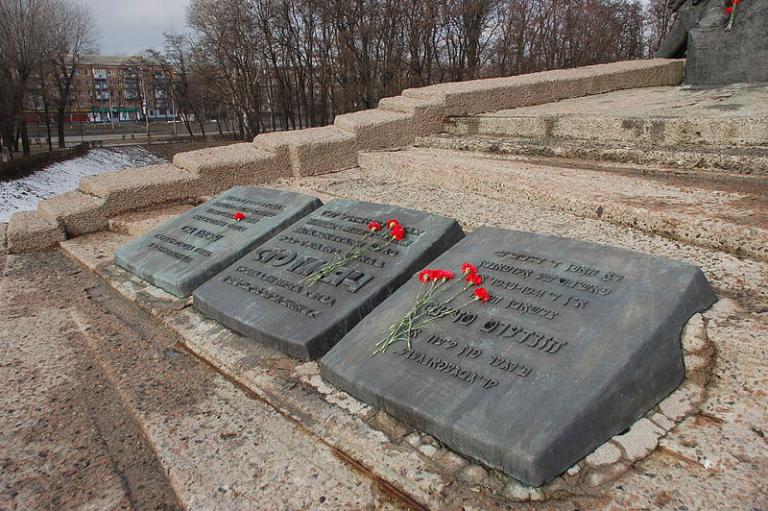
Image: memorial at Babi Yar. https://commons.wikimedia.org/wiki/File:Babi_Yar_17.jpg
Previous Post

February 17, 2017
What you don't know about that $89,000 drug
Next Post

February 19, 2017 Week 4: The Flynn leaks, and, when do the ends justify the means?
Browse Our Archives
Select a Category Actuarial/Retirement Issues Politics Uncategorized
Select a Month September 2026 August 2026 July 2026 June 2026 April 2026 March 2026 February 2026 January 2026 December 2025 November 2025 October 2025 July 2025 June 2025 May 2025 April 2025 March 2025 February 2025 January 2025 December 2024 November 2024 October 2024 September 2024 August 2024 July 2024 June 2024 May 2024 April 2024 March 2024 February 2024 December 2023 November 2023 October 2023 September 2023 August 2023 July 2023 December 2022 September 2022 August 2022 July 2022 June 2022 May 2022 February 2022 January 2022 December 2021 August 2021 June 2021 April 2021 February 2021 January 2021 December 2020 November 2020 October 2020 September 2020 August 2020 July 2020 June 2020 May 2020 April 2020 March 2020 February 2020 January 2020 December 2019 November 2019 October 2019 September 2019 August 2019 July 2019 June 2019 May 2019 April 2019 March 2019 February 2019 January 2019 December 2018 November 2018 October 2018 September 2018 August 2018 July 2018 June 2018 May 2018 April 2018 March 2018 February 2018 January 2018 December 2017 November 2017 October 2017 September 2017 August 2017 July 2017 June 2017 May 2017 April 2017 March 2017 February 2017 January 2017 December 2016 November 2016 October 2016 September 2016 August 2016 July 2016 June 2016 May 2016 April 2016 March 2016 February 2016 January 2016 December 2015 November 2015 October 2015 September 2015 August 2015 July 2015 June 2015 May 2015 April 2015 March 2015 February 2015 January 2015 December 2014 November 2014 October 2014 September 2014 August 2014 July 2014 June 2014 May 2014 April 2014 March 2014 February 2014 January 2014 December 2013 November 2013 October 2013 September 2013 August 2013 July 2013
Follow Us!
TAKE THE
Religious Wisdom Quiz
What does "Gethsemane" mean?
Select your answer to see how you score.
Oil press Spring Olive tree Garden
Related posts from Jane the Actuary
What about the Holocaust-denying Republicans?
Why the Holocaust isn't just one genocide among...

On Maus, Book-Banning, and Common Sense
TRENDING AT PATHEOS Catholic

57th Dove Awards Honor Dolly Parton, Crown New...
On gospel music’s biggest night, the 57th annual GMA Dove Awards honored...

The First Eucharistic Controversy: Christ’s Real Presence
For Catholics, the Eucharist is the source and summit of the Christian...

What a Stop Sign Can Teach Us About...
How to Make a Decision When You Can't Hear God Main point:...

Archdiocese Hosts Military Marriage Retreat in Germany
RASTATT, Germany — The transient military lifestyle, with its frequent deployments and...

Nearly every morning, I make the drive to Detroit with my high-school-age...

The Real AI Story Is Adoption Without Trust
Artificial intelligence has crossed a political threshold. It is no longer a...
view all Catholic blogs
Ad-Free & Subscriber Log-In Subscription Support
- About Us
- 2026 Calendar
- Videos
- Podcasts
- Library of World Religions
- Faith In Media Tracker
- Advertise With Us
- Write for Us
- Privacy Policy
- Terms of Service
- Do Not Sell My Data
- Contact Us
- Radiant Digital
- Manage Newsletter Subscriptions
- Unsubscribe From Notifications
- Sitemap
Copyright 2008-2026, Patheos. All rights reserved.
Subscription Support Ad-Free & Subscriber Log-In
Follow Patheos