
BuddhistCatholicContemplativeEvangelicalGeneral ChristianHinduJewishLatter-day SaintMuslimNew VisionsProgressive Christian
Beliefs
- Buddhist
- Catholic
- Contemplative
- Evangelical
- General Christian
- Hindu
- Jewish
- Latter-day Saint
- More Voices
- Muslim
- New Visions
- Pagan
- Progressive Christian
Topics
- Religion News
- Food and Religion
- Sports and Religion
- Religious Art
- Religious Music and Entertainment
- Religious Events
- History and Religion
- Style and Religion
- Politics and Religion
- Women in Religion
- Recreation Outdoors and Religion
- Business Finance and Religion
- Careers Workplace and Religion
- Education and Religion
- Family Parenting and Religion
- Health Fitness and Religion
- Home and Religion
- Relationships and Religion
- Technology and Religion
- Travel and Religion
Columnists
- Buddhist Columnists
- Business Finance and Religion Columnists
- Careers Workplace and Religion Columnists
- Catholic Columnists
- Contemplative Columnists
- Education and Religion Columnists
- Evangelists Columnists
- Family Parenting and Religion Columnists
- General Christian Columnists
- Health Fitness and Religion Columnists
- Hindu Columnists
- History and Religion Columnists
- Home and Religion Columnists
- Jewish Columnists
- More Voices Columnists
- Latter Day Columnists
- Muslim Columnists
- New Visions Columnists
- Nonreligious Columnists
- Pagan Columnists
- Politics and Religion Columnists
- Progressive Columnists
- Recreation Outdoors and Religion Columnists
- Relationships and Religion Columnists
- Religion News Columnists
- Religious Art Columnists
- Religious Events Columnists
- Religious Music and Entertainment Columnists
- Sports and Religion Columnists
- Style and Religion Columnists
- Technology and Religion Columnists
- Travel and Religion Columnists
- Women in Religion Columnists
Resource Library
- 2026 Calendar
- Library of World Religions
- The 100 Most Holy Places on Earth
- Patheos Answers
- Podcasts
- Videos
- Faith Leaders Database
- Anglican Episcopalian
- Bahai
- Baptist
- Buddhism
- Christianity
- Confucianism
- Eastern Orthodoxy
- Hinduism
- Holiness and Pentecostal
- ISKCON
- Islam
- Judaism
- Lutheran
- Methodist
- The Church of Jesus Christ of Latter-day Saints
- New Age
- Paganism
- Presbytarian and Reformed
- Protestantism
- Religion Behind the Scenes
- Roman Catholic
- Scientology
- Shia Islam
- Sikhism
- Sufism
- Sunni Islam
- Taoism
- Zen
- See all religions
Research Tools
 Ad-Free & Subscriber Log-In Subscription Support
Ad-Free & Subscriber Log-In Subscription Support
Follow Patheos 

- Trending:
- Forgiveness
- |
- Marriage
- |
- Consciousness
- |
- Death Penalty
- |
- Election
- |
- Halloween

- Home
- Catholic
- Politics and Religion
- The Holocaust and “what happened next”
The Holocaust and “what happened next”
Last updated on: February 8, 2017 at 9:10 am by Jane the Actuary
The Holocaust and “what happened next” 2017-02-08T09:10:29-06:00 Jane the Actuary
Patheos Explore the world's faith through different perspectives on religion and spirituality! Patheos has the views of the prevalent religions and spiritualities of the world.
If this were any other subject than what it is, this post would be perfect for a click bit headline: “Hitler kills 6 million Jews, and you’ll never believe what happens next!” —
But here’s what I want to share with you.
I wrote the other day that I’d been reading Final Solution: The Fate of the Jews, by David Cesarani, a very comprehensive book on the Holocaust. Now, it seems to me that most works about the Holocaust stop with the liberation of the camps, or, if it’s an individual narrative, the story of how that particular survivor made his or her way to the United States (because most narratives that you read are by survivors who emigrated to the United States, just because they’re most likely to have something published in the U.S.). And certainly, I expect that most Americans’ knowledge ends with liberation, with, as a bit of an epilogue, the idea that the survivors left Germany for Israel afterwards.
But here’s some detail (from pages 772 ff):
In Poland, the numbers looked like this:
30,000 – 60,000 Jews survived by hiding in the cities or forests.
20,000 were still alive in ghettos and camps in Poland.
A few thousand returned from camps in Germany.
Between 13,000 and 20,000 returned from military service in the Red Army.
But the largest number of Polish Jews were those who had been deported by Stalin to Siberia/central Asia during the period from 1939 to 1941. Many died due to the conditions in the camps to which they were deported, but 166,000 survived and were repatriated after the war.
This puts the total number of Jews in Poland at between 232,000 – 269,000. (How does this number compare with other sources? Wikipedia gives a figure of 350,000 survivors including 230,000 in the Soviet Union. It’s hard to pair these numbers, given the shifting borders and population movements.)
But these returnees were not welcomed home by neighbors happy to see that they had survived. Instead, they faced further violence, by neighbors unwilling to return homes and property to the survivors, and by Polish nationalists who (in the time before the communists had fully taken control) viewed the Jews as communist collaborators. It’s been calculated that 600 – 750 Jews were killed by Poles after the war, including a massacre of 42 Jews in July 1947.
As a result, initial efforts at rebuilding within Poland were abandoned, and the Displaced Person camps which the Allies had so busily been emptying out, refilled with Polish (and, I think – but it’s not clear – other Eastern European) Jews, who concluded that Poland could no longer be their home.
Cesarani writes,
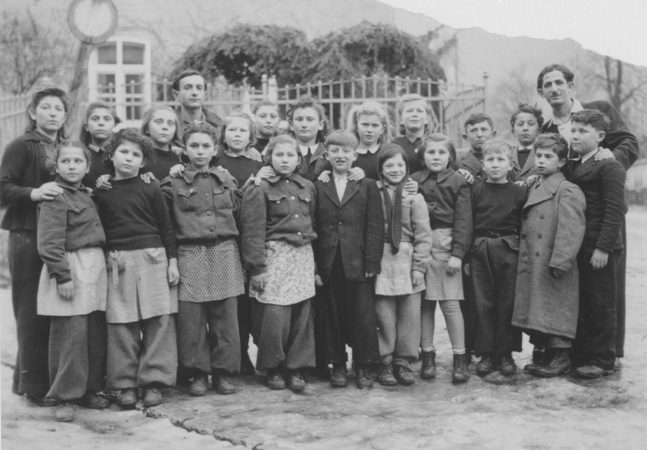
In December 1945 there were only about 1,800 children in the Jewish DP camps of Germany and Austria. One month after the Kielce pogrom the number reached 16,000 and by the end of the year there were 26,500 Jewish children in the US zone alone. The Polish Jews who had been exiled to the USSR had departed and come back as family units. Although conditions in places such as Kazakhstan were harsh it was possible to preserve family life, marry, and have children. Now these Polish Jews brought their families to Germany, creating new demands on the relief agencies and also generating new possibilities. The overall Jewish population rose to 141,000 in the American zone and 50,000 in the British zone during 1946, peaking at about 190,000 in Germany plus some 60,000 in other refugee centres. Although the vast majority of the Jewish DPs were now Polish, only a small proportion had actually endured German camps and ghettos. (p. 775)
which offered an explanation for a puzzling statement about the DP camps in the exhibits at the Holocaust Museum in Skokie; talking about revival after the war, the text moved from a “baby boom” among young survivors to the provision of services for children, showing happy preschoolers and school-aged children who were clearly too old to have been born following the war.
So, first of all, it is mind-blowingly ironic that Stalin’s deportations, while they destroyed communities and countless lives, in this case saved lives.
But, second, well, here’s something else to consider:
All those displaced people were waiting for the opportunity to leave for Israel or America. With respect to America, the path was cleared for an eventual 140,000 Jews (not just those in DP camps, but from elsewhere, too) by the Displaced Persons Act of 1948. With respect to Israel, Britain, which controlled Palestine subsequent to World War I, aimed to control the borders to prevent Jewish immigration to Palestine, and even kept would-be immigrants in camps in Cyprus, but large numbers came in illegally, and ultimately legally after Israeli independence in 1948.
One of the arguments I frequently read from Palestinian activists is that “the West gave Palestine to the Jews to make up for the Holocaust, but that’s unfair because the Palestinians had nothing to do with it.” And the rejoinders have to do with the historical connection of the Jews to the land, and the continuity of at least some numbers of Jews living there, and the fact that, until Jews began moving to the region, the area was a backwater, underdeveloped and sparsely populated, and it was the economic growth and farming advancements brought in by the Jews allowed it to support its growing population.
But it seems to me that the Holocaust isn’t really the right context, or at least not the complete context. Instead, the post-war context is just as significant. After the last shots were fired, there were massive relocations of ethnic groups, voluntary and not. Poles were removed from that part of Poland which the Soviet Union kept for itself after the war, and Ukrainians in Poland left for Ukraine/the Soviet Union. Ethnic Germans were expelled from Poland, Czeckoslovakia, Hungary, Yugoslavia, and the parts of Germany which were taken by Poland and the Soviet Union (Kaliningrad). Further afield, the Partition of India produced the relocation of millions of Hindus and Muslims in 1947, and closer to home, but further back in time, the population exchange between Greece and Turkey in the early 20s, was more orderly, but nonetheless a further instance of rearranging people by ethnic group (and remember, too, that until the dismantling of the Ottoman Empire following World War I, Palestine was just one region among many in the Ottoman Empire). And these were not the actions of criminal states like the Nazis, but of countries acting within established norms — Churchill and Truman were completely on board with the border re-drawing and deportations, and France even held onto the Saar region as a “protectorate” until it was allowed to rejoin Germany in 1957 (see Wikipedia).
This is, after all, what the majority of the DPs experienced — deportation to the Soviet Union, then a not-wholly-voluntary departure for the West.
So ideas of self-determination of nations and ethnic groups, and the notion of multi-ethnic countries singing kum-ba-yah — well, in the end, that’s all very new. And the difficulty with the situation of the Occupied Territories and the never-resettled refugees is that we have this traditional way of thinking of nations and peoples and the modern concept of self-determination bumping up against each other.
Image: children at the Schauenstein DP camp, https://commons.wikimedia.org/wiki/File:DP_class_at_Schauenstein_camp.jpg; public domain
Previous Post

February 5, 2017
A few words on Depo Provera
Next Post
February 8, 2017 Week 3 - the crazy continues
Browse Our Archives
Select a Category Actuarial/Retirement Issues Politics Uncategorized
Select a Month September 2026 August 2026 July 2026 June 2026 April 2026 March 2026 February 2026 January 2026 December 2025 November 2025 October 2025 July 2025 June 2025 May 2025 April 2025 March 2025 February 2025 January 2025 December 2024 November 2024 October 2024 September 2024 August 2024 July 2024 June 2024 May 2024 April 2024 March 2024 February 2024 December 2023 November 2023 October 2023 September 2023 August 2023 July 2023 December 2022 September 2022 August 2022 July 2022 June 2022 May 2022 February 2022 January 2022 December 2021 August 2021 June 2021 April 2021 February 2021 January 2021 December 2020 November 2020 October 2020 September 2020 August 2020 July 2020 June 2020 May 2020 April 2020 March 2020 February 2020 January 2020 December 2019 November 2019 October 2019 September 2019 August 2019 July 2019 June 2019 May 2019 April 2019 March 2019 February 2019 January 2019 December 2018 November 2018 October 2018 September 2018 August 2018 July 2018 June 2018 May 2018 April 2018 March 2018 February 2018 January 2018 December 2017 November 2017 October 2017 September 2017 August 2017 July 2017 June 2017 May 2017 April 2017 March 2017 February 2017 January 2017 December 2016 November 2016 October 2016 September 2016 August 2016 July 2016 June 2016 May 2016 April 2016 March 2016 February 2016 January 2016 December 2015 November 2015 October 2015 September 2015 August 2015 July 2015 June 2015 May 2015 April 2015 March 2015 February 2015 January 2015 December 2014 November 2014 October 2014 September 2014 August 2014 July 2014 June 2014 May 2014 April 2014 March 2014 February 2014 January 2014 December 2013 November 2013 October 2013 September 2013 August 2013 July 2013
Follow Us!
TAKE THE
Religious Wisdom Quiz
Which book contains the story of the Valley of Dry Bones?
Select your answer to see how you score.
Jeremiah Isaiah Daniel Ezekiel
Related posts from Jane the Actuary
What about the Holocaust-denying Republicans?
From the River. . . to the Yearbook
Why the Holocaust isn't just one genocide among...
TRENDING AT PATHEOS Catholic

The Iron Gates and the Lion of the...
Yesterday, I didn't finish my report about, well, yesterday. So I'll...

Dolly Parton’s Last Song Wins Dove Award with...
Bluegrass band The Grascals, speaking on the red carpet at the 57th...

The Image: On the Horror of Capitalism and...
The Image Then went the Pharisees, and took counsel how they might...

We are approaching the date of our new American national holiday: October...

Letters on Living the Faith by C.S. Lewis
Most of us met C.S. Lewis as a public intellectual. Mere Christianity....

When Halloween Unmasks Married Hearts
Written by Dr. David K. Ewen from Eternal Truth Bible College Behind...
view all Catholic blogs
Ad-Free & Subscriber Log-In Subscription Support
- About Us
- 2026 Calendar
- Videos
- Podcasts
- Library of World Religions
- Faith In Media Tracker
- Advertise With Us
- Write for Us
- Privacy Policy
- Terms of Service
- Do Not Sell My Data
- Contact Us
- Radiant Digital
- Manage Newsletter Subscriptions
- Unsubscribe From Notifications
- Sitemap
Copyright 2008-2026, Patheos. All rights reserved.
Subscription Support Ad-Free & Subscriber Log-In
Follow Patheos