
BuddhistCatholicContemplativeEvangelicalGeneral ChristianHinduJewishLatter-day SaintMuslimNew VisionsProgressive Christian
Beliefs
- Buddhist
- Catholic
- Contemplative
- Evangelical
- General Christian
- Hindu
- Jewish
- Latter-day Saint
- More Voices
- Muslim
- New Visions
- Pagan
- Progressive Christian
Topics
- Religion News
- Food and Religion
- Sports and Religion
- Religious Art
- Religious Music and Entertainment
- Religious Events
- History and Religion
- Style and Religion
- Politics and Religion
- Women in Religion
- Recreation Outdoors and Religion
- Business Finance and Religion
- Careers Workplace and Religion
- Education and Religion
- Family Parenting and Religion
- Health Fitness and Religion
- Home and Religion
- Relationships and Religion
- Technology and Religion
- Travel and Religion
Columnists
- Buddhist Columnists
- Business Finance and Religion Columnists
- Careers Workplace and Religion Columnists
- Catholic Columnists
- Contemplative Columnists
- Education and Religion Columnists
- Evangelists Columnists
- Family Parenting and Religion Columnists
- General Christian Columnists
- Health Fitness and Religion Columnists
- Hindu Columnists
- History and Religion Columnists
- Home and Religion Columnists
- Jewish Columnists
- More Voices Columnists
- Latter Day Columnists
- Muslim Columnists
- New Visions Columnists
- Nonreligious Columnists
- Pagan Columnists
- Politics and Religion Columnists
- Progressive Columnists
- Recreation Outdoors and Religion Columnists
- Relationships and Religion Columnists
- Religion News Columnists
- Religious Art Columnists
- Religious Events Columnists
- Religious Music and Entertainment Columnists
- Sports and Religion Columnists
- Style and Religion Columnists
- Technology and Religion Columnists
- Travel and Religion Columnists
- Women in Religion Columnists
Resource Library
- 2026 Calendar
- Library of World Religions
- The 100 Most Holy Places on Earth
- Patheos Answers
- Podcasts
- Videos
- Faith Leaders Database
- Anglican Episcopalian
- Bahai
- Baptist
- Buddhism
- Christianity
- Confucianism
- Eastern Orthodoxy
- Hinduism
- Holiness and Pentecostal
- ISKCON
- Islam
- Judaism
- Lutheran
- Methodist
- The Church of Jesus Christ of Latter-day Saints
- New Age
- Paganism
- Presbytarian and Reformed
- Protestantism
- Religion Behind the Scenes
- Roman Catholic
- Scientology
- Shia Islam
- Sikhism
- Sufism
- Sunni Islam
- Taoism
- Zen
- See all religions
Research Tools
 Ad-Free & Subscriber Log-In Subscription Support
Ad-Free & Subscriber Log-In Subscription Support
Follow Patheos 

- Trending:
- Forgiveness
- |
- Marriage
- |
- Consciousness
- |
- Death Penalty
- |
- Election
- |
- Halloween

- Home
- Catholic
- Politics and Religion
- The Myth of the Marshall Plan
The Myth of the Marshall Plan
Last updated on: January 23, 2017 at 9:22 pm by Jane the Actuary
The Myth of the Marshall Plan 2017-01-23T21:22:19-06:00 Jane the Actuary
Patheos Explore the world's faith through different perspectives on religion and spirituality! Patheos has the views of the prevalent religions and spiritualities of the world.
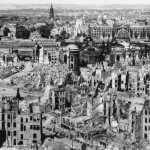
![Dresden, Teilansicht des zerstörten Stadtzentrums über die Elbe nach der Neustadt. In der Bildmitte der Neumarkt und die Ruine der Frauenkirche. Bundesarchiv, Bild 146-1994-041-07 / Unknown / CC-BY-SA 3.0 [CC BY-SA 3.0 de (http://creativecommons.org/licenses/by-sa/3.0/de/deed.en)], via Wikimedia Commons](https://wp-media.patheos.com/blogs/sites/533/2017/01/Bundesarchiv_Bild_146-1994-041-07_Dresden_zerst%C3%B6rtes_Stadtzentrum.jpg)
After World War I, the victorious allies obliged Germany to accept a treaty that was so humiliating that it directly led to World War II, because it forced Germany into a poverty and resentment from which Hitler rose to power. After World War II, the allies had learned their lesson and instead helped Germany rebuild, to create the democratic, peace-loving country it has been ever since. The lesson learned is that being magnanimous and generous even to your enemies is the right way to manage your foreign policy, and, incidentally, you can fix any problem if only you spend enough money on it.
Eh, not so much.
Turns out, I wrote about this briefly. Now I’ve been reading about this in a book I picked up while Christmas shopping, Germany 1945 by Richard Bessel. This is not about the Marshall Plan, but about the end of the war and its immediate aftermath and it’s just chock full of “holy ****, I didn’t know that!” bits.
Once the war was clearly coming to its conclusion, everyone in the East was terrified of the Red Army, so much so that it affected the course of the war: where in the West there are images of German soldiers being relieved to surrender, in the East they fought to the bitter end not just because Hitler spurred them on but because they knew the Red Army would be seeking revenge, which they indeed did, burning villages, raping women, killing civilians. The resistance at the front was also strategic, in that the generals, even in the last days, after Hitler was dead and they were working out surrender terms, were aiming at getting as many of their soldiers into territory from which they could surrender to the U.S./Britain rather than the Red Army, and they were moderately successful in this effort, leaving only 30% of soldiers in the path of the Red Army where originally the large majority of their troops were in the East. And the Red Army was so vengeful not just because of the destruction of the Nazis in the Soviet Union, nor because of propaganda, but because they were further enraged at entering German cities and seeing the prosperity, the material wealth that was still evident despite the years of war and bombings, of these cities compared with their own homes in the Soviet Union.
In the West, the army was not remotely as wrathful, but the French troops are singled out as having perpetrated their own mass rapes, though not as horrifically as in the East. Among the Brits and the American troops, the worst of the excess was in reaction to the concentration camp discoveries, both in directly taking revenge and allowing the prisoners free rein to exact their revenge. But all armies didn’t hesitate to requisition homes, offices, or other buildings, without regard to the fate of their inhabitants, giving them just hours to vacate. All armies also interned significant numbers of people — de-Nazification wasn’t just about removing Nazis from their political offices, but putting them sometimes into the very same concentration camps in which Jews and other Nazi prisoners had been held — though with reasonably humane treatment, except for the Soviets, who shipped them off to the Gulag, where half of them died. And there was a substantial fear of “Werewolves” – that is, of an underground resistance, which meant, in the case of the western sectors, a curfew and other restrictions, and, in the East, the imprisoning of young men, even teenagers, coerced confessions, and, again, the Gulag.
And — well, it wasn’t new to me that Germany had its map so radically redrawn, losing 1/5th of its territory, though I suspect most even reasonably-educated people aren’t aware of it. You read about the German/Russian carving-up of Poland in 1939, but never with the footnote that, oh, by the way, Russia never gave their piece back to Poland, but just sliced off the eastern part of contiguous Germany, plus took all of the isolated East Prussia region, to give to Poland in return. Now, to be sure, there were some grounds for keeping their piece, that is, the part of Poland that the Soviet Union kept was a region that, in centuries past, had passed between Poland and Ukraine multiple times before Russia swallowed it all, and was inhabited by both Poles and Ukrainians. As for taking part of Germany, that was a matter of purposefully weakening and punishing Germany, in addition to wanting to give Poland some replacement land. But the chaos and the dislocation that these population transfers involved, and the fact that the Germans being expelled did indeed suffer horribly both in their treatment before being removed, and after arriving, was extreme — and these population transfers were signed off by Churchill and Roosevelt, not just imposed by Stalin. (In Königsberg, as an extreme case, about three-quarters of the population of 100,000 immediately at the end of the war, died of starvation or disease before the remainder were expelled in 1947.) And although they were (that is, in the case of “real” Germans, rather than ethnic Germans, but citizens of Poland or Czechoslovakia or Yugoslavia) moving from one part of Germany to another, they lost their “Heimat,” their homeland, nonetheless. Now, to be sure, Germans committed horrors, too, but civilians were not the perpetrators, and for the most part, did not experience the Nazis’ crimes, so any idea that they should look at their treatment with a philosophical “well, we deserved the treatment we received” is fanciful. Their genuine suffering caused them to focus solely on day-to-day survival, not on the degree to which others suffered even more during the war.
What else? That notion that the Allies learned their lesson and didn’t demand reparations? The Soviet Union dismantled factories and had the equipment shipped to the USSR — an estimated 45% of industrial capacity by the end of 1946, plus railcars and half the train tracks in the Soviet zone by the end of 1947; even up to the end of the DDR, there were single-track lines which had originally been double-tracked. Factories that started to rebuild, only to have the fruit of their labors taken away in a further dismantling. And the Russians requisitioned various goods on top. But it wasn’t just the Russians: the French, too, requisitioned German factory and farm output, both to fund their occupation troops and for reparations sent back to France. Specifically, farmers were required to turn over to the occupying authorities their entire harvest except for what they would consume themselves or use for seed. (How those farmers were supposed to be able to manage their own needs beyond food — clothing, fuel, etc. — seems to have not been considered.)
And this all came to a head in the winter of 1945 – 1946, when Germans lacked for food and fuel. Oddly, this is a part of the story that isn’t told, except in broad terms, and in terms of the low calorie counts of the rations provided by the occupiers. How many Germans starved, or were malnourished, before the Allies relaxed restrictions and allowed food imports and food aid, isn’t clear. Heck, I have a personal anecdote, though: my Dad served in the army in the early 60s, and tells a story of driving around in Germany and having his car break down. A German family came to the rescue and fixed his car. He wanted to give them something for their trouble, but they told him that they were happy to do so, in order to, in some small way, repay the help they were given, shortly after the war, when they were literally starving, and an American GI gave them the food that kept them alive.
Finally, in Bessel’s conclusion, he addresses the question: what prevented Germany from again seething with resentment and starting another war? He has a five-point explanation:
First, the Germans were so utterly and completely defeated that they could not imagine that they were betrayed and could well have won, but for traitors.
Second, the absolute defeat meant that the entire Nazi ideology was exposed as bankrupt.
Third, despite our imagining it otherwise, the occupation, by all four powers, was harsh; there was no room for resistance.
Fourth, the losses, the complete devastation, the loss of lives, meant that Germans were “left . . . profoundly disoriented and without the energy for much more than a struggle for individual survival.”
And fifth (though perhaps too related to the fourth point to be a separate item), Germans were simply overwhelmingly focused on day-to-day concerns, both because of their material needs and because the lack of communication and transportation left them cut off from anything wider than their narrow geographic area.
Multiple reasons . . . and none of them are that the Allies demonstrated magnanimity in victory.
Now, did the United States ultimately provide aid? Yes, but not right away. Did the U.S. help Germany become a democratic, self-governing country? Yes, but not until 1950.
Does it matter? Among other things, I think that we had an image of our adventure in Iraq following this imagined model: win, be nice, forge a new alliance with a democratic country. We didn’t image that there would be resistance after the surrender, because there wasn’t in Germany — even though the situations were completey different.
image: Dresden, Teilansicht des zerstörten Stadtzentrums über die Elbe nach der Neustadt. In der Bildmitte der Neumarkt und die Ruine der Frauenkirche. Bundesarchiv, Bild 146-1994-041-07 / Unknown / CC-BY-SA 3.0 [CC BY-SA 3.0 de (http://creativecommons.org/licenses/by-sa/3.0/de/deed.en)], via Wikimedia Commons
Previous Post
January 22, 2017
An "America First" hypothetical
Next Post

January 24, 2017 Looking for vacation ideas
Browse Our Archives
Select a Category Actuarial/Retirement Issues Politics Uncategorized
Select a Month September 2026 August 2026 July 2026 June 2026 April 2026 March 2026 February 2026 January 2026 December 2025 November 2025 October 2025 July 2025 June 2025 May 2025 April 2025 March 2025 February 2025 January 2025 December 2024 November 2024 October 2024 September 2024 August 2024 July 2024 June 2024 May 2024 April 2024 March 2024 February 2024 December 2023 November 2023 October 2023 September 2023 August 2023 July 2023 December 2022 September 2022 August 2022 July 2022 June 2022 May 2022 February 2022 January 2022 December 2021 August 2021 June 2021 April 2021 February 2021 January 2021 December 2020 November 2020 October 2020 September 2020 August 2020 July 2020 June 2020 May 2020 April 2020 March 2020 February 2020 January 2020 December 2019 November 2019 October 2019 September 2019 August 2019 July 2019 June 2019 May 2019 April 2019 March 2019 February 2019 January 2019 December 2018 November 2018 October 2018 September 2018 August 2018 July 2018 June 2018 May 2018 April 2018 March 2018 February 2018 January 2018 December 2017 November 2017 October 2017 September 2017 August 2017 July 2017 June 2017 May 2017 April 2017 March 2017 February 2017 January 2017 December 2016 November 2016 October 2016 September 2016 August 2016 July 2016 June 2016 May 2016 April 2016 March 2016 February 2016 January 2016 December 2015 November 2015 October 2015 September 2015 August 2015 July 2015 June 2015 May 2015 April 2015 March 2015 February 2015 January 2015 December 2014 November 2014 October 2014 September 2014 August 2014 July 2014 June 2014 May 2014 April 2014 March 2014 February 2014 January 2014 December 2013 November 2013 October 2013 September 2013 August 2013 July 2013
Follow Us!
TAKE THE
Religious Wisdom Quiz
Who was sold into slavery by his brothers?
Select your answer to see how you score.
Dan Joseph Benjamin Judah
Related posts from Jane the Actuary
Armistice Day thoughts: learning the wrong lessons

Mosul, rebuilding and blame-shifting

From the library: Generation War
TRENDING AT PATHEOS Catholic

Letters on Living the Faith by C.S. Lewis
Most of us met C.S. Lewis as a public intellectual. Mere Christianity....

When Halloween Unmasks Married Hearts
Written by Dr. David K. Ewen from Eternal Truth Bible College Behind...

Aristotle. He’s been called the father of logic, the father of the...

Methodist Central Hall and Westminster Abbey
Situated on the same square is Methodist Central Hall and Westminster Abbey. ...

57th Dove Awards Honor Dolly Parton, Crown New...
On gospel music’s biggest night, the 57th annual GMA Dove Awards honored...

The First Eucharistic Controversy: Christ’s Real Presence
For Catholics, the Eucharist is the source and summit of the Christian...
view all Catholic blogs
Ad-Free & Subscriber Log-In Subscription Support
- About Us
- 2026 Calendar
- Videos
- Podcasts
- Library of World Religions
- Faith In Media Tracker
- Advertise With Us
- Write for Us
- Privacy Policy
- Terms of Service
- Do Not Sell My Data
- Contact Us
- Radiant Digital
- Manage Newsletter Subscriptions
- Unsubscribe From Notifications
- Sitemap
Copyright 2008-2026, Patheos. All rights reserved.
Subscription Support Ad-Free & Subscriber Log-In
Follow Patheos