
BuddhistCatholicContemplativeEvangelicalGeneral ChristianHinduJewishLatter-day SaintMuslimNew VisionsProgressive Christian
Beliefs
- Buddhist
- Catholic
- Contemplative
- Evangelical
- General Christian
- Hindu
- Jewish
- Latter-day Saint
- More Voices
- Muslim
- New Visions
- Pagan
- Progressive Christian
Topics
- Religion News
- Food and Religion
- Sports and Religion
- Religious Art
- Religious Music and Entertainment
- Religious Events
- History and Religion
- Style and Religion
- Politics and Religion
- Women in Religion
- Recreation Outdoors and Religion
- Business Finance and Religion
- Careers Workplace and Religion
- Education and Religion
- Family Parenting and Religion
- Health Fitness and Religion
- Home and Religion
- Relationships and Religion
- Technology and Religion
- Travel and Religion
Columnists
- Buddhist Columnists
- Business Finance and Religion Columnists
- Careers Workplace and Religion Columnists
- Catholic Columnists
- Contemplative Columnists
- Education and Religion Columnists
- Evangelists Columnists
- Family Parenting and Religion Columnists
- General Christian Columnists
- Health Fitness and Religion Columnists
- Hindu Columnists
- History and Religion Columnists
- Home and Religion Columnists
- Jewish Columnists
- More Voices Columnists
- Latter Day Columnists
- Muslim Columnists
- New Visions Columnists
- Nonreligious Columnists
- Pagan Columnists
- Politics and Religion Columnists
- Progressive Columnists
- Recreation Outdoors and Religion Columnists
- Relationships and Religion Columnists
- Religion News Columnists
- Religious Art Columnists
- Religious Events Columnists
- Religious Music and Entertainment Columnists
- Sports and Religion Columnists
- Style and Religion Columnists
- Technology and Religion Columnists
- Travel and Religion Columnists
- Women in Religion Columnists
Resource Library
- 2026 Calendar
- Library of World Religions
- The 100 Most Holy Places on Earth
- Patheos Answers
- Podcasts
- Videos
- Faith Leaders Database
- Anglican Episcopalian
- Bahai
- Baptist
- Buddhism
- Christianity
- Confucianism
- Eastern Orthodoxy
- Hinduism
- Holiness and Pentecostal
- ISKCON
- Islam
- Judaism
- Lutheran
- Methodist
- The Church of Jesus Christ of Latter-day Saints
- New Age
- Paganism
- Presbytarian and Reformed
- Protestantism
- Religion Behind the Scenes
- Roman Catholic
- Scientology
- Shia Islam
- Sikhism
- Sufism
- Sunni Islam
- Taoism
- Zen
- See all religions
Research Tools
 Ad-Free & Subscriber Log-In Subscription Support
Ad-Free & Subscriber Log-In Subscription Support
Follow Patheos 

- Trending:
- Forgiveness
- |
- Marriage
- |
- Consciousness
- |
- Death Penalty
- |
- Election
- |
- Halloween

- Home
- Catholic
- Politics and Religion
- 5 myths about the Holocaust
5 myths about the Holocaust
Last updated on: January 29, 2017 at 8:36 am by Jane the Actuary
5 myths about the Holocaust 2017-01-29T08:36:05-06:00 Jane the Actuary
Patheos Explore the world's faith through different perspectives on religion and spirituality! Patheos has the views of the prevalent religions and spiritualities of the world.
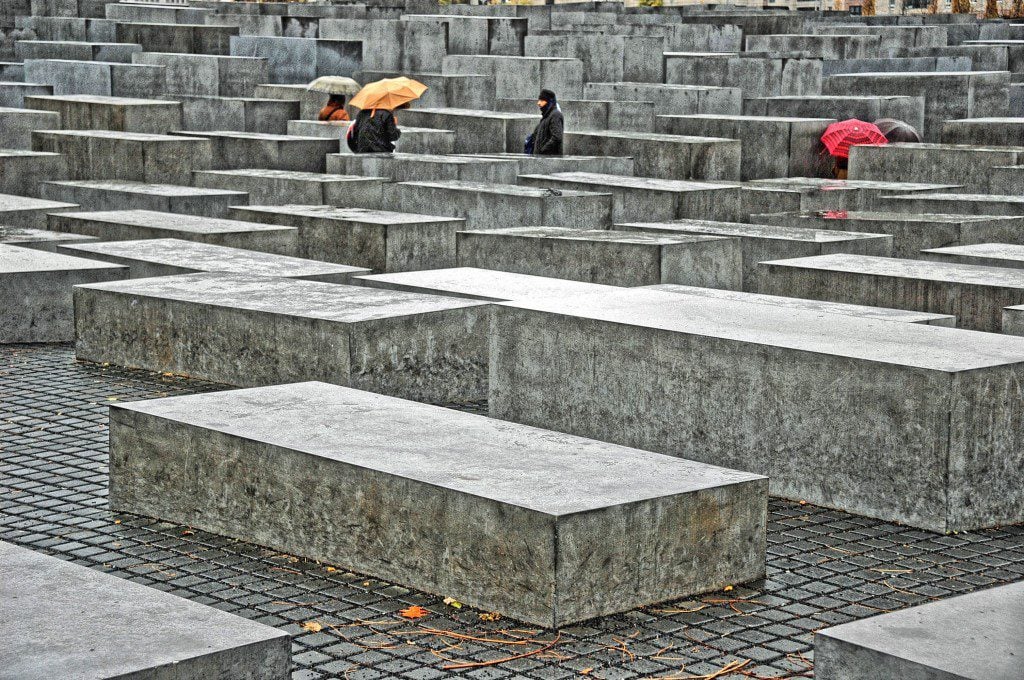
Yesterday was International Holocaust Remembrance Day, which generated a lot of “Trump = Hitler” tweets. And as it happened, I had gotten a new library book, Final Solution; the Fate of the Jews 1933 – 1949, by David Cesarani, a short time ago, and spent some time reading it. This is a very dense book, some 800 pages and full of detail, endless detail, though unfortunately lacking in a timeline to be able to grasp the overall course of events. And while I didn’t read the whole thing, reflecting on what I did read, and what I had previously known, I’ve put together a list of “myths” — or at least things that it seems to me are commonly believed about the Holocaust.
1. Most people died at Auschwitz, where the Nazis “selected” Jews who were capable of working, so that if you were young, you at least had a fighting change of surviving.
Actually, the large majority of Jews died at extermination camps like Sobibor, Belzec, and Treblinka, where you had no chance of surviving at all, or at the hands of the roving death squads called Einsatzgruppen (“Mission Groups”). The Einsatzgruppen are estimated to have killed 1.3 million Jews, in large massacres such as that at Babi Yar and smaller massacres in villages across Poland and the Soviet Union, following the German army’s conquests. An estimated 200 – 250,000 Jews were killed at Sobibor from May 1942 to October 1943. From 430,000 – 600,000 were killed at Belzec from March 1942 to June 1943, and between 700,000 – 900,000 were killed in Treblinka from July 1942 to October 1943. In all three cases the gas chambers used carbon monoxide, not Auschwitz’s Zyklon-B.
In total, 1 in 6 Jews killed in the Holocaust, died at Auschwitz, and, while that’s a tremendous number for a single camp, I guess I find the massacres and the extermination camps more horrifying. Once you disembarked that train, there was no way out.
2. The Nazis used trickery to lure unsuspecting Jews into the gas chambers by telling them that they were going to take showers.
Well, yes and no. I’d read before that there was a great deal of pretense, so that the unsuspecting Jews didn’t know what was going on up until the point when they saw that they were being crowded into the “disinfecting room” or “shower room” so tightly that there was no way this would be an actual shower. Or, rather, that this was the case for Jews coming from the West, who were much less likely to hear reports of what awaited them, and also seems to have been the case for the Hungarians at Auschwitz; for Jews from Poland and the East, who had been trapped in ghettos, there was much more widespread knowledge of their fate, and much more resistance — from efforts to escape the trains themselves, to riots after disembarkation on the platform, to resistance throughout the process.
And the Nazis kept their operation running by brutality — whipping, beating, bayonetting the victims. Men preceded women so that, even after the women heard the men’s shrieks, they were more powerless to fight. The forced nudity, too, added to the panic, and the last step, in the “tube” — the long corridor from the undressing area to the gas chamber — was meant to completely terrorize the victims. In the individual massacres, the forced undressing also had the effect of adding to the panic and inability to think ahead to an escape.
3. The Jews were clueless and didn’t fight back.
The images of Jews standing in line for their turn at the death pits are too close up, and miss the fact that they were surrounded. But even so, there were Jews who tried to escape, who ran to the forest. (I’d cite the page number and even quote but I read this last night and can’t find it now.) Some did succeed, but most were hunted down and killed. And that’s not to mention the partisans, and the famous acts of resistance such as that in the Warsaw Ghetto. But most Jews who attempted to escape found it very difficult to survive on the run or in hiding, and many even surrendered, hungry and exhausted.
4. There was something uniquely pathological about the Germans that caused them to do this.
No, no, and no. Jews in Germany were well-integrated into German society before Hitler came to power. On the other hand, in Poland, Ukraine, Lithuania, Slovakia, and so on, there were no shortage of locals willing to participate in the massacres, turn in their neighbors, help themselves to Jewish property left behind, and so on. To a certain extent, Germans brought about this collaborationist willingness by convincing the locals that the Jews had collaborated with the communists, especially given that the Germans portrayed themselves as liberators, freeing the locals from communist rule. But they certainly took advantage of longstanding antisemitism.
5. The point of studying the Holocaust is to ensure that it never happens again.
OK, this isn’t actually a “myth” in that scholars believe otherwise — I imagine that scholars generally would say exactly this. But we suck at never-again-ness. Dafur, Rwanda, Pol Pot, the Yazidis. We either sit on our thumbs or say “no boots on the ground!” And I think that in-depth study of the Holocaust can risk bringing about the illusion that we can easily stop a “new Holocaust” in its tracks, when we don’t really know how to do this at all. We find some similarity between the Holocaust and a present-day situation and cry out that so-and-so is as bad as Hitler, or we watch killings happen but say it’s not our business, or we’d only make the situation worse if we intervened.
To me, the point of studying the Holocaust is to learn more about humanity. What are humans capable of in these most extreme conditions? How far can a will to survive carry someone in the face of overwhelming odds? How readily can you quash the will to resist? What moves one person to save lives at great cost, and another to take lives for personal gain? And how was it that the Nazi killing machine was able to take men and women, mothers and fathers, daughters and sons, husbands and wives, who wrote touching letters home, and create of them killers and monsters?
It also compels us to reflect on the question, “what would I have done?” Would I have had the strength to resist, to organize? Or as a Gentile, would I have aided or looted the Jews?
Image: The Holocaust Memorial in Berlin; Wikimedia Commons.
Previous Post
January 28, 2017
Trump's "Muslim Ban" executive order: the good, the bad, and the ugly
Next Post

January 30, 2017 What does democracy look like?
Browse Our Archives
Select a Category Actuarial/Retirement Issues Politics Uncategorized
Select a Month September 2026 August 2026 July 2026 June 2026 April 2026 March 2026 February 2026 January 2026 December 2025 November 2025 October 2025 July 2025 June 2025 May 2025 April 2025 March 2025 February 2025 January 2025 December 2024 November 2024 October 2024 September 2024 August 2024 July 2024 June 2024 May 2024 April 2024 March 2024 February 2024 December 2023 November 2023 October 2023 September 2023 August 2023 July 2023 December 2022 September 2022 August 2022 July 2022 June 2022 May 2022 February 2022 January 2022 December 2021 August 2021 June 2021 April 2021 February 2021 January 2021 December 2020 November 2020 October 2020 September 2020 August 2020 July 2020 June 2020 May 2020 April 2020 March 2020 February 2020 January 2020 December 2019 November 2019 October 2019 September 2019 August 2019 July 2019 June 2019 May 2019 April 2019 March 2019 February 2019 January 2019 December 2018 November 2018 October 2018 September 2018 August 2018 July 2018 June 2018 May 2018 April 2018 March 2018 February 2018 January 2018 December 2017 November 2017 October 2017 September 2017 August 2017 July 2017 June 2017 May 2017 April 2017 March 2017 February 2017 January 2017 December 2016 November 2016 October 2016 September 2016 August 2016 July 2016 June 2016 May 2016 April 2016 March 2016 February 2016 January 2016 December 2015 November 2015 October 2015 September 2015 August 2015 July 2015 June 2015 May 2015 April 2015 March 2015 February 2015 January 2015 December 2014 November 2014 October 2014 September 2014 August 2014 July 2014 June 2014 May 2014 April 2014 March 2014 February 2014 January 2014 December 2013 November 2013 October 2013 September 2013 August 2013 July 2013
Follow Us!
TAKE THE
Religious Wisdom Quiz
I used a tent peg and hammer to kill a fleeing enemy commander while he slept. Who am I?
Select your answer to see how you score.
Deborah Jael Ruth Delilah
Related posts from Jane the Actuary
What about the Holocaust-denying Republicans?
Why the Holocaust isn't just one genocide among...

On Maus, Book-Banning, and Common Sense
TRENDING AT PATHEOS Catholic

Letters on Living the Faith by C.S. Lewis
Most of us met C.S. Lewis as a public intellectual. Mere Christianity....

When Halloween Unmasks Married Hearts
Written by Dr. David K. Ewen from Eternal Truth Bible College Behind...

Aristotle. He’s been called the father of logic, the father of the...

Methodist Central Hall and Westminster Abbey
Situated on the same square is Methodist Central Hall and Westminster Abbey. ...

57th Dove Awards Honor Dolly Parton, Crown New...
On gospel music’s biggest night, the 57th annual GMA Dove Awards honored...

The First Eucharistic Controversy: Christ’s Real Presence
For Catholics, the Eucharist is the source and summit of the Christian...
view all Catholic blogs
Ad-Free & Subscriber Log-In Subscription Support
- About Us
- 2026 Calendar
- Videos
- Podcasts
- Library of World Religions
- Faith In Media Tracker
- Advertise With Us
- Write for Us
- Privacy Policy
- Terms of Service
- Do Not Sell My Data
- Contact Us
- Radiant Digital
- Manage Newsletter Subscriptions
- Unsubscribe From Notifications
- Sitemap
Copyright 2008-2026, Patheos. All rights reserved.
Subscription Support Ad-Free & Subscriber Log-In
Follow Patheos