
BuddhistCatholicContemplativeEvangelicalGeneral ChristianHinduJewishLatter-day SaintMuslimNew VisionsProgressive Christian
Beliefs
- Buddhist
- Catholic
- Contemplative
- Evangelical
- General Christian
- Hindu
- Jewish
- Latter-day Saint
- More Voices
- Muslim
- New Visions
- Pagan
- Progressive Christian
Topics
- Religion News
- Food and Religion
- Sports and Religion
- Religious Art
- Religious Music and Entertainment
- Religious Events
- History and Religion
- Style and Religion
- Politics and Religion
- Women in Religion
- Recreation Outdoors and Religion
- Business Finance and Religion
- Careers Workplace and Religion
- Education and Religion
- Family Parenting and Religion
- Health Fitness and Religion
- Home and Religion
- Relationships and Religion
- Technology and Religion
- Travel and Religion
Columnists
- Buddhist Columnists
- Business Finance and Religion Columnists
- Careers Workplace and Religion Columnists
- Catholic Columnists
- Contemplative Columnists
- Education and Religion Columnists
- Evangelists Columnists
- Family Parenting and Religion Columnists
- General Christian Columnists
- Health Fitness and Religion Columnists
- Hindu Columnists
- History and Religion Columnists
- Home and Religion Columnists
- Jewish Columnists
- More Voices Columnists
- Latter Day Columnists
- Muslim Columnists
- New Visions Columnists
- Nonreligious Columnists
- Pagan Columnists
- Politics and Religion Columnists
- Progressive Columnists
- Recreation Outdoors and Religion Columnists
- Relationships and Religion Columnists
- Religion News Columnists
- Religious Art Columnists
- Religious Events Columnists
- Religious Music and Entertainment Columnists
- Sports and Religion Columnists
- Style and Religion Columnists
- Technology and Religion Columnists
- Travel and Religion Columnists
- Women in Religion Columnists
Resource Library
- 2026 Calendar
- Library of World Religions
- The 100 Most Holy Places on Earth
- Patheos Answers
- Podcasts
- Videos
- Faith Leaders Database
- Anglican Episcopalian
- Bahai
- Baptist
- Buddhism
- Christianity
- Confucianism
- Eastern Orthodoxy
- Hinduism
- Holiness and Pentecostal
- ISKCON
- Islam
- Judaism
- Lutheran
- Methodist
- The Church of Jesus Christ of Latter-day Saints
- New Age
- Paganism
- Presbytarian and Reformed
- Protestantism
- Religion Behind the Scenes
- Roman Catholic
- Scientology
- Shia Islam
- Sikhism
- Sufism
- Sunni Islam
- Taoism
- Zen
- See all religions
Research Tools
 Ad-Free & Subscriber Log-In Subscription Support
Follow Patheos 

- Trending:
- Advent
- |
- Forgiveness
- |
- Thanksgiving
- |
- Election
- |
- Seasonal Holidays
- |
- Marriage

- Home
- Catholic
- Politics and Religion
- Who is “financial aid” for?
Who is “financial aid” for?
Last updated on: October 1, 2016 at 12:05 pm by Jane the Actuary
Who is “financial aid” for? 2016-10-01T12:05:12-06:00 Jane the Actuary
Patheos Explore the world's faith through different perspectives on religion and spirituality! Patheos has the views of the prevalent religions and spiritualities of the world.
Here’s an article from the AP which appeared in the Chicago Tribune the other day: “Colleges lavishing more financial aid on wealthy students.” The gist of the article: that universities are, to an increasing degree, using monies labelled “financial aid” to provide scholarships for students whose families are not actually needy.
The key paragraphs:
Financial aid, traditionally a lifeline for poorer students at public colleges, is increasingly being used to attract students from more affluent families. In competition with private schools and other public institutions, the state schools are using the money to lure the most qualified students, raise average test scores and entice students from high-income families who can pay the rest of the full sticker price.
Critics say that by devoting aid to students who don’t need it, state schools are punishing the poor, making it harder for them to attend college when the gap between tuition costs and affordability is only growing.
“The reality is that for poor families, it’s a question of whether the kids go to college at all. For the better-off family, it’s a question of which college,” said Harold Levy, director of the Jack Kent Cooke Foundation, which provides need-based scholarships. “It’s a tragic waste of talent. It alters the lives of students.”
Of the institutional aid given last year to UConn freshmen, the amount not based on need rose to $19.9 million, up from $12.9 million five years earlier. But the school also increased the amount of need-based aid it offered, $50.9 million, up from $38.9 million five years earlier.
Other state schools have moved resources even more aggressively to merit aid. A review this year by Stephen Burd, an analyst with the think tank New America, found 28 percent of public colleges in 2014-2015 spent at least half of their aid dollars on students without financial need.
It’s a shift that has helped state universities cope with declines in state funding for higher education; the awards bring in students whose families can pay close to full tuition.
My first reaction is a bit of relief that the story I’d been told, that tuition is negotiable, has some confirmation. After all, I’ve done the math; I know that the “expected family contribution” that our income and savings would generate is so large that we wouldn’t qualify for any financial aid under conventional “need-based” formulas, but at the same time, we’re not so rich as to be able to write checks to the universities of our sons’ choices without batting an eye.
But this just demonstrates the fact that colleges raise tuition so sky-high that the “financial aid” game has moved well beyond helping the needy, and that it is absolutely a matter of price-discrimination and negotiation, with colleges doing all they can to ensure that they charge each (middle-class and above) family the maximum charge they can without losing their business. And the losers in this game are those families who don’t push for a “deal” (or who aren’t as talented at deal-making, or who the universities data-models determine will be full price-paying chumps, or who are just plain unlucky in the outcome of dealmaking process) and the kids whose parents reject the game. (Recall that there is no longer any such thing as working for a couple years and then applying as an “independent student” — you have to either be age 24, married, a parent supporting your own child, a veteran, or a graduate student, in order to get a pass on having financial aid be based on your parents’ income.)
And recall that the fact that this is “institutional aid” means that parents paying sticker price are in practice subsidizing everyone else. It’s like being required to contribute to a scholarship fund, except without the tax deduction. Sometimes this is open, and called “tuition set-asides“; most of the time, it’s hidden.
And, as a recent Atlantic article observed, this game adds an extra hardship for parents: rather than being able to reasonably plan ahead by pricing out the universities of your child’s choice, parents are wholly in the dark until spring. And the further burden on parents to do the negotiating and to aggressively make their case to universities, is hardly fair, and plenty of students who could benefit from the academic program at a more expensive university, aim low because they don’t believe claims of aid in the first place.
The Atlantic author describes the advice she was given with respect to her high school senior son: apply to a dozen colleges, to maximize the likelihood of getting a good financial aid package. We’ll be facing the same situation next year, and despite these claims of “everything’s negotiable,” it still seems unlikely that we’ll play the game successfully.
And you know what? For colleges to have constructed a system in which it is a game is fundamentally unethical. It’s not just “a difficult situation.” It’s not “mean to genuinely poor families.” It’s wrong and they shouldn’t be doing it, especially since they claim, as non-profit or public institutions, to follow high ethical standards rather than just pursuing revenue at all cost.
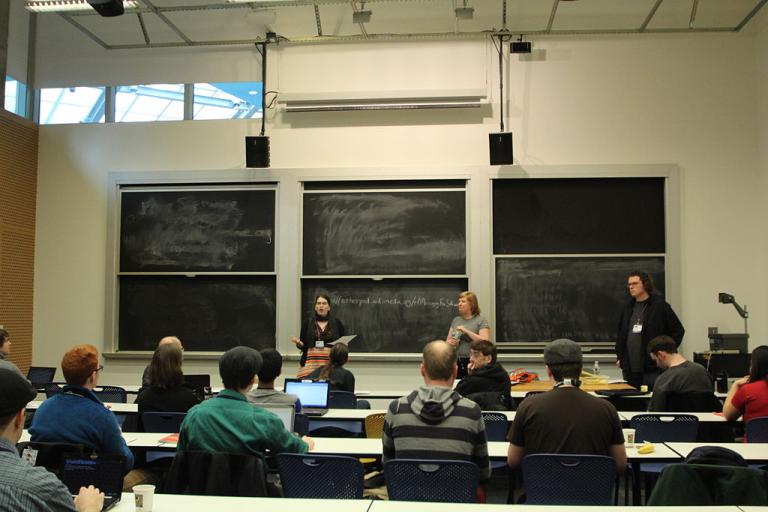
image: a generic university classroom. “LibrePlanet 2014 27” by Lionel Allorge – Own work. Licensed under CC BY-SA 3.0 via Wikimedia Commons – http://commons.wikimedia.org/wiki/File:LibrePlanet_2014_27.jpg#mediaviewer/File:LibrePlanet_2014_27.jpg
Previous Post

October 1, 2016
Stray thought on free tampons
Next Post

October 3, 2016 Is Kim Kardashian white?
Browse Our Archives
Select a Category Actuarial/Retirement Issues Politics Uncategorized
Select a Month October 2026 September 2026 August 2026 July 2026 June 2026 April 2026 March 2026 February 2026 January 2026 December 2025 November 2025 October 2025 July 2025 June 2025 May 2025 April 2025 March 2025 February 2025 January 2025 December 2024 November 2024 October 2024 September 2024 August 2024 July 2024 June 2024 May 2024 April 2024 March 2024 February 2024 December 2023 November 2023 October 2023 September 2023 August 2023 July 2023 December 2022 September 2022 August 2022 July 2022 June 2022 May 2022 February 2022 January 2022 December 2021 August 2021 June 2021 April 2021 February 2021 January 2021 December 2020 November 2020 October 2020 September 2020 August 2020 July 2020 June 2020 May 2020 April 2020 March 2020 February 2020 January 2020 December 2019 November 2019 October 2019 September 2019 August 2019 July 2019 June 2019 May 2019 April 2019 March 2019 February 2019 January 2019 December 2018 November 2018 October 2018 September 2018 August 2018 July 2018 June 2018 May 2018 April 2018 March 2018 February 2018 January 2018 December 2017 November 2017 October 2017 September 2017 August 2017 July 2017 June 2017 May 2017 April 2017 March 2017 February 2017 January 2017 December 2016 November 2016 October 2016 September 2016 August 2016 July 2016 June 2016 May 2016 April 2016 March 2016 February 2016 January 2016 December 2015 November 2015 October 2015 September 2015 August 2015 July 2015 June 2015 May 2015 April 2015 March 2015 February 2015 January 2015 December 2014 November 2014 October 2014 September 2014 August 2014 July 2014 June 2014 May 2014 April 2014 March 2014 February 2014 January 2014 December 2013 November 2013 October 2013 September 2013 August 2013 July 2013
Follow Us!
TAKE THE
Religious Wisdom Quiz
What is the Christian teaching about showing hospitality?
Select your answer to see how you score.
Avoid people Close your door Host only friends Welcome strangers
Related posts from Jane the Actuary

Oh, heck, let's criticize "free college" in detail
The Great Guardianship/Financial Aid Scandal of 2019 (or...

How much is a grad student worth?

Affirmative-Action Rhodes Scholarships?
TRENDING AT PATHEOS Catholic

Jesus explicitly mentions the book of Jonah twice, but he retells the...

Peggy Sue Got Married: Coppola’s Always Been Like...
I enjoyed Megalopolis (2024). It’s a mess, but I enjoyed it. The...

My dissertation The Place of Mysticism in the Late Middle Ages concerns...

God and the Contingency of This World
The great Catholic philosopher Aquinas and the great Lutheran philosopher Leibniz developed...

Pope Francis and The Devil – A Pagan...
According to his private diaries, Pope Francis saw visions of the devil...

Rock N' Roll-- Morphing into/for a New Generation...
Well, should we be grateful, or is rock n' roll just dead? ...
view all Catholic blogs
Ad-Free & Subscriber Log-In Subscription Support
- About Us
- 2026 Calendar
- Videos
- Podcasts
- Library of World Religions
- Faith In Media Tracker
- Advertise With Us
- Write for Us
- Privacy Policy
- Terms of Service
- Do Not Sell My Data
- Contact Us
- Radiant Digital
- Manage Newsletter Subscriptions
- Unsubscribe From Notifications
- Sitemap
Copyright 2008-2026, Patheos, part of the Radiant Digital network of media brands. All rights reserved.
Subscription Support Ad-Free & Subscriber Log-In
Follow Patheos