
BuddhistCatholicContemplativeEvangelicalGeneral ChristianHinduJewishLatter-day SaintMuslimNew VisionsProgressive Christian
Beliefs
- Buddhist
- Catholic
- Contemplative
- Evangelical
- General Christian
- Hindu
- Jewish
- Latter-day Saint
- More Voices
- Muslim
- New Visions
- Pagan
- Progressive Christian
Topics
- Religion News
- Food and Religion
- Sports and Religion
- Religious Art
- Religious Music and Entertainment
- Religious Events
- History and Religion
- Style and Religion
- Politics and Religion
- Women in Religion
- Recreation Outdoors and Religion
- Business Finance and Religion
- Careers Workplace and Religion
- Education and Religion
- Family Parenting and Religion
- Health Fitness and Religion
- Home and Religion
- Relationships and Religion
- Technology and Religion
- Travel and Religion
Columnists
- Buddhist Columnists
- Business Finance and Religion Columnists
- Careers Workplace and Religion Columnists
- Catholic Columnists
- Contemplative Columnists
- Education and Religion Columnists
- Evangelists Columnists
- Family Parenting and Religion Columnists
- General Christian Columnists
- Health Fitness and Religion Columnists
- Hindu Columnists
- History and Religion Columnists
- Home and Religion Columnists
- Jewish Columnists
- More Voices Columnists
- Latter Day Columnists
- Muslim Columnists
- New Visions Columnists
- Nonreligious Columnists
- Pagan Columnists
- Politics and Religion Columnists
- Progressive Columnists
- Recreation Outdoors and Religion Columnists
- Relationships and Religion Columnists
- Religion News Columnists
- Religious Art Columnists
- Religious Events Columnists
- Religious Music and Entertainment Columnists
- Sports and Religion Columnists
- Style and Religion Columnists
- Technology and Religion Columnists
- Travel and Religion Columnists
- Women in Religion Columnists
Resource Library
- 2026 Calendar
- Library of World Religions
- The 100 Most Holy Places on Earth
- Patheos Answers
- Podcasts
- Videos
- Faith Leaders Database
- Anglican Episcopalian
- Bahai
- Baptist
- Buddhism
- Christianity
- Confucianism
- Eastern Orthodoxy
- Hinduism
- Holiness and Pentecostal
- ISKCON
- Islam
- Judaism
- Lutheran
- Methodist
- The Church of Jesus Christ of Latter-day Saints
- New Age
- Paganism
- Presbytarian and Reformed
- Protestantism
- Religion Behind the Scenes
- Roman Catholic
- Scientology
- Shia Islam
- Sikhism
- Sufism
- Sunni Islam
- Taoism
- Zen
- See all religions
Research Tools
 Ad-Free & Subscriber Log-In Subscription Support
Ad-Free & Subscriber Log-In Subscription Support
Follow Patheos 

- Trending:
- Forgiveness
- |
- Marriage
- |
- Consciousness
- |
- Death Penalty
- |
- Election
- |
- Halloween

- Home
- Catholic
- Politics and Religion
- Mosel Valley
Mosel Valley
Last updated on: July 10, 2016 at 12:30 pm by Jane the Actuary
Mosel Valley 2016-07-10T12:30:30-06:00 Jane the Actuary
Patheos Explore the world's faith through different perspectives on religion and spirituality! Patheos has the views of the prevalent religions and spiritualities of the world.
Onward to Germany!
Our first stop was Winningen, a small town on the Moselle River just outside of Koblenz. We arrived there on Friday, after a stop in Antwerp, intended as a lunchtime stop, only moderately out-of-the-way but an opportunity for the kids to have visited another country. We didn’t see an awful lot in Antwerp, but parked just outside the city center, visited the impressive cathedral, ate doners for lunch, and continued on our way – and got trapped in rush hour/construction traffic.
The cathedral is really quite nice. Two noteworthy aspects to it: first, its history, having been built in the thirteenth century, then severely damaged by fire and rebuilt, then looted by Calvinists during the reformation, retaken by Catholics and re-furnished (with, then, multiple Rubens paintings), then looted by French revolutionaries (because the city was then part of France) and slated to be demolished but saved by bureaucrats who either stalled for time or just weren’t competent enough to get the demolition started (I wasn’t sure which) before the government changed again. Second, the cathedral did charge a modest admission charge and presented itself as a tourist attraction, but in both the printed materials, and with the way the cathedral was laid out, there was a continual invitation to prayer – and it was a Holy Door; the door itself was a side entrance that led to a section of the cathedral specially set aside for the purpose and, as we passed by after having toured and eaten lunch, we were invited in and invited to confession with an English-speaking (Indian) priest.
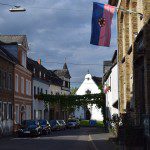
Our detour, however, meant that we arrived in Winningen with time to do little other than have a late dinner and settle in. The town itself, though, is cute as a button. Really, with half-timbered houses, and stone houses, and narrow streets, and grape vines all along the hillside and even on sides of houses and on trellises above the streets. It’s so cute you just want to pinch yourself. There are, I think I read somewhere, 3,000 inhabitants, and it has a fair number of restaurants and two bakeries and a small mom-and-pop type shop, but the larger grocery stores are all one town over.
Saturday we decided to combine a hike in the surrounding vineyard area, in the morning, with a drive over to Koblenz in the afternoon. As it happens, Koblenz isn’t a particularly remarkable town (it was bombed severely in the war and much of it was rebuilt fairly utilitarianly) but it is the site of the “Deutsches Eck,” a German patriotic monument from the time of unification, with a giant Kaiser Wilhelm, and, along the riverfront, all the Koblenzers were holding their equivalent to neighborhood garage sales, with people selling things at tables lined up. I thought at first that the wares might have been antiques or other interesting items, but, no, it was just the same sort of “one man’s trash is another man’s treasure” as at a typical American garage sale.
Sunday started with church. In a reversal from the typical Bavarian town, rather than the Catholic church at the center and a Lutheran church as an afterthought, here it’s the Lutheran church at the town center – a circa 1200 building which became Lutheran when the town did, during the Reformation – and the relatively newer Catholic church at the edge of town (though everything is relative – the town hasn’t grown much, and “relatively newer” means built in the 1850s). To a degree more extreme than I’d seen elsewhere, mass was the province of the elderly; we were the only family, and really there was only one other person under age 60 or so. Perhaps, since this was a combined parish with multiple other towns, the families attend elsewhere, or perhaps Winningen is itself relatively old in its population, or, most likely, it’s just a matter of families simply not attending mass or even identifying as Catholics.
Anyway, afterwards we went to a site that doesn’t appear in typical tourist guides: the museum of the government bunkers. The Rhine River valley is not far from Bonn, and just north of Koblenz is a mountainy, or at least hilly area, so when the government was looking about for a site for their bunkers, they settled on a 16 km stretch of tunnel, intended for a railroad line but never used for that purpose. During World War II it was used as an underground munitions factory, then abandoned again.
The original bunkers were huge – space for 3,000 people to live and work for 30 days in the case of a nuclear attack, including the top levels of government and other officials, with serious amounts of concrete protecting the complex, and doors able to close automatically in 10 seconds. We saw a decontamination room, the chancellor’s bedroom (distinguished from all the other sleeping quarters only by the fact that there was one standard-issue army bed rather than 4 sets of bunk beds), a war room with the magnet map and magnets for planning troop movements (as if there would be any troops left in the case of World War III, but I suppose the idea was that the government would take refuge there in the case of a threat of nuclear attack even if Soviet troops moved in in a conventional war). We saw storage rooms, a clinic with an operation room, and a room with TV cameras for the chancellor-in-hiding to use in giving talks to the German people. And we saw a communications room. The tour guide asked the tour group whether anyone came from the local towns, and then asked that local to describe the town – small, rural – and tell the group what the area code was and how many towns shared the area code. Turns out, a very small area had this area code because the largest number of the associated phone numbers were those of the bunker complex, and that local had never known this. (Now, there are many more area codes, and they vary in length – large cities have two digits, smaller regions have four – so it’s not quite the same as it would be in the US but it’s still an indicator of the magnitude of the complex.)
All this was intended to be top secret, but you won’t be surprised to learn that the STASI knew everything about it. Some materials suggested that the government tried to turn a bug into a feature by considering that, if the Reds new about it, they likewise knew about their seriousness in fighting back in the case of an attack. Here’s a funny little tidbit: the museum is run by volunteers from the community who continue to research its history. Much of the details are locked away as classified information – but researchers discovered that they could uncover its history, for instance the particulars of the NATO exercises, by going to the STASI files, which have been fully opened to the public.
The complex was in active use until the end of the Cold War, with biennial military exercises involving all of NATO from 1966 until 1987, but the bunkers, and their furnishings and their technology were never updated. After the Cold War, shockingly, in 1997, the government made the decision that they no longer needed the complex, and further decided that it should be wholly demolished, and returned to its original, empty-tunnel state, and the demolition work was nearly wholly complete when they agreed in 2001 to create a museum out of the final, undemolished bit; hence, many of the rooms were recreations of the originals, previously in other locations in the complex.
Way, way cool, and when we get all our pictures loaded on at home I will upload these to share with readers.
So that was Sunday.
Monday was Mosel Valley day. In the morning, we toured Burg Eltz. The Rick Steeves guidebook cites this as his favorite castle in all of Europe (this guidebook is unlike any I’ve used before – it’s very selective and opinionated, and written in the first person as if from Rick Steeves himself, though it’s not clear how much is his opinions vs. that of the various contributors within his Empire), and, indeed, for its type it was pretty good – “its type” being, not a palace like Neuschwanstein, but a true fortress, in the hands of the same noble family as when it was founded. The tour only covered a small portion of the castle, as seems to always be the case, but the rooms were very interesting, and the story that there were three branches to the family, each with their own part of the castle, and one common room where they met to sort out their disagreements.
We ate lunch at the castle café/cafeteria, with the usual assortment of wurst, then continued on to a small town to walk around and climb to a castle ruin for a panoramic view, then to an indoor pool to relax for a while to end the day.
Tuesday was Trier, to see such Roman monuments as the Porta Nigra (the remaining city gate), the cathedral (the oldest part of which was initiated by Constantine himself, and which houses the “Holy Robe” brought back from the Holy Land by Helena herself), the imperial basilica (originally the imperial palace, then, after multiple uses, now a Lutheran church), and the amphitheater, each of which have various superlatives (“oldest in Germany/outside Rome/etc.) attached to them. (Lesson learned: we got the Saver Card, which covers admission to two sites and the museum, and, in hindsight, would have chosen the Imperial Baths over the Amphitheater, both because the latter is a further walk than we had thought, and because there’s not really that much to see.) We also looked at the Archeological Museum, though annoyingly the most interesting section and the main draw, was closed off. Grrr. We then took a 15 minute detour to drive into Luxembourg, just because, got off the highway at the first exit and walked around the first town. Turns out it was fairly quiet – oddly quiet, with all the shops closed and the restaurants, seemingly sparse even in the town center, very quiet. So we turned around and came home, rather than having dinner there as we had originally thought.
Wednesday was Rhine Valley day. We started with a Rhine cruise, that is, one hour from Bacharach to St. Goar, then an immediate return – which was pleasant and scenic, and, happily not too warm, not too cold. We then wandered around Bacharach, with a hike along a part of the partially-surviving city walls. Rick Steeves’ opinions are starting to grate on me, but his recommendation of the town as nice to walk around was a good one, thought the restaurant listed among his recommendations was a disappointment.
We then, at the end of the afternoon, drove the few minutes up to St. Goar to the Rheinfels castle ruin. Originally a huge castle, it survived the maurading French who destroyed so many castles in the late 1600s, withstanding a siege, but then, after ultimately surrendering to the French, was destroyed in the aftermath of the French revolution by the revolutionary army. What remains, though, is still substantial, and, unlike the typical castle experience, you don’t need a tour but are just given a map and the opportunity to explore, including various underground tunnels which require flashlights (Rick Steeves warned us to take a flashlight, so we did – that is, my son’s flashlight – but the light was dim and supplemented by the iPhone flashlights). This was a huge, huge hit with the kids, who kept saying, “they’d never let you do this in the United States!”
So that was Winningen, which, in addition to being cute as a button, was also fairly central, with easy access to the Mosel and the Rhine, and a reasonable drive to Trier (1 hour, 15 minutes) because it’s close to the highway.
Previous Post

June 30, 2016
The Netherlands
Next Post
July 10, 2016 Bloggy request: the parish nurse?
Browse Our Archives
Select a Category Actuarial/Retirement Issues Politics Uncategorized
Select a Month September 2026 August 2026 July 2026 June 2026 April 2026 March 2026 February 2026 January 2026 December 2025 November 2025 October 2025 July 2025 June 2025 May 2025 April 2025 March 2025 February 2025 January 2025 December 2024 November 2024 October 2024 September 2024 August 2024 July 2024 June 2024 May 2024 April 2024 March 2024 February 2024 December 2023 November 2023 October 2023 September 2023 August 2023 July 2023 December 2022 September 2022 August 2022 July 2022 June 2022 May 2022 February 2022 January 2022 December 2021 August 2021 June 2021 April 2021 February 2021 January 2021 December 2020 November 2020 October 2020 September 2020 August 2020 July 2020 June 2020 May 2020 April 2020 March 2020 February 2020 January 2020 December 2019 November 2019 October 2019 September 2019 August 2019 July 2019 June 2019 May 2019 April 2019 March 2019 February 2019 January 2019 December 2018 November 2018 October 2018 September 2018 August 2018 July 2018 June 2018 May 2018 April 2018 March 2018 February 2018 January 2018 December 2017 November 2017 October 2017 September 2017 August 2017 July 2017 June 2017 May 2017 April 2017 March 2017 February 2017 January 2017 December 2016 November 2016 October 2016 September 2016 August 2016 July 2016 June 2016 May 2016 April 2016 March 2016 February 2016 January 2016 December 2015 November 2015 October 2015 September 2015 August 2015 July 2015 June 2015 May 2015 April 2015 March 2015 February 2015 January 2015 December 2014 November 2014 October 2014 September 2014 August 2014 July 2014 June 2014 May 2014 April 2014 March 2014 February 2014 January 2014 December 2013 November 2013 October 2013 September 2013 August 2013 July 2013
Follow Us!
TAKE THE
Religious Wisdom Quiz
What does the Bible say about parents and children?
Select your answer to see how you score.
Fathers, do not provoke your children Let them do as they wish Spoil your children Never instruct
Related posts from Jane the Actuary
Winningen, Mosel Valley, Germany - so cute you...
Camden Market + Canal Boats, London

Lower Marsh Street, Waterloo, London

Vacation photos, part 2: The Dokumentazionsstatte Regierungsbunker
TRENDING AT PATHEOS Catholic

In one sense walking into Westminster Abbey is like walking down the...

'Super Scam Me' Exposes AI Jon Bon Jovi...
Leslie Pickett believed she was in a relationship with Jon Bon Jovi....

The Brazilian Remake of Kendricks' 'Flywheel' Opens in...
“Flywheel,” the story that launched the Kendrick Brothers’ filmmaking career is getting...

The Dangers of Gradual Accommodation (Winking at Sin)
Recently, the “law of gradualness” resurfaced during the opening of a weeklong,...

The Iron Gates and the Lion of the...
Yesterday, I didn't finish my report about, well, yesterday. So I'll...

The Image: On the Horror of Capitalism and...
The Image Then went the Pharisees, and took counsel how they might...
view all Catholic blogs
Ad-Free & Subscriber Log-In Subscription Support
- About Us
- 2026 Calendar
- Videos
- Podcasts
- Library of World Religions
- Faith In Media Tracker
- Advertise With Us
- Write for Us
- Privacy Policy
- Terms of Service
- Do Not Sell My Data
- Contact Us
- Radiant Digital
- Manage Newsletter Subscriptions
- Unsubscribe From Notifications
- Sitemap
Copyright 2008-2026, Patheos. All rights reserved.
Subscription Support Ad-Free & Subscriber Log-In
Follow Patheos