
BuddhistCatholicContemplativeEvangelicalGeneral ChristianHinduJewishLatter-day SaintMuslimNew VisionsProgressive Christian
Beliefs
- Buddhist
- Catholic
- Contemplative
- Evangelical
- General Christian
- Hindu
- Jewish
- Latter-day Saint
- More Voices
- Muslim
- New Visions
- Pagan
- Progressive Christian
Topics
- Religion News
- Food and Religion
- Sports and Religion
- Religious Art
- Religious Music and Entertainment
- Religious Events
- History and Religion
- Style and Religion
- Politics and Religion
- Women in Religion
- Recreation Outdoors and Religion
- Business Finance and Religion
- Careers Workplace and Religion
- Education and Religion
- Family Parenting and Religion
- Health Fitness and Religion
- Home and Religion
- Relationships and Religion
- Technology and Religion
- Travel and Religion
Columnists
- Buddhist Columnists
- Business Finance and Religion Columnists
- Careers Workplace and Religion Columnists
- Catholic Columnists
- Contemplative Columnists
- Education and Religion Columnists
- Evangelists Columnists
- Family Parenting and Religion Columnists
- General Christian Columnists
- Health Fitness and Religion Columnists
- Hindu Columnists
- History and Religion Columnists
- Home and Religion Columnists
- Jewish Columnists
- More Voices Columnists
- Latter Day Columnists
- Muslim Columnists
- New Visions Columnists
- Nonreligious Columnists
- Pagan Columnists
- Politics and Religion Columnists
- Progressive Columnists
- Recreation Outdoors and Religion Columnists
- Relationships and Religion Columnists
- Religion News Columnists
- Religious Art Columnists
- Religious Events Columnists
- Religious Music and Entertainment Columnists
- Sports and Religion Columnists
- Style and Religion Columnists
- Technology and Religion Columnists
- Travel and Religion Columnists
- Women in Religion Columnists
Resource Library
- 2026 Calendar
- Library of World Religions
- The 100 Most Holy Places on Earth
- Patheos Answers
- Podcasts
- Videos
- Faith Leaders Database
- Anglican Episcopalian
- Bahai
- Baptist
- Buddhism
- Christianity
- Confucianism
- Eastern Orthodoxy
- Hinduism
- Holiness and Pentecostal
- ISKCON
- Islam
- Judaism
- Lutheran
- Methodist
- The Church of Jesus Christ of Latter-day Saints
- New Age
- Paganism
- Presbytarian and Reformed
- Protestantism
- Religion Behind the Scenes
- Roman Catholic
- Scientology
- Shia Islam
- Sikhism
- Sufism
- Sunni Islam
- Taoism
- Zen
- See all religions
Research Tools
 Ad-Free & Subscriber Log-In Subscription Support
Ad-Free & Subscriber Log-In Subscription Support
Follow Patheos 

- Trending:
- Forgiveness
- |
- Marriage
- |
- Consciousness
- |
- Death Penalty
- |
- Election
- |
- Halloween

- Home
- Catholic
- Politics and Religion
- Women deacons? Um, why?
Women deacons? Um, why?
Last updated on: May 13, 2016 at 1:44 pm by Jane the Actuary
Women deacons? Um, why? 2016-05-13T13:44:11-06:00 Jane the Actuary
Patheos Explore the world's faith through different perspectives on religion and spirituality! Patheos has the views of the prevalent religions and spiritualities of the world.
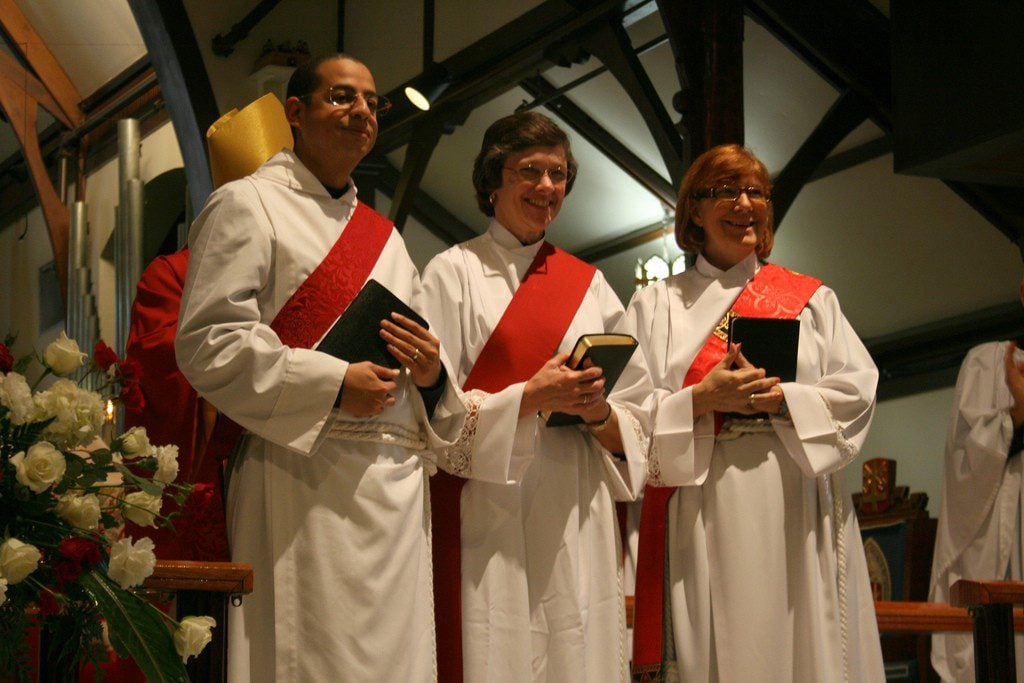
Yes, everyone was in a writing frenzy about suggestions that the Pope would permit the ordination of women as deacons.
Consider the “Deacon couple” — they take the classes together, and they both are acknowledged in the listing of staff in the church bulletin, and both are typically involved in the various church ministries, even though only he is formally ordained, and only he had a title. Would it be useful to have a way of recognizing and commissioning the female halves of such couples? Yes, of course.
But that doesn’t seem to be what’s under discussion.
Rather, what advocates of female deacons seem to want is a formal, “ordained” role for “professional” female church staff. And, really, the same issue is true for male, non-priest staff, such as a director of youth ministry, or a pastoral associate of whichever sex.
This morning, Aleteia published the full transcript of Pope’s words on this topic. One bit that’s noteworthy is that the references are to “consecrated women,” though the work that’s described that they do — the questioner says, “they teach catechesis, accompany the sick and dying, distribute Communion, and in many countries lead the common prayers in the absence of priests, and in those circumstances deliver the homily” — fits better with the work of women (and men) involved in their local parishes. And the further issue is that of “inclusion” and “need for a greater role of women in decision-making positions in the Church” – neither of which really seem to fit with the permanent diaconate, at least as it functions in the United States (perhaps elsewhere deacons are “professionals”/employees; I don’t know).
What would be of genuine value, it seems to me, is some sort of intermediate status: a sort of commissioning that’s not ordination per se, but a recognition by the community. In a way, this would be a very Protestant approach to the issue, where, it seems to me, ordination is a sort of commissioning. We’d just need a suitable title. Any thoughts?
(I wrote about this a long time ago, back when I was first dipping my toes into writing about “churchy” topics.)
Let’s back up a bit. I have 20-odd chrome tabs open right now, and need to close at least some of them before my lunch break ends. Here are some news sources/commentary on the subject.
Here’s what other Patheos writers are saying:
Fr. Dwight Longnecker’s article, “Catholic Women Deacons? Why Not?” answers the rhetorical question of his title this way:
Do we require women to be ordained so that they might have the authority to administer the church’s charitable work? The splendid work of our teaching and nursing sisters precludes the need. Women are already administering the church’s charitable work effectively at every level. Do we need deaconesses to be diocesan chancellors, school principals, parish pastoral associates, directors of faith formation, Vatican administrators, professional consultants, diplomats, journalists, and financial advisors? No. Plenty of women already fulfill these roles. Do we need women to be ordained as deaconesses to be spiritual directors, theologians, cultural activists, broadcasters, evangelists, writers and scholars? No. We have a growing number of women already doing this.
The only reason, therefore, to have deaconesses is to include women in the ranks of the clergy, but when the need is to de-clericalize the church and empower the laity, isn’t it counter productive to add yet another layer of clergy to the church? Furthermore, doesn’t it send the wrong signal to the women of the world that the only way a Catholic woman can really be important to the church is to assume a job that has traditionally been reserved to men? Doesn’t it also send a message to all laypeople that they are not bona fide disciples of Jesus Christ unless they have become a member of the clerical caste?
(One tab closed.)
Dave Armstrong addresses the concern that liberals would, if the diaconate were opened to women, use this as a wedge for their larger goal of female priests:
The so-called “progressives” would, of course, seek to exploit it, as they do everything else for their nefarious ends (as we massively see regarding Amoris Laetitia), but that’s a whole ‘nother discussion. [see fellow apologist Scott Eric Alt’s article on this very thing]
Liberals always try to exploit everything. They do that with supposedly finding permissible sodomy in the Bible, with Vatican II, with Amoris Laetitia [as well as women priests]. This will always be the case. I don’t see why that should stop us from believing or putting into practice something we deem to be proper and helpful (if indeed this is determined to be a good thing): just because they will then try to distort what happened and use it for their empty-headed goals.
Of course it is a “stalking horse,” for liberals. I’m saying that their predictable seeking to co-opt something for modernist / heterodox ends is not in and of itself a reason to rule anything out, since every good thing is distorted, inside the Church and outside it.
(Second tab closed.)
The Washington Post has an article on the subject, if you haven’t used up your free clicks. (I’m perilously close.) It fills in the context that the Pope was indeed speaking to an international conference of nuns, 900 women from the International Union of Superiors General, so it makes sense that his comments reference consecrated women. The article also cites a theologian:
“I can’t underscore enough how groundbreaking this is for the Church,” Boston College theologian James Bretzke wrote in an e-mail. “If women can be ordained as deacons, then this is going to weaken – not destroy – but weaken significantly the argument that women absolutely are incapable of being ordained as priests. So this is opening more than a crack in the door.”
(Third tab closed.)
And for the liberal Catholic view, Father James Martin’s facebook statements:
Women deacons would be able to baptize, preside at marriages and funerals, and preach during various liturgies. Their preaching would mean that the church would finally be able to hear, from the pulpit, the experience of over half its members.
What kinds of things could women deacons preach on? Everything of course, like male deacons! But imagine them preaching on the following: The Annunciation, the Visitation, the Nativity, Mary Magdalene, Mary and Martha, the Woman at the Well, the Syrophoenician woman, the appearance of the Risen Christ to Mary Magdalene, and on and on. Women deacons could preach on anything, like male deacons, but how I long to hear them preach on Jesus and on women in the New Testament. (I’d love to hear them preach on men in the Bible as well!)
(I find this odd — that a supposedly-egalitarian man would imagine women having a special gift for preaching on “women’s” topics, and the idea that your ability to preach is limited by your sex, and, by implication, the idea that men are unable to preach in a meaningful way to women.)
And, afterwards, he says
note Pope Francis’s parameters for preaching. But even with these parameters, the move is hugely significant. We are talking about reopening the discussion about ordaining women. And to reiterate, a deacon presides at baptisms, funerals and weddings, all occasions of preaching.
Now, here’s the thing about preaching: just because a person has a gift for many kinds of ministry, whether it’s paid or as a volunteer, be it working with youth, the sick or homebound, leading Bible studies or adult education groups, organizing the social or liturgical or charitable ministries of the parish — does not mean that this individual has a gift or a calling for leading liturgy, or for preaching. (And, to be honest, many people who think they have a gift for leading liturgy, who speak with earnest voices, don’t, actually.) And I’d rather not get into thinking of preaching at Mass or other liturgies as a “prize” for those who have earned it by their service in other roles.
So there you have it — and now lunch break’s over.
UPDATE: OK, a few more thoughts:
The issue isn’t confined to the Catholic Church. Here’s the big picture: it’s important to recognize people for the work they do, and the value of their contributions. This matters whether it’s providing formal thank-you’s to Scout leaders, and popcorn/cookie workers, or volunteers in professional organizations (interestingly, just today the Society of Actuaries sent around a note that they’re starting a formal recognition program for its volunteers), or at work. And the permanent diaconate has functioned as a way of formally recognizing men who dedicate a lot of time to their local parish communities, and giving them a formal role and “credential” — but there’s nothing equivalent for women. And there should be.
Image: Episcopalian deacons, from a flickr album by user Episcopal Diocese of Southwest Florida; https://www.flickr.com/photos/episcopalflorida/11309076544
Previous Post

May 13, 2016
Why the Trump nomination won't tear the GOP apart
Next Post

May 15, 2016 The transgender locker room "guidance", power, and punishment
Browse Our Archives
Select a Category Actuarial/Retirement Issues Politics Uncategorized
Select a Month September 2026 August 2026 July 2026 June 2026 April 2026 March 2026 February 2026 January 2026 December 2025 November 2025 October 2025 July 2025 June 2025 May 2025 April 2025 March 2025 February 2025 January 2025 December 2024 November 2024 October 2024 September 2024 August 2024 July 2024 June 2024 May 2024 April 2024 March 2024 February 2024 December 2023 November 2023 October 2023 September 2023 August 2023 July 2023 December 2022 September 2022 August 2022 July 2022 June 2022 May 2022 February 2022 January 2022 December 2021 August 2021 June 2021 April 2021 February 2021 January 2021 December 2020 November 2020 October 2020 September 2020 August 2020 July 2020 June 2020 May 2020 April 2020 March 2020 February 2020 January 2020 December 2019 November 2019 October 2019 September 2019 August 2019 July 2019 June 2019 May 2019 April 2019 March 2019 February 2019 January 2019 December 2018 November 2018 October 2018 September 2018 August 2018 July 2018 June 2018 May 2018 April 2018 March 2018 February 2018 January 2018 December 2017 November 2017 October 2017 September 2017 August 2017 July 2017 June 2017 May 2017 April 2017 March 2017 February 2017 January 2017 December 2016 November 2016 October 2016 September 2016 August 2016 July 2016 June 2016 May 2016 April 2016 March 2016 February 2016 January 2016 December 2015 November 2015 October 2015 September 2015 August 2015 July 2015 June 2015 May 2015 April 2015 March 2015 February 2015 January 2015 December 2014 November 2014 October 2014 September 2014 August 2014 July 2014 June 2014 May 2014 April 2014 March 2014 February 2014 January 2014 December 2013 November 2013 October 2013 September 2013 August 2013 July 2013
Follow Us!
TAKE THE
Religious Wisdom Quiz
Who was known for his great strength and long hair?
Select your answer to see how you score.
Peter David Samson Elijah
Related posts from Jane the Actuary


Illinois’ Assisted Suicide Law is, yes, literally deadly

Revising the "Disability [Pride] Flag"

In which I comment on the Supreme Court...
TRENDING AT PATHEOS Catholic

Emotion in Early Christianity by Andrew Crislip
Andrew Crislip’s Emotion in Early Christianity examines an often overlooked dimension of...

16 Spiritual Touchstones for a More Grounded Life
After decades of spiritual study, here are 16 principles I try...

Catholic Evangelization: Sharing Your Faith Every Day
Welcome back to the Graceful Awakening mini-series called, “From Faith to Mission.” ...

The Pillar of the Boatmen: the Ancient Monument...
The Pillar of the Boatmen is a Romano-Gaulish sculpture that dates from...

In one sense walking into Westminster Abbey is like walking down the...

'Super Scam Me' Exposes AI Jon Bon Jovi...
Leslie Pickett believed she was in a relationship with Jon Bon Jovi....
view all Catholic blogs
Ad-Free & Subscriber Log-In Subscription Support
- About Us
- 2026 Calendar
- Videos
- Podcasts
- Library of World Religions
- Faith In Media Tracker
- Advertise With Us
- Write for Us
- Privacy Policy
- Terms of Service
- Do Not Sell My Data
- Contact Us
- Radiant Digital
- Manage Newsletter Subscriptions
- Unsubscribe From Notifications
- Sitemap
Copyright 2008-2026, Patheos. All rights reserved.
Subscription Support Ad-Free & Subscriber Log-In
Follow Patheos