
BuddhistCatholicContemplativeEvangelicalGeneral ChristianHinduJewishLatter-day SaintMuslimNew VisionsProgressive Christian
Beliefs
- Buddhist
- Catholic
- Contemplative
- Evangelical
- General Christian
- Hindu
- Jewish
- Latter-day Saint
- More Voices
- Muslim
- New Visions
- Pagan
- Progressive Christian
Topics
- Religion News
- Food and Religion
- Sports and Religion
- Religious Art
- Religious Music and Entertainment
- Religious Events
- History and Religion
- Style and Religion
- Politics and Religion
- Women in Religion
- Recreation Outdoors and Religion
- Business Finance and Religion
- Careers Workplace and Religion
- Education and Religion
- Family Parenting and Religion
- Health Fitness and Religion
- Home and Religion
- Relationships and Religion
- Technology and Religion
- Travel and Religion
Columnists
- Buddhist Columnists
- Business Finance and Religion Columnists
- Careers Workplace and Religion Columnists
- Catholic Columnists
- Contemplative Columnists
- Education and Religion Columnists
- Evangelists Columnists
- Family Parenting and Religion Columnists
- General Christian Columnists
- Health Fitness and Religion Columnists
- Hindu Columnists
- History and Religion Columnists
- Home and Religion Columnists
- Jewish Columnists
- More Voices Columnists
- Latter Day Columnists
- Muslim Columnists
- New Visions Columnists
- Nonreligious Columnists
- Pagan Columnists
- Politics and Religion Columnists
- Progressive Columnists
- Recreation Outdoors and Religion Columnists
- Relationships and Religion Columnists
- Religion News Columnists
- Religious Art Columnists
- Religious Events Columnists
- Religious Music and Entertainment Columnists
- Sports and Religion Columnists
- Style and Religion Columnists
- Technology and Religion Columnists
- Travel and Religion Columnists
- Women in Religion Columnists
Resource Library
- 2026 Calendar
- Library of World Religions
- The 100 Most Holy Places on Earth
- Patheos Answers
- Podcasts
- Videos
- Faith Leaders Database
- Anglican Episcopalian
- Bahai
- Baptist
- Buddhism
- Christianity
- Confucianism
- Eastern Orthodoxy
- Hinduism
- Holiness and Pentecostal
- ISKCON
- Islam
- Judaism
- Lutheran
- Methodist
- The Church of Jesus Christ of Latter-day Saints
- New Age
- Paganism
- Presbytarian and Reformed
- Protestantism
- Religion Behind the Scenes
- Roman Catholic
- Scientology
- Shia Islam
- Sikhism
- Sufism
- Sunni Islam
- Taoism
- Zen
- See all religions
Research Tools
 Ad-Free & Subscriber Log-In Subscription Support
Ad-Free & Subscriber Log-In Subscription Support
Follow Patheos 

- Trending:
- Forgiveness
- |
- Marriage
- |
- Consciousness
- |
- Death Penalty
- |
- Election
- |
- Halloween

- Home
- Catholic
- Politics and Religion
- What makes poor men unmarriageable?
What makes poor men unmarriageable?
Last updated on: March 14, 2015 at 6:33 pm by Jane the Actuary
What makes poor men unmarriageable? 2015-03-14T18:33:03-06:00 Jane the Actuary
Patheos Explore the world's faith through different perspectives on religion and spirituality! Patheos has the views of the prevalent religions and spiritualities of the world.
Here’s a Ross Douthat column in the New York Times: “For Poorer and Richer.” This is another in the various columnists and bloggers commenting on the new book by Robert Putnam, Our Kids.
Here are a few key paragraphs:
. . . “Our Kids” is attuned to culture’s feedback loops, and it offers grist for social conservatives who suspect it would take a cultural counterrevolution to bring back the stable working class families of an earlier America.
That idea makes some people on the left angry. As they see it, it’s money and only money that Murray’s Fishtown and Putnam’s hometown lack and need. And it’s unchecked capitalism and Republican stinginess, not the sexual revolution, that has devastated working-class society over the last few decades. Fight poverty, redistribute wealth, and you’ll revive family and community — it’s as simple as that.
Their argument gets some things right. The American economy isn’t performing as well as it once did for less-skilled workers. Certain regions — like Putnam’s Ohio — have suffered painfully from deindustrialization. The shift to a service economy has favored women but has made low-skilled men less marriageable. The decline of unions has weakened professional stability and bargaining power for some workers.
And yet, for all these disturbances and shifts, lower-income Americans have more money, experience less poverty, and receive far more safety-net support than their grandparents ever did. Over all, material conditions have improved, not worsened, across the period when their communities have come apart.
Now, I’ve read leftist/progressive authors often enough to agree that Douthat characterizes their prescription correctly. In their telling, working class men have become unmarriageable because they can’t find jobs, simple as that. Ironically, these authors, recognizing this problem, have only minimal interest in actually helping young men — they’re pretty incidental to the project of helping single and teen mothers or increasing welfare benefits. I suppose they’ve just written off the men. (And it’s not about redistribution or such proposals as a “minimum income” if that doesn’t actually result in these men holding jobs of some kind or another.)
But let’s break apart the issue: there are two components of this “unmarriageability”: first, the bigger question of whether men contribute to the household, and, second, whether their presence actually makes the financial situation worse. And, in fact, for women without a job, getting married to a man who is also unemployed takes their welfare benefits away (doesn’t it?), without bring any income into the family. Even if he moves in without the marriage license that would eliminate her eligibility, he won’t be paying his own way. But men who work at low-paying jobs are likewise considered to be “unmarriageable”; the requirement seems to be that he be able to measureably improve her financial situation over and above what she can get from welfare or from her own job (supplemented or not by additional welfare money, like food stamps).
Fundamentally, this seems to be saying that the only use of a man is as a financial contributor to the household — both in the opinion of progressives and of poor women themselves.
And this just feels wrong. Is there not, among poor women, the same desire for companionship as motivates middle-class women to marry, even when they don’t need their husbands’ financial contribution? Consider the futuristic scenario in which anyone who chooses not to work, doesn’t have to, because automation will have changed the very concept of work: do we imagine that in that scenario, no one will bother marrying?
No, of course not. Because the unmarriageability of poor men extends beyond the mere fact that they are unemployed. I read a book quite a while ago called “Promises I Can Keep” about poor single mothers (this was right when I started blogging and it was one of my few kindle book purchases, which meant that I didnt’ get very far in summarizing the book after I read it, as I’m simply not accustomed to kindle-reading, but here’s my summary, parts one and two, for what it’s worth), and the stories these women told — well, you know how women often joke that they have four boys, rather than three, because their husband is just another kid, because he likes his “toys” (e.g., the Lego Tower Bridge from last Christmas)? Well, these women considered the men in their lives, whether dating relationships (which as often as not included children), or live-ins, to be as much trouble as their actual children. It’s not just a matter of whether they contributed, or had the potential to contribute, to the household financially, but that didn’t contribute in any way at all (not with the household chores, not with the childcare), and they were more trouble than they were worth, if they spent their time drinking, gambling, partying, in gangs, or just plain cheating on them.
A while back I read another book, specificially on black families and the “Great Migration” from southern sharecropping to northern cities, which essentially portrayed poor black families as, for the most part, troubled, even in the pre-Great Society, pre-welfare for single mothers days, not the romanticized Logan family of Roll of Thunder, Hear My Cry. Essentially, poor black men were just as unmarriageable then, but poor black women married them anyway.
So what happened? Did the rise of the welfare state and changing cultural norms free women from men they didn’t want to have anything to do with, anyway?
One last thought: here’s a graph on changing marriage rates from the National Center for Family and Marriage Research.
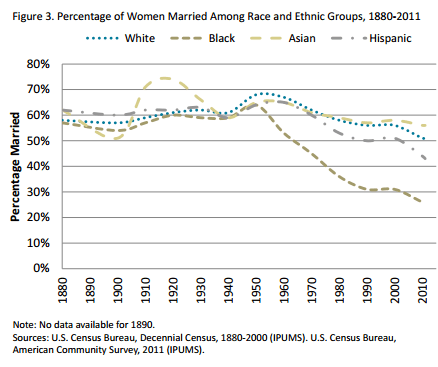
This graph shows that marriage rates have been dropping since the late 1940s and levelled off in the mid-80s. (I tried to find the data itself, to better identify the years and produce something more scaleable, but failed to find year-over-year data source.) There is no simple drop-off at the start of the War on Poverty; just the same rate of decrease as before. What happened, then? I don’t know.
(And, yes, I went from talking about poor men, in general, to black men — but the decline in marriage is similar for both groups, and I was able to find data on the latter more easily.)
Previous Post

March 14, 2015
On getting Catholics to sing: a question
Next Post

March 15, 2015 Is math optional? Or, should we have O and A levels, a Bac or an Abitur?
Browse Our Archives
Select a Category Actuarial/Retirement Issues Politics Uncategorized
Select a Month September 2026 August 2026 July 2026 June 2026 April 2026 March 2026 February 2026 January 2026 December 2025 November 2025 October 2025 July 2025 June 2025 May 2025 April 2025 March 2025 February 2025 January 2025 December 2024 November 2024 October 2024 September 2024 August 2024 July 2024 June 2024 May 2024 April 2024 March 2024 February 2024 December 2023 November 2023 October 2023 September 2023 August 2023 July 2023 December 2022 September 2022 August 2022 July 2022 June 2022 May 2022 February 2022 January 2022 December 2021 August 2021 June 2021 April 2021 February 2021 January 2021 December 2020 November 2020 October 2020 September 2020 August 2020 July 2020 June 2020 May 2020 April 2020 March 2020 February 2020 January 2020 December 2019 November 2019 October 2019 September 2019 August 2019 July 2019 June 2019 May 2019 April 2019 March 2019 February 2019 January 2019 December 2018 November 2018 October 2018 September 2018 August 2018 July 2018 June 2018 May 2018 April 2018 March 2018 February 2018 January 2018 December 2017 November 2017 October 2017 September 2017 August 2017 July 2017 June 2017 May 2017 April 2017 March 2017 February 2017 January 2017 December 2016 November 2016 October 2016 September 2016 August 2016 July 2016 June 2016 May 2016 April 2016 March 2016 February 2016 January 2016 December 2015 November 2015 October 2015 September 2015 August 2015 July 2015 June 2015 May 2015 April 2015 March 2015 February 2015 January 2015 December 2014 November 2014 October 2014 September 2014 August 2014 July 2014 June 2014 May 2014 April 2014 March 2014 February 2014 January 2014 December 2013 November 2013 October 2013 September 2013 August 2013 July 2013
Follow Us!
TAKE THE
Religious Wisdom Quiz
What part of the body does the Breastplate of Righteousness protect?
Select your answer to see how you score.
The head The back The stomach The heart
Related posts from Jane the Actuary
The polarization of America, part N: sex and...
Needs vs. Wants, date night edition

Dream-hoarding? Maybe dream-rejecting. Or, Holy Moly, would you...

About the age of majority, anyway
TRENDING AT PATHEOS Catholic

The Iron Gates and the Lion of the...
Yesterday, I didn't finish my report about, well, yesterday. So I'll...

Dolly Parton’s Last Song Wins Dove Award with...
Bluegrass band The Grascals, speaking on the red carpet at the 57th...

The Image: On the Horror of Capitalism and...
The Image Then went the Pharisees, and took counsel how they might...

We are approaching the date of our new American national holiday: October...

Letters on Living the Faith by C.S. Lewis
Most of us met C.S. Lewis as a public intellectual. Mere Christianity....

When Halloween Unmasks Married Hearts
Written by Dr. David K. Ewen from Eternal Truth Bible College Behind...
view all Catholic blogs
Ad-Free & Subscriber Log-In Subscription Support
- About Us
- 2026 Calendar
- Videos
- Podcasts
- Library of World Religions
- Faith In Media Tracker
- Advertise With Us
- Write for Us
- Privacy Policy
- Terms of Service
- Do Not Sell My Data
- Contact Us
- Radiant Digital
- Manage Newsletter Subscriptions
- Unsubscribe From Notifications
- Sitemap
Copyright 2008-2026, Patheos. All rights reserved.
Subscription Support Ad-Free & Subscriber Log-In
Follow Patheos