
BuddhistCatholicContemplativeEvangelicalGeneral ChristianHinduJewishLatter-day SaintMuslimNew VisionsProgressive Christian
Beliefs
- Buddhist
- Catholic
- Contemplative
- Evangelical
- General Christian
- Hindu
- Jewish
- Latter-day Saint
- More Voices
- Muslim
- New Visions
- Pagan
- Progressive Christian
Topics
- Religion News
- Food and Religion
- Sports and Religion
- Religious Art
- Religious Music and Entertainment
- Religious Events
- History and Religion
- Style and Religion
- Politics and Religion
- Women in Religion
- Recreation Outdoors and Religion
- Business Finance and Religion
- Careers Workplace and Religion
- Education and Religion
- Family Parenting and Religion
- Health Fitness and Religion
- Home and Religion
- Relationships and Religion
- Technology and Religion
- Travel and Religion
Columnists
- Buddhist Columnists
- Business Finance and Religion Columnists
- Careers Workplace and Religion Columnists
- Catholic Columnists
- Contemplative Columnists
- Education and Religion Columnists
- Evangelists Columnists
- Family Parenting and Religion Columnists
- General Christian Columnists
- Health Fitness and Religion Columnists
- Hindu Columnists
- History and Religion Columnists
- Home and Religion Columnists
- Jewish Columnists
- More Voices Columnists
- Latter Day Columnists
- Muslim Columnists
- New Visions Columnists
- Nonreligious Columnists
- Pagan Columnists
- Politics and Religion Columnists
- Progressive Columnists
- Recreation Outdoors and Religion Columnists
- Relationships and Religion Columnists
- Religion News Columnists
- Religious Art Columnists
- Religious Events Columnists
- Religious Music and Entertainment Columnists
- Sports and Religion Columnists
- Style and Religion Columnists
- Technology and Religion Columnists
- Travel and Religion Columnists
- Women in Religion Columnists
Resource Library
- 2026 Calendar
- Library of World Religions
- The 100 Most Holy Places on Earth
- Patheos Answers
- Podcasts
- Videos
- Faith Leaders Database
- Anglican Episcopalian
- Bahai
- Baptist
- Buddhism
- Christianity
- Confucianism
- Eastern Orthodoxy
- Hinduism
- Holiness and Pentecostal
- ISKCON
- Islam
- Judaism
- Lutheran
- Methodist
- The Church of Jesus Christ of Latter-day Saints
- New Age
- Paganism
- Presbytarian and Reformed
- Protestantism
- Religion Behind the Scenes
- Roman Catholic
- Scientology
- Shia Islam
- Sikhism
- Sufism
- Sunni Islam
- Taoism
- Zen
- See all religions
Research Tools
 Ad-Free & Subscriber Log-In Subscription Support
Ad-Free & Subscriber Log-In Subscription Support
Follow Patheos 

- Trending:
- Forgiveness
- |
- Marriage
- |
- Consciousness
- |
- Death Penalty
- |
- Election
- |
- Halloween

- Home
- Catholic
- Politics and Religion
- Back from The Mitten: More thoughts about Detroit
Back from The Mitten: More thoughts about Detroit
Last updated on: March 30, 2015 at 7:48 am by Jane the Actuary
Back from The Mitten: More thoughts about Detroit 2015-03-30T07:48:52-06:00 Jane the Actuary
Patheos Explore the world's faith through different perspectives on religion and spirituality! Patheos has the views of the prevalent religions and spiritualities of the world.
First item:
For those of you who don’t do Twitter, a Detroiter (besides the one in the comments) got, er, rather upset that I identified Midtown as a rebranding of the New Center area, so I spent some time trying to figure this out.
I first landed on a Wikipedia map that clearly delineated the neighborhoods/districts and says that everything south of I-94 is “Midtown”; north of there is the New Center area. But this just didn’t seem right to me; that places virtually all the city’s cultural institutions (e.g., Orchestra Hall, the Art Institute and History Museum) in Midtown rather than New Center. And that name just didn’t sound right to me. For a good decade of my life I read the Detroit News daily, and I’ve kept up with my Detroit news (lower case and upper case) since then; I think I’d know what “Midtown” was. And, after all, a definition based on an interstate that didn’t exist when these institutions were being built doesn’t make sense either.
So my husband stumbled upon an article from 2012 that clarifies the mystery to some degree, in an article called, “Would The Real Midtown Please Stand Up?”
There’s a quiet turf war going down in Detroit. Or maybe it’s a capital-intensive neighborhood re-branding campaign. It really depends on who you ask. Whatever you call it, one thing is clear: the area of Detroit that runs along Cass Avenue — from Cass Park to the south and Wayne State to the north — is changing. It isn’t just the rumble of bulldozers clearing ground for huge new projects like the Auburn Building or the much ballyhooed Whole Foods supermarket. It’s the history, the identity of the place, that’s being forgotten. The area once universally known as the Cass Corridor is finding that its memory, its very existence, is being erased, overwritten and systematically re-categorized under the name Midtown.
That being said, I tried to find some older maps of the city, with neighborhoods/districts labelled, that would tell me what area Orchestra Hall was in before the invention of Midtown. Maybe I’ll check the library; even though I’m back home in suburban Chicago, the local history section includes some Detroit items.
Why does it bug me?
Mostly, I think, because “Midtown” just isn’t authentically Detroit. Manhattan has a “midtown” — and an uptown and downtown, presumably initially defined based on “down” and “up” = south and north, or maybe the “up” was a slightly higher/less swampy elevation; I’m not sure. Now, of course, “downtown” simply means “city center” in American English. But “midtown”? It just doesn’t feel, well, Detroit enough.
Second item:
My twitter correspondent insisted that Detroit was truly on its way up, to which I said (judging from this person’s picture) that people have been claiming that since before she was born: the Renaissance Center, the People Mover, the Poletown plant, and, more recently, the Greektown casinos, were all supposed to herald a revival. For a while in the 80s, a warehouse at the edge of Greektown was turned into the sort of venue that was supposed to attract tourists; I remember a fudge shop that hoped to draw customers with its employees making the fudge while singing/chanting some kind of song.
Will this be the time that things really “take”? This newly-rebranded “Midtown” area does seem to be drawing the hipsters who might previously have gone to suburban Ferndale. Will they stick around once they’re no longer young? The Schools of Choice program and the wide availability of charter schools means that the train wreck that is Detroit Public Schools might not be a deal-breaker, but the availability of public services (e.g., police response times) and, of course, general crime rate issues will be a problem.
But Detroit is more than its city center and the people of Detroit consist of more than urban hipsters. It’s simply difficult to fathom what the solution to the depopulated areas is. (And these Detroiters are real Detroiters, and their socioeconomic situation can’t just be subtracted out to measure “how is Detroit doing?”)
In one respect, it’s tempting to say, “demolish the homes as they become abandoned, and hope that the city-center revival spreads outward and inspires a new generation to build on these vacant lots.” And the solution that some Detroit boosters are promoting is urban farming. But it is tremendously difficult to deliver city services to areas that are both poor and very low in density. All of it: police and fire protection, bus service, streetlights, city sewers, road maintenance. (On our drive last week, we passed through two intersections, blinking yellow, with signage that they were being studied for traffic light removal.) Look at a map of a suburban bus system — only a few routes, mostly concentrated on those areas with large apartment complexes — and then consider that Detroit, even before the population crash, was a city of single-family homes, and now a bus system is all the more difficult to sustain. These areas simply cannot be self-supporting in terms of city services, and the denser and the more affluent parts of the city — well, there just aren’t enough of them. Do we just say, “until such time as the city’s population recovers (presuming this happens someday), someone else — the state, the feds — has responsibility for them”?
(By the way: this isn’t an issue for school funding, even though Detroit has serious troubles here too: unlike most areas, money is collected and allocated statewide.)
Third Item:
Detroit is, of course, not the only city to have lost population over time.
Take a look at these tables, compiled from wikipedia and other readily-available data.
Most populous cities in the U.S., 1950, and their population change to 2013
New York City 7%
Chicago -25%
Philadelphia -25%
Los Angeles 97%
Detroit -63%
Baltimore -34%
Cleveland -57%
St. Louis -63%
Washington -18%
Boston -19%
Three cities have had pretty similar drops in population: Detroit, Cleveland, and St. Louis.
So I looked at these three individually:
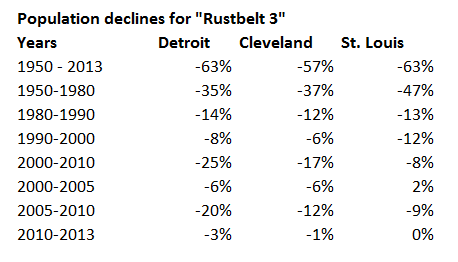
What do you make of this?
In the first place, St. Louis’s population crash happened a bit earlier, as it lost almost half of its population before 1980. Detroit and Cleveland had similar patterns, except that Detroit lost a full fifth of its population quite recently, in the half decade from 2005 – 2010 (after, according to my twitter correspondent, the revival was already underway).
Of course, what I haven’t shown here is that both Cleveland and St. Louis started out at about half the size of Detroit, so that, even if relative declines were similar, the absolute number of abandoned dwellings is greater in Detroit, by far.
In any case, why aren’t we reading reports of the devastation in these two “sister cities” to Detroit? I can make a couple guesses, for now, anyway:
In the first place, a certain portion of the housing, in any case, was destroyed intentionally, in urban renewal-type projects, similar to the demolition of Chicago’s major public housing complexes in favor of fewer units of mixed housing. There were, of course, similar demolitions for interstate highways, new ballparks and parking lots, and so on. (My St. Louis great-grandmother’s childhood home, per census records, is now a freeway.)
And in the second place, to the extent that the housing was multifamily, a city can de-densify in a less noticiable way. Again, my great-grandmother’s home was an alley apartment, 1290 1/2 Palm Street or some such. My mother grew up in a two-flat in the city (yes, they were part of the exodus in the 50s, moving out to a suburb, adjacent to Ferguson, actually). I could imagine that it’s easy for these multifamily buildings to become single-family with a bit of remodeling. But Detroit has a much greater proportion of single-family housing than other cities.
But that only gets you so far. Anyone else know more?
Previous Post

March 27, 2015
Report from The D: it takes more than a Whole Foods to revive a city
Next Post

March 30, 2015 Things I am not writing about
Browse Our Archives
Select a Category Actuarial/Retirement Issues Politics Uncategorized
Select a Month September 2026 August 2026 July 2026 June 2026 April 2026 March 2026 February 2026 January 2026 December 2025 November 2025 October 2025 July 2025 June 2025 May 2025 April 2025 March 2025 February 2025 January 2025 December 2024 November 2024 October 2024 September 2024 August 2024 July 2024 June 2024 May 2024 April 2024 March 2024 February 2024 December 2023 November 2023 October 2023 September 2023 August 2023 July 2023 December 2022 September 2022 August 2022 July 2022 June 2022 May 2022 February 2022 January 2022 December 2021 August 2021 June 2021 April 2021 February 2021 January 2021 December 2020 November 2020 October 2020 September 2020 August 2020 July 2020 June 2020 May 2020 April 2020 March 2020 February 2020 January 2020 December 2019 November 2019 October 2019 September 2019 August 2019 July 2019 June 2019 May 2019 April 2019 March 2019 February 2019 January 2019 December 2018 November 2018 October 2018 September 2018 August 2018 July 2018 June 2018 May 2018 April 2018 March 2018 February 2018 January 2018 December 2017 November 2017 October 2017 September 2017 August 2017 July 2017 June 2017 May 2017 April 2017 March 2017 February 2017 January 2017 December 2016 November 2016 October 2016 September 2016 August 2016 July 2016 June 2016 May 2016 April 2016 March 2016 February 2016 January 2016 December 2015 November 2015 October 2015 September 2015 August 2015 July 2015 June 2015 May 2015 April 2015 March 2015 February 2015 January 2015 December 2014 November 2014 October 2014 September 2014 August 2014 July 2014 June 2014 May 2014 April 2014 March 2014 February 2014 January 2014 December 2013 November 2013 October 2013 September 2013 August 2013 July 2013
Follow Us!
TAKE THE
Religious Wisdom Quiz
Who said, "If I perish, I perish"?
Select your answer to see how you score.
Deborah Hannah Ruth Esther
Related posts from Jane the Actuary

Yes, I am secretly Team Detroit for the...

Why I'm not (planning on) seeing "Detroit"

TRENDING AT PATHEOS Catholic

Catholic Evangelization: Sharing Your Faith Every Day
Welcome back to the Graceful Awakening mini-series called, “From Faith to Mission.” ...

The Pillar of the Boatmen: the Ancient Monument...
The Pillar of the Boatmen is a Romano-Gaulish sculpture that dates from...

In one sense walking into Westminster Abbey is like walking down the...

'Super Scam Me' Exposes AI Jon Bon Jovi...
Leslie Pickett believed she was in a relationship with Jon Bon Jovi....

The Brazilian Remake of Kendricks' 'Flywheel' Opens in...
“Flywheel,” the story that launched the Kendrick Brothers’ filmmaking career is getting...

The Dangers of Gradual Accommodation (Winking at Sin)
Recently, the “law of gradualness” resurfaced during the opening of a weeklong,...
view all Catholic blogs
Ad-Free & Subscriber Log-In Subscription Support
- About Us
- 2026 Calendar
- Videos
- Podcasts
- Library of World Religions
- Faith In Media Tracker
- Advertise With Us
- Write for Us
- Privacy Policy
- Terms of Service
- Do Not Sell My Data
- Contact Us
- Radiant Digital
- Manage Newsletter Subscriptions
- Unsubscribe From Notifications
- Sitemap
Copyright 2008-2026, Patheos. All rights reserved.
Subscription Support Ad-Free & Subscriber Log-In
Follow Patheos