
BuddhistCatholicContemplativeEvangelicalGeneral ChristianHinduJewishLatter-day SaintMuslimNew VisionsProgressive Christian
Beliefs
- Buddhist
- Catholic
- Contemplative
- Evangelical
- General Christian
- Hindu
- Jewish
- Latter-day Saint
- More Voices
- Muslim
- New Visions
- Pagan
- Progressive Christian
Topics
- Religion News
- Food and Religion
- Sports and Religion
- Religious Art
- Religious Music and Entertainment
- Religious Events
- History and Religion
- Style and Religion
- Politics and Religion
- Women in Religion
- Recreation Outdoors and Religion
- Business Finance and Religion
- Careers Workplace and Religion
- Education and Religion
- Family Parenting and Religion
- Health Fitness and Religion
- Home and Religion
- Relationships and Religion
- Technology and Religion
- Travel and Religion
Columnists
- Buddhist Columnists
- Business Finance and Religion Columnists
- Careers Workplace and Religion Columnists
- Catholic Columnists
- Contemplative Columnists
- Education and Religion Columnists
- Evangelists Columnists
- Family Parenting and Religion Columnists
- General Christian Columnists
- Health Fitness and Religion Columnists
- Hindu Columnists
- History and Religion Columnists
- Home and Religion Columnists
- Jewish Columnists
- More Voices Columnists
- Latter Day Columnists
- Muslim Columnists
- New Visions Columnists
- Nonreligious Columnists
- Pagan Columnists
- Politics and Religion Columnists
- Progressive Columnists
- Recreation Outdoors and Religion Columnists
- Relationships and Religion Columnists
- Religion News Columnists
- Religious Art Columnists
- Religious Events Columnists
- Religious Music and Entertainment Columnists
- Sports and Religion Columnists
- Style and Religion Columnists
- Technology and Religion Columnists
- Travel and Religion Columnists
- Women in Religion Columnists
Resource Library
- 2026 Calendar
- Library of World Religions
- The 100 Most Holy Places on Earth
- Patheos Answers
- Podcasts
- Videos
- Faith Leaders Database
- Anglican Episcopalian
- Bahai
- Baptist
- Buddhism
- Christianity
- Confucianism
- Eastern Orthodoxy
- Hinduism
- Holiness and Pentecostal
- ISKCON
- Islam
- Judaism
- Lutheran
- Methodist
- The Church of Jesus Christ of Latter-day Saints
- New Age
- Paganism
- Presbytarian and Reformed
- Protestantism
- Religion Behind the Scenes
- Roman Catholic
- Scientology
- Shia Islam
- Sikhism
- Sufism
- Sunni Islam
- Taoism
- Zen
- See all religions
Research Tools
 Ad-Free & Subscriber Log-In Subscription Support
Ad-Free & Subscriber Log-In Subscription Support
Follow Patheos 

- Trending:
- Forgiveness
- |
- Marriage
- |
- Consciousness
- |
- Death Penalty
- |
- Election
- |
- Halloween

- Home
- Catholic
- Politics and Religion
- Are we romanticizing poor families in history?
Are we romanticizing poor families in history?
Last updated on: March 22, 2015 at 10:15 pm by Jane the Actuary
Are we romanticizing poor families in history? 2015-03-22T22:15:47-06:00 Jane the Actuary
Patheos Explore the world's faith through different perspectives on religion and spirituality! Patheos has the views of the prevalent religions and spiritualities of the world.
The actuary in me insists on getting the math right; the historian in me insists on getting the history right.
Here’s a follow up to my post a couple days ago about “unmarriageable” poor men.
The left tends to say the reason why marriage rates have dropped among the poor, and among poor blacks in particular, is that, in our postindustrial economy, men without education are no longer able to get factory jobs that can support their families in the way they once were. I would dispute that the majority of black men were ever routinely able to get these sorts of respectable factory jobs; maybe, at best, this was true for a brief moment in time, between the migration northward and the decline in factory work. So: simplistic and wrong understanding of history => wrong conclusions (at best, “we need a massive government hiring program”; at worst, “poor men are simply never going to marry, so the state’s role in taking care of poor women is unchangeable and we’d better accept it and adapt with the times”).
The right, on the other hand, says, people have been poor throughout history, and the poor now are really far better off materially than in the past. Yet, in the past, marriage rates were much higher than today, so this is culture, not economics. And this is probably true in a very limited way. But when we take this further and say, “poor families in the past supported each other stuck with each other through thick and thin,” I think we’re missing the mark. Yes, the lower class in the United States today has a greater living standard than the middle class* a century ago (*this is clear, at least, with respect to farm families, though I’m not really sure about the urban middle class then, where I think there was far more of a gulf, but I’m not sure), but there was still a lower class then, with its fair share of dysfunctionality: after all, Prohibition didn’t come out of nowhere, but because there was a real issue with poor men drinking away their wages, then coming home to beat their children, and, no, I don’t believe this was just in middle-class women’s imagination.
I paid a visit to the basement books-in-exile shelves and found a book I had read many years ago, City of Women, by Christine Stansell; it was published back in 1987, when “women’s history” was emerging as a field of study. She studied women in New York City from 1789 to 1860, and particularly their changing work experiences, from domestic work, to the world of the factory. And she does indeed report that, among the poor/working class women she studies, wife-beating was common, and drunkenness, and husbands abandoning their families — but, then, her major sources for this are criminal court records and the records of almshouses/charities, so the work-a-day families, where husbands and wives live harmoniously and put food on the table more often than not, would be hidden from view, showing up neither in criminal cases nor charity pleas.
But in any case, we make a mistake if we think that, prior to the 60s, every white family was the Ingalls, and every black family the Logans (that is, from Roll of Thunder, Hear My Cry).
Did changing cultural norms simply mean that the marriages that never happened would have been bad marriages anyway? I don’t know.
But let’s look again at the graphic from my prior post:
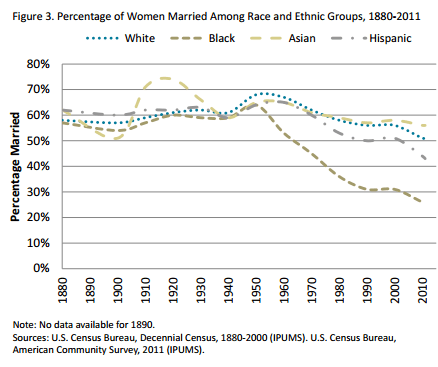
again, with apologies for the lack of detail as this is from a report and I couldn’t find the original, historical data online (again, here’s the link to the original source) — I could find marriage rates going back to the 50s, at census.gov, but not the fuller series to 1880 that would really help with patterns before the decline.
For what it’s worth, from census.gov, among whites, marriage rates (that is, percent of people ages 15+ who are married) from 1950 to the present, peaked in 1960 at 70% of men, 67% of women (showing the impact of men’s lower life expectancy), and dropped gradually but steadily to 57%/55% in 2010.
Here are the rates for blacks:
Men Women
1950 64% 62%
1960 61% 60%
1970 57% 54%
1980 49% 45%
1990 45% 40%
2000 43% 36%
2010 39% 33%
The footnotes at the site (downloading the first table) specify that the 1950 and 1960 data is based on ages 14+, so it’s a bit understated relative to the later years; in addition, these years count all non-whites as “black” so, again, it’s not apples-to-apples. But look at the drop-off from 1970 to 1980, and the widening gap between men and women, which points to an intermarriage component as well as widows.
What do you make of this? In the first place, don’t misread this: this doesn’t say that only 33% of black women will ever marry, but reflects some never marrying, others marrying at a later age, and still others marrying and divorcing. You can also combine this with tables on age at first marriage. And this data also doesn’t fit with the table above, which shows a more rapid drop-off (perhaps due to this data set being all nonwhites for ’50 and ’60?) and lower ultimate rates as well.
And that’s about as much as I’ve got for you for today. Your thoughts welcomed in the comments.
Previous Post

March 20, 2015
From the library: America's Bitter Pill, by Steven Brill
Next Post
March 21, 2015 On Juan Barros: I'm just stumped
Browse Our Archives
Select a Category Actuarial/Retirement Issues Politics Uncategorized
Select a Month September 2026 August 2026 July 2026 June 2026 April 2026 March 2026 February 2026 January 2026 December 2025 November 2025 October 2025 July 2025 June 2025 May 2025 April 2025 March 2025 February 2025 January 2025 December 2024 November 2024 October 2024 September 2024 August 2024 July 2024 June 2024 May 2024 April 2024 March 2024 February 2024 December 2023 November 2023 October 2023 September 2023 August 2023 July 2023 December 2022 September 2022 August 2022 July 2022 June 2022 May 2022 February 2022 January 2022 December 2021 August 2021 June 2021 April 2021 February 2021 January 2021 December 2020 November 2020 October 2020 September 2020 August 2020 July 2020 June 2020 May 2020 April 2020 March 2020 February 2020 January 2020 December 2019 November 2019 October 2019 September 2019 August 2019 July 2019 June 2019 May 2019 April 2019 March 2019 February 2019 January 2019 December 2018 November 2018 October 2018 September 2018 August 2018 July 2018 June 2018 May 2018 April 2018 March 2018 February 2018 January 2018 December 2017 November 2017 October 2017 September 2017 August 2017 July 2017 June 2017 May 2017 April 2017 March 2017 February 2017 January 2017 December 2016 November 2016 October 2016 September 2016 August 2016 July 2016 June 2016 May 2016 April 2016 March 2016 February 2016 January 2016 December 2015 November 2015 October 2015 September 2015 August 2015 July 2015 June 2015 May 2015 April 2015 March 2015 February 2015 January 2015 December 2014 November 2014 October 2014 September 2014 August 2014 July 2014 June 2014 May 2014 April 2014 March 2014 February 2014 January 2014 December 2013 November 2013 October 2013 September 2013 August 2013 July 2013
Follow Us!
TAKE THE
Religious Wisdom Quiz
How did God speak to Moses at the burning bush?
Select your answer to see how you score.
Through wind Through lightning Symbols from the fire By name
Related posts from Jane the Actuary

Curing the Birth Dearth: Reading Hannah's Children
The polarization of America, part N: sex and...
Needs vs. Wants, date night edition

From the library: Actung Baby, An American Mom...
TRENDING AT PATHEOS Catholic

We are approaching the date of our new American national holiday: October...

Letters on Living the Faith by C.S. Lewis
Most of us met C.S. Lewis as a public intellectual. Mere Christianity....

When Halloween Unmasks Married Hearts
Written by Dr. David K. Ewen from Eternal Truth Bible College Behind...

Aristotle. He’s been called the father of logic, the father of the...

Methodist Central Hall and Westminster Abbey
Situated on the same square is Methodist Central Hall and Westminster Abbey. ...

57th Dove Awards Honor Dolly Parton, Crown New...
On gospel music’s biggest night, the 57th annual GMA Dove Awards honored...
view all Catholic blogs
Ad-Free & Subscriber Log-In Subscription Support
- About Us
- 2026 Calendar
- Videos
- Podcasts
- Library of World Religions
- Faith In Media Tracker
- Advertise With Us
- Write for Us
- Privacy Policy
- Terms of Service
- Do Not Sell My Data
- Contact Us
- Radiant Digital
- Manage Newsletter Subscriptions
- Unsubscribe From Notifications
- Sitemap
Copyright 2008-2026, Patheos. All rights reserved.
Subscription Support Ad-Free & Subscriber Log-In
Follow Patheos