
BuddhistCatholicContemplativeEvangelicalGeneral ChristianHinduJewishLatter-day SaintMuslimNew VisionsProgressive Christian
Beliefs
- Buddhist
- Catholic
- Contemplative
- Evangelical
- General Christian
- Hindu
- Jewish
- Latter-day Saint
- More Voices
- Muslim
- New Visions
- Pagan
- Progressive Christian
Topics
- Religion News
- Food and Religion
- Sports and Religion
- Religious Art
- Religious Music and Entertainment
- Religious Events
- History and Religion
- Style and Religion
- Politics and Religion
- Women in Religion
- Recreation Outdoors and Religion
- Business Finance and Religion
- Careers Workplace and Religion
- Education and Religion
- Family Parenting and Religion
- Health Fitness and Religion
- Home and Religion
- Relationships and Religion
- Technology and Religion
- Travel and Religion
Columnists
- Buddhist Columnists
- Business Finance and Religion Columnists
- Careers Workplace and Religion Columnists
- Catholic Columnists
- Contemplative Columnists
- Education and Religion Columnists
- Evangelists Columnists
- Family Parenting and Religion Columnists
- General Christian Columnists
- Health Fitness and Religion Columnists
- Hindu Columnists
- History and Religion Columnists
- Home and Religion Columnists
- Jewish Columnists
- More Voices Columnists
- Latter Day Columnists
- Muslim Columnists
- New Visions Columnists
- Nonreligious Columnists
- Pagan Columnists
- Politics and Religion Columnists
- Progressive Columnists
- Recreation Outdoors and Religion Columnists
- Relationships and Religion Columnists
- Religion News Columnists
- Religious Art Columnists
- Religious Events Columnists
- Religious Music and Entertainment Columnists
- Sports and Religion Columnists
- Style and Religion Columnists
- Technology and Religion Columnists
- Travel and Religion Columnists
- Women in Religion Columnists
Resource Library
- 2026 Calendar
- Library of World Religions
- The 100 Most Holy Places on Earth
- Patheos Answers
- Podcasts
- Videos
- Faith Leaders Database
- Anglican Episcopalian
- Bahai
- Baptist
- Buddhism
- Christianity
- Confucianism
- Eastern Orthodoxy
- Hinduism
- Holiness and Pentecostal
- ISKCON
- Islam
- Judaism
- Lutheran
- Methodist
- The Church of Jesus Christ of Latter-day Saints
- New Age
- Paganism
- Presbytarian and Reformed
- Protestantism
- Religion Behind the Scenes
- Roman Catholic
- Scientology
- Shia Islam
- Sikhism
- Sufism
- Sunni Islam
- Taoism
- Zen
- See all religions
Research Tools
 Ad-Free & Subscriber Log-In Subscription Support
Ad-Free & Subscriber Log-In Subscription Support
Follow Patheos 

- Trending:
- Forgiveness
- |
- Marriage
- |
- Consciousness
- |
- Death Penalty
- |
- Election
- |
- Halloween
 James Wellman on American Religion
- Home
- Progressive Christian
- A Lament for Liberal Protestantism
A Lament for Liberal Protestantism
Last updated on: October 30, 2017 at 6:05 am by Dr. James Wellman
A Lament for Liberal Protestantism 2017-10-30T06:05:04-06:00 Dr. James Wellman
Patheos Explore the world's faith through different perspectives on religion and spirituality! Patheos has the views of the prevalent religions and spiritualities of the world.
This review was previously published in Sociology of Religion, but since so few read journals, here it is on my blog, for your enjoyment. The task of resurrecting the liberal Protestant vision is getting more difficult, not less. I show why in this review of David Hollinger’s After Cloven Tongues of Fire: Protestant Liberalism in Modern American History. 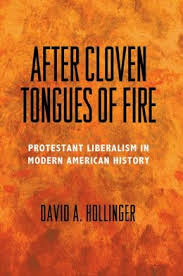
After Cloven Tongues of Fire is an ode to, a critique of, and lament for liberal Protestantism. It’s been awhile since I perused the latest historiography of a tradition that I studied early in my career. Hollinger’s devastating and entertaining assessment brought me up to date. He is the scholar for the task, a child of Protestantism, who lived and breathed it and then walked away from it. But he’s done so without bitterness or even any wistfulness toward it. Unlike what he calls the “Christian survivalists,” who seek to either resuscitate, or re-inflate the power of this tradition, Hollinger, like the precise intellectual historian he is, skillfully dissects the rise of the tradition, how it faltered, and the sputtering fuselage of was once the towering ideology that produced the early twentieth century social gospel, the mid-century fight against Nazism, and the dream of an egalitarian society.
As Hollinger shows so well, liberal Protestantism fabricated its own undoing. The creation of the social gospel mimicked and adapted the early progressive era critiques of the establishment, making social reform the benchmark of faithfulness, which also helped to produce a strong pacifist movement. Hollinger narrates the power of pacifism in the 1930s, which is precisely why Reinhold Niebuhr attacked it with such ferocity. Niebuhr won the argument with help of the Pearl Harbor attack, but Hollinger shows that is was no fait accompli. With a sense of irony, Hollinger announces, “Reinhold Niebuhr made war safe for American Protestants.” Hollinger is no fan of Niebuhr and rightly skewers him, showing how in the post World War II world few intellectuals outside the liberal theological community took Niebuhr seriously.
Niebuhr is the Trojan horse of theologians, yet once inside the American political establishment, instead of changing the insiders, Niebuhr became incidental. Yes, of course both George W. Bush and Barack Obama used Niebuhr’s Christian realism to make Americans feel good about trying to save the Middle East, but in both cases, these “missions” were either utter failures or wars with no exit.
Hollinger focuses on liberal Protestant history, but he understands the rise of American evangelicalism, and identifies it as a form of survivalism—forms of Christian faith that were attempts to save a religious ideology that has lost the argument, not only to the enlightenment but to American culture more generally. It is hard to argue with this in light of the fact that 81 percent of American evangelicals voted for Donald Trump—a candidate who proved himself a religious illiterate. The confusion on what it means to be a Protestant Christian is at an all time high. Liberal cultural despisers of Christianity are having the time of their lives.
Needless to say, Hollinger is not trying to save American Protestantism and his historicism is refreshing and sobering. But some of his best work is going back to the turn of the 19th century to engage with a spiritual survivalist, none other than William James. I wrote my undergraduate honors thesis on James, and I’m sure I saw in James, as Hollinger illumines, a 19th century intellectual wanting to create an rationale for taking religion, and Protestant Christianity in particular, seriously. Hollinger’s interrogation of James’s debate with the British agnostic W.K. Clifford shows that at first James rejected Clifford’s agnosticism, but toward the end of James’s career, like Clifford, James came to a position which Hollinger describes as “post-Protestant.”
And this short synopsis does not do justice to the richness of this collection of essays. The title, at first, put me off. But by the end of Hollinger’s essay on how he came into the profession, I was convinced that his title choice was equally superb. For Hollinger, the swing between provincialism and cosmopolitanism, which he adopted from the great China historian Joseph R. Levenson, is at the heart of all his work. The origins of this cosmopolitanism are not, for Hollinger, in the modernism of our era but in the very roots of the Christian tradition. As Hollinger notes, Galatians 3:28 and Acts 2:1-4, are both homages in the New Testament to a radical universalism in the early Christian tradition. And this more inclusive horizon translated into liberal Protestantism but as Hollinger shows it was quickly taken over by its secular and liberal competitors. In time, many no longer felt the need to be a Christian to be either a modernist or a cosmopolitan for that matter. Indeed, as Hollinger narrates, he took the secular cosmopolitan turn out the door of his rather provincial church. I don’t believe this is a necessary move for liberal Protestants but there is little doubt no one in our era is making a very convincing intellectual reason to stay.
Needless to say, this is a rich book of essays. Too often collected essays lack coherence—not so here. As a reader each essay opened up a new horizons of thought, but Hollinger’s own intellectual drive to narrate the twists and turns between the vernacular and the ecumenical traditions of Protestantism give the volume a propinquity that is powerful. This is a superb work of scholarship, a passionate intellectual argument without spite, and an invitation to think, which is the highest compliment one can pay to a scholar.
Previous Post

October 21, 2017
Driscoll on Patheos: My Request for an Apology
Browse Our Archives
Select a Category Uncategorized
Select a Month October 2017 June 2017 April 2017 March 2017 February 2017 January 2017 November 2016 October 2016 September 2016 July 2016 June 2016 April 2016 March 2016 February 2016 January 2016 December 2015 July 2015 April 2015 March 2015 June 2014 May 2014 March 2014 January 2014 November 2013 October 2013 September 2013 August 2013 July 2013 June 2013 May 2013 April 2013
Follow Us!
TAKE THE
Religious Wisdom Quiz
Who is described as "a beloved physician" and accompanied Paul?
Select your answer to see how you score.
Silas Luke Titus Mark
Related posts from James Wellman on American Religion

Driscoll on Patheos: My Request for an Apology
James Wellman on American Religion

More Blood at the Altar of the Gun
James Wellman on American Religion

James Wellman on American Religion
Everything Belongs and the End of Religion
James Wellman on American Religion
TRENDING AT PATHEOS Progressive Christian

What Being a Modern-Day Apostle Means to Me
In my last column, I discussed the ins and outs of modern-day...

Did Ancient China Once Worship the God of...
Across human history, a common thread weaves through the origins of the...

Love Your Neighbor – Including Earth-Kin: Lev. 19,...
God’s command to love your neighbor means acting in an ethical and...

Lead a Church Study of “Jesus and Lao...
Guest writer Jack Thomas (The Irreverent Reverend) reflects on leading his church...

Pastoral Wisdom for Responding to Sermon Pushback
Getting sermon pushback on your social justice sermon? Learn practical, Proverbs-based strategies...

Principles for Understanding the Apostolic Ministry Today
Whenever people discover that my formal ministry title is "apostle," as in...
view all Progressive Christian blogs
Ad-Free & Subscriber Log-In Subscription Support
- About Us
- 2026 Calendar
- Videos
- Podcasts
- Library of World Religions
- Faith In Media Tracker
- Advertise With Us
- Write for Us
- Privacy Policy
- Terms of Service
- Do Not Sell My Data
- Contact Us
- Radiant Digital
- Manage Newsletter Subscriptions
- Unsubscribe From Notifications
- Sitemap
Copyright 2008-2026, Patheos. All rights reserved.
Subscription Support Ad-Free & Subscriber Log-In
Follow Patheos