
BuddhistCatholicContemplativeEvangelicalGeneral ChristianHinduJewishLatter-day SaintMuslimNew VisionsProgressive Christian
Beliefs
- Buddhist
- Catholic
- Contemplative
- Evangelical
- General Christian
- Hindu
- Jewish
- Latter-day Saint
- More Voices
- Muslim
- New Visions
- Pagan
- Progressive Christian
Topics
- Religion News
- Food and Religion
- Sports and Religion
- Religious Art
- Religious Music and Entertainment
- Religious Events
- History and Religion
- Style and Religion
- Politics and Religion
- Women in Religion
- Recreation Outdoors and Religion
- Business Finance and Religion
- Careers Workplace and Religion
- Education and Religion
- Family Parenting and Religion
- Health Fitness and Religion
- Home and Religion
- Relationships and Religion
- Technology and Religion
- Travel and Religion
Columnists
- Buddhist Columnists
- Business Finance and Religion Columnists
- Careers Workplace and Religion Columnists
- Catholic Columnists
- Contemplative Columnists
- Education and Religion Columnists
- Evangelists Columnists
- Family Parenting and Religion Columnists
- General Christian Columnists
- Health Fitness and Religion Columnists
- Hindu Columnists
- History and Religion Columnists
- Home and Religion Columnists
- Jewish Columnists
- More Voices Columnists
- Latter Day Columnists
- Muslim Columnists
- New Visions Columnists
- Nonreligious Columnists
- Pagan Columnists
- Politics and Religion Columnists
- Progressive Columnists
- Recreation Outdoors and Religion Columnists
- Relationships and Religion Columnists
- Religion News Columnists
- Religious Art Columnists
- Religious Events Columnists
- Religious Music and Entertainment Columnists
- Sports and Religion Columnists
- Style and Religion Columnists
- Technology and Religion Columnists
- Travel and Religion Columnists
- Women in Religion Columnists
Resource Library
- 2026 Calendar
- Library of World Religions
- The 100 Most Holy Places on Earth
- Patheos Answers
- Podcasts
- Videos
- Faith Leaders Database
- Anglican Episcopalian
- Bahai
- Baptist
- Buddhism
- Christianity
- Confucianism
- Eastern Orthodoxy
- Hinduism
- Holiness and Pentecostal
- ISKCON
- Islam
- Judaism
- Lutheran
- Methodist
- The Church of Jesus Christ of Latter-day Saints
- New Age
- Paganism
- Presbytarian and Reformed
- Protestantism
- Religion Behind the Scenes
- Roman Catholic
- Scientology
- Shia Islam
- Sikhism
- Sufism
- Sunni Islam
- Taoism
- Zen
- See all religions
Research Tools
 Ad-Free & Subscriber Log-In Subscription Support
Ad-Free & Subscriber Log-In Subscription Support
Follow Patheos 

- Trending:
- Forgiveness
- |
- Marriage
- |
- Consciousness
- |
- Death Penalty
- |
- Election
- |
- Halloween
 Capitol and Cathedral
- Home
- Progressive Christian
- Visiting a cemetery in the Old South
Visiting a cemetery in the Old South
Last updated on: December 29, 2016 at 1:16 pm by Jacob Lupfer
Visiting a cemetery in the Old South 2016-12-29T13:16:58-04:00 Jacob Lupfer
Patheos Explore the world's faith through different perspectives on religion and spirituality! Patheos has the views of the prevalent religions and spiritualities of the world.
A couple days before Christmas, I rode with my mom out to the cemetery to put red and white flowers on her Daddy’s grave. My grandfather died in the summer of 2015, so it had been a year an a half since I visited Pleasant Hill Cemetery. I had not seen the completed headstone, nor taken any time to wander around after his burial. Mostly, I just didn’t want my mom to have to go alone.
I do not make a habit of visiting relatives’ graves. I suppose I do it somewhat more than the average American but somewhat less than most other members of my family. I was struck by a passage in J.D. Vance’s A Hillbilly Elegy in which his grandmother explained why they pulled their car over to the side of the road as a funeral procession passed: “We are hillbillies. We honor our dead.”
We are not hillbillies. But we do honor our dead.
I don’t think it’s a stretch to say that some of my ancestors fit the definition of hillbillies, especially the ones buried in Pleasant Hill Cemetery. In our community, the Lupfers were town people and the Lambs were country people. In a recent column about the 500th year of the Protestant Reformation, I wrote that my family embodied most WASP stereotypes. I was thinking of the upscale ones, but I also have gun-toting, hot tempered Scots-Irish blood in my veins.
As my mother paid respect to her aunts and uncles, I wandered around the grounds. One relative installed a bench to sit on when she visits the cemetery. My mom’s high school friend evidently visits his parents’ graves often, as the St. Augustine over their plot is a lush, well-watered patch of green surrounded by an ocean of dull-colored native grass struggling to push through the sand.

C.S.A. Southern Cross grave marker
The numerous flags on veterans’ graves made me recall with pride the three-volley salute a local Honor Guard performed at my grandfather’s funeral in the sweltering midday heat last July. I also noticed a few C.S.A. markers and fragments of sun-faded Confederate battle flags. For a long time, a local Sons of Confederate Veterans group steadfastly maintained gravesites and placed Southern Cross markers, which are available from the Department of Veterans Affairs. Maybe they still do. I thought of the recent debates over the display of Confederate symbols, in which my view was basically that celebrating the Confederacy is not good, but erasing it is impossible and unnecessary.
I was surprised to see the University of Florida’s gator mascot inscribed on so many gravestones. I can’t imagine that mere football fandom would merit these little monuments, but it would also surprise me if all those deceased are UF graduates. Still, most of the graves dated from a time when the University of Florida in Gainesville was the only public university. I believe Florida State in Tallahassee was a women’s college through World War II. Perhaps many of the sons of these pioneer families studied at UF.
In terms of diversity, I suspect there isn’t much. There are no Jews buried in Pleasant Hill Cemetery, and I would be surprised if there are any Roman Catholics. There is not a crucifix or saint to be found. Other than crosses, the religious symbols were mostly praying hands, Bibles, scriptural citations, and quotes or allusions to gospel hymns.
Pleasant Hill Cemetery was surrounded by miles of prairie as recently as 15 years ago. Today, it is boxed in by housing developments and shopping centers. I wonder if the balance of the plots will be used by the old families’ sons and daughters, or whether newcomers, mostly Hispanic, will one day lay to rest there. Up the county road and down the main highway, I noticed a new site, the Muslim Cemetery of Central Florida, something the people buried in Pleasant Hill never could have imagined.
The Old South has passed away, mostly for the better I suppose. Soon, cemeteries like this may be the only places you can see that it ever existed at all. But I enjoyed spending a few moments on a mild winter afternoon thinking about the departed. I have traced my family’s Union and Patriot ancestry with great pride, but it felt good to acknowledge that these are my people, too. Many had prejudicial attitudes. Some were unenlightened. But I figure that overall, most were no better or worse than I am.
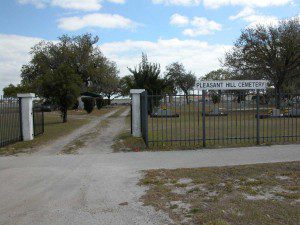
Pleasant Hill Cemetery, off Osceola County Road 531 south of Kissimmee, Florida
I considered picking up the Rebel flag fragments and throwing them away, thinking I might be doing a favor to residents and visitors alike. But they were torn. And faded. On the ground. In a cemetery. Really, they didn’t seem out of place. Instead, I let the gravestones bear silent witness to the deceased, however imperfect, however virtuous. The South has plenty it should leave behind. But it reminds us to value family, community, religion, and place.
It’s hard to know how to be a good son of the South. But for one day, at least, I think I did alright.
Previous Post

December 24, 2016
The most beautiful Christmas prayer ever
Next Post

January 16, 2017 Progressive faith leaders fête Obama in new book
Browse Our Archives
Select a Category #Faith2016 Christian right Christianity Debates Democratic Convention Donald Trump GOP nominating contest Inauguration Media News roundup Personal Polls Religious freedom Republican Convention Uncategorized
Select a Month February 2018 December 2017 November 2017 October 2017 August 2017 July 2017 May 2017 April 2017 March 2017 February 2017 January 2017 December 2016 November 2016 October 2016 September 2016 August 2016 July 2016 June 2016
Follow Us!
TAKE THE
Religious Wisdom Quiz
How did Jesus provide for the temple tax?
Select your answer to see how you score.
He multiplied bread Found in a tree He borrowed from Judas A coin in a fish's mouth
Related posts from Capitol and Cathedral

Georgetown University reckons with its slaveholding past

Some thoughts on Christian intellectuals

Do Jesuit schools turn students into atheists?

Orlando Massacre Hits Close to Home
TRENDING AT PATHEOS Progressive Christian

Why Christians Have a Sacred Duty to Vote:...
The Bible offers strong support for the sacred duty to vote. Here...

What Being a Modern-Day Apostle Means to Me
In my last column, I discussed the ins and outs of modern-day...

Did Ancient China Once Worship the God of...
Across human history, a common thread weaves through the origins of the...

Love Your Neighbor – Including Earth-Kin: Lev. 19,...
God’s command to love your neighbor means acting in an ethical and...

Lead a Church Study of “Jesus and Lao...
Guest writer Jack Thomas (The Irreverent Reverend) reflects on leading his church...

Principles for Understanding the Apostolic Ministry Today
Whenever people discover that my formal ministry title is "apostle," as in...
view all Progressive Christian blogs
Ad-Free & Subscriber Log-In Subscription Support
- About Us
- 2026 Calendar
- Videos
- Podcasts
- Library of World Religions
- Faith In Media Tracker
- Advertise With Us
- Write for Us
- Privacy Policy
- Terms of Service
- Do Not Sell My Data
- Contact Us
- Radiant Digital
- Manage Newsletter Subscriptions
- Unsubscribe From Notifications
- Sitemap
Copyright 2008-2026, Patheos. All rights reserved.
Subscription Support Ad-Free & Subscriber Log-In
Follow Patheos