
BuddhistCatholicContemplativeEvangelicalGeneral ChristianHinduJewishLatter-day SaintMuslimNew VisionsProgressive Christian
Beliefs
- Buddhist
- Catholic
- Contemplative
- Evangelical
- General Christian
- Hindu
- Jewish
- Latter-day Saint
- More Voices
- Muslim
- New Visions
- Pagan
- Progressive Christian
Topics
- Religion News
- Food and Religion
- Sports and Religion
- Religious Art
- Religious Music and Entertainment
- Religious Events
- History and Religion
- Style and Religion
- Politics and Religion
- Women in Religion
- Recreation Outdoors and Religion
- Business Finance and Religion
- Careers Workplace and Religion
- Education and Religion
- Family Parenting and Religion
- Health Fitness and Religion
- Home and Religion
- Relationships and Religion
- Technology and Religion
- Travel and Religion
Columnists
- Buddhist Columnists
- Business Finance and Religion Columnists
- Careers Workplace and Religion Columnists
- Catholic Columnists
- Contemplative Columnists
- Education and Religion Columnists
- Evangelists Columnists
- Family Parenting and Religion Columnists
- General Christian Columnists
- Health Fitness and Religion Columnists
- Hindu Columnists
- History and Religion Columnists
- Home and Religion Columnists
- Jewish Columnists
- More Voices Columnists
- Latter Day Columnists
- Muslim Columnists
- New Visions Columnists
- Nonreligious Columnists
- Pagan Columnists
- Politics and Religion Columnists
- Progressive Columnists
- Recreation Outdoors and Religion Columnists
- Relationships and Religion Columnists
- Religion News Columnists
- Religious Art Columnists
- Religious Events Columnists
- Religious Music and Entertainment Columnists
- Sports and Religion Columnists
- Style and Religion Columnists
- Technology and Religion Columnists
- Travel and Religion Columnists
- Women in Religion Columnists
Resource Library
- 2026 Calendar
- Library of World Religions
- The 100 Most Holy Places on Earth
- Patheos Answers
- Podcasts
- Videos
- Faith Leaders Database
- Anglican Episcopalian
- Bahai
- Baptist
- Buddhism
- Christianity
- Confucianism
- Eastern Orthodoxy
- Hinduism
- Holiness and Pentecostal
- ISKCON
- Islam
- Judaism
- Lutheran
- Methodist
- The Church of Jesus Christ of Latter-day Saints
- New Age
- Paganism
- Presbytarian and Reformed
- Protestantism
- Religion Behind the Scenes
- Roman Catholic
- Scientology
- Shia Islam
- Sikhism
- Sufism
- Sunni Islam
- Taoism
- Zen
- See all religions
Research Tools
 Ad-Free & Subscriber Log-In Subscription Support
Ad-Free & Subscriber Log-In Subscription Support
Follow Patheos 

- Trending:
- Forgiveness
- |
- Marriage
- |
- Consciousness
- |
- Death Penalty
- |
- Election
- |
- Halloween
 Capitol and Cathedral
- Home
- Progressive Christian
- Religious freedom and human flourishing
Religious freedom and human flourishing
Last updated on: November 15, 2016 at 12:58 pm by Jacob Lupfer
Religious freedom and human flourishing 2016-11-15T12:58:39-04:00 Jacob Lupfer
Patheos Explore the world's faith through different perspectives on religion and spirituality! Patheos has the views of the prevalent religions and spiritualities of the world.
Today, I’m taking a break from my usual research, teaching, and writing to attend a conference at Georgetown on religious freedom.
Here are some notes from a panel on religious freedom and human flourishing. These scholars discussed academic research that points to religious freedom playing a positive role in societies.
Byron Johnson, Baylor University (moderator)
Thomas Berg, University of St. Thomas
Rebecca Shah, Religious Freedom Project
Brad Wilcox, University of Virginia
Robert Woodberry, Baylor University
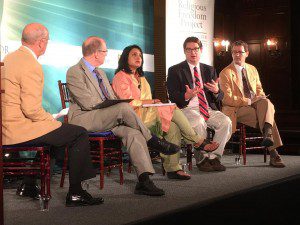
Rebecca Shah of the Religious Freedom Project has found that convert women in India are likelier to report sexual abuse — Religion gives them a feeling of worth and an expectation of dignity. She poses a provocative series of questions: What is the content of religious belief that directs future behavior? How do specific beliefs impact social phenomena? As a researcher, she has had to move beyond broad, simplistic demographic categories for religion. She finds more robust results when she has data on the specific content of religious beliefs. (I think there are clear parallels here to my writing on evangelicals.)
Bob Woodberry, a social scientist at Baylor University, has conducted research on Christian missionary work. He found that marginalized are most likely to convert, which in turn changes the dominant religious order. So mission groups not only bring faith (and arguably other social, economic, and political goods) to masses, but changes the behavior of the large or established majority churches. (See Guillermo Trejo’s 2009 article on the Catholic Church working with the poor more after Protestant missionaries came to Mexico.) Missions can shape societies through improved literacy, more book publishing, newspaper consumption, lower infant mortality, higher life expectancy etc. Not causal necessarily, but interesting to note.
Woodberry also notes that there are problems with causality and methodology: self-reporting is just “what I say about what I do.” But religious people live longer and recover from sickness more quickly. This has an economic benefit for society that people do not even think about.
Tom Berg of the University of St. Thomas is legal scholar and advocate in appellate courts and legislatures His role is as consumer of research on religious freedom, interpreting it for use in contemporary debates. Washington’s farewell address said that morality was quite essential for a good society. The framers did not believe government could inculcate virtue. Madison thought if government advanced religious institutions, it would corrupt them. This led to religious institutions promoting the common good in their own ways. Today’s conflicts often involve Roman Catholic or evangelical Protestant entities. John DiIulio says those communities figure most prominently in showering volunteer hours on members and non-members alike. They may promote vigorous to civic commitments and voluntarism but may depart from societal norms due to their unique religious character. They serve the broader society, but they are in a sense counter-cultural to dominant norms. Organizations that make counter-cultural demands tend to produce greater commitments in their members by reducing free riders, etc. What is is about Catholic and evangelical organizations that make them particularly vigorous in America? What are the dynamics that make for their vigor? Do they uniquely generate counter cultural practices that lead to conflict with law and society?
Berg also points out that, in terms of social stability, religious freedom could be very important. Muslims in the United States will feel more proud and secure about their country if they know their rights to live according to their faith is secure.
UVa sociologist Brad Wilcox has found that children (particularly disadvantaged) benefit from religious engagement. His research also finds that married couples who undertake religious devotion and participation together report higher marital satisfaction and are less likely to divorce. Again, these relationships are not necessarily causal and are difficult to quantify.
Wilcox says sometimes there is no effect, for example, between religious liberty and the health of marriage as an institution across the world. There is a positive association between religious attendance and the strength/quality of marriage. But this is not the same as saying religious freedom has a positive causal effect.

Browse Our Archives
Select a Category #Faith2016 Christian right Christianity Debates Democratic Convention Donald Trump GOP nominating contest Inauguration Media News roundup Personal Polls Religious freedom Republican Convention Uncategorized
Select a Month February 2018 December 2017 November 2017 October 2017 August 2017 July 2017 May 2017 April 2017 March 2017 February 2017 January 2017 December 2016 November 2016 October 2016 September 2016 August 2016 July 2016 June 2016
Follow Us!
TAKE THE
Religious Wisdom Quiz
What Christian holiday celebrates the visit of the Magi to the baby Jesus?
Select your answer to see how you score.
Advent Trinity Sunday Pentecost Epiphany
Related posts from Capitol and Cathedral
Sam Brownback, soon-to-be ambassador

Why anti-gay wedding vendors should discriminate more

Why opposing same sex marriage isn't like racism

Trump's anti-Semitism comments are too little, too late....
TRENDING AT PATHEOS Progressive Christian

Why Christians Have a Sacred Duty to Vote:...
The Bible offers strong support for the sacred duty to vote. Here...

What Being a Modern-Day Apostle Means to Me
In my last column, I discussed the ins and outs of modern-day...

Did Ancient China Once Worship the God of...
Across human history, a common thread weaves through the origins of the...

Love Your Neighbor – Including Earth-Kin: Lev. 19,...
God’s command to love your neighbor means acting in an ethical and...

Lead a Church Study of “Jesus and Lao...
Guest writer Jack Thomas (The Irreverent Reverend) reflects on leading his church...

Principles for Understanding the Apostolic Ministry Today
Whenever people discover that my formal ministry title is "apostle," as in...
view all Progressive Christian blogs
Ad-Free & Subscriber Log-In Subscription Support
- About Us
- 2026 Calendar
- Videos
- Podcasts
- Library of World Religions
- Faith In Media Tracker
- Advertise With Us
- Write for Us
- Privacy Policy
- Terms of Service
- Do Not Sell My Data
- Contact Us
- Radiant Digital
- Manage Newsletter Subscriptions
- Unsubscribe From Notifications
- Sitemap
Copyright 2008-2026, Patheos. All rights reserved.
Subscription Support Ad-Free & Subscriber Log-In
Follow Patheos