
BuddhistCatholicContemplativeEvangelicalGeneral ChristianHinduJewishLatter-day SaintMuslimNew VisionsProgressive Christian
Beliefs
- Buddhist
- Catholic
- Contemplative
- Evangelical
- General Christian
- Hindu
- Jewish
- Latter-day Saint
- More Voices
- Muslim
- New Visions
- Pagan
- Progressive Christian
Topics
- Religion News
- Food and Religion
- Sports and Religion
- Religious Art
- Religious Music and Entertainment
- Religious Events
- History and Religion
- Style and Religion
- Politics and Religion
- Women in Religion
- Recreation Outdoors and Religion
- Business Finance and Religion
- Careers Workplace and Religion
- Education and Religion
- Family Parenting and Religion
- Health Fitness and Religion
- Home and Religion
- Relationships and Religion
- Technology and Religion
- Travel and Religion
Columnists
- Buddhist Columnists
- Business Finance and Religion Columnists
- Careers Workplace and Religion Columnists
- Catholic Columnists
- Contemplative Columnists
- Education and Religion Columnists
- Evangelists Columnists
- Family Parenting and Religion Columnists
- General Christian Columnists
- Health Fitness and Religion Columnists
- Hindu Columnists
- History and Religion Columnists
- Home and Religion Columnists
- Jewish Columnists
- More Voices Columnists
- Latter Day Columnists
- Muslim Columnists
- New Visions Columnists
- Nonreligious Columnists
- Pagan Columnists
- Politics and Religion Columnists
- Progressive Columnists
- Recreation Outdoors and Religion Columnists
- Relationships and Religion Columnists
- Religion News Columnists
- Religious Art Columnists
- Religious Events Columnists
- Religious Music and Entertainment Columnists
- Sports and Religion Columnists
- Style and Religion Columnists
- Technology and Religion Columnists
- Travel and Religion Columnists
- Women in Religion Columnists
Resource Library
- 2026 Calendar
- Library of World Religions
- The 100 Most Holy Places on Earth
- Patheos Answers
- Podcasts
- Videos
- Faith Leaders Database
- Anglican Episcopalian
- Bahai
- Baptist
- Buddhism
- Christianity
- Confucianism
- Eastern Orthodoxy
- Hinduism
- Holiness and Pentecostal
- ISKCON
- Islam
- Judaism
- Lutheran
- Methodist
- The Church of Jesus Christ of Latter-day Saints
- New Age
- Paganism
- Presbytarian and Reformed
- Protestantism
- Religion Behind the Scenes
- Roman Catholic
- Scientology
- Shia Islam
- Sikhism
- Sufism
- Sunni Islam
- Taoism
- Zen
- See all religions
Research Tools
 Ad-Free & Subscriber Log-In Subscription Support
Ad-Free & Subscriber Log-In Subscription Support
Follow Patheos 

- Trending:
- Forgiveness
- |
- Marriage
- |
- Consciousness
- |
- Death Penalty
- |
- Election
- |
- Halloween

-
Tools
-
Support the Work
- Home
- Evangelical
- Politics and Religion
- When Cultural Identity Becomes Sacred
When Cultural Identity Becomes Sacred
Last updated on: March 19, 2024 at 3:49 am by Brad Vaughn
When Cultural Identity Becomes Sacred 2024-02-10T11:25:44-07:00 Brad Vaughn
Patheos Explore the world's faith through different perspectives on religion and spirituality! Patheos has the views of the prevalent religions and spiritualities of the world.
In contemporary American society, a striking phenomenon has emerged: the sacralization of culture and cultural identity. To put it more directly, culture has become a religion. Cultural identity has become a religious identity.

Credit: Maxwell Gallery / Artificial Intelligence Research of Images 2022
Cultural and ethnic identities have ascended to positions of reverence and unassailable authority in the lives of many individuals. This shift is emblematic of a broader social transformation, where culture has, in some respects, supplanted traditional religion in its role as a moral and ethical compass. This post delves into this dynamic, shedding light on how culture has become a new creed and why it has gained a status that is beyond challenge.
Culture as the New Creed
The decline of traditional religious adherence in many Western societies has left a vacuum that has been filled by the rise of culture as a source of meaning. Cultural or ethnic identity has become the primary source of meaning, ethics, and community for many individuals—roles traditionally played by religion.
This transition is not merely about rediscovering or reconnecting with cultural roots; it is about elevating those roots to a status that is beyond reproach or challenge, where cultural practices, norms, and values are viewed with a reverence akin to religious dogma.
Religion, for centuries, has provided frameworks for understanding the world, moral codes, and a sense of belonging. As the grip of organized religion loosens, these alternative frameworks are increasingly drawn from cultural narratives. The stories, traditions, and collective memories of culture provide a scaffolding for individuals to construct their identities and moral understanding of the world.
This reverence for culture has reached a point where it has become a creed— a set of beliefs and practices that command the ultimate loyalty and devotion.
Unchallengeable Authority
The sacralization of culture is marked by the idea that cultural identity and its related practices are beyond criticism. To question cultural norms and values is to risk being labeled as an offender of cultural sanctity. Such social “sinners” are deemed “bigots,” “colonialists,” “racists,” “close-minded,” and some flavor of -phobic.
Much like how religious dogma has historically been protected from scrutiny, the challenge to cultural norms is often met with vehement opposition. In public discourse, this dynamic plays out in debates where the criticism of cultural practices or perspectives is met with severe backlash, often framed as a defense against cultural insensitivity or appropriation. “Cancelling” is one of the most common mechanisms used recently.
In this context, cultural identity is not only a source of personal meaning but also a form of authority that dictates social interactions, political discourse, and personal relationships. The perceived inerrancy of cultural norms can be so ingrained that it assumes an almost canonical status, guiding behavior and thought in a way that parallels religious texts.
Cultural Identity and Personal Meaning
The sacralization of culture (i.e., making culture sacred) addresses a need left by the decline of traditional religious structures by providing personal meaning and identity. In a society characterized increasingly by secularism and individualism, cultural identity offers a sense of belonging and a connection to a larger narrative. This need for connection and meaning is a fundamental aspect of human nature, and as traditional religious observances wane, the rituals, symbols, and collective memories of a cultural identity step in to fill the void.
For many, their cultural heritage is not just a backdrop for their life story but the very essence of their being. This heritage provides a link to ancestral history, communal values, and a sense of continuity in a rapidly changing world.
The deep connection to cultural identity infuses everyday practices and traditions with sacred significance, turning cultural festivals into solemn celebrations and traditional costumes into ceremonial garb. Virtue signaling is an act of devotion. Cultural narratives become not just stories of the past but moral lessons and guiding principles for the present and future.
The Veneration of Cultural Identity
The sacralization of cultural identity also manifests in the elevation of symbols and figures that represent cultural heritage to a status of veneration. Icons of cultural history are treated with a reverence that mirrors the respect given to religious saints and prophets. Murals, statues, and other representations become sacred relics that embody the collective spirit and pride of a people.
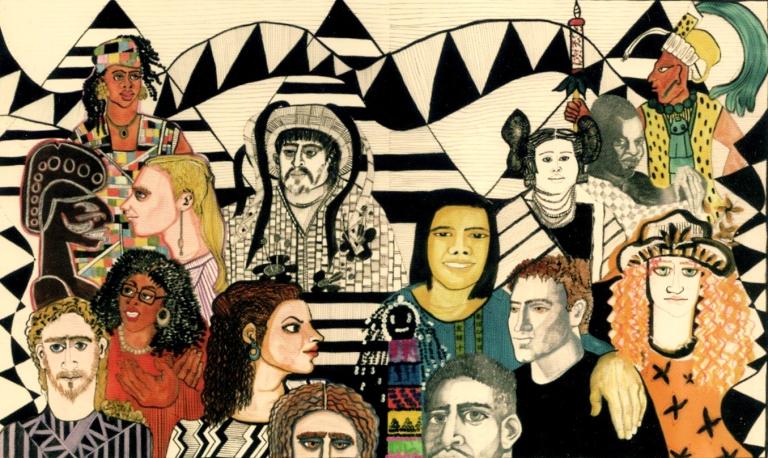
Diversidad Pura -Mirta Toledo 1993
To deface or disrespect these symbols is to commit an act tantamount to sacrilege, provoking a defensive response that is both visceral and intense. In some cases, one must be born into a culture to participate in the pseudo-religious rites, lest one be accused of “cultural appropriation,” a type of social sacrilege.
The Role of Media and Education
In this climate of cultural sacralization, the role of media and education becomes ever more critical. They are the main channels through which cultural narratives are disseminated and reinforced. Through film, literature, and the arts, cultural stories are told and retold, each time reinforcing their sanctity and central role in the community’s moral fabric.
With evangelistic fervor, media and schools are primary engines for spreading propaganda.
Education systems have the responsibility of imparting knowledge about cultural heritage, but with the added challenge of doing so in a way that respects the sanctified status of culture while still encouraging critical thought and individual interpretation.
Challenges to Integration and Cohesion
While the sacralization of culture can strengthen communal bonds within cultural groups, it also presents challenges to social integration and cohesion. When cultural identities are held as sacrosanct, they can become barriers to cross-cultural understanding and interaction.
The reluctance to challenge or critically engage with different cultural practices can lead to a form of cultural isolationism, where communities become echo chambers that reinforce their own sanctity while being resistant to external influences.
Conclusion
Sacralizing (“making sacred”) culture and cultural identity in American society represents a fundamental shift in how individuals find meaning and a sense of belonging in the modern world. It is a testament to the power of culture to provide a moral compass and a communal identity in the absence of traditional religious structures.
However, this elevation of culture to a sacred status also brings with it challenges that must be navigated with sensitivity and openness. As America continues to grapple with its diverse cultural landscape, the dialogue around the sacralization of culture will remain a pivotal part of its ongoing narrative.
Politics and Religion
Education and Religion
Previous Post

March 12, 2024
10 Places Honor and Shame Show Up in America
Next Post
March 26, 2024 Treating Culture as a Sacred Creed Has Consequences
Recent Comments
"A thoughtful and thought-provoking article that raises important questions about the challenges facing the Western ..."
"to fit social or religious expectations. Especially women, who were expected to sacrifice everything to ..."
3 reasons you should not be ..."
"Powerful reminder short, sturdy truths can lose their weight if treated as slogans. The solas ..."
How Western Individualism Quietly Undermines the ..."
"If 'America’s deepest crisis is not merely political. It is moral and spiritual.' is in ..."
The Real Crisis Beneath America’s Social ..."
Browse Our Archives
Select a Category Atonement Biblical Theology Book Reviews China Chinese Church Chinese Culture Chinese Language Collectivism Contextualization Culture (General) Ecclesiology Evangelism Gospel Honor & Shame (Face) Interpretation/Exegesis Justification/Righteousness Missiology Mission Methods One Gospel for All Nations Other Practical Contextualization Reading Romans with Eastern Eyes Resources Romans Salvation (General) Saving God's Face Seeking God's Face The Cross in Context Theological Contextualization Theological Education Theology Uncategorized
Select a Month October 2026 September 2026 August 2026 July 2026 June 2026 May 2026 April 2026 March 2026 February 2026 January 2026 December 2025 November 2025 October 2025 September 2025 August 2025 July 2025 June 2025 May 2025 April 2025 March 2025 February 2025 January 2025 December 2024 November 2024 October 2024 September 2024 August 2024 July 2024 June 2024 May 2024 April 2024 March 2024 February 2024 January 2024 December 2023 November 2023 October 2023 September 2023 August 2023 July 2023 June 2023 May 2023 April 2023 March 2023 February 2023 January 2023 December 2022 November 2022 October 2022 September 2022 August 2022 July 2022 June 2022 May 2022 April 2022 March 2022 February 2022 January 2022 December 2021 November 2021 October 2021 September 2021 August 2021 July 2021 June 2021 May 2021 April 2021 March 2021 February 2021 January 2021 December 2020 November 2020 October 2020 September 2020 August 2020 July 2020 June 2020 May 2020 April 2020 March 2020 February 2020 January 2020 December 2019 November 2019 October 2019 September 2019 August 2019 July 2019 June 2019 May 2019 April 2019 March 2019 February 2019 January 2019 December 2018 November 2018 October 2018 September 2018 August 2018 July 2018 June 2018 May 2018 April 2018 March 2018 February 2018 January 2018 December 2017 November 2017 October 2017 September 2017 August 2017 July 2017 June 2017 May 2017 April 2017 March 2017 February 2017 January 2017 December 2016 November 2016 October 2016 September 2016 August 2016 July 2016 June 2016 May 2016 April 2016 March 2016 February 2016 January 2016 December 2015 November 2015 October 2015 September 2015 August 2015 July 2015 June 2015 May 2015 April 2015 March 2015 February 2015 January 2015 December 2014 November 2014 October 2014 September 2014 August 2014 July 2014 June 2014 May 2014 April 2014 March 2014 February 2014 January 2014 December 2013 November 2013 October 2013 September 2013 August 2013 July 2013 June 2013 May 2013 April 2013 March 2013 February 2013 January 2013 December 2012 November 2012
Follow Us!
TAKE THE
Religious Wisdom Quiz
Who said: "His divine power has given us everything we need for a godly life through our knowledge of him"?
Select your answer to see how you score.
Paul John Peter James
Books by This Author Books by Brad Vaughn
Related posts from Saving God's Face

3 reasons you should not be your “authentic...
Treating Culture as a Sacred Creed Has Consequences

Balancing Individualism and Collectivism: Pros and Cons
The Nuanced Dance of Identity: Beyond East-West Dichotomies
TRENDING AT PATHEOS Evangelical

The Problem with False Prophets
Miller’s Station UMC| 10/18/26| Anchor Verse: Jeremiah 23: 1, 9-23 I...

Emotion in Early Christianity by Andrew Crislip
Andrew Crislip’s Emotion in Early Christianity examines an often overlooked dimension of...

16 Spiritual Touchstones for a More Grounded Life
After decades of spiritual study, here are 16 principles I try...

Catholic Evangelization: Sharing Your Faith Every Day
Welcome back to the Graceful Awakening mini-series called, “From Faith to Mission.” ...

The Pillar of the Boatmen: the Ancient Monument...
The Pillar of the Boatmen is a Romano-Gaulish sculpture that dates from...

In one sense walking into Westminster Abbey is like walking down the...
view all Evangelical blogs
What Are Your Thoughts?leave a comment
Ad-Free & Subscriber Log-In Subscription Support
- About Us
- 2026 Calendar
- Videos
- Podcasts
- Library of World Religions
- Faith In Media Tracker
- Advertise With Us
- Write for Us
- Privacy Policy
- Terms of Service
- Do Not Sell My Data
- Contact Us
- Radiant Digital
- Manage Newsletter Subscriptions
- Unsubscribe From Notifications
- Sitemap
Copyright 2008-2026, Patheos. All rights reserved.
Subscription Support Ad-Free & Subscriber Log-In
Follow Patheos