
BuddhistCatholicContemplativeEvangelicalGeneral ChristianHinduJewishLatter-day SaintMuslimNew VisionsProgressive Christian
Beliefs
- Buddhist
- Catholic
- Contemplative
- Evangelical
- General Christian
- Hindu
- Jewish
- Latter-day Saint
- More Voices
- Muslim
- New Visions
- Pagan
- Progressive Christian
Topics
- Religion News
- Food and Religion
- Sports and Religion
- Religious Art
- Religious Music and Entertainment
- Religious Events
- History and Religion
- Style and Religion
- Politics and Religion
- Women in Religion
- Recreation Outdoors and Religion
- Business Finance and Religion
- Careers Workplace and Religion
- Education and Religion
- Family Parenting and Religion
- Health Fitness and Religion
- Home and Religion
- Relationships and Religion
- Technology and Religion
- Travel and Religion
Columnists
- Buddhist Columnists
- Business Finance and Religion Columnists
- Careers Workplace and Religion Columnists
- Catholic Columnists
- Contemplative Columnists
- Education and Religion Columnists
- Evangelists Columnists
- Family Parenting and Religion Columnists
- General Christian Columnists
- Health Fitness and Religion Columnists
- Hindu Columnists
- History and Religion Columnists
- Home and Religion Columnists
- Jewish Columnists
- More Voices Columnists
- Latter Day Columnists
- Muslim Columnists
- New Visions Columnists
- Nonreligious Columnists
- Pagan Columnists
- Politics and Religion Columnists
- Progressive Columnists
- Recreation Outdoors and Religion Columnists
- Relationships and Religion Columnists
- Religion News Columnists
- Religious Art Columnists
- Religious Events Columnists
- Religious Music and Entertainment Columnists
- Sports and Religion Columnists
- Style and Religion Columnists
- Technology and Religion Columnists
- Travel and Religion Columnists
- Women in Religion Columnists
Resource Library
- 2026 Calendar
- Library of World Religions
- The 100 Most Holy Places on Earth
- Patheos Answers
- Podcasts
- Videos
- Faith Leaders Database
- Anglican Episcopalian
- Bahai
- Baptist
- Buddhism
- Christianity
- Confucianism
- Eastern Orthodoxy
- Hinduism
- Holiness and Pentecostal
- ISKCON
- Islam
- Judaism
- Lutheran
- Methodist
- The Church of Jesus Christ of Latter-day Saints
- New Age
- Paganism
- Presbytarian and Reformed
- Protestantism
- Religion Behind the Scenes
- Roman Catholic
- Scientology
- Shia Islam
- Sikhism
- Sufism
- Sunni Islam
- Taoism
- Zen
- See all religions
Research Tools
 Ad-Free & Subscriber Log-In Subscription Support
Ad-Free & Subscriber Log-In Subscription Support
Follow Patheos 

- Trending:
- Forgiveness
- |
- Marriage
- |
- Consciousness
- |
- Death Penalty
- |
- Election
- |
- Halloween

-
Tools
-
Support the Work
- Home
- Evangelical
- Relationships and Religion
- Refuge, Confession, and the End of Shame
Refuge, Confession, and the End of Shame
Last updated on: August 18, 2026 at 4:09 am by Brad Vaughn
Refuge, Confession, and the End of Shame 2026-03-19T08:11:17-07:00 Brad Vaughn
Patheos Explore the world's faith through different perspectives on religion and spirituality! Patheos has the views of the prevalent religions and spiritualities of the world.
Previously, in part 1, we considered how Psalm 25 is especially meaningful for people who fear shame (i.e., all of us). Psalm 25 does not limit itself to moral failure. The psalmist also admits emotional and circumstantial need.
“Turn to me and be gracious to me, for I am lonely and afflicted” (v. 16).
“The troubles of my heart are enlarged” (v. 17).
“Consider my affliction and my trouble” (v. 18).
This is significant.
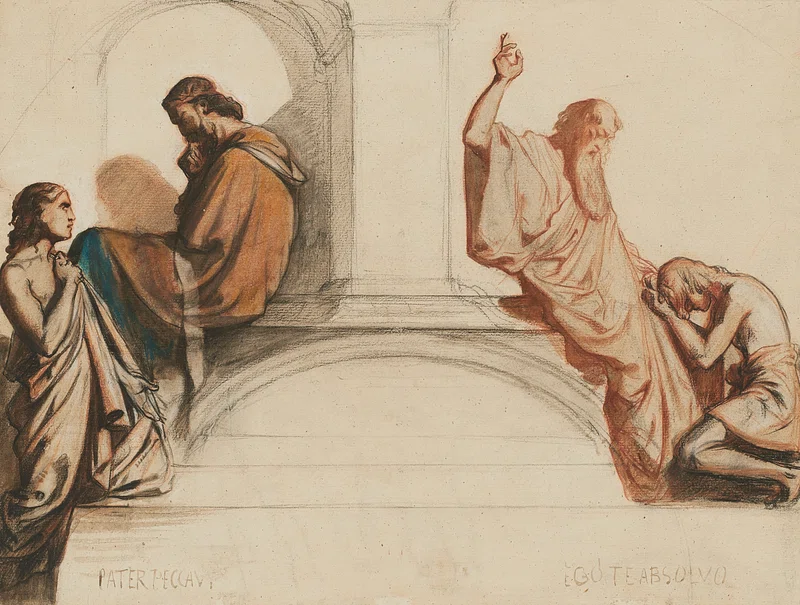
Credit: Universal CC 1.0
The Courage to Admit Need
Many people are not only ashamed of what they have done. They are ashamed of what they suffer. Loneliness feels like exposure. Weakness feels like failure. Need itself becomes something to hide.
Psalm 25 rejects that logic. The psalmist does not only confess sin. He confesses frailty. That is a different kind of humility. It is not merely moral honesty. It is existential honesty.
And… it is necessary. The one who refuses to admit need cannot take refuge. He can only manage appearances.
Refuge, Not Self-Construction
The psalm reaches its climax in a simple but profound statement:
“Let me not be put to shame, for I take refuge in you” (v. 20).
That line reorients the entire discussion. The opposite of shame is not self-esteem. It is refuge.
This is a critical distinction. Modern approaches to shame often focus on strengthening the self, such as improving self-image, building confidence, or achieving enough success to silence internal criticism.
Psalm 25 points elsewhere. The psalmist does not say, “Let me not be put to shame because I have proven myself.” He says, “because I have taken refuge in you.”
Refuge means that one’s safety is not self-generated. It’s received. It means that final vindication lies outside oneself.
The Role of God’s Character
This is why the psalm repeatedly recalls who God is.
He is merciful.
He is steadfast in love.
He is good and upright.
He teaches sinners.
He leads the humble.
The psalmist does not merely ask for help. He reasons from God’s character.
This is not abstract theology. It’s an existential necessity. A person gripped by the fear of shame needs more than reassurance. He needs a stable reference point outside himself.
The character of God provides that stability.
Integrity as the Shape of Waiting
The psalm concludes with an important clarification:
“May integrity and uprightness preserve me, for I wait for you” (v. 21).
Waiting on God is not passive. It has a moral shape.
This guards against two common distortions. Some people respond to shame by becoming hyper-performers, trying to secure themselves through flawless behavior. Others drift into compromise, deciding that integrity is too costly.
Psalm 25 rejects both. Integrity is not a strategy for self-justification. It is the proper path of the one who waits on God.
Treachery cannot save us from shame. It only deepens it.
A Word for Those Who Fear
Psalm 25 offers a coherent path forward.
Take refuge in the Lord
Learn his ways.
Wait for him.
Confess your sin.
Admit your affliction.
Remember who he is.
Walk in integrity.
None of these removes vulnerability. Together, they relocate it. They move it out of the unstable realm of self-protection and into the stability of God’s covenant faithfulness.
Conclusion
Psalm 25 understands how deeply the fear of shame can shape a life. It can make us defensive, controlling, and evasive. It can quietly push us toward treachery. But the psalm offers a better way.
Those who fear shame are not told to become less needy. They are told to become more honest and more dependent. They are told to take refuge in the Lord, to confess sin, to admit affliction, to seek his ways, and to wait for him.
The psalm’s confidence is not naive. It does not deny guilt, enemies, or inner distress. It simply insists that shame does not have the last word for those who entrust themselves to the God of steadfast love.
The treacherous will not ultimately succeed.
Those who wait for the Lord will not finally be put to shame.
Relationships and Religion
Family, Parenting and Religion
Previous Post

August 4, 2026
Psalm 25 and the Fear of Being Put to Shame (Part 1)
Next Post

September 1, 2026 America’s Crisis Is Deeper Than Politics
Recent Comments
"A thoughtful and thought-provoking article that raises important questions about the challenges facing the Western ..."
"to fit social or religious expectations. Especially women, who were expected to sacrifice everything to ..."
3 reasons you should not be ..."
"Powerful reminder short, sturdy truths can lose their weight if treated as slogans. The solas ..."
How Western Individualism Quietly Undermines the ..."
"If 'America’s deepest crisis is not merely political. It is moral and spiritual.' is in ..."
The Real Crisis Beneath America’s Social ..."
Browse Our Archives
Select a Category Atonement Biblical Theology Book Reviews China Chinese Church Chinese Culture Chinese Language Collectivism Contextualization Culture (General) Ecclesiology Evangelism Gospel Honor & Shame (Face) Interpretation/Exegesis Justification/Righteousness Missiology Mission Methods One Gospel for All Nations Other Practical Contextualization Reading Romans with Eastern Eyes Resources Romans Salvation (General) Saving God's Face Seeking God's Face The Cross in Context Theological Contextualization Theological Education Theology Uncategorized
Select a Month October 2026 September 2026 August 2026 July 2026 June 2026 May 2026 April 2026 March 2026 February 2026 January 2026 December 2025 November 2025 October 2025 September 2025 August 2025 July 2025 June 2025 May 2025 April 2025 March 2025 February 2025 January 2025 December 2024 November 2024 October 2024 September 2024 August 2024 July 2024 June 2024 May 2024 April 2024 March 2024 February 2024 January 2024 December 2023 November 2023 October 2023 September 2023 August 2023 July 2023 June 2023 May 2023 April 2023 March 2023 February 2023 January 2023 December 2022 November 2022 October 2022 September 2022 August 2022 July 2022 June 2022 May 2022 April 2022 March 2022 February 2022 January 2022 December 2021 November 2021 October 2021 September 2021 August 2021 July 2021 June 2021 May 2021 April 2021 March 2021 February 2021 January 2021 December 2020 November 2020 October 2020 September 2020 August 2020 July 2020 June 2020 May 2020 April 2020 March 2020 February 2020 January 2020 December 2019 November 2019 October 2019 September 2019 August 2019 July 2019 June 2019 May 2019 April 2019 March 2019 February 2019 January 2019 December 2018 November 2018 October 2018 September 2018 August 2018 July 2018 June 2018 May 2018 April 2018 March 2018 February 2018 January 2018 December 2017 November 2017 October 2017 September 2017 August 2017 July 2017 June 2017 May 2017 April 2017 March 2017 February 2017 January 2017 December 2016 November 2016 October 2016 September 2016 August 2016 July 2016 June 2016 May 2016 April 2016 March 2016 February 2016 January 2016 December 2015 November 2015 October 2015 September 2015 August 2015 July 2015 June 2015 May 2015 April 2015 March 2015 February 2015 January 2015 December 2014 November 2014 October 2014 September 2014 August 2014 July 2014 June 2014 May 2014 April 2014 March 2014 February 2014 January 2014 December 2013 November 2013 October 2013 September 2013 August 2013 July 2013 June 2013 May 2013 April 2013 March 2013 February 2013 January 2013 December 2012 November 2012
Follow Us!
TAKE THE
Religious Wisdom Quiz
What empire destroyed the Second Temple in Jerusalem?
Select your answer to see how you score.
Babylonian Roman Greek Assyrian
Books by This Author Books by Brad Vaughn
Related posts from Saving God's Face

No King forgets his crown. Why do we?

Recovering Moral Vision Between Shame and Shamelessness

Psalm 25 and the Fear of Being Put...
How Biblical Sacrifices Vindicate God’s Glory
TRENDING AT PATHEOS Evangelical

Emotion in Early Christianity by Andrew Crislip
Andrew Crislip’s Emotion in Early Christianity examines an often overlooked dimension of...

16 Spiritual Touchstones for a More Grounded Life
After decades of spiritual study, here are 16 principles I try...

Catholic Evangelization: Sharing Your Faith Every Day
Welcome back to the Graceful Awakening mini-series called, “From Faith to Mission.” ...

The Pillar of the Boatmen: the Ancient Monument...
The Pillar of the Boatmen is a Romano-Gaulish sculpture that dates from...

In one sense walking into Westminster Abbey is like walking down the...

'Super Scam Me' Exposes AI Jon Bon Jovi...
Leslie Pickett believed she was in a relationship with Jon Bon Jovi....
view all Evangelical blogs
What Are Your Thoughts?leave a comment
Ad-Free & Subscriber Log-In Subscription Support
- About Us
- 2026 Calendar
- Videos
- Podcasts
- Library of World Religions
- Faith In Media Tracker
- Advertise With Us
- Write for Us
- Privacy Policy
- Terms of Service
- Do Not Sell My Data
- Contact Us
- Radiant Digital
- Manage Newsletter Subscriptions
- Unsubscribe From Notifications
- Sitemap
Copyright 2008-2026, Patheos. All rights reserved.
Subscription Support Ad-Free & Subscriber Log-In
Follow Patheos