
BuddhistCatholicContemplativeEvangelicalGeneral ChristianHinduJewishLatter-day SaintMuslimNew VisionsProgressive Christian
Beliefs
- Buddhist
- Catholic
- Contemplative
- Evangelical
- General Christian
- Hindu
- Jewish
- Latter-day Saint
- More Voices
- Muslim
- New Visions
- Pagan
- Progressive Christian
Topics
- Religion News
- Food and Religion
- Sports and Religion
- Religious Art
- Religious Music and Entertainment
- Religious Events
- History and Religion
- Style and Religion
- Politics and Religion
- Women in Religion
- Recreation Outdoors and Religion
- Business Finance and Religion
- Careers Workplace and Religion
- Education and Religion
- Family Parenting and Religion
- Health Fitness and Religion
- Home and Religion
- Relationships and Religion
- Technology and Religion
- Travel and Religion
Columnists
- Buddhist Columnists
- Business Finance and Religion Columnists
- Careers Workplace and Religion Columnists
- Catholic Columnists
- Contemplative Columnists
- Education and Religion Columnists
- Evangelists Columnists
- Family Parenting and Religion Columnists
- General Christian Columnists
- Health Fitness and Religion Columnists
- Hindu Columnists
- History and Religion Columnists
- Home and Religion Columnists
- Jewish Columnists
- More Voices Columnists
- Latter Day Columnists
- Muslim Columnists
- New Visions Columnists
- Nonreligious Columnists
- Pagan Columnists
- Politics and Religion Columnists
- Progressive Columnists
- Recreation Outdoors and Religion Columnists
- Relationships and Religion Columnists
- Religion News Columnists
- Religious Art Columnists
- Religious Events Columnists
- Religious Music and Entertainment Columnists
- Sports and Religion Columnists
- Style and Religion Columnists
- Technology and Religion Columnists
- Travel and Religion Columnists
- Women in Religion Columnists
Resource Library
- 2026 Calendar
- Library of World Religions
- The 100 Most Holy Places on Earth
- Patheos Answers
- Podcasts
- Videos
- Faith Leaders Database
- Anglican Episcopalian
- Bahai
- Baptist
- Buddhism
- Christianity
- Confucianism
- Eastern Orthodoxy
- Hinduism
- Holiness and Pentecostal
- ISKCON
- Islam
- Judaism
- Lutheran
- Methodist
- The Church of Jesus Christ of Latter-day Saints
- New Age
- Paganism
- Presbytarian and Reformed
- Protestantism
- Religion Behind the Scenes
- Roman Catholic
- Scientology
- Shia Islam
- Sikhism
- Sufism
- Sunni Islam
- Taoism
- Zen
- See all religions
Research Tools
 Ad-Free & Subscriber Log-In Subscription Support
Ad-Free & Subscriber Log-In Subscription Support
Follow Patheos 

- Trending:
- Forgiveness
- |
- Marriage
- |
- Consciousness
- |
- Death Penalty
- |
- Election
- |
- Halloween

-
Tools
-
Support the Work
- Home
- Evangelical
- How Western Individualism Quietly Undermines the Solas
How Western Individualism Quietly Undermines the Solas
Last updated on: May 12, 2026 at 7:26 am by Brad Vaughn
How Western Individualism Quietly Undermines the Solas 2026-01-21T08:33:29-07:00 Brad Vaughn
Patheos Explore the world's faith through different perspectives on religion and spirituality! Patheos has the views of the prevalent religions and spiritualities of the world.

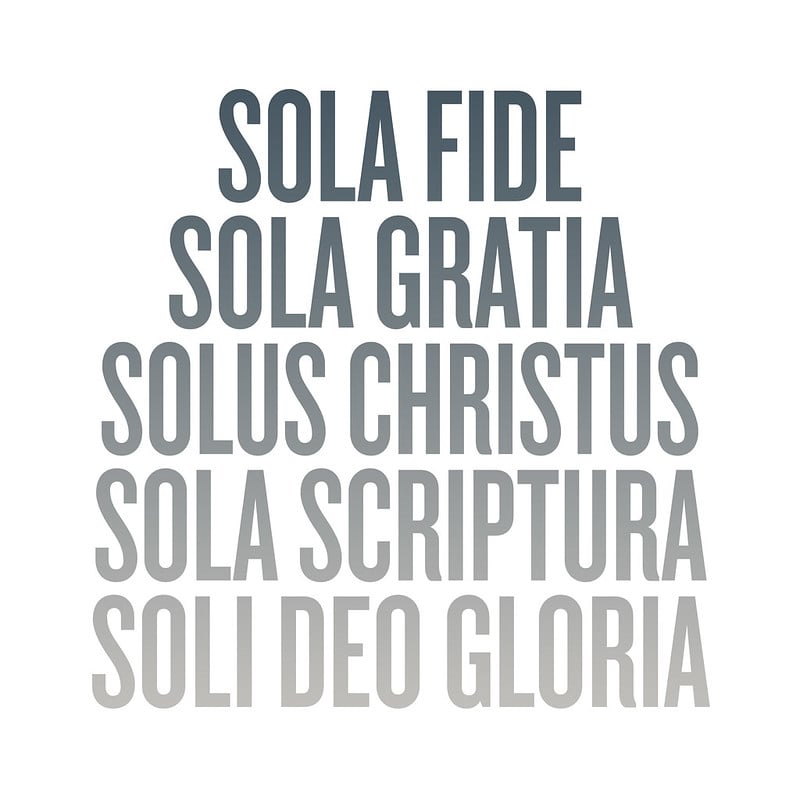
Evangelicals love the solas. They’re short, sturdy, and hard to wiggle out of. Scripture alone. Faith alone. Grace alone. Christ alone. God’s glory alone.
They remind us that Christianity is not a religion of self-improvement or of spiritual résumé-building but a means of rescue. Salvation doesn’t come from human effort, church credentials, or religious performance. Salvation comes from God.
Something strange, however, has happened in the modern West. In a lot of churches, the solas don’t function as anchors for the gospel anymore. They’ve become excuses. We still quote them, defend them, print them on banners, and build conference themes around them. Still, we increasingly use them to justify a posture of independence the Reformers were not trying to produce. The words stay, but the weight shifts.
Individualism: The Air We Breathe
That shift has a name: Western individualism. I don’t mean individuality. Christianity has never treated people as interchangeable units in a machine. We bear God’s image and are morally responsible. You and I will stand before God. You can’t borrow faith from your parents, outsource repentance to a pastor, nor hide behind “our group” on the last day.
But individualism isn’t merely the claim that the individual matters. It’s the assumption that the autonomous self is the highest authority. It trains us to treat the self as the final interpreter (“what I think this means”), the final judge (“what feels right”), and the final manager of identity (“who I am”). It’s so normal to us that we don’t notice it as a philosophy ideology. It just feels like reality.
Once that instinct settles into church life, it doesn’t usually announce itself. It doesn’t wave a red flag saying, “Hello, I’m here to corrupt your theology.” It just shows up as a default setting. It’s the silent assumption behind our reactions, habits, and instincts.
Why This Doesn’t Feel Like Compromise
This is why the danger is easy to miss. Western individualism rarely attacks Christians head-on. It’s more patient than that. It just translates Christian language into its own dialect. The vocabulary stays the same while the meaning slides somewhere else.
So you can affirm the solas sincerely and still use them in a way that keeps the self in charge. You can sound Reformational and still operate with thoroughly modern instincts. You can be “orthodox” on paper while practice a kind of Christianity rooted in personal autonomy.
In other words, it’s entirely possible to confess the solas yet still treat them as tools for independence rather than confessions of dependence. The result is a Protestantism that looks solid in its doctrinal statements but feels strangely weightless in its communal life. This “Christianity” feels less like a church being shaped by God’s Word and more like a collection of spiritual consumers protecting their freedom.
When “Alone” Turns Into “Leave Me Alone”
To see what’s happening, pay attention to one small word: alone.
The solas have a simple logic running through them. God is the source. God is the authority. God is the Savior. God is the glory. They aren’t five disconnected ideas. They are one unified claim: salvation is God’s work from start to finish, and therefore God alone gets the credit.
In the Reformation, “alone” was a theological word. It was meant to exclude rivals. Not faith plus merit. Not grace plus earning. Not Christ plus extra mediators. Not Scripture plus an infallible magisterium. Not God’s glory plus human boasting. “Alone” meant God is sufficient.
Western individualism, however, hears “alone” and instinctively turns it into an autonomy word. “Alone” becomes less about God’s sufficiency and more about my independence. Instead of hearing, “God is the decisive authority and saving agent,” we hear, “I don’t need anyone else.”
Credit: Flickr/x1brett
That’s where things go sideways. Once “alone” becomes “I’m alone,” the solas stop working like gospel guardrails and start working like spiritual insulation. They become ways to protect myself from being challenged, corrected, or bound to anyone outside my own inner world.
What This Sounds Like on the Ground
You can hear this individualistic translation in the kinds of sentences Christians say without even thinking:
“It’s just me and Jesus.”
“I don’t need the church.”
“No one can tell me what the Bible means.”
“My faith is personal.”
“God knows my heart.”
These statements often sound humble because they sound non-institutional. Of course, in a world where plenty of institutions deserve criticism, that posture can feel pure. It can feel like courage. It can feel like maturity.
However, these phrases aren’t neutral. They aren’t timeless Christian wisdom. They’re modern Western instincts wearing Christian clothing, reflecting a culture that’s suspicious of authority and allergic to obligation. And guess what…. the self ends up as the final judge.
I’ve seen this play out in ordinary conversations where someone pushes back and says, “That’s just your interpretation.” Sometimes that’s a fair caution. Often, though, what it really means is, “No one gets to tell me what this text demands of me.” The posture isn’t humility. It’s untouchability.
Yes, Church Hurt Is Real
At this point someone will say, “But spiritual abuse is real.” Yes it is. “Institutions can become corrupt.” Absolutely. “Legalism can twist the gospel.” Of course. A person who has been manipulated by authority will often swing hard toward independence, and that reaction makes emotional sense.
Still, we still have to say this clearly: the solution to corrupted authority is not the elimination of authority. It’s the reform of authority under Christ and His Word. A person can be freed from abuse and still end up captured by individualism, because trauma and autonomy make easy allies. “No one can tell me what to do” can feel like healing.
Healing is not the same as holiness. Independence is not the same as maturity.
The Reformers were not trying to produce churchless Christianity. They were trying to produce a gospel-centered church, re-formed by Scripture, anchored in grace, centered on Christ, and aimed at the glory of God. The solas were never meant to be weapons against the church. They were meant to rescue the church from false gospels, false authorities, and false grounds of confidence.
A Simple Test
Here’s a quick test for whether the solas are functioning in a Reformational way or an individualist way. Ask what the word “alone” does to you.
When you say, “Scripture alone,” do you become more accountable to the Word, or more insulated from correction? When you say, “faith alone,” do you become more dependent on Christ or more protected from evaluation? When you say, “grace alone,” do you become more grateful and humbled or more entitled? When you say, “Christ alone,” do you move toward Christ’s people or away from them? When you say, “to God alone be glory,” do you feel decentered or simply reassured that God approves of your preferences?
That’s not a trick question. It’s diagnostic. It reveals whether “alone” functions as worship or self-defense.
Where We Go Next
Western individualism doesn’t typically destroy Christianity by denying it. It hollows it out by recentering it. It trains us to treat doctrine as personal property rather than a shared confession. It trains us to treat the church as a consumer choice rather than a covenant family. If we aren’t careful, it trains us to treat autonomy as maturity.
In the posts that follow, I’m going to show how this same dynamic plays out in each of the solas. The pattern will stay consistent. Each sola begins as a confession of God’s sufficiency, and then individualism quietly reframes it as a tool for self-rule.
Recovering the solas in our day, then, isn’t mainly about getting the slogans right. It’s about recovering the posture the slogans were meant to produce: dependence on God, together, as His people, under His Word, through His Christ, by His grace, for His glory.
Previous Post

April 28, 2026
Why Do I Wear a Guillotine Around My Neck?
Next Post

May 26, 2026 The Sin of Most Political Debates Isn’t What You Think
Recent Comments
"A thoughtful and thought-provoking article that raises important questions about the challenges facing the Western ..."
"to fit social or religious expectations. Especially women, who were expected to sacrifice everything to ..."
3 reasons you should not be ..."
"Powerful reminder short, sturdy truths can lose their weight if treated as slogans. The solas ..."
How Western Individualism Quietly Undermines the ..."
"If 'America’s deepest crisis is not merely political. It is moral and spiritual.' is in ..."
The Real Crisis Beneath America’s Social ..."
Browse Our Archives
Select a Category Atonement Biblical Theology Book Reviews China Chinese Church Chinese Culture Chinese Language Collectivism Contextualization Culture (General) Ecclesiology Evangelism Gospel Honor & Shame (Face) Interpretation/Exegesis Justification/Righteousness Missiology Mission Methods One Gospel for All Nations Other Practical Contextualization Reading Romans with Eastern Eyes Resources Romans Salvation (General) Saving God's Face Seeking God's Face The Cross in Context Theological Contextualization Theological Education Theology Uncategorized
Select a Month October 2026 September 2026 August 2026 July 2026 June 2026 May 2026 April 2026 March 2026 February 2026 January 2026 December 2025 November 2025 October 2025 September 2025 August 2025 July 2025 June 2025 May 2025 April 2025 March 2025 February 2025 January 2025 December 2024 November 2024 October 2024 September 2024 August 2024 July 2024 June 2024 May 2024 April 2024 March 2024 February 2024 January 2024 December 2023 November 2023 October 2023 September 2023 August 2023 July 2023 June 2023 May 2023 April 2023 March 2023 February 2023 January 2023 December 2022 November 2022 October 2022 September 2022 August 2022 July 2022 June 2022 May 2022 April 2022 March 2022 February 2022 January 2022 December 2021 November 2021 October 2021 September 2021 August 2021 July 2021 June 2021 May 2021 April 2021 March 2021 February 2021 January 2021 December 2020 November 2020 October 2020 September 2020 August 2020 July 2020 June 2020 May 2020 April 2020 March 2020 February 2020 January 2020 December 2019 November 2019 October 2019 September 2019 August 2019 July 2019 June 2019 May 2019 April 2019 March 2019 February 2019 January 2019 December 2018 November 2018 October 2018 September 2018 August 2018 July 2018 June 2018 May 2018 April 2018 March 2018 February 2018 January 2018 December 2017 November 2017 October 2017 September 2017 August 2017 July 2017 June 2017 May 2017 April 2017 March 2017 February 2017 January 2017 December 2016 November 2016 October 2016 September 2016 August 2016 July 2016 June 2016 May 2016 April 2016 March 2016 February 2016 January 2016 December 2015 November 2015 October 2015 September 2015 August 2015 July 2015 June 2015 May 2015 April 2015 March 2015 February 2015 January 2015 December 2014 November 2014 October 2014 September 2014 August 2014 July 2014 June 2014 May 2014 April 2014 March 2014 February 2014 January 2014 December 2013 November 2013 October 2013 September 2013 August 2013 July 2013 June 2013 May 2013 April 2013 March 2013 February 2013 January 2013 December 2012 November 2012
Follow Us!
TAKE THE
Religious Wisdom Quiz
Which parable features a man building on rock versus sand?
Select your answer to see how you score.
The Talents The Sower The Wise and Foolish Builders The Workers in the Vineyard
Books by This Author Books by Brad Vaughn
Related posts from Saving God's Face

The Real Crisis Beneath America’s Social Crises (Part...

America’s Crisis Is Deeper Than Politics

Independent Thinking Isn’t What You Think

The Gulag Theology of One Day in the...
TRENDING AT PATHEOS Evangelical

The Sermon on the Mount, Part I: Matthew...
The Sermon on the Mount, Part I (Matthew 4:12-5:12) St. Matthew moves...

What's up from Crossway: Reviewing some of their latest A few weeks...

Janie Learns the Way of the Cross: A...
Teaching children about Jesus' Passion can be challenging. Many parents and educators...

Looking For Good Catholic Writing - October 2026
He alone extends the heavens, and he walks upon the waves of...

In "Irreplaceable," our book on vocation and technology, Trevor Sutton and I...

I was strolling through the top floor of the brand new Parthenon...
view all Evangelical blogs
What Are Your Thoughts?leave a comment
Ad-Free & Subscriber Log-In Subscription Support
- About Us
- 2026 Calendar
- Videos
- Podcasts
- Library of World Religions
- Faith In Media Tracker
- Advertise With Us
- Write for Us
- Privacy Policy
- Terms of Service
- Do Not Sell My Data
- Contact Us
- Radiant Digital
- Manage Newsletter Subscriptions
- Unsubscribe From Notifications
- Sitemap
Copyright 2008-2026, Patheos. All rights reserved.
Subscription Support Ad-Free & Subscriber Log-In
Follow Patheos