
BuddhistCatholicContemplativeEvangelicalGeneral ChristianHinduJewishLatter-day SaintMuslimNew VisionsProgressive Christian
Beliefs
- Buddhist
- Catholic
- Contemplative
- Evangelical
- General Christian
- Hindu
- Jewish
- Latter-day Saint
- More Voices
- Muslim
- New Visions
- Pagan
- Progressive Christian
Topics
- Religion News
- Food and Religion
- Sports and Religion
- Religious Art
- Religious Music and Entertainment
- Religious Events
- History and Religion
- Style and Religion
- Politics and Religion
- Women in Religion
- Recreation Outdoors and Religion
- Business Finance and Religion
- Careers Workplace and Religion
- Education and Religion
- Family Parenting and Religion
- Health Fitness and Religion
- Home and Religion
- Relationships and Religion
- Technology and Religion
- Travel and Religion
Columnists
- Buddhist Columnists
- Business Finance and Religion Columnists
- Careers Workplace and Religion Columnists
- Catholic Columnists
- Contemplative Columnists
- Education and Religion Columnists
- Evangelists Columnists
- Family Parenting and Religion Columnists
- General Christian Columnists
- Health Fitness and Religion Columnists
- Hindu Columnists
- History and Religion Columnists
- Home and Religion Columnists
- Jewish Columnists
- More Voices Columnists
- Latter Day Columnists
- Muslim Columnists
- New Visions Columnists
- Nonreligious Columnists
- Pagan Columnists
- Politics and Religion Columnists
- Progressive Columnists
- Recreation Outdoors and Religion Columnists
- Relationships and Religion Columnists
- Religion News Columnists
- Religious Art Columnists
- Religious Events Columnists
- Religious Music and Entertainment Columnists
- Sports and Religion Columnists
- Style and Religion Columnists
- Technology and Religion Columnists
- Travel and Religion Columnists
- Women in Religion Columnists
Resource Library
- 2026 Calendar
- Library of World Religions
- The 100 Most Holy Places on Earth
- Patheos Answers
- Podcasts
- Videos
- Faith Leaders Database
- Anglican Episcopalian
- Bahai
- Baptist
- Buddhism
- Christianity
- Confucianism
- Eastern Orthodoxy
- Hinduism
- Holiness and Pentecostal
- ISKCON
- Islam
- Judaism
- Lutheran
- Methodist
- The Church of Jesus Christ of Latter-day Saints
- New Age
- Paganism
- Presbytarian and Reformed
- Protestantism
- Religion Behind the Scenes
- Roman Catholic
- Scientology
- Shia Islam
- Sikhism
- Sufism
- Sunni Islam
- Taoism
- Zen
- See all religions
Research Tools
 Ad-Free & Subscriber Log-In Subscription Support
Ad-Free & Subscriber Log-In Subscription Support
Follow Patheos 

- Trending:
- Forgiveness
- |
- Marriage
- |
- Consciousness
- |
- Death Penalty
- |
- Election
- |
- Halloween

-
Tools
-
Support the Work
- Home
- Evangelical
- Politics and Religion
- Glory, Violence, and the Gospel of Peace
Glory, Violence, and the Gospel of Peace
Last updated on: June 10, 2025 at 4:48 am by Brad Vaughn
Glory, Violence, and the Gospel of Peace 2025-05-12T14:18:43-07:00 Brad Vaughn
Patheos Explore the world's faith through different perspectives on religion and spirituality! Patheos has the views of the prevalent religions and spiritualities of the world.
Today’s guest post by Werner Mischke is an excerpt from his new book One New Humanity: Glory, Violence, and the Gospel of Peace (WCP, 2025), 206–08. It’s available at MissionBooks.org, Amazon.com, and other major retailers. Check out the book website, which includes short videos for each chapter.
Note: In Appendix 1, I contributed an exegetical article, “Reconciling Atonement in Ephesians 2: An exegetical approach.” This 10,000-word theological article examines the often-overlooked text of Ephesians 2:11-22 relative to the doctrine of atonement.
Depolarizing the Disciples
Consider also Jesus’s twelve disciples. Jesus calls Simon (later named Peter) and Andrew (Mark 1:16-20). Socially, they are Jewish peasants. From their earnings as fishermen, we imagine they would grudgingly pay taxes to Rome. Not only because they need every penny to support their families, but because their land and people are forced to exist under pagan Roman rule.
Then there is Levi (or Matthew), a tax collector. Jesus calls him, too, to join his band of disciples (Matt 9:9-10). Matthew collects taxes from his own Jewish community to support the Roman state. To faithful Jews, Matthew is a traitor. Luke tells us that Matthew made for Jesus “a great feast in his home, and there was a large company of tax collectors and others reclining at table with them” (Luke 5:29). Matthew was wealthy, upper class. We wonder: how surprised, how offended, were Simon and Andrew when they learned Jesus chose a traitor, a hated tax collector, to join their in-group?
At the other end of the spectrum is Simon the Zealot.[1] The name “Zealot” could have meant he was a member of an underground resistance group fighting for independence from Rome (i.e., a man of violence). If so, it is possible that Simon the Zealot might have wanted to kill Matthew the tax collector for Matthew’s complicity with unclean idolatrous Rome. Al Tizon comments, “No one dared to bring together fishermen, whom the state heavily taxed, and Matthew, who collected those taxes on behalf of the state. And to add fuel to the fire, Jesus invited Simon the Zealot, someone bent on overthrowing the Roman state, to join the group.”[2]
Finally, we add faithful women to Jesus’s group, likely of various social classes. These women provided for Jesus and the disciples “out of their means” (Luke 8:1-3). Women supporting Jesus and his (male) disciples? It’s a shocking inversion of traditional gender roles.
Luke is hinting at the subversive nature of Jesus’s unusual community. What matters is this: Jesus holds the group together. Jesus himself depolarizes and unites diverse persons and perspectives among his followers, as figure 12.8 below illustrates. Allegiance to Christ as sovereign Lord and truest human being relativizes lesser loyalties, lesser allegiances, lesser glories.
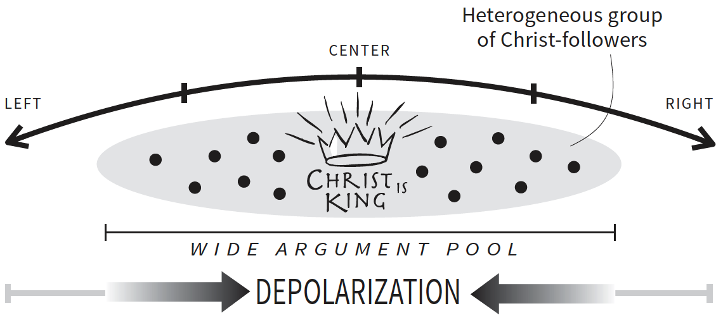
Figure 12.8: Depolarization through allegiance to Christ the King
So, although group identity is often a potent source of polarization, when our identity is primarily in King Jesus, he is the depolarizing source of our unity in diversity. “Identity can be used to divide, but it can and has also been used to integrate.”[3]
This begs the question: To what degree does your local church offer this asset—the ministry of depolarization—to the world? Is this not an under-leveraged ministry of the church of our Lord Jesus Christ? Is this diversity-loving Jesus an outlier, a “woke” part of God, who happens to be a lot nicer than some bigger, truer, holier God? I jest. Obviously not.
This is Jesus revealing the true God. Jesus said, “I and the Father are one” (John 10:30). “Whoever has seen me has seen the Father” (John 14:9). God really is like Jesus, who loves, forgives, and transforms human enemies. Jesus brings persons and peoples together across social boundaries. “He is the radiance of the glory of God and the exact imprint of his nature” (Heb 1:3).
Depolarization in Ephesians 2
We see this same Jesus-centered reconciliation and depolarization in Ephesians 2:11–22. When Paul writes to the early Christian communities in and around Ephesus, he is advocating for local churches to embody the “one new man” (Gk., anthrōpos, humanity).
Paul is the former super-zealous Pharisee (Phil 3:5–6); in his prior life he was committed to separation from all-things-gentile. Now Paul is a slave of Christ and apostle to the Gentiles. He zealously advocates for a reconciled Jew-and-gentile assembly (Gal 2:11–14; Eph 2:11–22), a fellowship of peoples previously in conflict for centuries. This miracle of peace happens only one Way—through mutual allegiance to Christ the King whose body was crucified, and whose blood was shed to break down “the dividing wall of hostility” (Eph 2:13–16).
Why am I emphasizing this aspect of Christ?
The HUP [Homogenous Unit Principle] has silently and broadly shaped the American evangelical community. “It was a missional principle, and when it came to the US, it became a marketing principle: how to gather more people like us … mission morphed into marketing.”[4] For too long evangelicals have settled for homogenous units as a standard framework for gaining converts, starting churches, sustaining churches, and building community.
But in our increasingly diverse cities, many workplaces, the military, and other communities, this doesn’t look like Jesus. And the world knows it. “Whereas the world recognizes that segregation is a kind of moral failure, in the evangelical church it is basically a go-to strategy. Instead of seeking to be unified in our diversity, we segregate into communities that look alike, make similar amounts of money, appreciate the same kinds of music, and share the same social status.”[5]
In our broken world of social divisions and polarization, of violence and political tribalism, bullying, and unprecedented demographic shifts, of wars born of imperial or tribal jealousies, of social media shouting matches, of mass migrations and 100 million forcibly displaced persons[6]—what does it mean to follow Jesus?
[1] Matt 10:4; Luke 6:15; Mark 3:18; Acts 1:18.
[2] Tizon, Christ Among the Classes, 17.
[3] Fukuyama, Identity, Kindle loc 2552.
[4] Quote from Fuller Seminary professor Eddie Gibbs in Bishop, The Big Sort, 181.
[5] Goggin and Strobel, The Way of the Dragon or the Way of the Lamb, 203.
[6] UNHCR, “More than 100 Million People Are Forcibly Displaced.”
Politics and Religion
History and Religion
Previous Post

May 27, 2025
Praise Is Not a Proxy for God’s Acceptance
Next Post
June 24, 2025 Hypocrisy in the Bible. Doing Right Things for Wrong Reasons
Recent Comments
Browse Our Archives
Select a Category Atonement Biblical Theology Book Reviews China Chinese Church Chinese Culture Chinese Language Collectivism Contextualization Culture (General) Ecclesiology Evangelism Gospel Honor & Shame (Face) Interpretation/Exegesis Justification/Righteousness Missiology Mission Methods One Gospel for All Nations Other Practical Contextualization Reading Romans with Eastern Eyes Resources Romans Salvation (General) Saving God's Face Seeking God's Face The Cross in Context Theological Contextualization Theological Education Theology Uncategorized
Select a Month October 2026 September 2026 August 2026 July 2026 June 2026 May 2026 April 2026 March 2026 February 2026 January 2026 December 2025 November 2025 October 2025 September 2025 August 2025 July 2025 June 2025 May 2025 April 2025 March 2025 February 2025 January 2025 December 2024 November 2024 October 2024 September 2024 August 2024 July 2024 June 2024 May 2024 April 2024 March 2024 February 2024 January 2024 December 2023 November 2023 October 2023 September 2023 August 2023 July 2023 June 2023 May 2023 April 2023 March 2023 February 2023 January 2023 December 2022 November 2022 October 2022 September 2022 August 2022 July 2022 June 2022 May 2022 April 2022 March 2022 February 2022 January 2022 December 2021 November 2021 October 2021 September 2021 August 2021 July 2021 June 2021 May 2021 April 2021 March 2021 February 2021 January 2021 December 2020 November 2020 October 2020 September 2020 August 2020 July 2020 June 2020 May 2020 April 2020 March 2020 February 2020 January 2020 December 2019 November 2019 October 2019 September 2019 August 2019 July 2019 June 2019 May 2019 April 2019 March 2019 February 2019 January 2019 December 2018 November 2018 October 2018 September 2018 August 2018 July 2018 June 2018 May 2018 April 2018 March 2018 February 2018 January 2018 December 2017 November 2017 October 2017 September 2017 August 2017 July 2017 June 2017 May 2017 April 2017 March 2017 February 2017 January 2017 December 2016 November 2016 October 2016 September 2016 August 2016 July 2016 June 2016 May 2016 April 2016 March 2016 February 2016 January 2016 December 2015 November 2015 October 2015 September 2015 August 2015 July 2015 June 2015 May 2015 April 2015 March 2015 February 2015 January 2015 December 2014 November 2014 October 2014 September 2014 August 2014 July 2014 June 2014 May 2014 April 2014 March 2014 February 2014 January 2014 December 2013 November 2013 October 2013 September 2013 August 2013 July 2013 June 2013 May 2013 April 2013 March 2013 February 2013 January 2013 December 2012 November 2012
Follow Us!
TAKE THE
Religious Wisdom Quiz
Which country has the largest number of Christians?
Select your answer to see how you score.
United States Germany Russia Brazil
Books by This Author Books by Brad Vaughn
Related posts from Saving God's Face

No King forgets his crown. Why do we?

Recovering Moral Vision Between Shame and Shamelessness

Refuge, Confession, and the End of Shame

Psalm 25 and the Fear of Being Put...
TRENDING AT PATHEOS Evangelical

Pope Leo Celebrates Mass for Nurses & Docs...
I don't have any idea how he did it, but Pope Leo...

The Sermon on the Mount, Part I: Matthew...
The Sermon on the Mount, Part I (Matthew 4:12-5:12) St. Matthew moves...

What's up from Crossway: Reviewing some of their latest A few weeks...

Janie Learns the Way of the Cross: A...
Teaching children about Jesus' Passion can be challenging. Many parents and educators...

Looking For Good Catholic Writing - October 2026
He alone extends the heavens, and he walks upon the waves of...

In "Irreplaceable," our book on vocation and technology, Trevor Sutton and I...
view all Evangelical blogs
What Are Your Thoughts?leave a comment
Ad-Free & Subscriber Log-In Subscription Support
- About Us
- 2026 Calendar
- Videos
- Podcasts
- Library of World Religions
- Faith In Media Tracker
- Advertise With Us
- Write for Us
- Privacy Policy
- Terms of Service
- Do Not Sell My Data
- Contact Us
- Radiant Digital
- Manage Newsletter Subscriptions
- Unsubscribe From Notifications
- Sitemap
Copyright 2008-2026, Patheos. All rights reserved.
Subscription Support Ad-Free & Subscriber Log-In
Follow Patheos