
BuddhistCatholicContemplativeEvangelicalGeneral ChristianHinduJewishLatter-day SaintMuslimNew VisionsProgressive Christian
Beliefs
- Buddhist
- Catholic
- Contemplative
- Evangelical
- General Christian
- Hindu
- Jewish
- Latter-day Saint
- More Voices
- Muslim
- New Visions
- Pagan
- Progressive Christian
Topics
- Religion News
- Food and Religion
- Sports and Religion
- Religious Art
- Religious Music and Entertainment
- Religious Events
- History and Religion
- Style and Religion
- Politics and Religion
- Women in Religion
- Recreation Outdoors and Religion
- Business Finance and Religion
- Careers Workplace and Religion
- Education and Religion
- Family Parenting and Religion
- Health Fitness and Religion
- Home and Religion
- Relationships and Religion
- Technology and Religion
- Travel and Religion
Columnists
- Buddhist Columnists
- Business Finance and Religion Columnists
- Careers Workplace and Religion Columnists
- Catholic Columnists
- Contemplative Columnists
- Education and Religion Columnists
- Evangelists Columnists
- Family Parenting and Religion Columnists
- General Christian Columnists
- Health Fitness and Religion Columnists
- Hindu Columnists
- History and Religion Columnists
- Home and Religion Columnists
- Jewish Columnists
- More Voices Columnists
- Latter Day Columnists
- Muslim Columnists
- New Visions Columnists
- Nonreligious Columnists
- Pagan Columnists
- Politics and Religion Columnists
- Progressive Columnists
- Recreation Outdoors and Religion Columnists
- Relationships and Religion Columnists
- Religion News Columnists
- Religious Art Columnists
- Religious Events Columnists
- Religious Music and Entertainment Columnists
- Sports and Religion Columnists
- Style and Religion Columnists
- Technology and Religion Columnists
- Travel and Religion Columnists
- Women in Religion Columnists
Resource Library
- 2026 Calendar
- Library of World Religions
- The 100 Most Holy Places on Earth
- Patheos Answers
- Podcasts
- Videos
- Faith Leaders Database
- Anglican Episcopalian
- Bahai
- Baptist
- Buddhism
- Christianity
- Confucianism
- Eastern Orthodoxy
- Hinduism
- Holiness and Pentecostal
- ISKCON
- Islam
- Judaism
- Lutheran
- Methodist
- The Church of Jesus Christ of Latter-day Saints
- New Age
- Paganism
- Presbytarian and Reformed
- Protestantism
- Religion Behind the Scenes
- Roman Catholic
- Scientology
- Shia Islam
- Sikhism
- Sufism
- Sunni Islam
- Taoism
- Zen
- See all religions
Research Tools
 Ad-Free & Subscriber Log-In Subscription Support
Ad-Free & Subscriber Log-In Subscription Support
Follow Patheos 

- Trending:
- Forgiveness
- |
- Marriage
- |
- Consciousness
- |
- Death Penalty
- |
- Election
- |
- Halloween

-
Tools
-
Support the Work
- Home
- Evangelical
- Politics and Religion
- Treating Culture as a Sacred Creed Has Consequences
Treating Culture as a Sacred Creed Has Consequences
Last updated on: March 26, 2024 at 7:29 am by Brad Vaughn
Treating Culture as a Sacred Creed Has Consequences 2024-03-26T07:29:36-07:00 Brad Vaughn
Patheos Explore the world's faith through different perspectives on religion and spirituality! Patheos has the views of the prevalent religions and spiritualities of the world.
Americans now treat culture as a sacred creed. This sacralization of culture in American society has led to a notable shift in the social dynamics of the country (as I shared in my previous post). As cultural identity ascends to a place of sacrosanct significance, it fosters a robust in-group loyalty that is double-edged.
When We Idolize Cultural Identity
On one edge, this loyalty enhances the understanding and appreciation of one’s heritage, leading to a vibrant mosaic of community life and personal identity. Individuals within these cultural enclaves can experience a profound sense of belonging and solidarity, often resulting in strong support networks and a resilient sense of self.
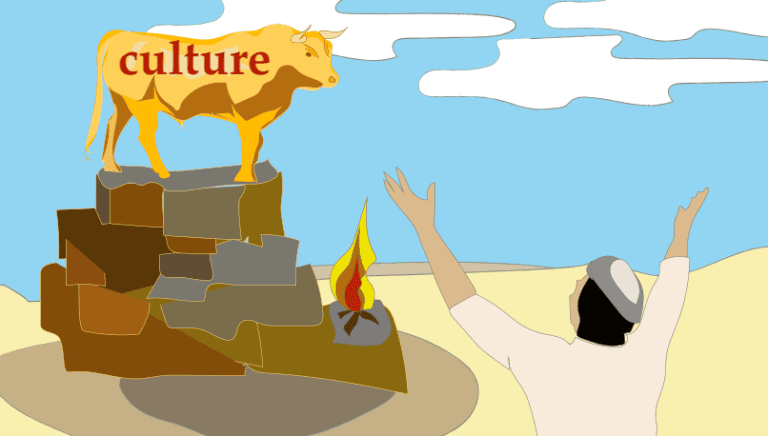
However, the other edge of this loyalty can be sharp and divisive. The intense focus on cultural identity can lead to siloing, a phenomenon where individuals become insular within their cultural groups, engaging less with those outside their immediate cultural sphere.
This insularity may not be intentional, but the outcome is the same: a societal fragmentation where the common ground—once the hallmark of the American experiment—is slowly eroded. Cultural absolutism (the idea that one’s cultural practices and beliefs are the supreme guide for life) can take root, leaving little room for the mutual exchange of ideas and traditions.
One can never compromise one’s most sacred creed.
This dynamic is not just theoretical; it manifests in neighborhoods, schools, workplaces, and places of worship. Communities may self-segregate, not just in terms of physical space but in the realm of ideas and shared experiences. The rich potential for cross-cultural interaction and learning is diminished when cultural identities are held as infallible.
Challenges to Dialogue and Integration
Treating culture as sacred poses significant challenges to dialogue and integration, especially in a pluralistic society like the United States. When cultural norms and values are positioned beyond the realm of questioning, it effectively stifles open dialogue and the exchange of ideas. This hindrance is problematic because it impedes the kind of constructive criticism and robust debate that leads to societal growth and understanding.
In a country where diverse cultures have historically come together to form a more unified whole, the inability to critique or discuss aspects of cultural identity can create barriers to understanding. When individuals from different cultural backgrounds meet, the unwillingness to engage in dialogue about cultural differences can lead to misunderstandings and missed opportunities for cooperation.
Instead of a melting pot or a mosaic, society risks becoming a series of monoliths, impressive yet isolated.
The Role of Education and Awareness
What can be done? To address the challenges posed by the sacralization of culture, education and awareness must play pivotal roles.
Education not only bears responsibility for imparting knowledge of the richness and diversity of cultural identities, but it also cultivates skills necessary for critical thinking and respectful discourse. Schools have the power to facilitate understanding and promote the value of questioning and dialogue. It can do so by integrating into its curriculum the histories and perspectives of various cultures in a manner that encourages students to appreciate diversity while also engaging critically with all forms of cultural expression.
Put simply, it’s about teaching each generation to approach cultural norms with both reverence and a healthy dose of skepticism, ensuring that respect for cultural diversity does not preclude the examination of its practices and beliefs.
Of course, awareness initiatives help to bridge gaps rather than deepen them. This can be achieved through churches, community programs, media campaigns, and public discourse that highlight both the uniqueness of cultures and the universal human experiences that connect them. Such initiatives can demystify otherness, encouraging individuals to see beyond the cultural veneer to the shared human beneath.
Without question, people will become upset with we challenge their cultural idols. But we must recall that not exposing such idolatry only deepened the problem and its inevitable consequences. Aside from the social conflagration that will eventually occur, should we not pursue humility within our communities and society?
Cultural idolatry creates unteachable and arrogant bullies. A cultural creed can have that effect.
Navigating the Terrain of Sacred Cultures
The path forward is a delicate one, requiring a balance that respects cultural diversity while also embracing a shared human experience. It involves recognizing the intrinsic value of each culture’s contribution to the collective human story while also acknowledging that no culture is above examination or evolution. The challenge lies in honoring the sacredness of cultural identity without letting it become a barrier to integration and mutual understanding.
The sacralization (“making sacred”) of culture and cultural identity in American society is, indeed, a reflection of a shifting landscape of belief and belonging. It provides a sense of identity and continuity for many, anchoring them in a tradition that gives their life meaning and context. However, it also brings to the forefront the challenges to social cohesion and open dialogue.
Navigating this terrain is one of the great tasks of contemporary society. It requires finding a balance between the need for cultural reverence and the necessity for dialogue and integration. As the American narrative continues to unfold, the role of culture as a source of identity and meaning will undoubtedly remain a central theme. Yet, there is hope in the possibility of crafting communities that, while rich in cultural diversity, are united by a commitment to a shared understanding of the gospel and love for Christ.
Politics and Religion
History and Religion
Previous Post

March 19, 2024
When Cultural Identity Becomes Sacred
Next Post

April 2, 2024 10 Principles for Reading the Bible Missionally
Recent Comments
"A thoughtful and thought-provoking article that raises important questions about the challenges facing the Western ..."
"to fit social or religious expectations. Especially women, who were expected to sacrifice everything to ..."
3 reasons you should not be ..."
"Powerful reminder short, sturdy truths can lose their weight if treated as slogans. The solas ..."
How Western Individualism Quietly Undermines the ..."
"If 'America’s deepest crisis is not merely political. It is moral and spiritual.' is in ..."
The Real Crisis Beneath America’s Social ..."
Browse Our Archives
Select a Category Atonement Biblical Theology Book Reviews China Chinese Church Chinese Culture Chinese Language Collectivism Contextualization Culture (General) Ecclesiology Evangelism Gospel Honor & Shame (Face) Interpretation/Exegesis Justification/Righteousness Missiology Mission Methods One Gospel for All Nations Other Practical Contextualization Reading Romans with Eastern Eyes Resources Romans Salvation (General) Saving God's Face Seeking God's Face The Cross in Context Theological Contextualization Theological Education Theology Uncategorized
Select a Month October 2026 September 2026 August 2026 July 2026 June 2026 May 2026 April 2026 March 2026 February 2026 January 2026 December 2025 November 2025 October 2025 September 2025 August 2025 July 2025 June 2025 May 2025 April 2025 March 2025 February 2025 January 2025 December 2024 November 2024 October 2024 September 2024 August 2024 July 2024 June 2024 May 2024 April 2024 March 2024 February 2024 January 2024 December 2023 November 2023 October 2023 September 2023 August 2023 July 2023 June 2023 May 2023 April 2023 March 2023 February 2023 January 2023 December 2022 November 2022 October 2022 September 2022 August 2022 July 2022 June 2022 May 2022 April 2022 March 2022 February 2022 January 2022 December 2021 November 2021 October 2021 September 2021 August 2021 July 2021 June 2021 May 2021 April 2021 March 2021 February 2021 January 2021 December 2020 November 2020 October 2020 September 2020 August 2020 July 2020 June 2020 May 2020 April 2020 March 2020 February 2020 January 2020 December 2019 November 2019 October 2019 September 2019 August 2019 July 2019 June 2019 May 2019 April 2019 March 2019 February 2019 January 2019 December 2018 November 2018 October 2018 September 2018 August 2018 July 2018 June 2018 May 2018 April 2018 March 2018 February 2018 January 2018 December 2017 November 2017 October 2017 September 2017 August 2017 July 2017 June 2017 May 2017 April 2017 March 2017 February 2017 January 2017 December 2016 November 2016 October 2016 September 2016 August 2016 July 2016 June 2016 May 2016 April 2016 March 2016 February 2016 January 2016 December 2015 November 2015 October 2015 September 2015 August 2015 July 2015 June 2015 May 2015 April 2015 March 2015 February 2015 January 2015 December 2014 November 2014 October 2014 September 2014 August 2014 July 2014 June 2014 May 2014 April 2014 March 2014 February 2014 January 2014 December 2013 November 2013 October 2013 September 2013 August 2013 July 2013 June 2013 May 2013 April 2013 March 2013 February 2013 January 2013 December 2012 November 2012
Follow Us!
TAKE THE
Religious Wisdom Quiz
Who was Jeremiah's faithful secretary and scribe?
Select your answer to see how you score.
Baruch Eliakim Micah Zephaniah
Books by This Author Books by Brad Vaughn
Related posts from Saving God's Face

The Real Crisis Beneath America’s Social Crises (Part...

America’s Crisis Is Deeper Than Politics

Independent Thinking Isn’t What You Think

The Gulag Theology of One Day in the...
TRENDING AT PATHEOS Evangelical

The Iron Gates and the Lion of the...
Yesterday, I didn't finish my report about, well, yesterday. So I'll...

Dolly Parton’s Last Song Wins Dove Award with...
Bluegrass band The Grascals, speaking on the red carpet at the 57th...

The Image: On the Horror of Capitalism and...
The Image Then went the Pharisees, and took counsel how they might...

We are approaching the date of our new American national holiday: October...

Letters on Living the Faith by C.S. Lewis
Most of us met C.S. Lewis as a public intellectual. Mere Christianity....

When Halloween Unmasks Married Hearts
Written by Dr. David K. Ewen from Eternal Truth Bible College Behind...
view all Evangelical blogs
What Are Your Thoughts?leave a comment
Ad-Free & Subscriber Log-In Subscription Support
- About Us
- 2026 Calendar
- Videos
- Podcasts
- Library of World Religions
- Faith In Media Tracker
- Advertise With Us
- Write for Us
- Privacy Policy
- Terms of Service
- Do Not Sell My Data
- Contact Us
- Radiant Digital
- Manage Newsletter Subscriptions
- Unsubscribe From Notifications
- Sitemap
Copyright 2008-2026, Patheos. All rights reserved.
Subscription Support Ad-Free & Subscriber Log-In
Follow Patheos