
BuddhistCatholicContemplativeEvangelicalGeneral ChristianHinduJewishLatter-day SaintMuslimNew VisionsProgressive Christian
Beliefs
- Buddhist
- Catholic
- Contemplative
- Evangelical
- General Christian
- Hindu
- Jewish
- Latter-day Saint
- More Voices
- Muslim
- New Visions
- Pagan
- Progressive Christian
Topics
- Religion News
- Food and Religion
- Sports and Religion
- Religious Art
- Religious Music and Entertainment
- Religious Events
- History and Religion
- Style and Religion
- Politics and Religion
- Women in Religion
- Recreation Outdoors and Religion
- Business Finance and Religion
- Careers Workplace and Religion
- Education and Religion
- Family Parenting and Religion
- Health Fitness and Religion
- Home and Religion
- Relationships and Religion
- Technology and Religion
- Travel and Religion
Columnists
- Buddhist Columnists
- Business Finance and Religion Columnists
- Careers Workplace and Religion Columnists
- Catholic Columnists
- Contemplative Columnists
- Education and Religion Columnists
- Evangelists Columnists
- Family Parenting and Religion Columnists
- General Christian Columnists
- Health Fitness and Religion Columnists
- Hindu Columnists
- History and Religion Columnists
- Home and Religion Columnists
- Jewish Columnists
- More Voices Columnists
- Latter Day Columnists
- Muslim Columnists
- New Visions Columnists
- Nonreligious Columnists
- Pagan Columnists
- Politics and Religion Columnists
- Progressive Columnists
- Recreation Outdoors and Religion Columnists
- Relationships and Religion Columnists
- Religion News Columnists
- Religious Art Columnists
- Religious Events Columnists
- Religious Music and Entertainment Columnists
- Sports and Religion Columnists
- Style and Religion Columnists
- Technology and Religion Columnists
- Travel and Religion Columnists
- Women in Religion Columnists
Resource Library
- 2026 Calendar
- Library of World Religions
- The 100 Most Holy Places on Earth
- Patheos Answers
- Podcasts
- Videos
- Faith Leaders Database
- Anglican Episcopalian
- Bahai
- Baptist
- Buddhism
- Christianity
- Confucianism
- Eastern Orthodoxy
- Hinduism
- Holiness and Pentecostal
- ISKCON
- Islam
- Judaism
- Lutheran
- Methodist
- The Church of Jesus Christ of Latter-day Saints
- New Age
- Paganism
- Presbytarian and Reformed
- Protestantism
- Religion Behind the Scenes
- Roman Catholic
- Scientology
- Shia Islam
- Sikhism
- Sufism
- Sunni Islam
- Taoism
- Zen
- See all religions
Research Tools
 Ad-Free & Subscriber Log-In Subscription Support
Ad-Free & Subscriber Log-In Subscription Support
Follow Patheos 

- Trending:
- Forgiveness
- |
- Marriage
- |
- Consciousness
- |
- Death Penalty
- |
- Election
- |
- Halloween

-
Tools
-
Support the Work
- Home
- Evangelical
- Paul Defends the Status of Women in 1 Corinthians 11
Paul Defends the Status of Women in 1 Corinthians 11
Last updated on: May 25, 2022 at 11:33 pm by Brad Vaughn
Paul Defends the Status of Women in 1 Corinthians 11 2022-05-25T23:33:44-07:00 Brad Vaughn
Patheos Explore the world's faith through different perspectives on religion and spirituality! Patheos has the views of the prevalent religions and spiritualities of the world.
 While people debate 1 Corinthians 11, all recognize that honor and shame play a critical role in its interpretation its message to men and women. My previous post showed one such proposal by Cindy Westfall. In this post, I put forth another suggestion by Lucy Peppiatt.
I find parts of each argument compelling, so I emailed them both to ask if it’s possible to reconcile their views. Appreciative of the other, both women agreed on at least one thing: their interpretations cannot be reconciled. :(
Paul Uses a Rhetorical Strategy
The key to Peppiatt’s view is that Paul uses a common rhetorical device in which he quotes his opponents before responding to them. Biblical Greek did not use any markings signaling when they quoted others, yet the strategy is widespread and evident even within 1 Corinthians itself. Undisputed examples include 1 Cor 1:12; 3:4; 6:12-13; 7:1; 8:1, 4, 8; 10:23. Possible instances are 4:6b; 8:5a; 12:3; 15:12, 35.
Peppiatt contends that Paul uses this rhetorical device in 1 Corinthians 11, such that the indented verses and italicized words below (in blue) represent the Corinthians’ ideas, not Paul’s.
1 Corinthians 11:2-16
2 Now I praise you because you remember me in everything and hold firmly to the traditions, just as I delivered them to you. 3 But I want you to understand that Christ is the head of every man, and the man is the head of a woman, and God is the head of Christ.
4 Every man who has something on his head while praying or prophesying disgraces his head. 5 But every woman who has her head uncovered while praying or prophesying disgraces her head, for she is one and the same as the woman whose head is shaved.
6 For if a woman does not cover her head, let her also have her hair cut off; but if it is disgraceful for a woman to have her hair cut off or her head shaved, let her cover her head.
7 For a man ought not to have his head covered, since he is the image and glory of God; but the woman is the glory of man. 8 For man does not originate from woman, but woman from man; 9 for indeed man was not created for the woman’s sake, but woman for the man’s sake. 10 Therefore the woman ought to have a symbol of authority on her head, because of the angels.
11 However [πλήν; except that], in the Lord, neither is woman independent of man, nor is man independent of woman. 12 For as the woman originates from the man, so also the man has his birth through the woman; and all things originate from God.
13 Judge for yourselves: is it proper for a woman to pray to God with her head uncovered?
14 Does not even nature itself teach you that if a man has long hair, it is a dishonor to him, 15 but if a woman has long hair, it is a glory to her? For her hair is given to her for a covering.
16 But if one is inclined to be contentious, we have no other practice, nor have the churches of God.
Is Paul’s Big Idea Cultural or Theological?
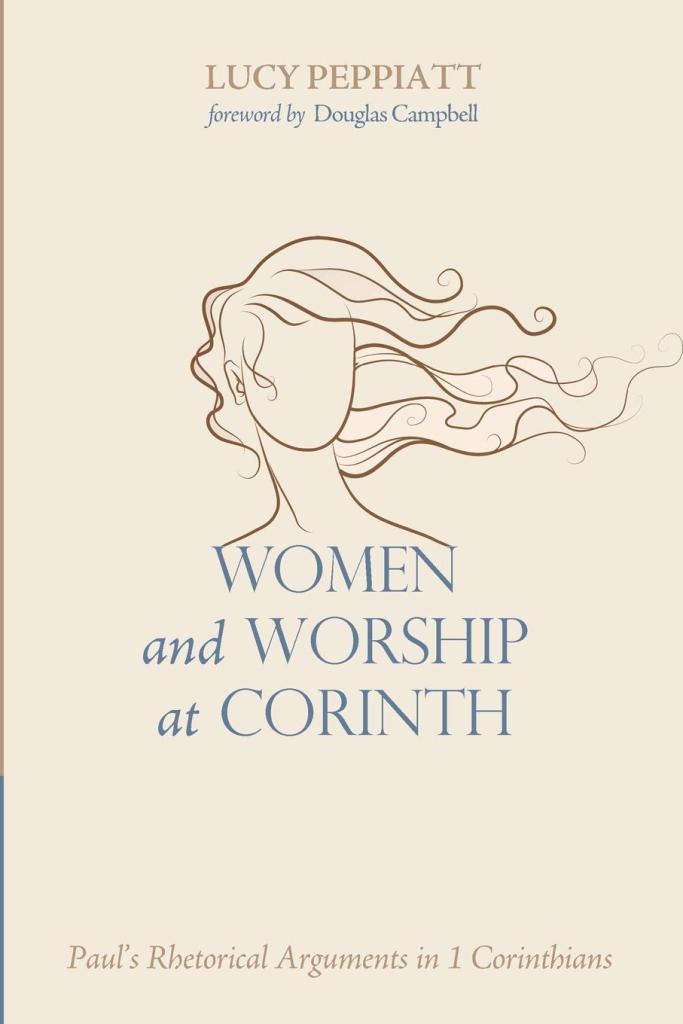
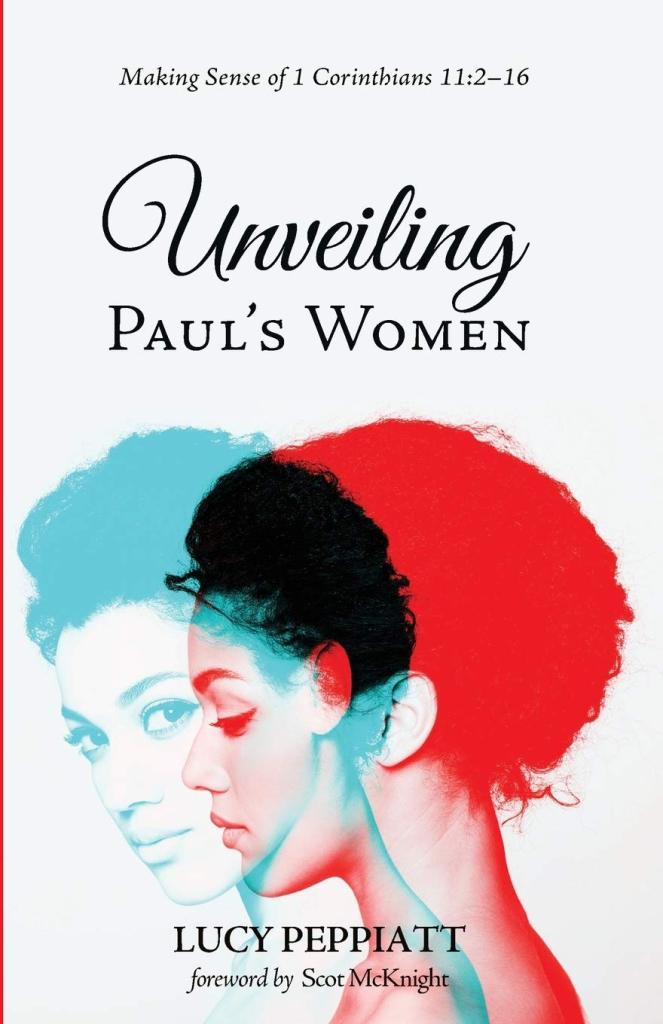
It’s laughable to think I can explain her entire interpretation in a single post, so I will merely attempt to capture a few of her central claims. She makes her case most fully in Women and Worship at Corinth, simplified for a popular audience in Unveiling Paul’s Women.
 Whereas Westfall says Paul wants the men to allow women to wear veils (for reasons of honor), Peppiatt claims that Paul argues the opposite, namely, that women should not be forced to wear veils, which the Corinthians men think symbolize women’s inferior status. Westfall offers a “cultural reading” whereby Paul addresses a cultural value. By contrast, Peppiatt thinks Paul makes a theological argument, evidenced by his exchange in 11:7-12 with the Corinthians.
For Peppiatt, 11:7-10 are especially significant because they give a clear rationale concerning the head covering. The reason given to us and it’s not cultural; it’s rooted in creation/cosmology.
(Remember, it doesn’t matter what we think about veils today. What matters is their meaning to Paul and his readers.)
As previously noted, some people looked down on women who did not wear veils. However, the problem is that ancient Greco-Roman views on veiling are so diverse as to make it near impossible to know what precisely Paul addresses. Ancient ideas about veiling varied according to status, location, culture, and time period.
The Logic of Paul’s Argument
In broad strokes, here is Paul’s argument as Peppiatt sees it.
In 11:2-3, Paul commends the Corinthians’ desire to hold firmly to his teaching yet wants to correct their misunderstanding of that teaching. They mistake his comments about headship (v. 2) to imply vv. 4-5. Accordingly, the men use veiling to signify the subordination of women and their (supposedly) higher status before God, which they base on a flawed view of Genesis (cited in 11:7-10).
Agreeing with Chrysostom, Peppiatt says 11:6 is a reductio ad absurdum, a type of argument where Paul shows the absurdity of their thinking by highlighting its logical implication. The severity of the penalty mentioned in v. 6 also suggests that Paul is not dealing with a cultural issue but a theological one. This conclusion is reinforced by 11:7-10, 16.
Peppiatt’s reading reconciles the apparent contradiction between 11:7-10 and 11:11-12. The critical transition word in v. 11 (πλήν) signals Paul’s differing perspective. She translates πλήν with a gloss “The point is….” Paul’s “in the Lord” language further contrasts their errant reading of Genesis. In short, he underscores man and woman’s interdependence (not hierarchy) undermines any claim to prominence based on origin.
Headship
The stress on origin further supports the view that headship in 11:3 relates to a source (Peppiatt) or kinship (Westfall). As many scholars note, the “head” signified status and prominence, but not necessarily authority. Metaphors have several potential connotations, but their meaning is always bound by context. Peppiatt argues,
Whatever kephale [head] does mean, it does not mean that God rules over Christ, Christ rules over man, and man rules over woman, because we cannot claim that God rules over Christ in the first place. (p. 91)
She quotes Cyril of Alexandria when writing,
“Thus we say that the kephale of every man is Christ, because he was excellently made through him. And the kephale of woman is man, because she was taken from his flesh. Likewise, the kephale of Christ is God, because He is from Him according to nature.” According to Cyril, kephale is used in three similar but different ways, all denoting origin and relation. (p. 91)
Moreover, Peppiatt suggests that 1 Corinthians 12, the immediate context of 1 Cor 11, helps us understand the import of kephale (i.e., head language). She says,
Paul sets the context for the language of “head” within his picture of the “body” as well as in his theology of God/Christ… as Paul has introduced the language of “head” in 11:3 we should explore what he teaches on the “body” in chapter 12 with particular reference to the body of Christ. (p. 95).
Judge for yourselves
The rhetorical question in 11:13 calls on readers to agree that “Yes, it is proper for a woman to pray to God with her head uncovered.” Verses 14-15 reinforce this conclusion. Paul even appeals to their own reasoning (note the italics in v. 14, quoting the Corinthians). Paul exposes a contradiction in their own thinking. In effect, he says something like this:
You guys recognize that long hair acts like a covering (11:4, 14), which is why you think men are dishonorable with long hair. However, you don’t apply this same logic to women. The woman’s glorious hair serves as a cover, yet you, Corinthians, want her to cover that glory.
This response resembles the ironic logic of 11:6. Accordingly, by their reasoning, a woman who only has her hair (without a veil) should “have her hair cut off,” which would be a disgrace. Thus, showing her glory is reckoned disgraceful!
This is how twisted the Corinthians are in their thinking!
Finally, 11:16 supports the claim that Paul is not making a cultural argument since he says that all the churches align with the practice he advocates in the passage.
Concluding Comments and Questions
In both Westfall and Peppiatt’s views, honor plays a vital role in interpreting 1 Corinthians 11. Their readings differ, yet both have strengths. And both raise more questions, although I think their interpretations are far more coherent than most conventional readings.
If you want to do your own deep dive, here are the places for you to go:
- Lucy Peppiatt, Women and Worship at Corinth (simplified in Unveiling Paul’s Women)
- Cynthia Long Westfall, Paul and Gender.
In addition, both have several talks online and are interviewed on multiple podcasts.
Let me know what you think. What questions do these posts raise for you?
Previous Post

May 17, 2022
Protecting the Honor of Women in 1 Corinthians 11
Next Post
May 31, 2022 The IMB and SBC must lose face to give God face
Browse Our Archives
Select a Category Atonement Biblical Theology Book Reviews China Chinese Church Chinese Culture Chinese Language Collectivism Contextualization Culture (General) Ecclesiology Evangelism Gospel Honor & Shame (Face) Interpretation/Exegesis Justification/Righteousness Missiology Mission Methods One Gospel for All Nations Other Practical Contextualization Reading Romans with Eastern Eyes Resources Romans Salvation (General) Saving God's Face Seeking God's Face The Cross in Context Theological Contextualization Theological Education Theology Uncategorized
Select a Month October 2026 September 2026 August 2026 July 2026 June 2026 May 2026 April 2026 March 2026 February 2026 January 2026 December 2025 November 2025 October 2025 September 2025 August 2025 July 2025 June 2025 May 2025 April 2025 March 2025 February 2025 January 2025 December 2024 November 2024 October 2024 September 2024 August 2024 July 2024 June 2024 May 2024 April 2024 March 2024 February 2024 January 2024 December 2023 November 2023 October 2023 September 2023 August 2023 July 2023 June 2023 May 2023 April 2023 March 2023 February 2023 January 2023 December 2022 November 2022 October 2022 September 2022 August 2022 July 2022 June 2022 May 2022 April 2022 March 2022 February 2022 January 2022 December 2021 November 2021 October 2021 September 2021 August 2021 July 2021 June 2021 May 2021 April 2021 March 2021 February 2021 January 2021 December 2020 November 2020 October 2020 September 2020 August 2020 July 2020 June 2020 May 2020 April 2020 March 2020 February 2020 January 2020 December 2019 November 2019 October 2019 September 2019 August 2019 July 2019 June 2019 May 2019 April 2019 March 2019 February 2019 January 2019 December 2018 November 2018 October 2018 September 2018 August 2018 July 2018 June 2018 May 2018 April 2018 March 2018 February 2018 January 2018 December 2017 November 2017 October 2017 September 2017 August 2017 July 2017 June 2017 May 2017 April 2017 March 2017 February 2017 January 2017 December 2016 November 2016 October 2016 September 2016 August 2016 July 2016 June 2016 May 2016 April 2016 March 2016 February 2016 January 2016 December 2015 November 2015 October 2015 September 2015 August 2015 July 2015 June 2015 May 2015 April 2015 March 2015 February 2015 January 2015 December 2014 November 2014 October 2014 September 2014 August 2014 July 2014 June 2014 May 2014 April 2014 March 2014 February 2014 January 2014 December 2013 November 2013 October 2013 September 2013 August 2013 July 2013 June 2013 May 2013 April 2013 March 2013 February 2013 January 2013 December 2012 November 2012
Follow Us!
TAKE THE
Religious Wisdom Quiz
Which companion of Paul was also a physician and wrote Acts?
Select your answer to see how you score.
Luke Barnabas Mark Silas
Books by This Author Books by Brad Vaughn
Related posts from Saving God's Face

No King forgets his crown. Why do we?

Recovering Moral Vision Between Shame and Shamelessness

Refuge, Confession, and the End of Shame

Psalm 25 and the Fear of Being Put...
TRENDING AT PATHEOS Evangelical

The Real AI Story Is Adoption Without Trust
Artificial intelligence has crossed a political threshold. It is no longer a...

A new article, written by Jeff Lindsay and Gale L. Pooley,...

Swimfan: Forgotten Aughts Pleasures
This is a recovery effort. In 2002, My Big Fat Greek Wedding...

Top Three Anti-Catholic Lies About Catholicism
This is my initial transcript for the video, "THE 3 WORST...

Pope Leo Celebrates Mass for Nurses & Docs...
I don't have any idea how he did it, but Pope Leo...

The Sermon on the Mount, Part I: Matthew...
The Sermon on the Mount, Part I (Matthew 4:12-5:12) St. Matthew moves...
view all Evangelical blogs
Ad-Free & Subscriber Log-In Subscription Support
- About Us
- 2026 Calendar
- Videos
- Podcasts
- Library of World Religions
- Faith In Media Tracker
- Advertise With Us
- Write for Us
- Privacy Policy
- Terms of Service
- Do Not Sell My Data
- Contact Us
- Radiant Digital
- Manage Newsletter Subscriptions
- Unsubscribe From Notifications
- Sitemap
Copyright 2008-2026, Patheos. All rights reserved.
Subscription Support Ad-Free & Subscriber Log-In
Follow Patheos