
BuddhistCatholicContemplativeEvangelicalGeneral ChristianHinduJewishLatter-day SaintMuslimNew VisionsProgressive Christian
Beliefs
- Buddhist
- Catholic
- Contemplative
- Evangelical
- General Christian
- Hindu
- Jewish
- Latter-day Saint
- More Voices
- Muslim
- New Visions
- Pagan
- Progressive Christian
Topics
- Religion News
- Food and Religion
- Sports and Religion
- Religious Art
- Religious Music and Entertainment
- Religious Events
- History and Religion
- Style and Religion
- Politics and Religion
- Women in Religion
- Recreation Outdoors and Religion
- Business Finance and Religion
- Careers Workplace and Religion
- Education and Religion
- Family Parenting and Religion
- Health Fitness and Religion
- Home and Religion
- Relationships and Religion
- Technology and Religion
- Travel and Religion
Columnists
- Buddhist Columnists
- Business Finance and Religion Columnists
- Careers Workplace and Religion Columnists
- Catholic Columnists
- Contemplative Columnists
- Education and Religion Columnists
- Evangelists Columnists
- Family Parenting and Religion Columnists
- General Christian Columnists
- Health Fitness and Religion Columnists
- Hindu Columnists
- History and Religion Columnists
- Home and Religion Columnists
- Jewish Columnists
- More Voices Columnists
- Latter Day Columnists
- Muslim Columnists
- New Visions Columnists
- Nonreligious Columnists
- Pagan Columnists
- Politics and Religion Columnists
- Progressive Columnists
- Recreation Outdoors and Religion Columnists
- Relationships and Religion Columnists
- Religion News Columnists
- Religious Art Columnists
- Religious Events Columnists
- Religious Music and Entertainment Columnists
- Sports and Religion Columnists
- Style and Religion Columnists
- Technology and Religion Columnists
- Travel and Religion Columnists
- Women in Religion Columnists
Resource Library
- 2026 Calendar
- Library of World Religions
- The 100 Most Holy Places on Earth
- Patheos Answers
- Podcasts
- Videos
- Faith Leaders Database
- Anglican Episcopalian
- Bahai
- Baptist
- Buddhism
- Christianity
- Confucianism
- Eastern Orthodoxy
- Hinduism
- Holiness and Pentecostal
- ISKCON
- Islam
- Judaism
- Lutheran
- Methodist
- The Church of Jesus Christ of Latter-day Saints
- New Age
- Paganism
- Presbytarian and Reformed
- Protestantism
- Religion Behind the Scenes
- Roman Catholic
- Scientology
- Shia Islam
- Sikhism
- Sufism
- Sunni Islam
- Taoism
- Zen
- See all religions
Research Tools
 Ad-Free & Subscriber Log-In Subscription Support
Ad-Free & Subscriber Log-In Subscription Support
Follow Patheos 

- Trending:
- Forgiveness
- |
- Marriage
- |
- Consciousness
- |
- Death Penalty
- |
- Election
- |
- Halloween

-
Tools
-
Support the Work
- Home
- Evangelical
- Contextualizing Deconstruction and “Deconstruction”
Contextualizing Deconstruction and “Deconstruction”
Last updated on: December 20, 2021 at 11:58 pm by Brad Vaughn
Contextualizing Deconstruction and “Deconstruction” 2021-12-20T23:58:40-07:00 Brad Vaughn
Patheos Explore the world's faith through different perspectives on religion and spirituality! Patheos has the views of the prevalent religions and spiritualities of the world.
My wife told me to stay out of this conversation. She said I’d only invite attacks and a bunch of headaches. It’s typically good advice to listen to your wife. But today, I’m going rogue. My email box will judge whether I made a good decision.
Words matter. They both affect people and reflect their perspectives. There is harm in not paying attention to the context of words. Check out the following quote from Samuel Sey’s recent post.
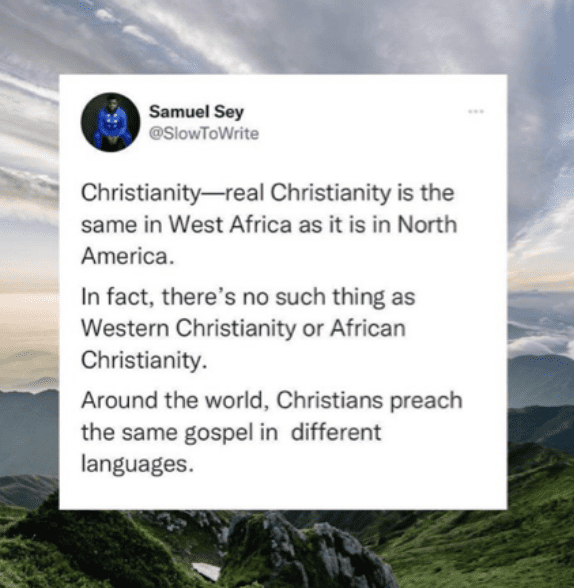 The inconvenient problem with words is that their meaning always depends on context. The same word can have different connotations depending on the contacts in which it’s said. If we ignore this fact, we open ourselves up to several problems.
First, we don’t listen to what people actually say. We import our assumptions into their words. Second, we misrepresent people, often even demonizing them for suggesting things they don’t really believe. Third, we perpetuate division, bride, and greater hurt.
How I wish Christians would recognize is a simple point: we compromise the truth when we settle for truth.
What I mean is that we can neglect or misrepresent the truth simply because some aspect of what we say is true. So, we defend ourselves and ignore the criticisms leveled against us. Samuel Sey’s comment above opens the door for such compromise.
When he speaks of “real Christianity,” I think he means the real “gospel.” Such use of “Christianity” is sloppy, especially in the context of an article about deconstruction. Christianity is a general, vague word. It often refers to various sociological expressions of the Christian faith. The faith is expressed in diverse ways across historical, cultural, and geographic contexts.
In that sense, real Christianity is very different in West Africa as it is in North America. And there are such things as Western Christianity and African Christianity.
Deconstructing “Deconstruction”
These remarks matter because of the context in which he makes his comments.
Sey’s article “The First People to Deconstruct Their Faith” is a forthright attack on the phenomenon popularly called “deconstruction.” What he means by this term is unambiguous. For him, deconstruction refers to people rejecting Christ. A few quotes make that clear:
“The first people to deconstruct their faith were people in the Garden of Eden—they were people dissatisfied with God.”
“When people say they’re deconstructing their faith, they’re just using a pretentious phrase to say they’re doubting what God says in the Bible.”
The article plays up the “Did God actually say” language from Genesis 3 to make the connection between deconstructionists and the fall of humanity. It’s a subtle but potent rhetorical move, made more effective by his dropping buzzwords like “Nietzsche” and “postmodernism” to ensure our mental alarms ring at full volume.
What happens, however, if we turn to the New Testament? Jesus’ language intends to elicit doubt. He says, “You’ve heard it said…. But I tell you….” Perhaps, this manner of speaking more accurately captures the sentiments of countless people who undergo deconstruction.
To be sure, many people use “deconstruction” as a synonym for deconversion, referring to their forsaking Jesus. No doubt, the reasons for turning away from Jesus are diverse, sad, and stem from the influence of all sorts of godless ideologies.

Credit: Flickr/theredphotographies
However, his and other writers’ blanket dismissal of deconstruction ignores the fact that the word is also used by many people, who rethink and reject much of the church tradition that swallows the biblical gospel, much like Jesus urges in Mark 7:5-9.
My friend and pastor, Joshua Butler, for example, never defines “deconstruction” yet gives 4 reasons why people do it. Ironically, he cites Ivan Mesa, who is more generous and clearer on the matter:
“Deconstruction is the process of systematically dissecting and often rejecting the beliefs you grew up with. Sometimes the Christian will deconstruct all the way to atheism. Some remain there, but others experience a reconstruction. But the type of faith they end up embracing almost never resembles the Christianity they formerly knew.”
This is an accurate definition because it’s necessarily broad. I say “necessarily” because it reflects the actual way people use to term to describe their experience. Butler himself recognizes this point when he says,
“Jesus deconstructs bad teaching in order to reconstruct good teaching. Not all deconstruction is bad.”
Precisely! Yet, contrast this observation with what is implied by Sey’s comments above and Butler’s remark,
“Deconstruction is poison, not medicine. It supplements the sin that’s killing you, rather than healing it. It allows you to save face, to look virtuous in your departure from God (“He’s the problem, not me”), while distracting you from squarely facing your true motivations.”
Do “Deconstructionists” Really Say…?
Brandon O’Brien offers a helpful framework for talking about this issue. In a Twitter thread, he says,
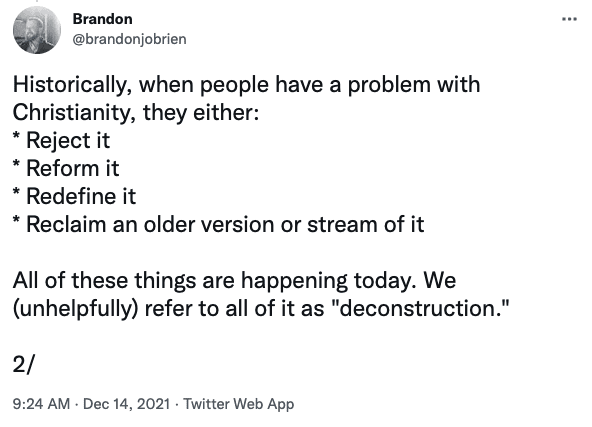
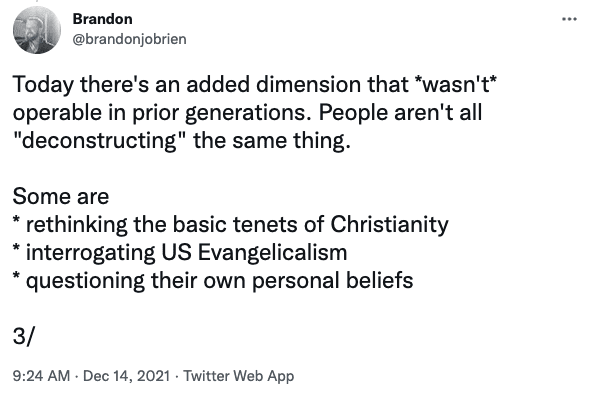
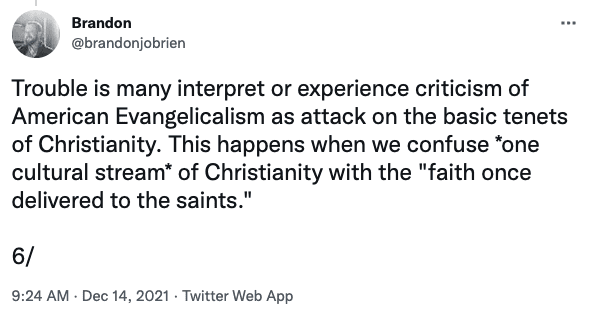
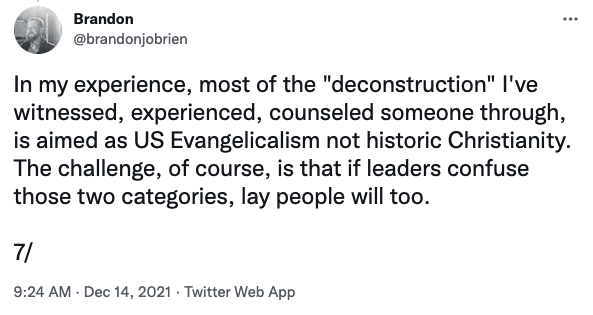
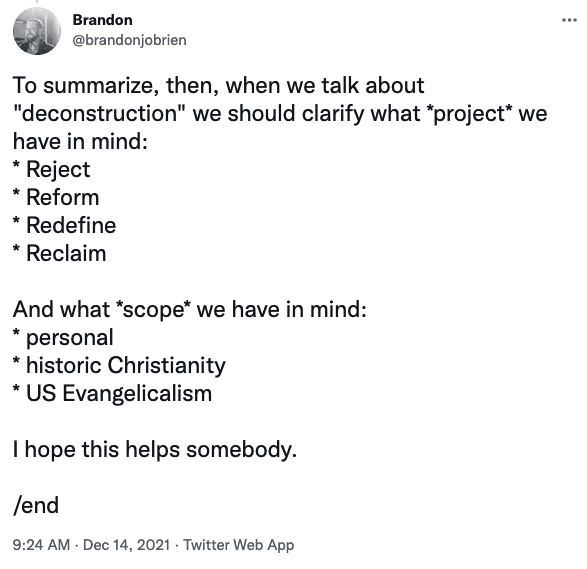
Brandon’s summary is spot on.
Three Consequences of Not Defining “Deconstruction”
Why do I raise this discussion?
First, critiques of deconstruction need to define their terms. Better yet, we could begin using other terms that better clarify what’s being described. Loving truth begins with seeking clarity.
Second, if we don’t improve our language, we’ll perpetuate hurt, alienation, and, yes, “deconstruction,” which people say they want to avoid.
Third and perhaps most serious, failing to account for the multiple meanings of deconstruction allows people to ignore the underlying problems that lead to deconstruction.
This is what we find in Sey’s post, who, like Adam and Eve, shifts blame.
He’s aware of what deconstructionists say about their own deconstruction. For example, Sey writes,
“Therefore people who deconstruct their faith believe there is no such thing as Biblical truth, just interpretations—interpretations mostly dominated by supposedly racist, misogynistic, homophobic, and transphobic white people who—according to deconstructionists—preach American or Western Christianity as the only correct interpretation or version of Christianity.”
“This is why deconstructionists tend to call themselves exevangelicals instead of ex-Christians. They believe evangelicalism is Western Christianity—not real Christianity.”
“The Reformers didn’t deconstruct Christianity, they did the opposite. They didn’t reject the authority of the Bible—they returned to the authority of the Bible. People who deconstruct their faith conform to this world.”
In other words, what many people reject is not Jesus but a caricature of Jesus. They don’t necessarily walk away from Christianity but a syncretistic version that reflects certain (sub)cultural values above the Bible.

Credit: Flickr/vogelium
Sey’s careless language proves reckless. It distracts readers from the substance of deconstructionists’ concerns. We then don’t have to address racism, abuse, misogyny, etc., because, after all, such critics are faithful apostates anyway. Consequently, the church doesn’t have to do the hard work of removing an entire forest of trees from our eyes.
It never occurs to some people that combating these internal problems not only glorifies God but also goes a long way in bringing people to Jesus. Such reform would slow the current wave of deconstruction, which now occurs most frequently among evangelicals. Coincidence?
Sey’s article expresses a genuine desire to protect the church and affirm the gospel. Praise the Lord for that ambition! But it also demonstrates a rhetorical sleight of hand that marks much evangelical discourse.
By fixing our language about “deconstruction,” we might make progress in the task of reconstruction. As Ivan Mesa says:
“Deconstructing, however jarring and emotionally exhausting, need not end in a cul-de-sac of unbelief. In fact, deconstructing can be the road toward reconstructing—building up a more mature, robust faith that grapples honestly with the deepest questions of life.”
Previous Post

December 14, 2021
Top Posts from 2021
Next Post
December 28, 2021 The Global Gospel now translated into Chinese
Browse Our Archives
Select a Category Atonement Biblical Theology Book Reviews China Chinese Church Chinese Culture Chinese Language Collectivism Contextualization Culture (General) Ecclesiology Evangelism Gospel Honor & Shame (Face) Interpretation/Exegesis Justification/Righteousness Missiology Mission Methods One Gospel for All Nations Other Practical Contextualization Reading Romans with Eastern Eyes Resources Romans Salvation (General) Saving God's Face Seeking God's Face The Cross in Context Theological Contextualization Theological Education Theology Uncategorized
Select a Month October 2026 September 2026 August 2026 July 2026 June 2026 May 2026 April 2026 March 2026 February 2026 January 2026 December 2025 November 2025 October 2025 September 2025 August 2025 July 2025 June 2025 May 2025 April 2025 March 2025 February 2025 January 2025 December 2024 November 2024 October 2024 September 2024 August 2024 July 2024 June 2024 May 2024 April 2024 March 2024 February 2024 January 2024 December 2023 November 2023 October 2023 September 2023 August 2023 July 2023 June 2023 May 2023 April 2023 March 2023 February 2023 January 2023 December 2022 November 2022 October 2022 September 2022 August 2022 July 2022 June 2022 May 2022 April 2022 March 2022 February 2022 January 2022 December 2021 November 2021 October 2021 September 2021 August 2021 July 2021 June 2021 May 2021 April 2021 March 2021 February 2021 January 2021 December 2020 November 2020 October 2020 September 2020 August 2020 July 2020 June 2020 May 2020 April 2020 March 2020 February 2020 January 2020 December 2019 November 2019 October 2019 September 2019 August 2019 July 2019 June 2019 May 2019 April 2019 March 2019 February 2019 January 2019 December 2018 November 2018 October 2018 September 2018 August 2018 July 2018 June 2018 May 2018 April 2018 March 2018 February 2018 January 2018 December 2017 November 2017 October 2017 September 2017 August 2017 July 2017 June 2017 May 2017 April 2017 March 2017 February 2017 January 2017 December 2016 November 2016 October 2016 September 2016 August 2016 July 2016 June 2016 May 2016 April 2016 March 2016 February 2016 January 2016 December 2015 November 2015 October 2015 September 2015 August 2015 July 2015 June 2015 May 2015 April 2015 March 2015 February 2015 January 2015 December 2014 November 2014 October 2014 September 2014 August 2014 July 2014 June 2014 May 2014 April 2014 March 2014 February 2014 January 2014 December 2013 November 2013 October 2013 September 2013 August 2013 July 2013 June 2013 May 2013 April 2013 March 2013 February 2013 January 2013 December 2012 November 2012
Follow Us!
TAKE THE
Religious Wisdom Quiz
What does "Jordan" (as in Jordan River) mean?
Select your answer to see how you score.
To anoint To heal To open To descend
Books by This Author Books by Brad Vaughn
Related posts from Saving God's Face

The Real Crisis Beneath America’s Social Crises (Part...

America’s Crisis Is Deeper Than Politics

Independent Thinking Isn’t What You Think

The Gulag Theology of One Day in the...
TRENDING AT PATHEOS Evangelical

I was strolling through the top floor of the brand new Parthenon...

What Does Gêvâh Mean For Kimberley Guifoyle &...
This week, a lot of the news is focused on Kimberly Guilfoyle....

INNER CIRCLE: Profound Mystery (Of Christ In All...
Ephesians 5:31-32 “For this reason, a man will leave his father and...

Do Not Rejoice When Your Enemy Falls: The...
Turning an execution into a public spectacle is a disturbing expression of...

'The Chosen' S6 Trailer: The Passion Gets Very...
Not many watching 'The Chosen' worry about spoilers, but just because they...

The purpose-driven labor priest
A labor activist reads Rick Warren and it gets me wondering about...
view all Evangelical blogs
Ad-Free & Subscriber Log-In Subscription Support
- About Us
- 2026 Calendar
- Videos
- Podcasts
- Library of World Religions
- Faith In Media Tracker
- Advertise With Us
- Write for Us
- Privacy Policy
- Terms of Service
- Do Not Sell My Data
- Contact Us
- Radiant Digital
- Manage Newsletter Subscriptions
- Unsubscribe From Notifications
- Sitemap
Copyright 2008-2026, Patheos. All rights reserved.
Subscription Support Ad-Free & Subscriber Log-In
Follow Patheos