
BuddhistCatholicContemplativeEvangelicalGeneral ChristianHinduJewishLatter-day SaintMuslimNew VisionsProgressive Christian
Beliefs
- Buddhist
- Catholic
- Contemplative
- Evangelical
- General Christian
- Hindu
- Jewish
- Latter-day Saint
- More Voices
- Muslim
- New Visions
- Pagan
- Progressive Christian
Topics
- Religion News
- Food and Religion
- Sports and Religion
- Religious Art
- Religious Music and Entertainment
- Religious Events
- History and Religion
- Style and Religion
- Politics and Religion
- Women in Religion
- Recreation Outdoors and Religion
- Business Finance and Religion
- Careers Workplace and Religion
- Education and Religion
- Family Parenting and Religion
- Health Fitness and Religion
- Home and Religion
- Relationships and Religion
- Technology and Religion
- Travel and Religion
Columnists
- Buddhist Columnists
- Business Finance and Religion Columnists
- Careers Workplace and Religion Columnists
- Catholic Columnists
- Contemplative Columnists
- Education and Religion Columnists
- Evangelists Columnists
- Family Parenting and Religion Columnists
- General Christian Columnists
- Health Fitness and Religion Columnists
- Hindu Columnists
- History and Religion Columnists
- Home and Religion Columnists
- Jewish Columnists
- More Voices Columnists
- Latter Day Columnists
- Muslim Columnists
- New Visions Columnists
- Nonreligious Columnists
- Pagan Columnists
- Politics and Religion Columnists
- Progressive Columnists
- Recreation Outdoors and Religion Columnists
- Relationships and Religion Columnists
- Religion News Columnists
- Religious Art Columnists
- Religious Events Columnists
- Religious Music and Entertainment Columnists
- Sports and Religion Columnists
- Style and Religion Columnists
- Technology and Religion Columnists
- Travel and Religion Columnists
- Women in Religion Columnists
Resource Library
- 2026 Calendar
- Library of World Religions
- The 100 Most Holy Places on Earth
- Patheos Answers
- Podcasts
- Videos
- Faith Leaders Database
- Anglican Episcopalian
- Bahai
- Baptist
- Buddhism
- Christianity
- Confucianism
- Eastern Orthodoxy
- Hinduism
- Holiness and Pentecostal
- ISKCON
- Islam
- Judaism
- Lutheran
- Methodist
- The Church of Jesus Christ of Latter-day Saints
- New Age
- Paganism
- Presbytarian and Reformed
- Protestantism
- Religion Behind the Scenes
- Roman Catholic
- Scientology
- Shia Islam
- Sikhism
- Sufism
- Sunni Islam
- Taoism
- Zen
- See all religions
Research Tools
 Ad-Free & Subscriber Log-In Subscription Support
Ad-Free & Subscriber Log-In Subscription Support
Follow Patheos 

- Trending:
- Forgiveness
- |
- Marriage
- |
- Consciousness
- |
- Death Penalty
- |
- Election
- |
- Halloween

-
Tools
-
Support the Work
- Home
- Evangelical
- 9Marks is Right, but Its Arguments are Wrong
9Marks is Right, but Its Arguments are Wrong
Last updated on: November 22, 2021 at 3:56 pm by Brad Vaughn
9Marks is Right, but Its Arguments are Wrong 2021-11-22T09:02:31-07:00 Brad Vaughn
Patheos Explore the world's faith through different perspectives on religion and spirituality! Patheos has the views of the prevalent religions and spiritualities of the world.
In China, people will simply tell you, “You’re fat,” as a way of showing affection. For them, making such comments (including “You’re too skinny”) expresses their concern for your health. Most Americans can’t “hear” the love.
I think something similar goes on in the social media exchanges, as typified by Jonathan Leeman’s recent 9Mark editorial and the flurry of reactions it spurred.

Jonathan Leeman
For me, this is a painful post to write. My flesh wants to “pick a side” and spout off angrily at people who seemingly lack any mark of Christian humility and graciousness. But I hope to identify where some miscommunication is happening, then suggest constructive ideas to move us forward.
I write as a longtime (but former) Southern Baptist. But I also endorsed Beth Allison Barr’s book and adamantly care about issues raised by so-called “woke” writers. Therefore, I will attempt to offer a generous reading of the recent 9Marks article, despite my impulse to respond in a contrary manner. Where I reference Leeman, I could just as quickly cite others since so much of what he says aptly represent the concerns of countless conservative evangelicals, both in their confusion and coherency.
I’ll approach the conversation in three parts. First, I’ll begin with where I think Leeman makes legitimate points. Second, I’ll note a few unhelpful bits from his editorial as a way of highlighting how we talk both past and down to others. Third, I’ll sketch a few ideas to make genuine progress.
Digging Deeper to a Core Concern
Leeman raises numerous issues that are hard to sort out. Much of his argument (I think) is unnecessary and distracts from what (I think), in fact, disturbs him and others. Accordingly, 9Marks is justified in their fundamental concern but wrong in framing the problem and thus making their argument.
Why do I say this? Because he eventually affirms much of what he at first seems to dismiss. For example, whereas first appears to object to David Gushee’s comment that “the Bible is always an interpreted text, and that we flawed, limited, self-interested people are the interpreters” Later, however, Leeman concedes,
“We cannot help but speak to what we think is true, even the person who denies that truth exists. To be sure, none of us possesses God’s perspective and in one sense we should always hold our evaluations with a loose grip.”[1]
Upon closer reading, what fundamentally agitates him seems to be this: Much of theology today is being dismissed out of hand as merely “white” and/or “male,” as though such interpretations had no possible link to Scripture and church tradition.
Throughout the article, this theme emerges repeatedly. Leeman’s underlying concern is captured well by Andrew Walker, whom he quotes:
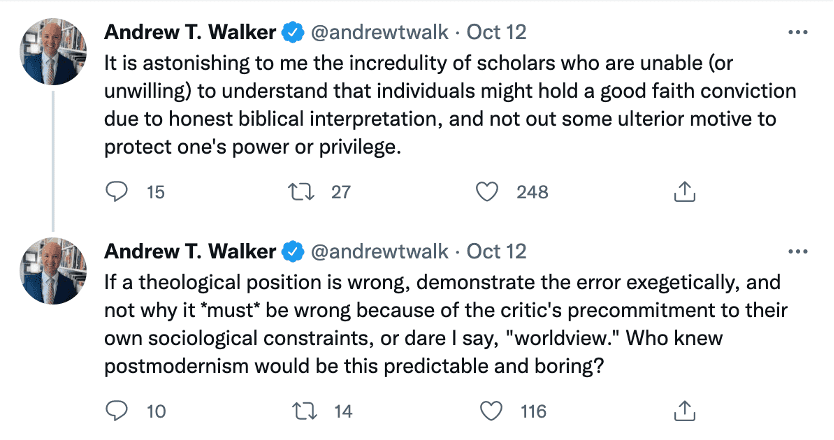 Simply as stated, this is a reasonable concern. Sadly, everything goes utterly haywire when Leeman and others then try to diagnose the problem and offer a prescription. It’s at this point that innuendos, name-calling, and social media “burns” enter and complicate things.
Distraction and Defensiveness Make Us Deaf
We should assume Leeman and others have good intentions. Therefore, based on my decades in conservative Southern churches, I can only suppose Leeman’s less constructive comments stem from frustration and fear.
The following instances serve as a case study in talking past one another. It happens when we don’t attempt to represent other people in ways that they recognize as their positions. We further create frustration and confusion when we don’t give people the benefit of the doubt.
Consequently, the distraction and defensiveness only make us deaf to what others (and perhaps the Holy Spirit) are saying.
1. Tone
Leeman’s tone is counterproductive and unhelpful.[2] He cryptically speaks of “the work of wolves.” His reference, however, is ambiguous. Is he referring to Beth Allison Barr? Kristen Kobes Du Mez? Others?
Elsewhere, Leeman does seem to have Barr, Du Mez, Jemar Tisby, and others squarely in view. He says, “It’s like they’ve taken a hike with the devil and asked him to explain how he interprets all the vistas before them.”
Not. Helpful.
2. Strawman
Leeman’s editorial is chock-full of strawman arguments, which (again) can easily be avoided by laboring to accurately reflect others’ views in ways that they recognize.
Here is one place where Leeman’s counterpoint implicitly creates strawman arguments:
“In short, Christians should read history and learn it. But they must not trust any historian like they trust the Bible. Teach your members that we can learn from the works of history and sociology, but it’s only the Bible which gives us a God’s-eye view of life in the universe.”
Barr, Du Mez, Tisby agree: Trust the Bible! And, yes, there’s a sense in which the Bible gives a “God’s-eye view of life in the universe.” But Leeman fails to see that none of us have an absolute perspective on absolute truth. Our theology is not entirely equivalent to the Bible. Biblical truth is always bigger and better than our theology.
At best, we all have a relative perspective on absolute truth. Leeman and others seem fearful to take the implications of that fact seriously. In alarm, they needlessly mishear such a statement as if I or others advocated relativism. Absolutely not!
Another of Leeman’s strawmen is his contrast between the Bible and personal stories. He writes, “The answer is to do better exegesis. Our doctrine can fail us, but the answer is not to give final authority to our stories and experiences.” Yes! Yes! And Yes!
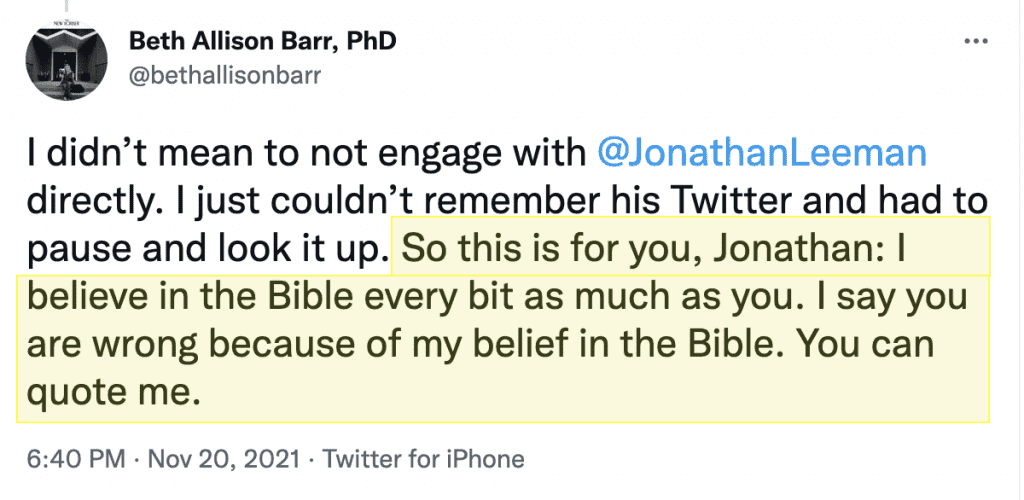 While there are certainly people who do think personal stories trump Scripture, that is not the case for those he targets in the article.
Concerning Tisby, Leeman adds,
“Yet should we assume Tisby’s choice of stories offers a perfect God’s-eye view of white Christians in the past or present?”
Honestly, who assumes that? Not Tisby. That’s an unwarranted charge against either him or his readers.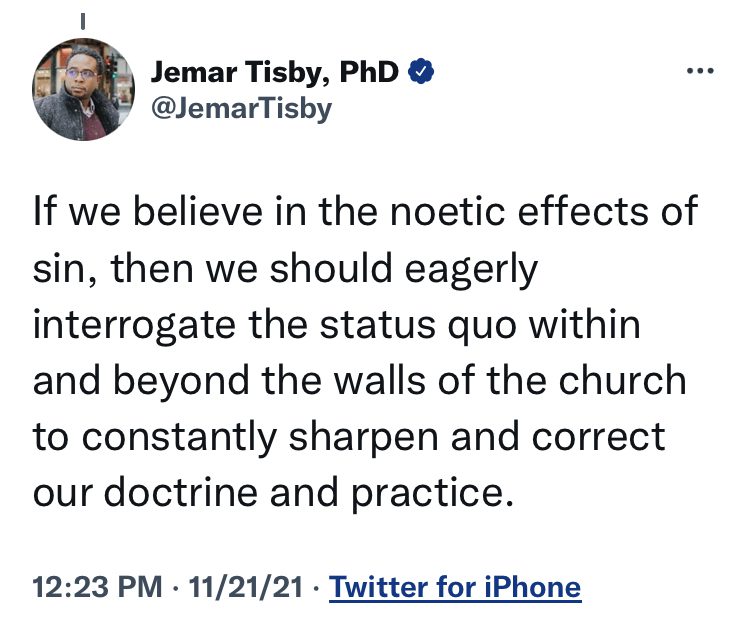
3. Naïve?
Finally, Leeman’s comments about the scholarship of Du Mez and Tisby are inexplicable, so much so that I’m tempted to call them “disingenuous.” That’s not fair to his character, so the best alternative I can come up with is “naïve.”
He critiques Du Mez’s argument by attacking her historical argument:
“Yet when, for instance, Du Mez argues that post-war white evangelicalism was characterized by patriarchy and toxic masculinity, there’s no text or fixed data set to check her work against. She might offer 14 or even 140 examples to prove her point. Yet how do we know that 140,000 counter examples remain unmentioned? We can learn from those 14 examples— “Don’t do what those guys did!” Yet her overall thesis about what “evangelicals as a whole were like” might simply restate her ideological and theological viewpoint.”
By his logic, no historian or social scientist could ever make truth claims unless their evidence was virtually exhaustive. Given the limitations of space, it’s natural that historians can only demonstrate frequency and patterns of behavior. They don’t claim that to disprove any possible counterexamples.
In short, Leeman’s counter may be naïve, but it’s undoubtedly irresponsible.
The Presence of Irony
One sign that parties are talking past each other and might actually agree (more than they suspect) is the presence of irony.
For example, Leeman says,
If postmodernism, critical theory, and the deconstruction project rightly point to the connection between doctrine and power, they wrongly limit its scope. Or as Kevin DeYoung puts it, “Critical race theory doesn’t go far enough…. The fundamental problem of CRT, DeYoung writes, “is limiting ‘power’ to the one axis of race, class, and sex.
Ironically, evangelicals sympathetic to CRT highlight race precisely because they think American Christians “don’t go far enough” with their understanding of sin (e.g., systemic and historical, not just individual) and of the gospel (including but going further than personal salvation).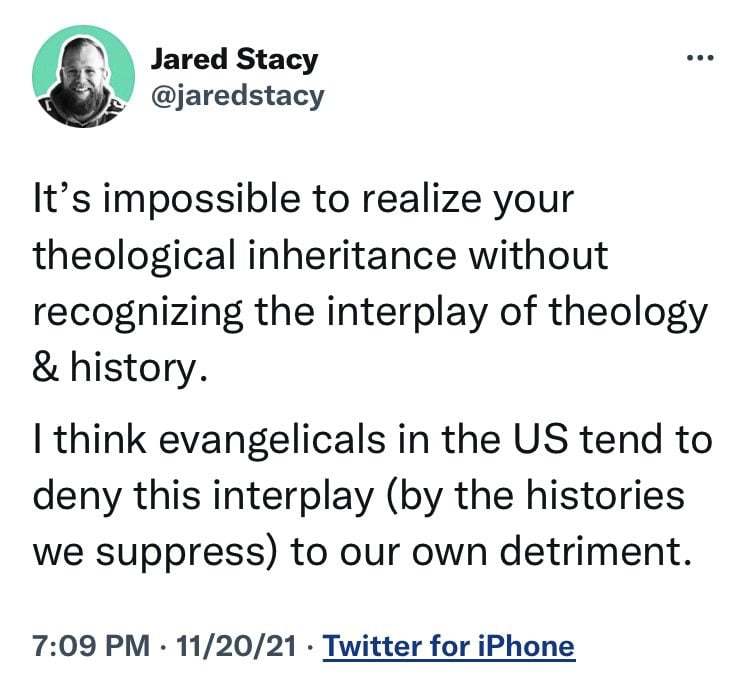
Furthermore, Leeman levels criticism against Barr, Du Mez, Tisby, etc. (see Leeman’s point #6), whom he likens to Pharisees, propping up history and tradition above the Bible. Yet, he then contends,
“In this postmodern moment, people’s personal stories and group histories are leveraged to question traditional doctrines. Liberation theologies challenge traditional views of the atonement, eschatology, and even God. People’s experiences of abuse challenge the traditional view of male headship in the home and church.”
But is his lens for interpreting Scripture? He underscores the importance of tradition when it agrees with his interpretation of the Bible.
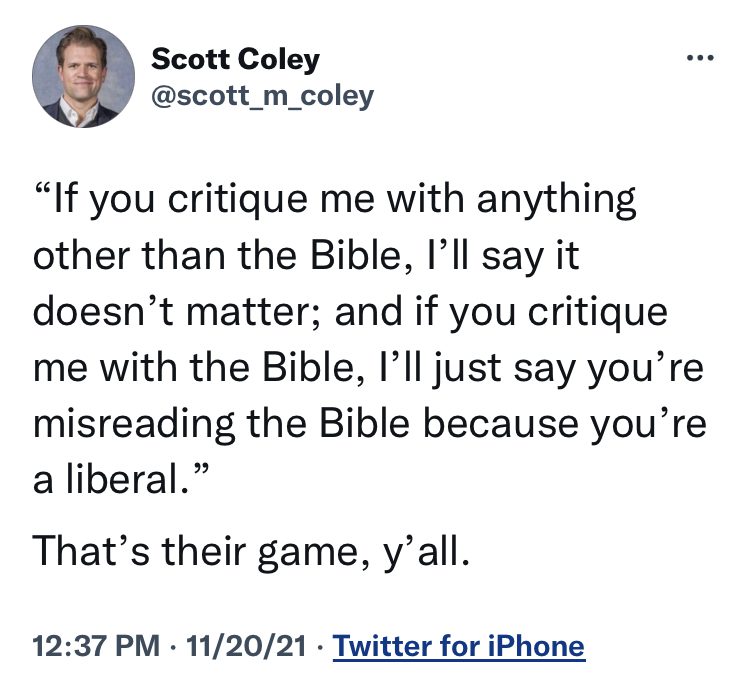 As long as conservative evangelicals argue in these ways, people write them off, in agreement with Scott Coley’s Tweet above.
Constructive Suggestions
Here are a few ways for all parties to move forward constructively.
1. Meet One Another
First, relevant conversants (re: evangelicalism, race, and gender) could convene a smallish meeting or consultation. Once together, they can *hear one another, not simply read each other*. This would help to correct the tone not only of participants but also of those they influence.
2. Apply Advice
Second, apply much of Leeman’s pastoral advice to theological and scholarly interactions. For example, he urges his opponents to assume innocence before guilt. Leeman writes,
“We treat one another as innocent until proven guilty, insisting on due process before handing out indictments. Folks used to call this giving each other the benefit of the doubt. Apart from due process, we will necessarily remain divided and tribalized.”
Agreed! Shouldn’t this apply to Barr, Du Mez, and others as well? No doubt, this is advice that all sides should heed.
Likewise, Leeman says,
“Most crucially for this conversation, it helps us lower our defenses and listen earnestly to charges of sin made against us and our group. It helps us hear the 10 percent of truth from the angry member.”
Yep. Everything would improve, including our theology.
3. For Leeman’s “opponents”
If people want to make a stronger case that Leeman and others will find persuasive, they need to have criteria to establish when “white privilege” is being used such that “white” arguments could not emerge from a sincere reading of the text. Until then, expect conservatives to react defensively.
4. For Leeman and friends
How might I advise Leeman and others like him?
There is a danger that his article will incline readers to dismiss the concerns of Barr, Du Mez, Tisby, etc., out of hand. So, here’s an idea. I suggest that 9Marks (and similar ministries) take up their concerns with such sincerity and vigor that some might even dare to call 9Marks “woke.” Specifically, they can begin by publicly wrestling with the question, “To what degree does whiteness affect theology and biblical studies?”
These suggestions are neither expensive nor time-intensive, yet they can bring much fruit. They testify to our unity in Christ rather than a unity rooted in political ideologies or national narratives.
[1] Likewise, Leeman states, “Gushee and the deconstruction project are right about everyone’s self-interest.” By “deconstruction,” they don’t refer to the social phenomenon of people who “deconstruct” and leave the church. Put simply, they refer to the task of deconstructing theological paradigms.
[2] I am not saying that others don’t have the same problem. I can only say so many things at one time.
Previous Post

November 16, 2021
Winner of the Middle Eastern Women's Video Contest
Next Post
November 30, 2021 How do Jesus and Paul talk about “outsiders”?
Browse Our Archives
Select a Category Atonement Biblical Theology Book Reviews China Chinese Church Chinese Culture Chinese Language Collectivism Contextualization Culture (General) Ecclesiology Evangelism Gospel Honor & Shame (Face) Interpretation/Exegesis Justification/Righteousness Missiology Mission Methods One Gospel for All Nations Other Practical Contextualization Reading Romans with Eastern Eyes Resources Romans Salvation (General) Saving God's Face Seeking God's Face The Cross in Context Theological Contextualization Theological Education Theology Uncategorized
Select a Month October 2026 September 2026 August 2026 July 2026 June 2026 May 2026 April 2026 March 2026 February 2026 January 2026 December 2025 November 2025 October 2025 September 2025 August 2025 July 2025 June 2025 May 2025 April 2025 March 2025 February 2025 January 2025 December 2024 November 2024 October 2024 September 2024 August 2024 July 2024 June 2024 May 2024 April 2024 March 2024 February 2024 January 2024 December 2023 November 2023 October 2023 September 2023 August 2023 July 2023 June 2023 May 2023 April 2023 March 2023 February 2023 January 2023 December 2022 November 2022 October 2022 September 2022 August 2022 July 2022 June 2022 May 2022 April 2022 March 2022 February 2022 January 2022 December 2021 November 2021 October 2021 September 2021 August 2021 July 2021 June 2021 May 2021 April 2021 March 2021 February 2021 January 2021 December 2020 November 2020 October 2020 September 2020 August 2020 July 2020 June 2020 May 2020 April 2020 March 2020 February 2020 January 2020 December 2019 November 2019 October 2019 September 2019 August 2019 July 2019 June 2019 May 2019 April 2019 March 2019 February 2019 January 2019 December 2018 November 2018 October 2018 September 2018 August 2018 July 2018 June 2018 May 2018 April 2018 March 2018 February 2018 January 2018 December 2017 November 2017 October 2017 September 2017 August 2017 July 2017 June 2017 May 2017 April 2017 March 2017 February 2017 January 2017 December 2016 November 2016 October 2016 September 2016 August 2016 July 2016 June 2016 May 2016 April 2016 March 2016 February 2016 January 2016 December 2015 November 2015 October 2015 September 2015 August 2015 July 2015 June 2015 May 2015 April 2015 March 2015 February 2015 January 2015 December 2014 November 2014 October 2014 September 2014 August 2014 July 2014 June 2014 May 2014 April 2014 March 2014 February 2014 January 2014 December 2013 November 2013 October 2013 September 2013 August 2013 July 2013 June 2013 May 2013 April 2013 March 2013 February 2013 January 2013 December 2012 November 2012
Follow Us!
TAKE THE
Religious Wisdom Quiz
What does "Selah," found often in Psalms, likely mean?
Select your answer to see how you score.
Pause or reflect Sing loudly Forever Give thanks
Books by This Author Books by Brad Vaughn
Related posts from Saving God's Face

The Real Crisis Beneath America’s Social Crises (Part...

America’s Crisis Is Deeper Than Politics

Independent Thinking Isn’t What You Think

The Gulag Theology of One Day in the...
TRENDING AT PATHEOS Evangelical

The Image: On the Horror of Capitalism and...
The Image Then went the Pharisees, and took counsel how they might...

We are approaching the date of our new American national holiday: October...

Letters on Living the Faith by C.S. Lewis
Most of us met C.S. Lewis as a public intellectual. Mere Christianity....

When Halloween Unmasks Married Hearts
Written by Dr. David K. Ewen from Eternal Truth Bible College Behind...

Aristotle. He’s been called the father of logic, the father of the...

Methodist Central Hall and Westminster Abbey
Situated on the same square is Methodist Central Hall and Westminster Abbey. ...
view all Evangelical blogs
Ad-Free & Subscriber Log-In Subscription Support
- About Us
- 2026 Calendar
- Videos
- Podcasts
- Library of World Religions
- Faith In Media Tracker
- Advertise With Us
- Write for Us
- Privacy Policy
- Terms of Service
- Do Not Sell My Data
- Contact Us
- Radiant Digital
- Manage Newsletter Subscriptions
- Unsubscribe From Notifications
- Sitemap
Copyright 2008-2026, Patheos. All rights reserved.
Subscription Support Ad-Free & Subscriber Log-In
Follow Patheos