
BuddhistCatholicContemplativeEvangelicalGeneral ChristianHinduJewishLatter-day SaintMuslimNew VisionsProgressive Christian
Beliefs
- Buddhist
- Catholic
- Contemplative
- Evangelical
- General Christian
- Hindu
- Jewish
- Latter-day Saint
- More Voices
- Muslim
- New Visions
- Pagan
- Progressive Christian
Topics
- Religion News
- Food and Religion
- Sports and Religion
- Religious Art
- Religious Music and Entertainment
- Religious Events
- History and Religion
- Style and Religion
- Politics and Religion
- Women in Religion
- Recreation Outdoors and Religion
- Business Finance and Religion
- Careers Workplace and Religion
- Education and Religion
- Family Parenting and Religion
- Health Fitness and Religion
- Home and Religion
- Relationships and Religion
- Technology and Religion
- Travel and Religion
Columnists
- Buddhist Columnists
- Business Finance and Religion Columnists
- Careers Workplace and Religion Columnists
- Catholic Columnists
- Contemplative Columnists
- Education and Religion Columnists
- Evangelists Columnists
- Family Parenting and Religion Columnists
- General Christian Columnists
- Health Fitness and Religion Columnists
- Hindu Columnists
- History and Religion Columnists
- Home and Religion Columnists
- Jewish Columnists
- More Voices Columnists
- Latter Day Columnists
- Muslim Columnists
- New Visions Columnists
- Nonreligious Columnists
- Pagan Columnists
- Politics and Religion Columnists
- Progressive Columnists
- Recreation Outdoors and Religion Columnists
- Relationships and Religion Columnists
- Religion News Columnists
- Religious Art Columnists
- Religious Events Columnists
- Religious Music and Entertainment Columnists
- Sports and Religion Columnists
- Style and Religion Columnists
- Technology and Religion Columnists
- Travel and Religion Columnists
- Women in Religion Columnists
Resource Library
- 2026 Calendar
- Library of World Religions
- The 100 Most Holy Places on Earth
- Patheos Answers
- Podcasts
- Videos
- Faith Leaders Database
- Anglican Episcopalian
- Bahai
- Baptist
- Buddhism
- Christianity
- Confucianism
- Eastern Orthodoxy
- Hinduism
- Holiness and Pentecostal
- ISKCON
- Islam
- Judaism
- Lutheran
- Methodist
- The Church of Jesus Christ of Latter-day Saints
- New Age
- Paganism
- Presbytarian and Reformed
- Protestantism
- Religion Behind the Scenes
- Roman Catholic
- Scientology
- Shia Islam
- Sikhism
- Sufism
- Sunni Islam
- Taoism
- Zen
- See all religions
Research Tools
 Ad-Free & Subscriber Log-In Subscription Support
Ad-Free & Subscriber Log-In Subscription Support
Follow Patheos 

- Trending:
- Forgiveness
- |
- Marriage
- |
- Consciousness
- |
- Death Penalty
- |
- Election
- |
- Halloween

-
Tools
-
Support the Work
- Home
- Evangelical
- Honor and Shame in Vertical-Horizontal Individualism and Collectivism
Honor and Shame in Vertical-Horizontal Individualism and Collectivism
Last updated on: October 26, 2021 at 4:25 pm by Brad Vaughn
Honor and Shame in Vertical-Horizontal Individualism and Collectivism 2021-08-11T04:31:49-07:00 Brad Vaughn
Patheos Explore the world's faith through different perspectives on religion and spirituality! Patheos has the views of the prevalent religions and spiritualities of the world.

Credit: Public Domain
The previous post introduced two categories important for understanding more specifically how individualism and collectivism in various societies. What scholars call “horizontal” and “vertical” orientations also intersect with individualism and collectivism.
The chart below grossly oversimplifies four dynamics that potentially emerge across cultures. It serves merely as a reminder rather than a well-rounded description.
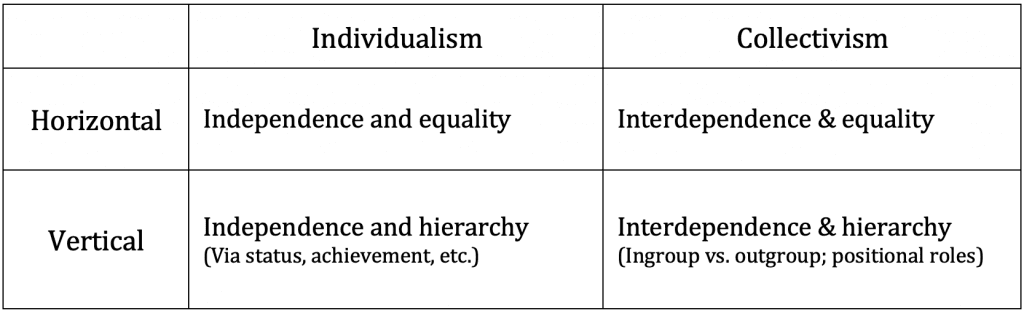
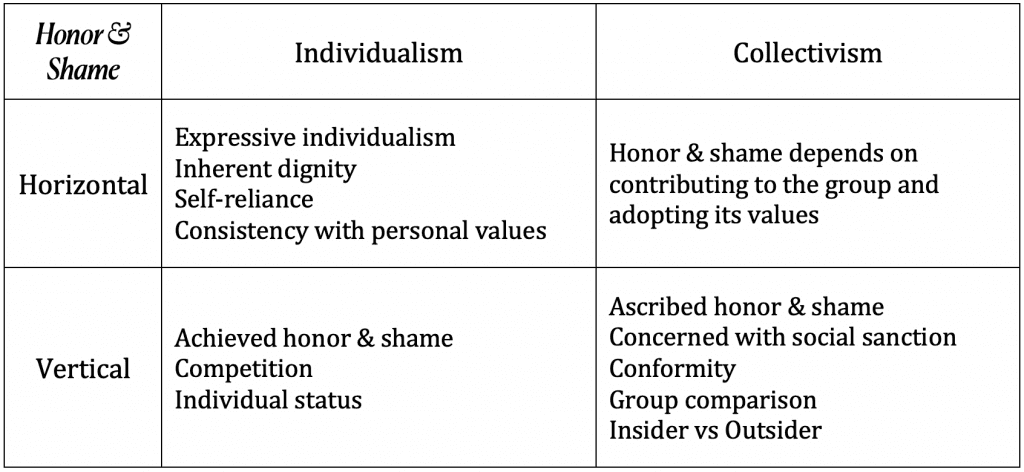
In this post, we consider possible implications for better understanding honor and shame. Why do this mental work? By understanding such cultural nuances, we can do two things.
(1) We can discern how people understand the world and its meaning. Accordingly, we can identify potential obstacles or idols related to honor and shame.
(2) We can consider promising approaches to sharing the gospel and serving people such that they can grasp God’s perspective about what is honorable and shameful.
What follows is a spattering of ideas to catalyze further reflection and conversation. I’m eager to hear your ideas.
Horizontal Individualism (HI)
From where does an HI amass honor or shame? This is where we find greater stress on expressive individualism. One’s value is rooted in personal uniqueness. Expressing one’s “authentic self” is praiseworthy. This orientation will most frequently speak of “dignity,” not “honor,” since the latter requires one to care about the opinions of a group (or at least some other person). It is shameful to offend or disregard another’s sense of identity.
I’d suspect a HI-culture would likely be a “loose culture,” in which society’s social norms are only loosely enforced. Accordingly, few behaviors will incur public shaming aside from those that transgress the norms of equality and individualism.
Finally, a person feels honor or shame based on whether they behave consistently with personal goals and values. Thus, one’s sense of honor or shame doesn’t as strongly depend on receiving recognition by others for outperforming one’s peers. More emphasis is on self-sufficiency or self-reliance, but not necessarily self-exaltation (i.e., achieving more than others).
Vertical Individualism (VI)
VI-contexts (e.g., America, Canada, England) pursue “achieved honor” above “ascribed honor.” Naturally, one is most concerned about shame that is “achieved” (i.e., failure or lack of success), though VI’s are not entirely indifferent to “low-status” labels (e.g., poor, uneducated, “redneck”). With loose group identities, VIs are more eager to assert their status to strangers than HCs or VCs.
One researcher adds another interesting tidbit:
Responses to receiving disrespectful service also reflect culturally distinct power concepts and norms. For people who are high (versus low) in a VI cultural orientation, and thus who have a personalized concept of power, receiving disrespectful service from a low-ranking person such as a front-desk receptionist is more likely to be seen as a threat to one’s personal status and power.
This experience can therefore trigger negative affective responses as well as efforts to restore one’s power through status consumption. However, receiving disrespectful service from a high-ranking person (e.g., hotel vice-president) does not necessarily implicate one’s personal status and could instead trigger deferential responses from people high in VI.[1]
Competition and comparison are integral for gaining personal honor or shame. Who has better grades? A higher income? Who ranks above or lower than whom? Ambition centers on the individual more than one’s group. In short, honor is frequently measured in relative terms (e.g., “second place is the first loser”).
Individuals use social media to manage their social persona. Impression management can be an all-consuming task. In cultures with a VI orientation, there is a danger of stressing fame over honor-as-moral-emotion. (This is not surprising since viewing honor as a moral emotion is premised on the idea that morality entails conforming to social norms.) Thus, as Andy Crouch suggests, America has slowly become a “fame-shame” culture.
Vertical Collectivism (VC)
VCs give greater weight to ascribed honor than do VI’s. Therefore, gender, position, and family name either privilege or hinder people’s pursuit of status. In this context, the relative status of the group is prioritized above that of the individual. Naturally, symbolism is important. Following tradition matters. Symbols of honor or symbolic actions serve as markers of group identity. Not to bear such symbols could be regarded as shameful.
Frequently “tight cultures,” people are conscious of avoiding social sanction. Non-conformity disgraces individuals. Hierarchy is valued and expected. Disrespecting authorities is shameful.
Finally, people lay greater stress on honor-as-moral-emotion (e.g., Confucianism). One could describe China and flesh out much of what characterizes VC cultures.
Horizontal Collectivism (HC)
This category presents a unique challenge. While identifying what constitutes something honorable or shameful is doable, a person finds it difficult to locate a precise exemplar. As I’ve surveyed the research, scholars can hardly agree about what culture deserves the label. One could say that a culture is more horizontal and collectivistic than other contexts, but that is not the same as being an HC culture.
I see HCs as somewhat utopian in nature. In this setting, honor is gained through one’s contribution to the group and its values. Such people affirm the equality of individuals yet see themselves as interdependent. Generosity and service fuel a sense that my wellbeing is bound up in our wellbeing.
One writer says:
Vertical individualists tend to view power in personalized terms: Power is a tool to advance their personal status and prestige. On the other hand, horizontal collectivists tend to conceptualize power in socialized terms: Power is a means to benefit and help others. [2]
An HC culture seems to fit Paul’s body analogy. The various members are interdependent, yet each makes a unique and valued contribution.
[1] Sharon Shavitt and Hyewon Cho. “Culture and Consumer Behavior: The Role of Horizontal and Vertical Cultural Factors.” Curr Opin Psychol 8 (2016 April): 149–154.
[2] Ibid.
Previous Post

October 19, 2021
Horizontal and Vertical Individualism and Collectivism
Next Post

November 2, 2021 Why punish parents for kids’ bad behavior?
Browse Our Archives
Select a Category Atonement Biblical Theology Book Reviews China Chinese Church Chinese Culture Chinese Language Collectivism Contextualization Culture (General) Ecclesiology Evangelism Gospel Honor & Shame (Face) Interpretation/Exegesis Justification/Righteousness Missiology Mission Methods One Gospel for All Nations Other Practical Contextualization Reading Romans with Eastern Eyes Resources Romans Salvation (General) Saving God's Face Seeking God's Face The Cross in Context Theological Contextualization Theological Education Theology Uncategorized
Select a Month October 2026 September 2026 August 2026 July 2026 June 2026 May 2026 April 2026 March 2026 February 2026 January 2026 December 2025 November 2025 October 2025 September 2025 August 2025 July 2025 June 2025 May 2025 April 2025 March 2025 February 2025 January 2025 December 2024 November 2024 October 2024 September 2024 August 2024 July 2024 June 2024 May 2024 April 2024 March 2024 February 2024 January 2024 December 2023 November 2023 October 2023 September 2023 August 2023 July 2023 June 2023 May 2023 April 2023 March 2023 February 2023 January 2023 December 2022 November 2022 October 2022 September 2022 August 2022 July 2022 June 2022 May 2022 April 2022 March 2022 February 2022 January 2022 December 2021 November 2021 October 2021 September 2021 August 2021 July 2021 June 2021 May 2021 April 2021 March 2021 February 2021 January 2021 December 2020 November 2020 October 2020 September 2020 August 2020 July 2020 June 2020 May 2020 April 2020 March 2020 February 2020 January 2020 December 2019 November 2019 October 2019 September 2019 August 2019 July 2019 June 2019 May 2019 April 2019 March 2019 February 2019 January 2019 December 2018 November 2018 October 2018 September 2018 August 2018 July 2018 June 2018 May 2018 April 2018 March 2018 February 2018 January 2018 December 2017 November 2017 October 2017 September 2017 August 2017 July 2017 June 2017 May 2017 April 2017 March 2017 February 2017 January 2017 December 2016 November 2016 October 2016 September 2016 August 2016 July 2016 June 2016 May 2016 April 2016 March 2016 February 2016 January 2016 December 2015 November 2015 October 2015 September 2015 August 2015 July 2015 June 2015 May 2015 April 2015 March 2015 February 2015 January 2015 December 2014 November 2014 October 2014 September 2014 August 2014 July 2014 June 2014 May 2014 April 2014 March 2014 February 2014 January 2014 December 2013 November 2013 October 2013 September 2013 August 2013 July 2013 June 2013 May 2013 April 2013 March 2013 February 2013 January 2013 December 2012 November 2012
Follow Us!
TAKE THE
Religious Wisdom Quiz
What kind of animal swallowed Jonah?
Select your answer to see how you score.
A lion A serpent A camel A great fish
Books by This Author Books by Brad Vaughn
Related posts from Saving God's Face

No King forgets his crown. Why do we?

Recovering Moral Vision Between Shame and Shamelessness

Refuge, Confession, and the End of Shame

Psalm 25 and the Fear of Being Put...
TRENDING AT PATHEOS Evangelical

Emotion in Early Christianity by Andrew Crislip
Andrew Crislip’s Emotion in Early Christianity examines an often overlooked dimension of...

16 Spiritual Touchstones for a More Grounded Life
After decades of spiritual study, here are 16 principles I try...

Catholic Evangelization: Sharing Your Faith Every Day
Welcome back to the Graceful Awakening mini-series called, “From Faith to Mission.” ...

The Pillar of the Boatmen: the Ancient Monument...
The Pillar of the Boatmen is a Romano-Gaulish sculpture that dates from...

In one sense walking into Westminster Abbey is like walking down the...

'Super Scam Me' Exposes AI Jon Bon Jovi...
Leslie Pickett believed she was in a relationship with Jon Bon Jovi....
view all Evangelical blogs
Ad-Free & Subscriber Log-In Subscription Support
- About Us
- 2026 Calendar
- Videos
- Podcasts
- Library of World Religions
- Faith In Media Tracker
- Advertise With Us
- Write for Us
- Privacy Policy
- Terms of Service
- Do Not Sell My Data
- Contact Us
- Radiant Digital
- Manage Newsletter Subscriptions
- Unsubscribe From Notifications
- Sitemap
Copyright 2008-2026, Patheos. All rights reserved.
Subscription Support Ad-Free & Subscriber Log-In
Follow Patheos