
BuddhistCatholicContemplativeEvangelicalGeneral ChristianHinduJewishLatter-day SaintMuslimNew VisionsProgressive Christian
Beliefs
- Buddhist
- Catholic
- Contemplative
- Evangelical
- General Christian
- Hindu
- Jewish
- Latter-day Saint
- More Voices
- Muslim
- New Visions
- Pagan
- Progressive Christian
Topics
- Religion News
- Food and Religion
- Sports and Religion
- Religious Art
- Religious Music and Entertainment
- Religious Events
- History and Religion
- Style and Religion
- Politics and Religion
- Women in Religion
- Recreation Outdoors and Religion
- Business Finance and Religion
- Careers Workplace and Religion
- Education and Religion
- Family Parenting and Religion
- Health Fitness and Religion
- Home and Religion
- Relationships and Religion
- Technology and Religion
- Travel and Religion
Columnists
- Buddhist Columnists
- Business Finance and Religion Columnists
- Careers Workplace and Religion Columnists
- Catholic Columnists
- Contemplative Columnists
- Education and Religion Columnists
- Evangelists Columnists
- Family Parenting and Religion Columnists
- General Christian Columnists
- Health Fitness and Religion Columnists
- Hindu Columnists
- History and Religion Columnists
- Home and Religion Columnists
- Jewish Columnists
- More Voices Columnists
- Latter Day Columnists
- Muslim Columnists
- New Visions Columnists
- Nonreligious Columnists
- Pagan Columnists
- Politics and Religion Columnists
- Progressive Columnists
- Recreation Outdoors and Religion Columnists
- Relationships and Religion Columnists
- Religion News Columnists
- Religious Art Columnists
- Religious Events Columnists
- Religious Music and Entertainment Columnists
- Sports and Religion Columnists
- Style and Religion Columnists
- Technology and Religion Columnists
- Travel and Religion Columnists
- Women in Religion Columnists
Resource Library
- 2026 Calendar
- Library of World Religions
- The 100 Most Holy Places on Earth
- Patheos Answers
- Podcasts
- Videos
- Faith Leaders Database
- Anglican Episcopalian
- Bahai
- Baptist
- Buddhism
- Christianity
- Confucianism
- Eastern Orthodoxy
- Hinduism
- Holiness and Pentecostal
- ISKCON
- Islam
- Judaism
- Lutheran
- Methodist
- The Church of Jesus Christ of Latter-day Saints
- New Age
- Paganism
- Presbytarian and Reformed
- Protestantism
- Religion Behind the Scenes
- Roman Catholic
- Scientology
- Shia Islam
- Sikhism
- Sufism
- Sunni Islam
- Taoism
- Zen
- See all religions
Research Tools
 Ad-Free & Subscriber Log-In Subscription Support
Ad-Free & Subscriber Log-In Subscription Support
Follow Patheos 

- Trending:
- Forgiveness
- |
- Marriage
- |
- Consciousness
- |
- Death Penalty
- |
- Election
- |
- Halloween

-
Tools
-
Support the Work
- Home
- Evangelical
- The Genesis of Masculinity and Femininity
The Genesis of Masculinity and Femininity
Last updated on: March 5, 2023 at 8:49 am by Brad Vaughn
The Genesis of Masculinity and Femininity 2023-03-05T08:49:52-07:00 Brad Vaughn
Patheos Explore the world's faith through different perspectives on religion and spirituality! Patheos has the views of the prevalent religions and spiritualities of the world.

Credit: Public Domain
Does the Bible clearly present a distinct, normative vision of masculinity and femininity, one that transcends every culture and age? That question has motivated this series and proved more challenging than many people suspect.
I also defined toxic masculinity and femininity and suggested that Genesis 1-2 should realign our discipleship goals. In this post, we turn to biblical texts that people often use when addressing these issues.
Gender in the Image of God
Before moving to Genesis 2, let’s take time to make preliminary observations from Genesis 1:26-28
26 Then God said, “Let us make humankind in our image, according to our likeness; and let them have dominion over the fish of the sea, and over the birds of the air, and over the cattle, and over all the wild animals of the earth, and over every creeping thing that creeps upon the earth.”
27 So God created humankind in his image, in the image of God he created them; male and female he created them.
28 God blessed them, and God said to them, “Be fruitful and multiply, and fill the earth and subdue it; and have dominion over the fish of the sea and over the birds of the air and over every living thing that moves upon the earth.”
First, as various scholars have highlighted, the “image of God” is a collective concept, describing humanity. Individuals are made in the image of God by virtue of the fact that they belong to the collective. The significance of this thinking will become clearer shortly.
Second, being made “in the image of God” entails a mission, a vocational and calling (1:26, 28). Verbs like “have dominion,” sometimes translated as “rule” (over), are applied to both male and female.
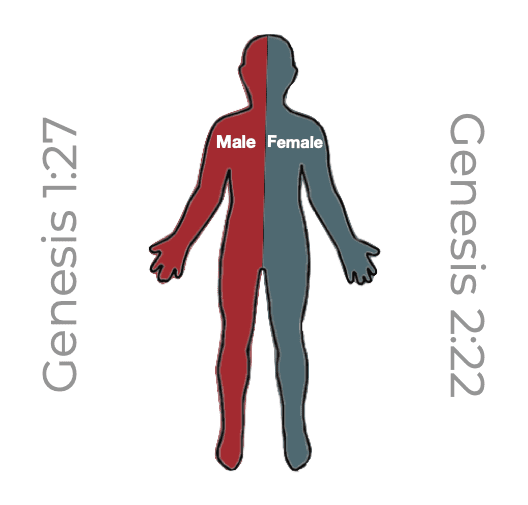
Third, the concept in Gen 1:27 entails two genders… maleness and femaleness. Within the “image of God,” God creates two kinds of interdependent genders. Verse 27 indicates plurality within a singularity. And this brings us to a critical point:
If “God’s image” fundamentally distinguishes us, then gender does not.
Male and female are complementary, having different roles but equal importance.
Is femininity about helping?
Because the woman in Genesis 2:18 is called a “helper” (ezer, עֵזֶר), some people infer that God designed or calls women to be subordinate in a unique way not expected of men. For example, Wayne Grudem says,
“Adam was created first, was put in the garden and giving commands by God, and Eve was created as a helper for Adam; in that sequence of events God gave Adam a leadership role.” (Evangelical Feminism and Biblical Truth, 68)
Let’s immediately set aside such thinking with a simple observation. The Bible uses this exact same word (ezer) to describe God:
for he said, “The God of my father was my help(ezer), and delivered me from the sword of Pharaoh” (Exodus 18:4)
But I am poor and needy; hasten to me, O God! You are my help (ezer) and my deliverer; O Lord, do not delay! (Psalm 70:5)
Clearly, subordination is in no way inherent to the meaning of ezer. Actually, if anything, the fact that the man needed an ezer speaks to his insufficiency. The verbiage should evoke humility in the man’s position.
Some translations of Genesis 2:18 almost seem to portray Eve as though she were a housekeeper who won the job since she better suited Adam’s busy schedule.
“… I will make him a helper suitable for him.” (NASB)
“… I will make him a helper fit for him.” (ESV)
“… I will make him a helper as his partner.” (NRSV)
Translators struggle to convey the sense of נֶגֶד (ngd), which typically indicates “corresponding” (cf. Genesis 21:16; Ezek 40:23). It can also signify something’s position, i.e., “opposite/across.” The text does not depict the woman as a mere tool.
Thus, the idea communicated is this: men and women have a mutually complementary relationship. This point is reinforced by the imagery used next in the passage.
A Vivid Word Picture
Unfortunately, readers often miss the vivid word picture found in Gen 2:21–24. Here’s how the ESV translates it.
“So the Lord God caused a deep sleep to fall upon the man, and while he slept took one of his ribs and closed up its place with flesh. And the rib that the Lord God had taken from the man he made into a woman and brought her to the man. Then the man said, “This at last is bone of my bones and flesh of my flesh; she shall be called Woman, because she was taken out of Man.” Therefore a man shall leave his father and his mother and hold fast to his wife, and they shall become one flesh.”
I’ll highlight three observations.[1]
First, the original word for “rib” [tsela, צֵלָע; πλευρά (LXX)] simply does not mean rib, nor has it ever according to the ancient Hebrew literature that still exists. Why then the long-standing use of “rib”?

Credit: Creative Commons
The explanation is not difficult to understand. Elsewhere, the common word was related to construction. It indicates the side of a thing. Here are just a few examples.
“For the second side of the tabernacle, on the north side, he made twenty frames.” (Exodus 36:25; cf. 36:31, 32)
“And he cast for it four rings of gold for its four feet, two rings on its one side and two rings on its other side.” (Exod 37:3; cf. 5, 37)
“So David and his men went on the road, while Shimei went along on the hillside opposite him and cursed as he went and threw stones at him and flung dust.” (2 Sam 16:13)
Let’s combine this point with the above comments about 2:18 (concerning נֶגֶד, ngd), meaning “corresponding”). Put together, the woman is man’s complementary counterpart.
But doesn’t the Bible say that God used Adam’s rib? Not exactly…. at least not according to the Hebrew text. Keep reading…
God “builds” the woman
A full explanation is important though it can get technical. Still, I can simplify the main ideas. If you want more, there’s plenty of scholarships for you to do deep dive into.
Genesis 2:22 says,
“And the rib side that the Lord God had taken from the man he made [bnh] into a woman and brought her to the man.” (NRSV)
Like tsela [“side,” not “rib”], the verb bnh [“made”] is also a term related to construction. For instance, Noah (Gen 8:20), Abraham (12:7), and Moses (Exod 24:4]) build [bnh] an altar.
 But the next point is critical for our purposes. The verb’s direct object is tsela [again “side,” not “rib”]. When this verb has a direct object, that direct object is always the object being built, not the source material.
In other words, the rib “side” is the result, the thing God builds. It is not the material used to build something else.
Furthermore, in verse 22, tsela [“side”] and “woman” have an “appositional relationship.” That means “side” and “woman” refer to the same object. The two words point to the other. For example, in America, “President” and “Biden” have an “appositional relationship.” At least until the next election, those words refer to the same person.
Something else is noteworthy. In Scripture, when this verb is paired with people, the idea indicates a purpose or result; namely, building up progeny/ generations. For example, Ruth 4:11 speaks of “Rachel and Leah, who together built up the house of Israel” (cf. Deut 25:9; Jer 12:16; 24:6; 31:4; 33:7; 42:10; Ps 28:5).
In short, the writer says God built Adam’s complementary counterpart, i.e., the woman.
Verse 23–24 only supports this reading:
Then the man said, “This at last is bone of my bones and flesh of my flesh; this one shall be called Woman, for out of Man this one was taken.” Therefore a man leaves his father and his mother and clings to his wife, and they become one flesh.
Verse 24 indicates this imagery’s significance. It highlights man and woman’s unity. After all, 1:27 already equates the singular humankind with a plurality (male and female). Furthermore, the “bone and flesh” language in 2:23 talks about “kinship relationship,” not sex and not the substance God used to make people. This is rather apparent throughout Scripture (cf. Gen 29:14; Judge 9:2; 2 Sam 5:1; 2 Sam 19:12-13).
Summary, then Conclusion
I’ll summarize a few key ideas from this post.
1) The image of God describes humanity collectively, and that collective consists of a plurality of sexes (male, female).
2) Women are not made to be subordinate helpers; rather, the text explains that men and women have a mutually complementary relationship.
3) The verb and the noun (meaning side, not rib) depict a construction analogy. Accordingly, Eve is the complementary counterpart to Adam. They each are half of the “human.”
How does this relate to the previous comments about gender and toxicity?
I previously argued that our goal should be about becoming more fully human, not primarily “masculine” or “feminine” as society dictates. Nothing is necessarily wrong with common character traits associated with masculinity and femininity, yet our goal should not be to limit ourselves to being half-humans.
This is precisely why Beverly Gaventa can write a book like Our Mother Saint Paul, in which she documents how Paul uses maternal imagery to talk about his apostolic ministry, even referring to himself as a mother.
[1] John Walton. Genesis: The NIV Applications Commentary (Grand Rapids, MI: Zondervan, 2001), 177.
Previous Post

September 28, 2021
When does masculinity and femininity become toxic?
Next Post

October 12, 2021 How Honor Affects Our Response to Covid
Browse Our Archives
Select a Category Atonement Biblical Theology Book Reviews China Chinese Church Chinese Culture Chinese Language Collectivism Contextualization Culture (General) Ecclesiology Evangelism Gospel Honor & Shame (Face) Interpretation/Exegesis Justification/Righteousness Missiology Mission Methods One Gospel for All Nations Other Practical Contextualization Reading Romans with Eastern Eyes Resources Romans Salvation (General) Saving God's Face Seeking God's Face The Cross in Context Theological Contextualization Theological Education Theology Uncategorized
Select a Month October 2026 September 2026 August 2026 July 2026 June 2026 May 2026 April 2026 March 2026 February 2026 January 2026 December 2025 November 2025 October 2025 September 2025 August 2025 July 2025 June 2025 May 2025 April 2025 March 2025 February 2025 January 2025 December 2024 November 2024 October 2024 September 2024 August 2024 July 2024 June 2024 May 2024 April 2024 March 2024 February 2024 January 2024 December 2023 November 2023 October 2023 September 2023 August 2023 July 2023 June 2023 May 2023 April 2023 March 2023 February 2023 January 2023 December 2022 November 2022 October 2022 September 2022 August 2022 July 2022 June 2022 May 2022 April 2022 March 2022 February 2022 January 2022 December 2021 November 2021 October 2021 September 2021 August 2021 July 2021 June 2021 May 2021 April 2021 March 2021 February 2021 January 2021 December 2020 November 2020 October 2020 September 2020 August 2020 July 2020 June 2020 May 2020 April 2020 March 2020 February 2020 January 2020 December 2019 November 2019 October 2019 September 2019 August 2019 July 2019 June 2019 May 2019 April 2019 March 2019 February 2019 January 2019 December 2018 November 2018 October 2018 September 2018 August 2018 July 2018 June 2018 May 2018 April 2018 March 2018 February 2018 January 2018 December 2017 November 2017 October 2017 September 2017 August 2017 July 2017 June 2017 May 2017 April 2017 March 2017 February 2017 January 2017 December 2016 November 2016 October 2016 September 2016 August 2016 July 2016 June 2016 May 2016 April 2016 March 2016 February 2016 January 2016 December 2015 November 2015 October 2015 September 2015 August 2015 July 2015 June 2015 May 2015 April 2015 March 2015 February 2015 January 2015 December 2014 November 2014 October 2014 September 2014 August 2014 July 2014 June 2014 May 2014 April 2014 March 2014 February 2014 January 2014 December 2013 November 2013 October 2013 September 2013 August 2013 July 2013 June 2013 May 2013 April 2013 March 2013 February 2013 January 2013 December 2012 November 2012
Follow Us!
TAKE THE
Religious Wisdom Quiz
True or False: Ezra read the Book of the Law to the people from morning until noon.
Select your answer to see how you score.
FALSE TRUE
Books by This Author Books by Brad Vaughn
Related posts from Saving God's Face

The Real Crisis Beneath America’s Social Crises (Part...

America’s Crisis Is Deeper Than Politics

Independent Thinking Isn’t What You Think

The Gulag Theology of One Day in the...
TRENDING AT PATHEOS Evangelical

The Sermon on the Mount, Part I: Matthew...
The Sermon on the Mount, Part I (Matthew 4:12-5:12) St. Matthew moves...

What's up from Crossway: Reviewing some of their latest A few weeks...

Janie Learns the Way of the Cross: A...
Teaching children about Jesus' Passion can be challenging. Many parents and educators...

Looking For Good Catholic Writing - October 2026
He alone extends the heavens, and he walks upon the waves of...

In "Irreplaceable," our book on vocation and technology, Trevor Sutton and I...

I was strolling through the top floor of the brand new Parthenon...
view all Evangelical blogs
Ad-Free & Subscriber Log-In Subscription Support
- About Us
- 2026 Calendar
- Videos
- Podcasts
- Library of World Religions
- Faith In Media Tracker
- Advertise With Us
- Write for Us
- Privacy Policy
- Terms of Service
- Do Not Sell My Data
- Contact Us
- Radiant Digital
- Manage Newsletter Subscriptions
- Unsubscribe From Notifications
- Sitemap
Copyright 2008-2026, Patheos. All rights reserved.
Subscription Support Ad-Free & Subscriber Log-In
Follow Patheos