
BuddhistCatholicContemplativeEvangelicalGeneral ChristianHinduJewishLatter-day SaintMuslimNew VisionsProgressive Christian
Beliefs
- Buddhist
- Catholic
- Contemplative
- Evangelical
- General Christian
- Hindu
- Jewish
- Latter-day Saint
- More Voices
- Muslim
- New Visions
- Pagan
- Progressive Christian
Topics
- Religion News
- Food and Religion
- Sports and Religion
- Religious Art
- Religious Music and Entertainment
- Religious Events
- History and Religion
- Style and Religion
- Politics and Religion
- Women in Religion
- Recreation Outdoors and Religion
- Business Finance and Religion
- Careers Workplace and Religion
- Education and Religion
- Family Parenting and Religion
- Health Fitness and Religion
- Home and Religion
- Relationships and Religion
- Technology and Religion
- Travel and Religion
Columnists
- Buddhist Columnists
- Business Finance and Religion Columnists
- Careers Workplace and Religion Columnists
- Catholic Columnists
- Contemplative Columnists
- Education and Religion Columnists
- Evangelists Columnists
- Family Parenting and Religion Columnists
- General Christian Columnists
- Health Fitness and Religion Columnists
- Hindu Columnists
- History and Religion Columnists
- Home and Religion Columnists
- Jewish Columnists
- More Voices Columnists
- Latter Day Columnists
- Muslim Columnists
- New Visions Columnists
- Nonreligious Columnists
- Pagan Columnists
- Politics and Religion Columnists
- Progressive Columnists
- Recreation Outdoors and Religion Columnists
- Relationships and Religion Columnists
- Religion News Columnists
- Religious Art Columnists
- Religious Events Columnists
- Religious Music and Entertainment Columnists
- Sports and Religion Columnists
- Style and Religion Columnists
- Technology and Religion Columnists
- Travel and Religion Columnists
- Women in Religion Columnists
Resource Library
- 2026 Calendar
- Library of World Religions
- The 100 Most Holy Places on Earth
- Patheos Answers
- Podcasts
- Videos
- Faith Leaders Database
- Anglican Episcopalian
- Bahai
- Baptist
- Buddhism
- Christianity
- Confucianism
- Eastern Orthodoxy
- Hinduism
- Holiness and Pentecostal
- ISKCON
- Islam
- Judaism
- Lutheran
- Methodist
- The Church of Jesus Christ of Latter-day Saints
- New Age
- Paganism
- Presbytarian and Reformed
- Protestantism
- Religion Behind the Scenes
- Roman Catholic
- Scientology
- Shia Islam
- Sikhism
- Sufism
- Sunni Islam
- Taoism
- Zen
- See all religions
Research Tools
 Ad-Free & Subscriber Log-In Subscription Support
Ad-Free & Subscriber Log-In Subscription Support
Follow Patheos 

- Trending:
- Forgiveness
- |
- Marriage
- |
- Consciousness
- |
- Death Penalty
- |
- Election
- |
- Halloween

-
Tools
-
Support the Work
- Home
- Evangelical
- What’s the relationship between 4 types of shame?
What’s the relationship between 4 types of shame?
Last updated on: September 14, 2021 at 4:15 pm by Brad Vaughn
What’s the relationship between 4 types of shame? 2021-08-03T00:55:16-07:00 Brad Vaughn
Patheos Explore the world's faith through different perspectives on religion and spirituality! Patheos has the views of the prevalent religions and spiritualities of the world.
Previously, we saw how Gregg Ten Elshoff in For Shame highlights shame as “sensitivity to social opinion.” This aspect of shame is foundational for every other kind of shame. Without sensitivity to social opinion, a person becomes shameless and immoral.
In this post, I explain the interrelationship between 4 types of shame––shame as sensitivity, social, psychological, and sacred.
Shame as sensitivity
Humans are wired for social connection. We are sensitive to the opinions of others, even if we disagree with those opinions. One is aware and displeased when rejected, isolated, or scorned.
Without this sensitivity, we have no capacity to become moral agents. Shamelessness is the path to immoral living. Accordingly, such sensitivity is the basic starting point for experiencing other types of shame.
Social Shame
Social shame is based on the measure that society uses to ascribe worth. It is the dishonor suffered by a person (or people) at the hand of some social group. Bullying, doxing, being “canceled,” and insults are ways that a community shames or dishonors others.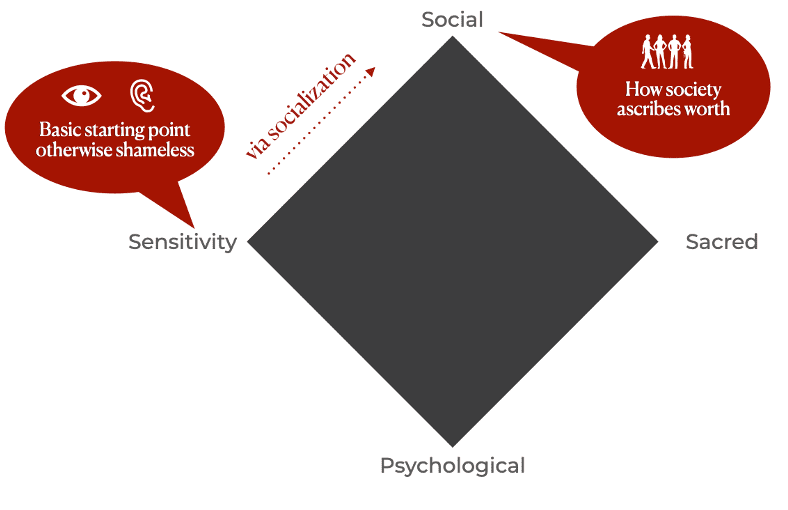
It’s important to note, however, that the individual experiencing social shame does not necessarily suffer psychological shame (explained below). Thus, when the Pharisees called in the apostles in Acts 5:40-41,
“they had them flogged. Then they ordered them not to speak in the name of Jesus, and let them go. As they left the council, they rejoiced that they were considered worthy to suffer dishonor for the sake of the name.”
Because the Pharisees behaved as outsiders to God’s kingdom, the apostles did not feel the psychological pain or distress that would come if they identified themselves more closely with the Pharisees.
Through socialization, a person learns what society deems shameful and honorable. No one is born with this knowledge. Regard for one’s community fosters great sensitivity to their opinion. The more a person internalizes the norms of the ingroup, the more likely they will experience psychological shame when they veer from them.
Psychological Shame
If someone says the word “shame,” your first thought will probably concern psychological shame. This is an internal experience; it is an intense feeling of unworthiness.
Although felt inward, the force of this shame stems from its social underbelly. How so? Someone experiencing psychological shame does so because they perceive a watching public, whether real or imagined, whether a crowd, God, or just themselves. Even seeing ourselves fall short of our own ideals can evoke some degree of shame.
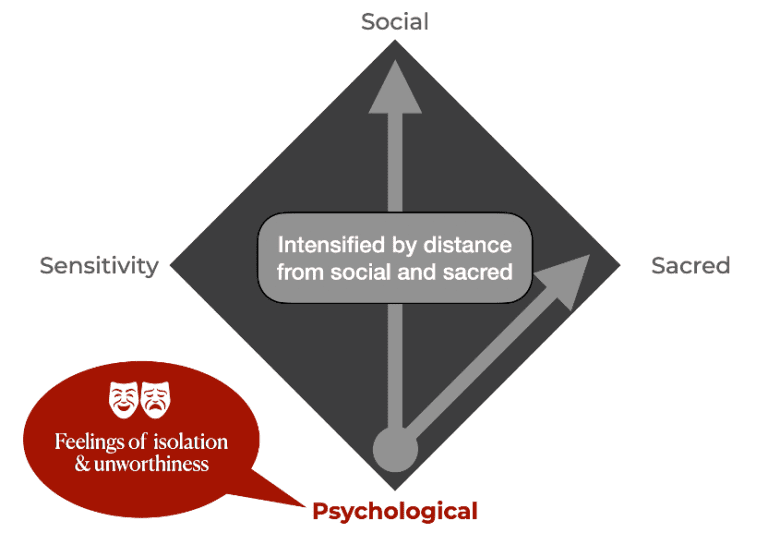 Feelings of fear and isolation routinely accompany such shame. It is intensified when one feels greater distance from one’s own community or sense of sacredness (i.e., God).
Sacred Shame
Sacred shame derives from what God deems worthy of shame or honor. As I state elsewhere,
Like social shame, this is an objective shame. That is, a person or thing is determined to be shameful according to some outside measure; in this case, God’s character. Ultimately, God is the measure of true honor/glory (and conversely, whatever is dishonorable or shameful). Having shame before God may or may not be linked directly with psychological or social shame.
For example, Daniel 12:2, “And many of those who sleep in the dust of the earth shall awake, some to everlasting life, and some to shame and everlasting contempt.” Paul adds that the “enemies of the cross of Christ … glory in their shame, which minds set on earthly things” (Phil 3:18–19). Finally, Peter writes, “Yet if anyone suffers as a Christian, let him not be ashamed, but let him glorify God in that name” (1 Pet 4:16; cf. Rom 1:16).
Whereas sensitivity is the starting point, having a sense of sacred shame is the goal of Christian character. However, one should not think that we can skip from one to the other. It is impossible both practically and theologically.
How so? Practically, no one has a sense of morality apart from community. Theologically, sacred shame is fostered within the church. This comes through living life with one another, being the body of Christ, as expounded throughout the New Testament.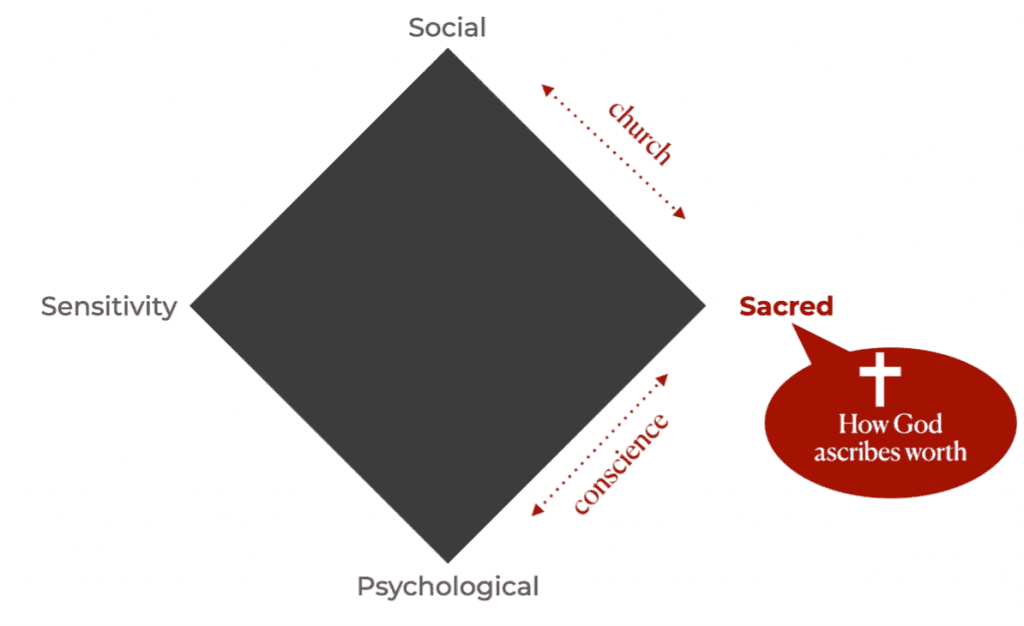
On the one hand, high levels of psychological shame can prevent people from repenting (i.e., an expression of sacred shame). On the other hand, low levels of psychological shame can catalyze genuine life change. Furthermore, some degree of psychological shame is a fruit of repentance. Consider Ezekiel 16:53–54, where the Lord says,
I will restore their fortunes, both the fortunes of Sodom and her daughters, and the fortunes of Samaria and her daughters, and I will restore your own fortunes in their midst, that you may bear your disgrace and be ashamed of all that you have done, becoming a consolation to them.
In these respects, the conscience uses psychological shame to shape our behavior and develop character. (On this point, Te-Li Lau further distinguishes “retrospective shame” and “prospective shame” when discussing how Paul discipled his churches.
Different Illustration. Same Explanation.
The picture above could be redrawn, as seen below. Each diagram has its own advantages. The following illustration places “sensitivity” in the middle, indicating its integral role in connecting other types of shame. Furthermore, it shows the natural progression from social to sacred and places the psychological in a distant position from the above shame types.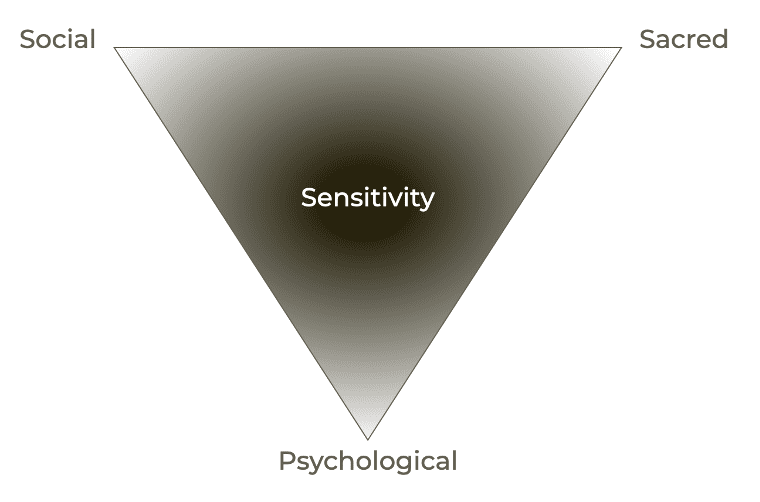
Are these diagrams and this explanation helpful? What else needs to go into my explanation?
Previous Post

September 7, 2021
Jesus experienced shame, not low self-esteem
Next Post

September 21, 2021 Defining masculinity and femininity biblically is harder than you think
Browse Our Archives
Select a Category Atonement Biblical Theology Book Reviews China Chinese Church Chinese Culture Chinese Language Collectivism Contextualization Culture (General) Ecclesiology Evangelism Gospel Honor & Shame (Face) Interpretation/Exegesis Justification/Righteousness Missiology Mission Methods One Gospel for All Nations Other Practical Contextualization Reading Romans with Eastern Eyes Resources Romans Salvation (General) Saving God's Face Seeking God's Face The Cross in Context Theological Contextualization Theological Education Theology Uncategorized
Select a Month October 2026 September 2026 August 2026 July 2026 June 2026 May 2026 April 2026 March 2026 February 2026 January 2026 December 2025 November 2025 October 2025 September 2025 August 2025 July 2025 June 2025 May 2025 April 2025 March 2025 February 2025 January 2025 December 2024 November 2024 October 2024 September 2024 August 2024 July 2024 June 2024 May 2024 April 2024 March 2024 February 2024 January 2024 December 2023 November 2023 October 2023 September 2023 August 2023 July 2023 June 2023 May 2023 April 2023 March 2023 February 2023 January 2023 December 2022 November 2022 October 2022 September 2022 August 2022 July 2022 June 2022 May 2022 April 2022 March 2022 February 2022 January 2022 December 2021 November 2021 October 2021 September 2021 August 2021 July 2021 June 2021 May 2021 April 2021 March 2021 February 2021 January 2021 December 2020 November 2020 October 2020 September 2020 August 2020 July 2020 June 2020 May 2020 April 2020 March 2020 February 2020 January 2020 December 2019 November 2019 October 2019 September 2019 August 2019 July 2019 June 2019 May 2019 April 2019 March 2019 February 2019 January 2019 December 2018 November 2018 October 2018 September 2018 August 2018 July 2018 June 2018 May 2018 April 2018 March 2018 February 2018 January 2018 December 2017 November 2017 October 2017 September 2017 August 2017 July 2017 June 2017 May 2017 April 2017 March 2017 February 2017 January 2017 December 2016 November 2016 October 2016 September 2016 August 2016 July 2016 June 2016 May 2016 April 2016 March 2016 February 2016 January 2016 December 2015 November 2015 October 2015 September 2015 August 2015 July 2015 June 2015 May 2015 April 2015 March 2015 February 2015 January 2015 December 2014 November 2014 October 2014 September 2014 August 2014 July 2014 June 2014 May 2014 April 2014 March 2014 February 2014 January 2014 December 2013 November 2013 October 2013 September 2013 August 2013 July 2013 June 2013 May 2013 April 2013 March 2013 February 2013 January 2013 December 2012 November 2012
Follow Us!
TAKE THE
Religious Wisdom Quiz
What is the biblical view of work?
Select your answer to see how you score.
Work is a curse Work hard as for the Lord Avoid work Only kings should work
Books by This Author Books by Brad Vaughn
Related posts from Saving God's Face

No King forgets his crown. Why do we?

Recovering Moral Vision Between Shame and Shamelessness

Refuge, Confession, and the End of Shame

Psalm 25 and the Fear of Being Put...
TRENDING AT PATHEOS Evangelical

The Iron Gates and the Lion of the...
Yesterday, I didn't finish my report about, well, yesterday. So I'll...

Dolly Parton’s Last Song Wins Dove Award with...
Bluegrass band The Grascals, speaking on the red carpet at the 57th...

The Image: On the Horror of Capitalism and...
The Image Then went the Pharisees, and took counsel how they might...

We are approaching the date of our new American national holiday: October...

Letters on Living the Faith by C.S. Lewis
Most of us met C.S. Lewis as a public intellectual. Mere Christianity....

When Halloween Unmasks Married Hearts
Written by Dr. David K. Ewen from Eternal Truth Bible College Behind...
view all Evangelical blogs
Ad-Free & Subscriber Log-In Subscription Support
- About Us
- 2026 Calendar
- Videos
- Podcasts
- Library of World Religions
- Faith In Media Tracker
- Advertise With Us
- Write for Us
- Privacy Policy
- Terms of Service
- Do Not Sell My Data
- Contact Us
- Radiant Digital
- Manage Newsletter Subscriptions
- Unsubscribe From Notifications
- Sitemap
Copyright 2008-2026, Patheos. All rights reserved.
Subscription Support Ad-Free & Subscriber Log-In
Follow Patheos