
BuddhistCatholicContemplativeEvangelicalGeneral ChristianHinduJewishLatter-day SaintMuslimNew VisionsProgressive Christian
Beliefs
- Buddhist
- Catholic
- Contemplative
- Evangelical
- General Christian
- Hindu
- Jewish
- Latter-day Saint
- More Voices
- Muslim
- New Visions
- Pagan
- Progressive Christian
Topics
- Religion News
- Food and Religion
- Sports and Religion
- Religious Art
- Religious Music and Entertainment
- Religious Events
- History and Religion
- Style and Religion
- Politics and Religion
- Women in Religion
- Recreation Outdoors and Religion
- Business Finance and Religion
- Careers Workplace and Religion
- Education and Religion
- Family Parenting and Religion
- Health Fitness and Religion
- Home and Religion
- Relationships and Religion
- Technology and Religion
- Travel and Religion
Columnists
- Buddhist Columnists
- Business Finance and Religion Columnists
- Careers Workplace and Religion Columnists
- Catholic Columnists
- Contemplative Columnists
- Education and Religion Columnists
- Evangelists Columnists
- Family Parenting and Religion Columnists
- General Christian Columnists
- Health Fitness and Religion Columnists
- Hindu Columnists
- History and Religion Columnists
- Home and Religion Columnists
- Jewish Columnists
- More Voices Columnists
- Latter Day Columnists
- Muslim Columnists
- New Visions Columnists
- Nonreligious Columnists
- Pagan Columnists
- Politics and Religion Columnists
- Progressive Columnists
- Recreation Outdoors and Religion Columnists
- Relationships and Religion Columnists
- Religion News Columnists
- Religious Art Columnists
- Religious Events Columnists
- Religious Music and Entertainment Columnists
- Sports and Religion Columnists
- Style and Religion Columnists
- Technology and Religion Columnists
- Travel and Religion Columnists
- Women in Religion Columnists
Resource Library
- 2026 Calendar
- Library of World Religions
- The 100 Most Holy Places on Earth
- Patheos Answers
- Podcasts
- Videos
- Faith Leaders Database
- Anglican Episcopalian
- Bahai
- Baptist
- Buddhism
- Christianity
- Confucianism
- Eastern Orthodoxy
- Hinduism
- Holiness and Pentecostal
- ISKCON
- Islam
- Judaism
- Lutheran
- Methodist
- The Church of Jesus Christ of Latter-day Saints
- New Age
- Paganism
- Presbytarian and Reformed
- Protestantism
- Religion Behind the Scenes
- Roman Catholic
- Scientology
- Shia Islam
- Sikhism
- Sufism
- Sunni Islam
- Taoism
- Zen
- See all religions
Research Tools
 Ad-Free & Subscriber Log-In Subscription Support
Ad-Free & Subscriber Log-In Subscription Support
Follow Patheos 

- Trending:
- Forgiveness
- |
- Marriage
- |
- Consciousness
- |
- Death Penalty
- |
- Election
- |
- Halloween

-
Tools
-
Support the Work
- Home
- Evangelical
- The First of Four Stages in Contextualization
The First of Four Stages in Contextualization
Last updated on: August 10, 2021 at 4:10 pm by Brad Vaughn
The First of Four Stages in Contextualization 2021-07-15T06:03:58-07:00 Brad Vaughn
Patheos Explore the world's faith through different perspectives on religion and spirituality! Patheos has the views of the prevalent religions and spiritualities of the world.
In my previous post, I showed how the Bible and culture are inextricably tied together. Misunderstanding that relationship undermines the prospects of doing contextualization in a biblically faithful and culturally meaningful way.
This post highlights a few key points from (what I consider to be) the most important chapter in One Gospel for All Nations. The discussion there deserved a lengthier explanation, but, alas, I had a word limit to keep.
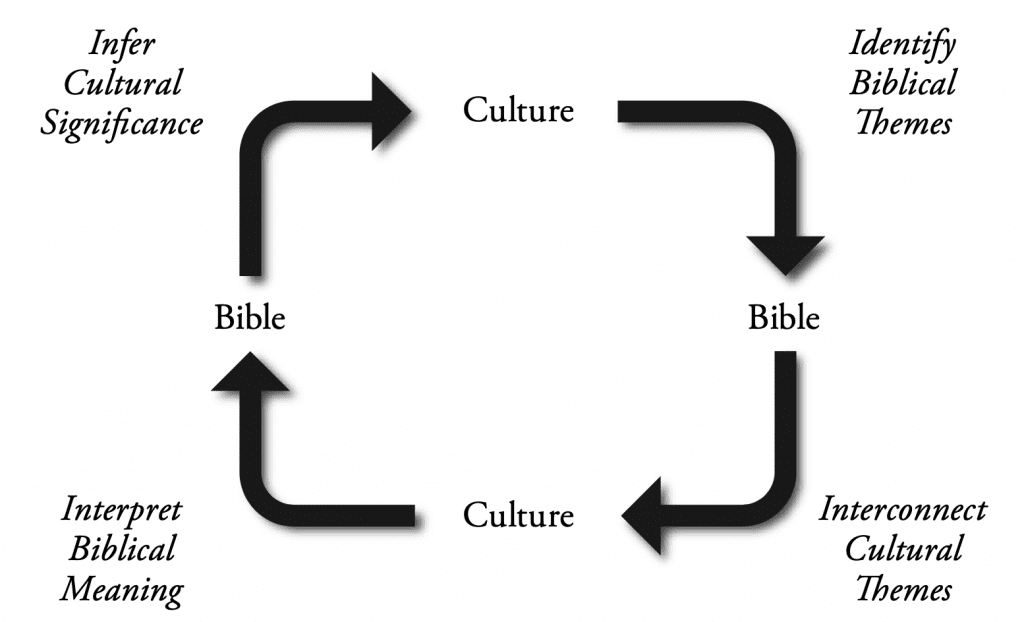 NOTE: The picture above is different from that seen in my last post. This figure stems from the one in the previous post. Below are the four primary stages of contextualization
Stage One: Identify Biblical Themes
Stage Two: Interconnect Cultural Themes
Stage Three: Interpret Biblical Meaning
Stage Four: Infer Cultural Significance
I will address each one in turn, but you will have to follow the links and/or (re)read the book to dig deeper into the specifics. This post only looks are Stages 1-2. The next post will return to Stages 3-4.
Stage One: Identify Biblical Themes
What is the end goal of stage one? We want to identify how the Bible frames and explains the gospel. The gospel tells a specific story with a particular plot. In stage one, we study the Bible to discern what sort of flexibility we have in presenting this story.
From the start, our model takes measures to ensure that contemporary culture doesn’t subtly distort our understanding of God’s revelation. This stage in the process makes a key contribution to the contextualization process. It helps us determine the organizing principles that we can use. After all, on the surface, we have no way to differentiate one cultural vantage point from another. Thus, this stage tempers or regulates the influence of our culture. Accordingly, we begin by examining the Scripture.
First, we identify the gospel’s framework as used in its original setting. Only then can we explore discern the gospel’s significance in each context. Proceeding in this sequence is one way (at least to some degree) to guard against cultural syncretism.
We first study the entirety of Scripture to grasp the coherency of the grand biblical story. Our goal is not mere familiarity; rather, we identify threads that unify the story.
This is essentially the work of biblical theology. The narrative (not theology) dictates which threads are unifying.
By reading broadly across the biblical text, we identify the essential framework for presenting the gospel. I have already argued for a threefold structure—creation, covenant, kingdom. Certain interconnections exist between these three motifs, which I’ve called “framework themes.” In addition, many concepts and images explain the gospel’s significance, which I’ll call “explanation themes” (e.g., atonement, justification, sacrifice, adoption, etc.)
Stage Two: Interconnect Cultural Themes
How do our findings connect to the cultures in which we live? Whereas stage one identifies the gospel’s framework and explanatory themes, stage two uses these themes as a lens for studying culture. Our goal is to interlink the biblical text and the cultural context. The model presented in One Gospel for All Nations equips us to identify thematic parallels between the two. We want to find which cultural themes faithfully frame and explain a biblical gospel presentation.
Before overlaying the ancient and modern contexts together, we first observe what is accomplished by working in this order—from biblical text to cultural context—in stages one and two. Early in the contextualization process, the Bible frames the agenda for what follows. How so?
Here are two ways.
- At the most fundamental level, the model establishes the grid through which to look at modern culture. That automatically gives a certain priority to Scripture in that it directs our focus when looking at culture.
- The model more easily allows Scripture to determine which ideas we regard as firm and flexible (i.e., those framing the gospel’s essence versus those explaining its significance). This is because the grand biblical narrative (biblical theology) precedes systematic theology and our cultural study (stage two).
The themes that frame the biblical gospel should also define our presentations.
In stage one, we use the firm and flexible gospel themes in the Bible so that, in stage two, we can identify how to frame a biblically faithful and culturally meaningful gospel presentation. The model helps us discern how the gospel most directly speaks to a specific culture, yet without forsaking theological balance.
We can balance themes found in both the Bible and local culture. Using the biblical framework as a grid for studying culture, we are forced to consider the interrelationships between themes within a given culture. We must not forget that concepts, images, and language have distinct connotations and interconnections within specific cultures. The model I’ve proposed slows us down to consider how ideas relate to one another. At the same time, our sequence ensures that we do everything given the gospel’s biblical framework.
Previous Post
August 3, 2021
The Circular Relationship Between Culture and the Bible
Next Post

August 17, 2021 Finding Biblical Meaning and Cultural Significance
Browse Our Archives
Select a Category Atonement Biblical Theology Book Reviews China Chinese Church Chinese Culture Chinese Language Collectivism Contextualization Culture (General) Ecclesiology Evangelism Gospel Honor & Shame (Face) Interpretation/Exegesis Justification/Righteousness Missiology Mission Methods One Gospel for All Nations Other Practical Contextualization Reading Romans with Eastern Eyes Resources Romans Salvation (General) Saving God's Face Seeking God's Face The Cross in Context Theological Contextualization Theological Education Theology Uncategorized
Select a Month October 2026 September 2026 August 2026 July 2026 June 2026 May 2026 April 2026 March 2026 February 2026 January 2026 December 2025 November 2025 October 2025 September 2025 August 2025 July 2025 June 2025 May 2025 April 2025 March 2025 February 2025 January 2025 December 2024 November 2024 October 2024 September 2024 August 2024 July 2024 June 2024 May 2024 April 2024 March 2024 February 2024 January 2024 December 2023 November 2023 October 2023 September 2023 August 2023 July 2023 June 2023 May 2023 April 2023 March 2023 February 2023 January 2023 December 2022 November 2022 October 2022 September 2022 August 2022 July 2022 June 2022 May 2022 April 2022 March 2022 February 2022 January 2022 December 2021 November 2021 October 2021 September 2021 August 2021 July 2021 June 2021 May 2021 April 2021 March 2021 February 2021 January 2021 December 2020 November 2020 October 2020 September 2020 August 2020 July 2020 June 2020 May 2020 April 2020 March 2020 February 2020 January 2020 December 2019 November 2019 October 2019 September 2019 August 2019 July 2019 June 2019 May 2019 April 2019 March 2019 February 2019 January 2019 December 2018 November 2018 October 2018 September 2018 August 2018 July 2018 June 2018 May 2018 April 2018 March 2018 February 2018 January 2018 December 2017 November 2017 October 2017 September 2017 August 2017 July 2017 June 2017 May 2017 April 2017 March 2017 February 2017 January 2017 December 2016 November 2016 October 2016 September 2016 August 2016 July 2016 June 2016 May 2016 April 2016 March 2016 February 2016 January 2016 December 2015 November 2015 October 2015 September 2015 August 2015 July 2015 June 2015 May 2015 April 2015 March 2015 February 2015 January 2015 December 2014 November 2014 October 2014 September 2014 August 2014 July 2014 June 2014 May 2014 April 2014 March 2014 February 2014 January 2014 December 2013 November 2013 October 2013 September 2013 August 2013 July 2013 June 2013 May 2013 April 2013 March 2013 February 2013 January 2013 December 2012 November 2012
Follow Us!
TAKE THE
Religious Wisdom Quiz
Which Gospel emphasizes Jesus as the Son of God?
Select your answer to see how you score.
John Luke Matthew Mark
Books by This Author Books by Brad Vaughn
Related posts from Saving God's Face
Treating Culture as a Sacred Creed Has Consequences

When Cultural Identity Becomes Sacred
Paul’s Contextualization of Artemis for the Ephesians
What is a Good Definition of Culture?
TRENDING AT PATHEOS Evangelical

The Sermon on the Mount, Part I: Matthew...
The Sermon on the Mount, Part I (Matthew 4:12-5:12) St. Matthew moves...

What's up from Crossway: Reviewing some of their latest A few weeks...

Janie Learns the Way of the Cross: A...
Teaching children about Jesus' Passion can be challenging. Many parents and educators...

Looking For Good Catholic Writing - October 2026
He alone extends the heavens, and he walks upon the waves of...

In "Irreplaceable," our book on vocation and technology, Trevor Sutton and I...

I was strolling through the top floor of the brand new Parthenon...
view all Evangelical blogs
Ad-Free & Subscriber Log-In Subscription Support
- About Us
- 2026 Calendar
- Videos
- Podcasts
- Library of World Religions
- Faith In Media Tracker
- Advertise With Us
- Write for Us
- Privacy Policy
- Terms of Service
- Do Not Sell My Data
- Contact Us
- Radiant Digital
- Manage Newsletter Subscriptions
- Unsubscribe From Notifications
- Sitemap
Copyright 2008-2026, Patheos. All rights reserved.
Subscription Support Ad-Free & Subscriber Log-In
Follow Patheos