
BuddhistCatholicContemplativeEvangelicalGeneral ChristianHinduJewishLatter-day SaintMuslimNew VisionsProgressive Christian
Beliefs
- Buddhist
- Catholic
- Contemplative
- Evangelical
- General Christian
- Hindu
- Jewish
- Latter-day Saint
- More Voices
- Muslim
- New Visions
- Pagan
- Progressive Christian
Topics
- Religion News
- Food and Religion
- Sports and Religion
- Religious Art
- Religious Music and Entertainment
- Religious Events
- History and Religion
- Style and Religion
- Politics and Religion
- Women in Religion
- Recreation Outdoors and Religion
- Business Finance and Religion
- Careers Workplace and Religion
- Education and Religion
- Family Parenting and Religion
- Health Fitness and Religion
- Home and Religion
- Relationships and Religion
- Technology and Religion
- Travel and Religion
Columnists
- Buddhist Columnists
- Business Finance and Religion Columnists
- Careers Workplace and Religion Columnists
- Catholic Columnists
- Contemplative Columnists
- Education and Religion Columnists
- Evangelists Columnists
- Family Parenting and Religion Columnists
- General Christian Columnists
- Health Fitness and Religion Columnists
- Hindu Columnists
- History and Religion Columnists
- Home and Religion Columnists
- Jewish Columnists
- More Voices Columnists
- Latter Day Columnists
- Muslim Columnists
- New Visions Columnists
- Nonreligious Columnists
- Pagan Columnists
- Politics and Religion Columnists
- Progressive Columnists
- Recreation Outdoors and Religion Columnists
- Relationships and Religion Columnists
- Religion News Columnists
- Religious Art Columnists
- Religious Events Columnists
- Religious Music and Entertainment Columnists
- Sports and Religion Columnists
- Style and Religion Columnists
- Technology and Religion Columnists
- Travel and Religion Columnists
- Women in Religion Columnists
Resource Library
- 2026 Calendar
- Library of World Religions
- The 100 Most Holy Places on Earth
- Patheos Answers
- Podcasts
- Videos
- Faith Leaders Database
- Anglican Episcopalian
- Bahai
- Baptist
- Buddhism
- Christianity
- Confucianism
- Eastern Orthodoxy
- Hinduism
- Holiness and Pentecostal
- ISKCON
- Islam
- Judaism
- Lutheran
- Methodist
- The Church of Jesus Christ of Latter-day Saints
- New Age
- Paganism
- Presbytarian and Reformed
- Protestantism
- Religion Behind the Scenes
- Roman Catholic
- Scientology
- Shia Islam
- Sikhism
- Sufism
- Sunni Islam
- Taoism
- Zen
- See all religions
Research Tools
 Ad-Free & Subscriber Log-In Subscription Support
Ad-Free & Subscriber Log-In Subscription Support
Follow Patheos 

- Trending:
- Forgiveness
- |
- Marriage
- |
- Consciousness
- |
- Death Penalty
- |
- Election
- |
- Halloween

-
Tools
-
Support the Work
- Home
- Evangelical
- The Circular Relationship Between Culture and the Bible
The Circular Relationship Between Culture and the Bible
Last updated on: August 3, 2021 at 4:00 pm by Brad Vaughn
The Circular Relationship Between Culture and the Bible 2021-07-15T06:02:58-07:00 Brad Vaughn
Patheos Explore the world's faith through different perspectives on religion and spirituality! Patheos has the views of the prevalent religions and spiritualities of the world.
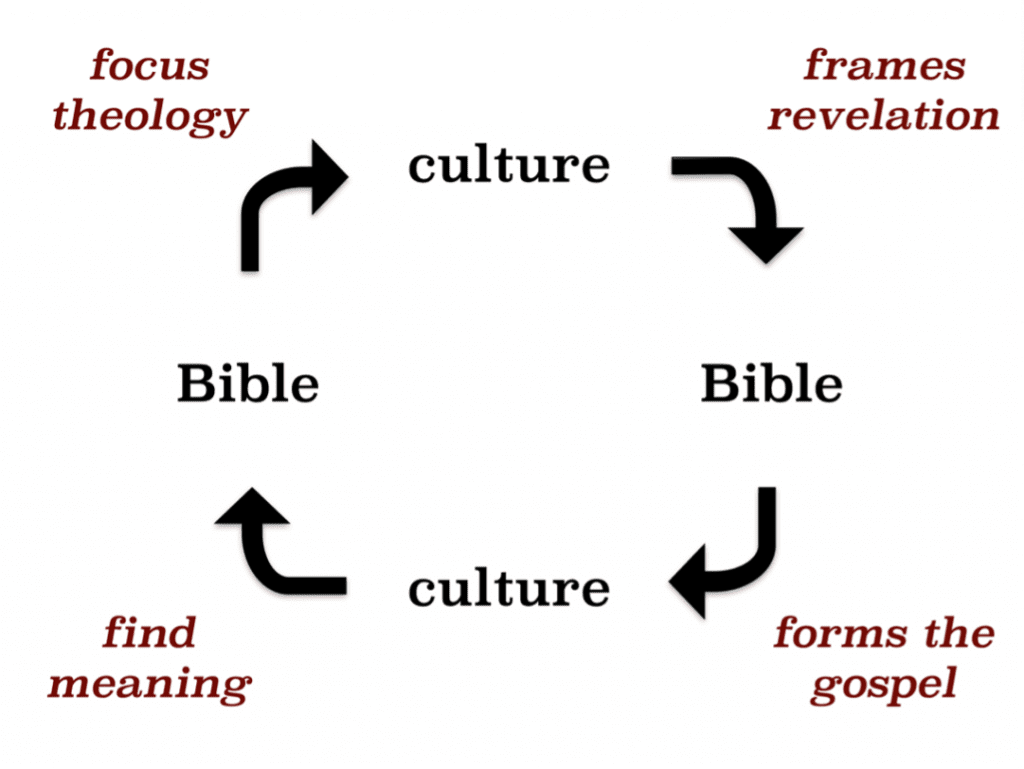
This first post in a contextualization mini-series will explain the circular relationship between the Bible and culture. It supplements the content found in One Gospel for All Nations. The next post will build on this foundation, surveying the four primary stages of contextualization.
From Culture to Bible and Back
-
Culture FRAMES God’s revelation
Everything begins with culture. Yes, you read that correctly. Why? God used various ancient cultures to shape the content of his revelation (i.e., the Bible). He uses assorted concepts from said cultures to reveal his character, his will, and his plans. These include Ancient Near Eastern (ANE) covenants and temples as well as the practice of circumcision. The “image of God” concept was borrowed from neighboring ANE cultures (On this last point, check out either a summary explanation or a more robust academic treatment.) Ancient people within the ANE world were very familiar with these symbols and ideas, which is why God used culture to frame his self-revelation.
This is why I and others have said, “All theology is contextualized.” Not only do all people read the Bible through a cultural lens (reason #1), but also contextualization is rooted in the process of biblical revelation itself (reason #2). Although culture logically precedes revelation, it is the Bible that ultimately holds authority. This is no contradiction. In Saving God’s Face, I explain . . .
The argument hinges on an order fallacy. To ask whether the Bible or culture has “priority” is unclear. The idea of “priority” can refer either to temporal sequence (i.e. what comes first) or to authoritative rank (i.e. what has authority). According to the fallacy, it is supposed that whatever comes first temporally has greater authority. To the contrary, sequence is not always supreme. For example, in the apologetics . . . one can easily see how reason initially has epistemological authority (over revelation) in its defense of sola scriptura. (SGF, 60)
In other words, the Bible is decisive, not culture, yet God reveals himself through already existing human cultures. God used cultures to contextualize his self-revelation. The fact that culture is sequentially prior to revelation does not undermine biblical authority.
-
The Bible FORMS the gospel.
The Bible proclaims the gospel, not culture. It inherently limits whatever authority someone might ascribe to culture. Not only this, but the Bible also determines the content of the gospel. Therefore, we cannot casually decide which themes we want to emphasize. No matter our culture or denomination, the entire Bible decides what is important (not just our favorite portions of the Bible). All cultures are called to conform to biblical revelation. The gospel does not change from one culture to another. (The practical significance of this point will become clearer in the second post of this series.)

Lesslie Newbigin
At this point, a quote from Lesslie Newbigin is fitting:
There can never be a culture-free gospel. Yet the gospel, which is from the beginning to the end embodied in culturally conditioned forms, calls into question all cultures, including the one in which it was originally embodied.
His statement deserves a lifetime of reflection.
-
Culture helps us FIND biblical meaning.
We all have intellectual, cultural, and emotional baggage we bring to the biblical text. Our knowledge (or lack thereof) will affect what we pay attention to. In short, our cultural lens helps us find meaning from within the text. I did not assert that we can use culture to insert meaning into the Bible. Rather, culture invariably acts as our lens to interpret Scripture. Our eyes act as natural filters, either for good or bad. Again, I did not say our culture determines the Bible’s meaning. Rather, our lens determines our field of vision. Accordingly, our cultural lens gives us insight, but it also limits our understanding. For example, if I previously have never seen a dog, then I’ll have difficulty understanding those places where the Bible mentions “dogs.”
-
The Bible FOCUSES our explanations and applications
Having interpreted the Bible (via our cultural lenses) and discerns theological understanding, then what? The Bible focuses our theological explanations and applications. In other words, it both critiques and challenges contemporary culture. The Scriptures lead us in properly communicating truth to the surrounding context. The Bible decides what is honorable or shameful, what is right or wrong. Likewise, the Bible narrows our priorities. From the various cultural themes and issues available to us, biblical text gives us our focus to address what is of utmost importance.
A Few Key Ideas
Many people only want to say the Bible transcends culture. However, the facts present us with a far more complex scenario. The Bible and culture have an organic relationship. In the model depicted above, “culture” is not static. “Culture” initially refers to the ancient biblical contexts that inform the biblical text. “Culture” then includes the varied backgrounds and experiences that inform our view of the world. Finally, “culture” signifies the contexts in which we live and serve. I’ll conclude with a few key takeaways….
- Scripture and culture are intertwined.
- The Bible is rooted in history.
- The gospel is not abstract.
In the coming posts, I’ll build on this discussion to formulate four stages to the contextualization process.
Previous Post

July 27, 2021
Ranking Schools Based On Reputation, Not Education
Next Post

August 10, 2021 The First of Four Stages in Contextualization
Browse Our Archives
Select a Category Atonement Biblical Theology Book Reviews China Chinese Church Chinese Culture Chinese Language Collectivism Contextualization Culture (General) Ecclesiology Evangelism Gospel Honor & Shame (Face) Interpretation/Exegesis Justification/Righteousness Missiology Mission Methods One Gospel for All Nations Other Practical Contextualization Reading Romans with Eastern Eyes Resources Romans Salvation (General) Saving God's Face Seeking God's Face The Cross in Context Theological Contextualization Theological Education Theology Uncategorized
Select a Month October 2026 September 2026 August 2026 July 2026 June 2026 May 2026 April 2026 March 2026 February 2026 January 2026 December 2025 November 2025 October 2025 September 2025 August 2025 July 2025 June 2025 May 2025 April 2025 March 2025 February 2025 January 2025 December 2024 November 2024 October 2024 September 2024 August 2024 July 2024 June 2024 May 2024 April 2024 March 2024 February 2024 January 2024 December 2023 November 2023 October 2023 September 2023 August 2023 July 2023 June 2023 May 2023 April 2023 March 2023 February 2023 January 2023 December 2022 November 2022 October 2022 September 2022 August 2022 July 2022 June 2022 May 2022 April 2022 March 2022 February 2022 January 2022 December 2021 November 2021 October 2021 September 2021 August 2021 July 2021 June 2021 May 2021 April 2021 March 2021 February 2021 January 2021 December 2020 November 2020 October 2020 September 2020 August 2020 July 2020 June 2020 May 2020 April 2020 March 2020 February 2020 January 2020 December 2019 November 2019 October 2019 September 2019 August 2019 July 2019 June 2019 May 2019 April 2019 March 2019 February 2019 January 2019 December 2018 November 2018 October 2018 September 2018 August 2018 July 2018 June 2018 May 2018 April 2018 March 2018 February 2018 January 2018 December 2017 November 2017 October 2017 September 2017 August 2017 July 2017 June 2017 May 2017 April 2017 March 2017 February 2017 January 2017 December 2016 November 2016 October 2016 September 2016 August 2016 July 2016 June 2016 May 2016 April 2016 March 2016 February 2016 January 2016 December 2015 November 2015 October 2015 September 2015 August 2015 July 2015 June 2015 May 2015 April 2015 March 2015 February 2015 January 2015 December 2014 November 2014 October 2014 September 2014 August 2014 July 2014 June 2014 May 2014 April 2014 March 2014 February 2014 January 2014 December 2013 November 2013 October 2013 September 2013 August 2013 July 2013 June 2013 May 2013 April 2013 March 2013 February 2013 January 2013 December 2012 November 2012
Follow Us!
TAKE THE
Religious Wisdom Quiz
I am a period of seven years times seven, followed by a year of liberty and restoration. What am I?
Select your answer to see how you score.
A year of rest A holy year The Sabbath year The Year of Jubilee
Books by This Author Books by Brad Vaughn
Related posts from Saving God's Face
Treating Culture as a Sacred Creed Has Consequences

When Cultural Identity Becomes Sacred
Paul’s Contextualization of Artemis for the Ephesians
What is a Good Definition of Culture?
TRENDING AT PATHEOS Evangelical

The Sermon on the Mount, Part I: Matthew...
The Sermon on the Mount, Part I (Matthew 4:12-5:12) St. Matthew moves...

What's up from Crossway: Reviewing some of their latest A few weeks...

Janie Learns the Way of the Cross: A...
Teaching children about Jesus' Passion can be challenging. Many parents and educators...

Looking For Good Catholic Writing - October 2026
He alone extends the heavens, and he walks upon the waves of...

In "Irreplaceable," our book on vocation and technology, Trevor Sutton and I...

I was strolling through the top floor of the brand new Parthenon...
view all Evangelical blogs
Ad-Free & Subscriber Log-In Subscription Support
- About Us
- 2026 Calendar
- Videos
- Podcasts
- Library of World Religions
- Faith In Media Tracker
- Advertise With Us
- Write for Us
- Privacy Policy
- Terms of Service
- Do Not Sell My Data
- Contact Us
- Radiant Digital
- Manage Newsletter Subscriptions
- Unsubscribe From Notifications
- Sitemap
Copyright 2008-2026, Patheos. All rights reserved.
Subscription Support Ad-Free & Subscriber Log-In
Follow Patheos