
BuddhistCatholicContemplativeEvangelicalGeneral ChristianHinduJewishLatter-day SaintMuslimNew VisionsProgressive Christian
Beliefs
- Buddhist
- Catholic
- Contemplative
- Evangelical
- General Christian
- Hindu
- Jewish
- Latter-day Saint
- More Voices
- Muslim
- New Visions
- Pagan
- Progressive Christian
Topics
- Religion News
- Food and Religion
- Sports and Religion
- Religious Art
- Religious Music and Entertainment
- Religious Events
- History and Religion
- Style and Religion
- Politics and Religion
- Women in Religion
- Recreation Outdoors and Religion
- Business Finance and Religion
- Careers Workplace and Religion
- Education and Religion
- Family Parenting and Religion
- Health Fitness and Religion
- Home and Religion
- Relationships and Religion
- Technology and Religion
- Travel and Religion
Columnists
- Buddhist Columnists
- Business Finance and Religion Columnists
- Careers Workplace and Religion Columnists
- Catholic Columnists
- Contemplative Columnists
- Education and Religion Columnists
- Evangelists Columnists
- Family Parenting and Religion Columnists
- General Christian Columnists
- Health Fitness and Religion Columnists
- Hindu Columnists
- History and Religion Columnists
- Home and Religion Columnists
- Jewish Columnists
- More Voices Columnists
- Latter Day Columnists
- Muslim Columnists
- New Visions Columnists
- Nonreligious Columnists
- Pagan Columnists
- Politics and Religion Columnists
- Progressive Columnists
- Recreation Outdoors and Religion Columnists
- Relationships and Religion Columnists
- Religion News Columnists
- Religious Art Columnists
- Religious Events Columnists
- Religious Music and Entertainment Columnists
- Sports and Religion Columnists
- Style and Religion Columnists
- Technology and Religion Columnists
- Travel and Religion Columnists
- Women in Religion Columnists
Resource Library
- 2026 Calendar
- Library of World Religions
- The 100 Most Holy Places on Earth
- Patheos Answers
- Podcasts
- Videos
- Faith Leaders Database
- Anglican Episcopalian
- Bahai
- Baptist
- Buddhism
- Christianity
- Confucianism
- Eastern Orthodoxy
- Hinduism
- Holiness and Pentecostal
- ISKCON
- Islam
- Judaism
- Lutheran
- Methodist
- The Church of Jesus Christ of Latter-day Saints
- New Age
- Paganism
- Presbytarian and Reformed
- Protestantism
- Religion Behind the Scenes
- Roman Catholic
- Scientology
- Shia Islam
- Sikhism
- Sufism
- Sunni Islam
- Taoism
- Zen
- See all religions
Research Tools
 Ad-Free & Subscriber Log-In Subscription Support
Ad-Free & Subscriber Log-In Subscription Support
Follow Patheos 

- Trending:
- Forgiveness
- |
- Marriage
- |
- Consciousness
- |
- Death Penalty
- |
- Election
- |
- Halloween

-
Tools
-
Support the Work
- Home
- Evangelical
- Does the Bible really address policing and black identity?
Does the Bible really address policing and black identity?
Last updated on: November 10, 2020 at 3:23 pm by Brad Vaughn
Does the Bible really address policing and black identity? 2020-09-30T00:39:29-07:00 Brad Vaughn
Patheos Explore the world's faith through different perspectives on religion and spirituality! Patheos has the views of the prevalent religions and spiritualities of the world.
The previous post looked at Esau McCaulley’s Reading While Black as an exercise in theological contextualization. Today, we consider a few ways the church can benefit from interpreters who read Scripture through the lens of the black experience.
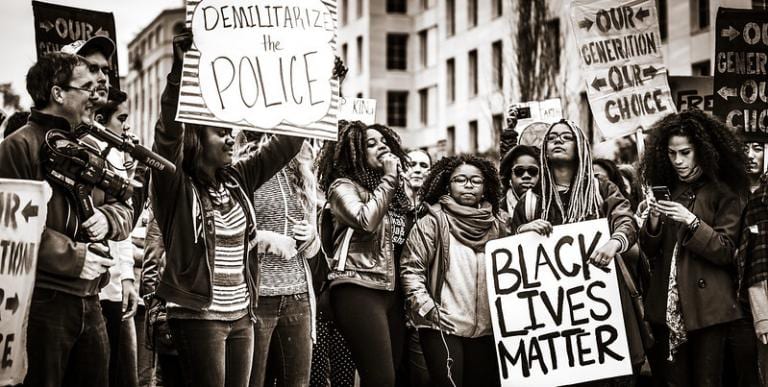
Credit: Flickr/Johnny Silvercloud
Looking at the table of contents, I scratched my head trying to imagine how McCaulley would use Scripture to address topics such as policing, black identity, and black rage. I could only hope his methodology would be more exegetically rigorous than many authors of black liberation theology. He did not disappoint. I was humbled and in awe of the ways that McCaulley analyzed several texts.
A Theology of Policing
Having written a book on Romans, I’m spent a lot of time in Paul’s letter. So, when McCaulley directed my attention to Romans 13:1-7 in his discussion about policing, I was skeptical as to what there was to find. Yet, he artfully shows how a change in perspective sheds light on familiar passages.
In Romans 13:3, Paul writes,
For rulers are not a terror to good conduct, but to bad. Would you have no fear of the one who is in authority? Then do what is good, and you will receive his approval.
From this, McCaulley rightly draws an implication, “Paul says that the state’s policing duties should never be a terror to those who are innocent” (29). He rejects common applications of the chapter that argue for Christians to be passively obedient to the government (31-32). Instead, he uses the text to critique on the state and our ability to discern what God is doing through it.
McCaulley explains how Romans soldiers served a policing function in much of the empire. He then makes an astute observation, noting that Paul distinguishes the state (“rulers”) and the police (i.e., soldiers who “bear the sword”). Accordingly,
Paul recognizes that the soldier’s attitude toward the people who reside in the city will in large part be determined by those who give the orders. The problem, if there is one, does not reside solely in those who bear the sword, but those who direct it. In other words, Paul does not focus on individual actions, but on power structures. (39)
McCaulley adds,
He rightly focuses on those who control the sword and not merely the individual. This gives the Christian thinker and advocate the space to think structurally about how a just society should treat its people. Paul also speaks about the absence of fear, a central concern for Black folks. (41)
I can’t give a full recap of his entire argument here. But these quotes give a little taste of the chapter.
A Biblical Look at Black Identity
Chapter Five turns our attention to the question of identity. For many who have felt Christianity was a “white religion” and a tool of oppression, it’s no wonder that some people would wonder what the Bible has to say about black identity.
In a series of masterful moves, McCaulley highlights several key points in the biblical story in which black people play an important role. For example, he reminds us that Joseph married an African woman during his time in Egypt. He had two sons with her. The time eventually comes when Jacob decides to adopt Joseph’s sons, Ephraim and Manasseh.
Jacob sees the Brown flesh and African origin of these boys as the beginning of God’s fulfillment of his promise to make Jacob a community of different nations and ethnicities, and for that reason, he claims these two boys as his own. These two boys become two of the twelve tribes of Israel. Egypt and Africa are not outside of God’s people; African blood flows into Israel from the beginning as a fulfillment of the promise made to Abraham, Isaac, and Jacob. (101-2)
In these two African children, Jacob sees God fulfilling his promise to include different nations within his family. Therefore, McCaulley says, “We need to be as clear as possible about this. When it comes to the question of Black presence in the Bible, it is not a question of finding our place in someone else’s story” (103).
McCaulley also draws our eyes to the New Testament. While most readers are familiar with the Ethiopian eunuch, many people may overlook the fact that an African man walked with Jesus to his death. In Mark’s Gospel,
He says that Simon of Cyrene was compelled to carry the cross. Cyrene is a city in North Africa in what we now call Libya… At the moment in which Christ is reconciling the world to himself on the cross, an African family is making its first steps toward the kingdom. (107–8)
McCaulley concludes with a question.
What do the stories of Simon and the Ethiopian eunuch mean for Black Christianity? They show that the story of early Christianity is in part our story. We are at the cross. We are at the beginning of the emerging Christian community. There is no evidence that Simon or the Ethiopian felt that one couldn’t be African and Christian. (111-12)
For many American evangelicals, a “colorblind” interpretation is an ideal one. After all, some suppose, God does not see color. McCaulley disagrees.
The colorblind interpretation of Paul cuts against the grain of his entire ministry…. Jesus as the risen and reigning king has won for himself the ability to order history. This is relevant to the question of ethnic identity because Jesus’ vision for the climax of human history lauds the importance of ethnicity. (114-15)
These comments only begin to scratch the surface of Reading While Black. For example, some readers will be surprised that the book has an entire (and excellent) chapter on black rage.
Throughout this work, McCaulley demonstrates the value of biblically faithful and culturally meaningful contextualization. I hope others will further take up this approach to reading Scripture so that we can learn more from God’s word thanks to the cultural lens of people from around the world.
Previous Post

November 3, 2020
Reading While Black as an Exercise in Contextualization
Next Post
November 17, 2020 Honor, Shame, and the Gospel (New Book!)
Browse Our Archives
Select a Category Atonement Biblical Theology Book Reviews China Chinese Church Chinese Culture Chinese Language Collectivism Contextualization Culture (General) Ecclesiology Evangelism Gospel Honor & Shame (Face) Interpretation/Exegesis Justification/Righteousness Missiology Mission Methods One Gospel for All Nations Other Practical Contextualization Reading Romans with Eastern Eyes Resources Romans Salvation (General) Saving God's Face Seeking God's Face The Cross in Context Theological Contextualization Theological Education Theology Uncategorized
Select a Month October 2026 September 2026 August 2026 July 2026 June 2026 May 2026 April 2026 March 2026 February 2026 January 2026 December 2025 November 2025 October 2025 September 2025 August 2025 July 2025 June 2025 May 2025 April 2025 March 2025 February 2025 January 2025 December 2024 November 2024 October 2024 September 2024 August 2024 July 2024 June 2024 May 2024 April 2024 March 2024 February 2024 January 2024 December 2023 November 2023 October 2023 September 2023 August 2023 July 2023 June 2023 May 2023 April 2023 March 2023 February 2023 January 2023 December 2022 November 2022 October 2022 September 2022 August 2022 July 2022 June 2022 May 2022 April 2022 March 2022 February 2022 January 2022 December 2021 November 2021 October 2021 September 2021 August 2021 July 2021 June 2021 May 2021 April 2021 March 2021 February 2021 January 2021 December 2020 November 2020 October 2020 September 2020 August 2020 July 2020 June 2020 May 2020 April 2020 March 2020 February 2020 January 2020 December 2019 November 2019 October 2019 September 2019 August 2019 July 2019 June 2019 May 2019 April 2019 March 2019 February 2019 January 2019 December 2018 November 2018 October 2018 September 2018 August 2018 July 2018 June 2018 May 2018 April 2018 March 2018 February 2018 January 2018 December 2017 November 2017 October 2017 September 2017 August 2017 July 2017 June 2017 May 2017 April 2017 March 2017 February 2017 January 2017 December 2016 November 2016 October 2016 September 2016 August 2016 July 2016 June 2016 May 2016 April 2016 March 2016 February 2016 January 2016 December 2015 November 2015 October 2015 September 2015 August 2015 July 2015 June 2015 May 2015 April 2015 March 2015 February 2015 January 2015 December 2014 November 2014 October 2014 September 2014 August 2014 July 2014 June 2014 May 2014 April 2014 March 2014 February 2014 January 2014 December 2013 November 2013 October 2013 September 2013 August 2013 July 2013 June 2013 May 2013 April 2013 March 2013 February 2013 January 2013 December 2012 November 2012
Follow Us!
TAKE THE
Religious Wisdom Quiz
Who told Saul, "To obey is better than sacrifice"?
Select your answer to see how you score.
Nathan David Eli Samuel
Books by This Author Books by Brad Vaughn
Related posts from Saving God's Face

The Real Crisis Beneath America’s Social Crises (Part...

America’s Crisis Is Deeper Than Politics

Independent Thinking Isn’t What You Think

The Gulag Theology of One Day in the...
TRENDING AT PATHEOS Evangelical

Swimfan: Forgotten Aughts Pleasures
This is a recovery effort. In 2002, My Big Fat Greek Wedding...

Top Three Anti-Catholic Lies About Catholicism
This is my initial transcript for the video, "THE 3 WORST...

Pope Leo Celebrates Mass for Nurses & Docs...
I don't have any idea how he did it, but Pope Leo...

The Sermon on the Mount, Part I: Matthew...
The Sermon on the Mount, Part I (Matthew 4:12-5:12) St. Matthew moves...

What's up from Crossway: Reviewing some of their latest A few weeks...

Janie Learns the Way of the Cross: A...
Teaching children about Jesus' Passion can be challenging. Many parents and educators...
view all Evangelical blogs
Ad-Free & Subscriber Log-In Subscription Support
- About Us
- 2026 Calendar
- Videos
- Podcasts
- Library of World Religions
- Faith In Media Tracker
- Advertise With Us
- Write for Us
- Privacy Policy
- Terms of Service
- Do Not Sell My Data
- Contact Us
- Radiant Digital
- Manage Newsletter Subscriptions
- Unsubscribe From Notifications
- Sitemap
Copyright 2008-2026, Patheos. All rights reserved.
Subscription Support Ad-Free & Subscriber Log-In
Follow Patheos