
BuddhistCatholicContemplativeEvangelicalGeneral ChristianHinduJewishLatter-day SaintMuslimNew VisionsProgressive Christian
Beliefs
- Buddhist
- Catholic
- Contemplative
- Evangelical
- General Christian
- Hindu
- Jewish
- Latter-day Saint
- More Voices
- Muslim
- New Visions
- Pagan
- Progressive Christian
Topics
- Religion News
- Food and Religion
- Sports and Religion
- Religious Art
- Religious Music and Entertainment
- Religious Events
- History and Religion
- Style and Religion
- Politics and Religion
- Women in Religion
- Recreation Outdoors and Religion
- Business Finance and Religion
- Careers Workplace and Religion
- Education and Religion
- Family Parenting and Religion
- Health Fitness and Religion
- Home and Religion
- Relationships and Religion
- Technology and Religion
- Travel and Religion
Columnists
- Buddhist Columnists
- Business Finance and Religion Columnists
- Careers Workplace and Religion Columnists
- Catholic Columnists
- Contemplative Columnists
- Education and Religion Columnists
- Evangelists Columnists
- Family Parenting and Religion Columnists
- General Christian Columnists
- Health Fitness and Religion Columnists
- Hindu Columnists
- History and Religion Columnists
- Home and Religion Columnists
- Jewish Columnists
- More Voices Columnists
- Latter Day Columnists
- Muslim Columnists
- New Visions Columnists
- Nonreligious Columnists
- Pagan Columnists
- Politics and Religion Columnists
- Progressive Columnists
- Recreation Outdoors and Religion Columnists
- Relationships and Religion Columnists
- Religion News Columnists
- Religious Art Columnists
- Religious Events Columnists
- Religious Music and Entertainment Columnists
- Sports and Religion Columnists
- Style and Religion Columnists
- Technology and Religion Columnists
- Travel and Religion Columnists
- Women in Religion Columnists
Resource Library
- 2026 Calendar
- Library of World Religions
- The 100 Most Holy Places on Earth
- Patheos Answers
- Podcasts
- Videos
- Faith Leaders Database
- Anglican Episcopalian
- Bahai
- Baptist
- Buddhism
- Christianity
- Confucianism
- Eastern Orthodoxy
- Hinduism
- Holiness and Pentecostal
- ISKCON
- Islam
- Judaism
- Lutheran
- Methodist
- The Church of Jesus Christ of Latter-day Saints
- New Age
- Paganism
- Presbytarian and Reformed
- Protestantism
- Religion Behind the Scenes
- Roman Catholic
- Scientology
- Shia Islam
- Sikhism
- Sufism
- Sunni Islam
- Taoism
- Zen
- See all religions
Research Tools
 Ad-Free & Subscriber Log-In Subscription Support
Ad-Free & Subscriber Log-In Subscription Support
Follow Patheos 

- Trending:
- Forgiveness
- |
- Marriage
- |
- Consciousness
- |
- Death Penalty
- |
- Election
- |
- Halloween

-
Tools
-
Support the Work
- Home
- Evangelical
- The Return of Oral Hermeneutics (An Overview)
The Return of Oral Hermeneutics (An Overview)
Last updated on: September 2, 2020 at 3:52 pm by Brad Vaughn
The Return of Oral Hermeneutics (An Overview) 2020-06-02T03:57:37-07:00 Brad Vaughn
Patheos Explore the world's faith through different perspectives on religion and spirituality! Patheos has the views of the prevalent religions and spiritualities of the world.
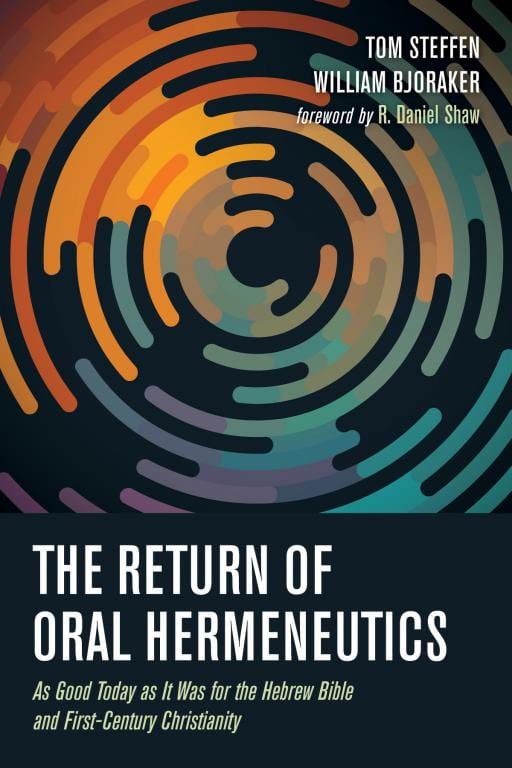
Today’s guest post comes from my friend and scholar, Tom Steffen, who served twenty years with New Tribes Mission. He is an emeritus professor of Intercultural Studies at Biola University. He introduces us to his new book Oral Hermeneutics.
His first post provided the backstory of The Return of Oral Hermeneutics: As Good Today as it Was for the Hebrew Bible and First-Century Christianity.

This second post looks at the central question that shapes our introductory book on the topic of oral hermeneutics:
Why is it important to know and practice oral hermeneutics in ascertaining and communicating biblical meaning?
To answer that question, we outlined the book this way:
Setting the Stage
Part 1 Demonstrations
1 Elisha and the Widow’s Oil
2 Reflections on the Elisha Story
Part 2 Propositions
3 Orality’s Influence on Text and Teaching
4 Oral Hermeneutics
5 Hebrew Hermeneutics
6 Character Theology
7 Questioning Our Questions
8 Reflections
Part 3 Echoes
9 Elisha and General Naaman
10 Reflections on the Elisha Story
Concluding Reflections
Part 1 Demonstrations
Part 1 demonstrates what the authors will later define. Did you catch the order?
The authors model what is argued throughout the book—build from the concrete to the abstract. Yes, there is a sequence, but without implying that one is superior over the other.
We begin making the case for the return of oral hermeneutics by challenging the long-held comfortable conclusions of textual hermeneutics. Chapter 1 provides a concrete example of the use of oral hermeneutic via an oral inductive Bible study of the story of “Elisha and the Widow’s Oil.” This chapter foregrounds, embodies, and demonstrates what follows in the book. Chapter 2 summarizes key reflections from the Bible story that we will later develop and expand.
The two oral inductive story presentations in Chapters 1 and 9 serve as bookends of practice that enclose theory. Sandwiching the theory between the two slices of bread (i.e., the practice of oral storying) honors story as the dominant genre of Scripture, and the primary expression of oral hermeneutics.
Part 2 Propositions
Part 2 lays out our propositional proposals on oral hermeneutics based on the clues partially provided from the story of “Elisha and the Widow’s Oil.” It reviews how the canon evolved from voice to text, how the spoken and written Word interfaced, and how these are significant for oral hermeneutics today. Over time, of course, scientific logic, linear thought, theorizing, atomized textual analysis, propositions (as the main product of biblical interpretation) and systematic theology dominated, extending to today.
The central question in Chapter 3 asks, “How did orality influence text and teaching?” To answer this question, the authors consider how orality and text interfaced before, during, and postconstruction of the canon, something often overlooked in relation to hermeneutics. In the search for a new way to theologize, we mull over orality, the role of scribes, individual and collective memory, and how manuscripts were delivered and discussed.
 Chapter 4 offers a possible course correction to what some consider the “settled science” of textual hermeneutics. The authors do so without entirely jettisoning established scholarship. The chapter calls for dialogue between proponents of oral hermeneutics and textual hermeneutics.
It calls for a new (actually an old) hermeneutic that specifically addresses the literary portions of Scripture, making Scripture more accessible and meaningful to a large and growing audience of oral-preference learners worldwide. It lays out a definition and the need for oral hermeneutics.
Interestingly, what the authors discussed and called for in the former chapter (“Oral Hermeneutics”) existed centuries prior. Chapter 5 reviews Hebrew hermeneutics. It highlights the distinctions between textual hermeneutics and oral hermeneutics, taking cues from the first custodians of Scripture, i.e., the rabbis, scholars, and teachers of the Jewish people.
Chapter 6 proposes a different type of theologizing and theology that goes beyond but does not discard systematic theology, biblical theology, or narrative theology. The goal is character theology. This chapter addresses how oral hermeneutics, driven by narrative logic (in contrast to propositional logic), relies on character theologizing (process) that results in character theology (product) so that we can build an initial and ongoing relationship with the Chief Character—Jesus.
Chapter 7 delves into the questions currently being used in many prominent Bible storying models today, such as Discovery Bible Study (DBS), T4T (Training for Trainers), OT4T (Orality Training for Trainers), S-T4T (Storying Training for Trainers), DMM (Disciple-Making Movements), STS (Simply the Story), among others. This chapter offers more character-centric questions.
Part 2 concludes with Chapter 8 by reviewing and reflecting on the challenges and contributions of oral hermeneutics highlighted in Chapters 4-7.
Part 3 Echoes
Part 3 offers a second opportunity to demonstrate what the authors discussed in the previous chapters, this time to dedicated readers who have a clearer understanding of our intent. We dip back into the narrative flow of 2 Kings where the sounds of previous chapters reviewed here provide Bible communicators echoes of distinctives and overlap between oral hermeneutics and character theology.
Chapter 9 conveys the story of “Elisha and General Naaman.” As in the former sections, Part 3 concludes by offering our reflections (Chapter 10). The authors then tender concluding reflections, summarizing echoes of threads and ideas heard throughout the journey of the entire book, as we built the case for the return of oral hermeneutics at home and abroad.
This book challenges comfortable hermeneutic conclusions offering possible course corrections so that the full honor due to the Chief Character is realized at home and abroad.
Previous Post

August 26, 2020
The Need for Oral Hermeneutics
Next Post

September 8, 2020 Introducing Terranova –– A Case Study of Kingdom Movement Work
Browse Our Archives
Select a Category Atonement Biblical Theology Book Reviews China Chinese Church Chinese Culture Chinese Language Collectivism Contextualization Culture (General) Ecclesiology Evangelism Gospel Honor & Shame (Face) Interpretation/Exegesis Justification/Righteousness Missiology Mission Methods One Gospel for All Nations Other Practical Contextualization Reading Romans with Eastern Eyes Resources Romans Salvation (General) Saving God's Face Seeking God's Face The Cross in Context Theological Contextualization Theological Education Theology Uncategorized
Select a Month October 2026 September 2026 August 2026 July 2026 June 2026 May 2026 April 2026 March 2026 February 2026 January 2026 December 2025 November 2025 October 2025 September 2025 August 2025 July 2025 June 2025 May 2025 April 2025 March 2025 February 2025 January 2025 December 2024 November 2024 October 2024 September 2024 August 2024 July 2024 June 2024 May 2024 April 2024 March 2024 February 2024 January 2024 December 2023 November 2023 October 2023 September 2023 August 2023 July 2023 June 2023 May 2023 April 2023 March 2023 February 2023 January 2023 December 2022 November 2022 October 2022 September 2022 August 2022 July 2022 June 2022 May 2022 April 2022 March 2022 February 2022 January 2022 December 2021 November 2021 October 2021 September 2021 August 2021 July 2021 June 2021 May 2021 April 2021 March 2021 February 2021 January 2021 December 2020 November 2020 October 2020 September 2020 August 2020 July 2020 June 2020 May 2020 April 2020 March 2020 February 2020 January 2020 December 2019 November 2019 October 2019 September 2019 August 2019 July 2019 June 2019 May 2019 April 2019 March 2019 February 2019 January 2019 December 2018 November 2018 October 2018 September 2018 August 2018 July 2018 June 2018 May 2018 April 2018 March 2018 February 2018 January 2018 December 2017 November 2017 October 2017 September 2017 August 2017 July 2017 June 2017 May 2017 April 2017 March 2017 February 2017 January 2017 December 2016 November 2016 October 2016 September 2016 August 2016 July 2016 June 2016 May 2016 April 2016 March 2016 February 2016 January 2016 December 2015 November 2015 October 2015 September 2015 August 2015 July 2015 June 2015 May 2015 April 2015 March 2015 February 2015 January 2015 December 2014 November 2014 October 2014 September 2014 August 2014 July 2014 June 2014 May 2014 April 2014 March 2014 February 2014 January 2014 December 2013 November 2013 October 2013 September 2013 August 2013 July 2013 June 2013 May 2013 April 2013 March 2013 February 2013 January 2013 December 2012 November 2012
Follow Us!
TAKE THE
Religious Wisdom Quiz
What is the largest predominantly Catholic country in South America?
Select your answer to see how you score.
Mexico Argentina Brazil Peru
Books by This Author Books by Brad Vaughn
Related posts from Saving God's Face
How Technique Undermines Mission
God both exceeds and undermines our expectations
10 Principles for Reading the Bible Missionally

Implications of Dignity, Honor, and Face Cultures for...
TRENDING AT PATHEOS Evangelical

The Brazilian Remake of Kendricks' 'Flywheel' Opens in...
“Flywheel,” the story that launched the Kendrick Brothers’ filmmaking career is getting...

The Dangers of Gradual Accommodation (Winking at Sin)
Recently, the “law of gradualness” resurfaced during the opening of a weeklong,...

The Iron Gates and the Lion of the...
Yesterday, I didn't finish my report about, well, yesterday. So I'll...

Dolly Parton’s Last Song Wins Dove Award with...
Bluegrass band The Grascals, speaking on the red carpet at the 57th...

The Image: On the Horror of Capitalism and...
The Image Then went the Pharisees, and took counsel how they might...

We are approaching the date of our new American national holiday: October...
view all Evangelical blogs
Ad-Free & Subscriber Log-In Subscription Support
- About Us
- 2026 Calendar
- Videos
- Podcasts
- Library of World Religions
- Faith In Media Tracker
- Advertise With Us
- Write for Us
- Privacy Policy
- Terms of Service
- Do Not Sell My Data
- Contact Us
- Radiant Digital
- Manage Newsletter Subscriptions
- Unsubscribe From Notifications
- Sitemap
Copyright 2008-2026, Patheos. All rights reserved.
Subscription Support Ad-Free & Subscriber Log-In
Follow Patheos