
BuddhistCatholicContemplativeEvangelicalGeneral ChristianHinduJewishLatter-day SaintMuslimNew VisionsProgressive Christian
Beliefs
- Buddhist
- Catholic
- Contemplative
- Evangelical
- General Christian
- Hindu
- Jewish
- Latter-day Saint
- More Voices
- Muslim
- New Visions
- Pagan
- Progressive Christian
Topics
- Religion News
- Food and Religion
- Sports and Religion
- Religious Art
- Religious Music and Entertainment
- Religious Events
- History and Religion
- Style and Religion
- Politics and Religion
- Women in Religion
- Recreation Outdoors and Religion
- Business Finance and Religion
- Careers Workplace and Religion
- Education and Religion
- Family Parenting and Religion
- Health Fitness and Religion
- Home and Religion
- Relationships and Religion
- Technology and Religion
- Travel and Religion
Columnists
- Buddhist Columnists
- Business Finance and Religion Columnists
- Careers Workplace and Religion Columnists
- Catholic Columnists
- Contemplative Columnists
- Education and Religion Columnists
- Evangelists Columnists
- Family Parenting and Religion Columnists
- General Christian Columnists
- Health Fitness and Religion Columnists
- Hindu Columnists
- History and Religion Columnists
- Home and Religion Columnists
- Jewish Columnists
- More Voices Columnists
- Latter Day Columnists
- Muslim Columnists
- New Visions Columnists
- Nonreligious Columnists
- Pagan Columnists
- Politics and Religion Columnists
- Progressive Columnists
- Recreation Outdoors and Religion Columnists
- Relationships and Religion Columnists
- Religion News Columnists
- Religious Art Columnists
- Religious Events Columnists
- Religious Music and Entertainment Columnists
- Sports and Religion Columnists
- Style and Religion Columnists
- Technology and Religion Columnists
- Travel and Religion Columnists
- Women in Religion Columnists
Resource Library
- 2026 Calendar
- Library of World Religions
- The 100 Most Holy Places on Earth
- Patheos Answers
- Podcasts
- Videos
- Faith Leaders Database
- Anglican Episcopalian
- Bahai
- Baptist
- Buddhism
- Christianity
- Confucianism
- Eastern Orthodoxy
- Hinduism
- Holiness and Pentecostal
- ISKCON
- Islam
- Judaism
- Lutheran
- Methodist
- The Church of Jesus Christ of Latter-day Saints
- New Age
- Paganism
- Presbytarian and Reformed
- Protestantism
- Religion Behind the Scenes
- Roman Catholic
- Scientology
- Shia Islam
- Sikhism
- Sufism
- Sunni Islam
- Taoism
- Zen
- See all religions
Research Tools
 Ad-Free & Subscriber Log-In Subscription Support
Ad-Free & Subscriber Log-In Subscription Support
Follow Patheos 

- Trending:
- Forgiveness
- |
- Marriage
- |
- Consciousness
- |
- Death Penalty
- |
- Election
- |
- Halloween

-
Tools
-
Support the Work
- Home
- Evangelical
- Honor and Shame Should Not Control Biblical Interpretation
Honor and Shame Should Not Control Biblical Interpretation
Last updated on: October 8, 2019 at 8:01 pm by Brad Vaughn
Honor and Shame Should Not Control Biblical Interpretation 2019-10-08T20:01:35-07:00 Brad Vaughn
Patheos Explore the world's faith through different perspectives on religion and spirituality! Patheos has the views of the prevalent religions and spiritualities of the world.
Although it contains several misunderstandings, I am grateful for articles like “Did the Apostles Proclaim an Honor-Shame Gospel?,” recently posted on a missions website, AccessTruth. The writer expresses many of the same concerns I’ve heard elsewhere.

Credit: Flickr/adactio
This series will answer common objections people have to honor and shame as they relate to the gospel and contextualization. Hopefully, my responses will clarify a few key ideas that remain muddled in people’s minds. In this first part of the series, I’ll comment on the biblical interpretation.
What “controls” biblical interpretation?
I appreciate the author’s clarity in stating what bothers him. He says,
“My concern, from a missiological standpoint, revolves around the controlling interpretive role that the honor-shame movement grants to the target audience culture.”
In a footnote, he adds,
“I highly value the target culture and its interpretive role in communicating the gospel. However, I do not see it as having the controlling interpretive role that the honor-shame movement wants to give it. The culture affects the presentation of the gospel, but it does not determine the content of the gospel.”
In response, I would agree if it were true that proponents of honor-shame movement wanted to grant the target audience a controlling interpretive role. However, I and others adamantly reject anything that smells like eisegesis or “reader response” interpretations of the Bible.
What should control biblical interpretation. Answer: The Bible.
What does that mean more specifically? We must read the biblical text in context. “Context is king.” The Bible’s own literary and cultural context should shape our interpretation, not our context or agendas.
Why the confusion?
So why the confusion? I and others have labored to point out an undeniable fact and limitation in the interpretive process. We all have perspectives that are limited by our own experience, assumptions, and (sub)cultures. It cannot be any other way. We are not omniscient. At best, we can gain only a partial glimpse at the ancient world as seen by the biblical writers. In myriad ways, ancient biblical cultures are more foreign to us than cultures that exist today.
This does not imply we are so hopelessly disconnected such that we can’t possibly interpret the Bible faithfully. Humility requires we simply acknowledge two points.
1. We all have limited perspectives.
2. Our cultural vantage point inevitably influences our interpretations, whether for better or worse.
By comparison, we all know the value of time and experience for understanding the Bible and the world. Ideally, a more mature perspective helps us better to grasp key ideas in the Bible. Just as we admit the limitations of our 25-year-old self, so we acknowledge the limits of our cultural perspective. Even with such limitations, we can discern much truth, but we all have room to grow.
What can we do?
While most people concede this point, one scarcely finds anyone talk about how to solve the problem. How do we improve biblical interpretation when inevitably read the Bible through historically and culturally biased lenses? Of course, we need to understand the ancient biblical context, but, as we’ve noted, we’re limited in our ability to fully apprehend the worldview of the original audience.
So, what can we do? I want us to get practical and not merely acknowledge the problem in theory.
Once we admit the influence of culture on our interpretation, I suggest we harness it for our advantage. How we do that is the subject of One Gospel for All Nations. In the final chapter, I explain why the approach I suggest is not eisegesis and does not allow contemporary cultures to have a “controlling interpretive role.”
“In order to interpret and apply Scripture, it is critical that we balance our particular perspective by becoming aware of other ways of seeing the world. Let me reiterate a quote that captures the spirit of this chapter quite well…. ‘[A] cross-cultural reading is more objective than a monocultural reading of the biblical text.’ Inevitably people from some cultures will grasp aspects of biblical teaching more easily than those from other cultures (and time periods) …” (p. 183)
We cannot entirely set aside our worldview lens, but we can certainly try to broaden our perspective. Notice I said “broaden,” not replace.
I reject any suggestion that we should prioritize any cultural lens (e.g., honor-shame, guilt-innocence, fear-power, etc.) when reading the biblical text. I and others merely advocate the need to broaden our cultural lens. Why?
“…the Bible was written for all humankind. Therefore, interpreting the Bible is not the exclusive privilege of any one particular culture or tradition” (p. 144).
Practical Implications?
What happens if we admit our limitations but do nothing about it? We will eventually confuse the Bible with our own theology. In other words, we will limit or mistake the Bible’s message to the scope and content of our theology, which is partially filtered by our culture.
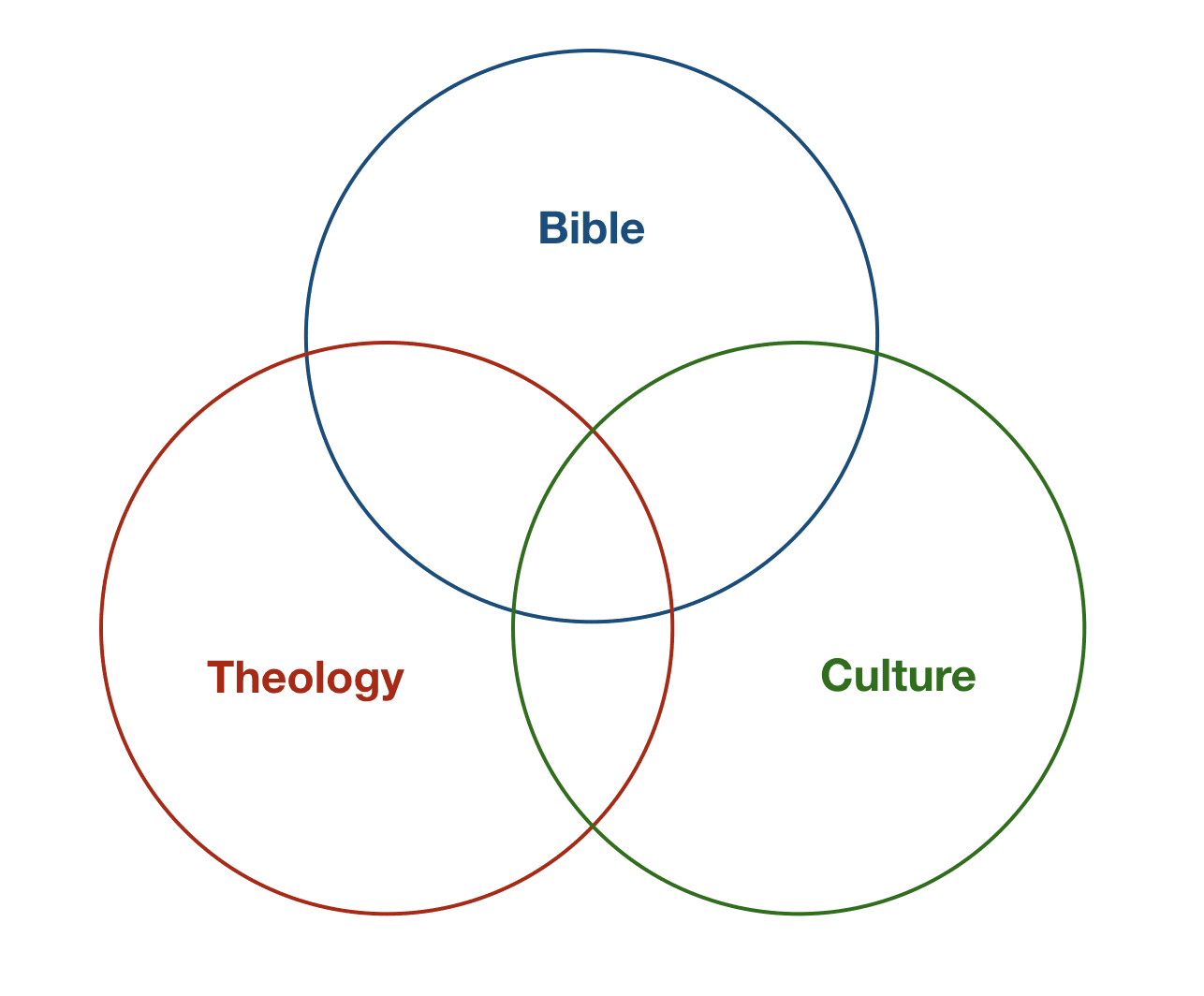 As a result, we might affirm many glorious biblical truths yet overlook or underemphasize various other biblical teachings. This does not honor God’s word.
On the other hand, what happens if we take seriously the above ideas? What if we do broaden our cultural lens? What if we do engage in serious dialogue with people who read the text from different cultural backgrounds?
“Naturally, the various interpretations that result will have differing points of emphasis. Trying to reconcile these competing ideas only complicates the interpretive process. Interpreters will be tempted to accuse one another of eisegesis, whereby people force a meaning into the text that is actually foreign to the author’s intent. Likewise, readers will be quite unaware of their own eisegesis, since they naively presume the biblical author categorized the world in the same general ways that they do. One should not assume that these differing interpretations contradict; they may simply have distinct points of emphasis.” (pp. 183-84)
This last paragraph from One Gospel captures a fundamental dynamic at work in the article posted on AccessTruth.
Honor and shame should not control how we interpret the Bible. The same should be said about any single aspect of culture. However, honor and shame should influence our theology as we become aware of topics and themes that concerned the biblical authors. It is their concerns that should shape our reading of the text.
In the next post, I will focus on what some call the “honor and shame gospel.”
Next Post

October 10, 2019 There is no “honor and shame gospel”
Browse Our Archives
Select a Category Atonement Biblical Theology Book Reviews China Chinese Church Chinese Culture Chinese Language Collectivism Contextualization Culture (General) Ecclesiology Evangelism Gospel Honor & Shame (Face) Interpretation/Exegesis Justification/Righteousness Missiology Mission Methods One Gospel for All Nations Other Practical Contextualization Reading Romans with Eastern Eyes Resources Romans Salvation (General) Saving God's Face Seeking God's Face The Cross in Context Theological Contextualization Theological Education Theology Uncategorized
Select a Month October 2026 September 2026 August 2026 July 2026 June 2026 May 2026 April 2026 March 2026 February 2026 January 2026 December 2025 November 2025 October 2025 September 2025 August 2025 July 2025 June 2025 May 2025 April 2025 March 2025 February 2025 January 2025 December 2024 November 2024 October 2024 September 2024 August 2024 July 2024 June 2024 May 2024 April 2024 March 2024 February 2024 January 2024 December 2023 November 2023 October 2023 September 2023 August 2023 July 2023 June 2023 May 2023 April 2023 March 2023 February 2023 January 2023 December 2022 November 2022 October 2022 September 2022 August 2022 July 2022 June 2022 May 2022 April 2022 March 2022 February 2022 January 2022 December 2021 November 2021 October 2021 September 2021 August 2021 July 2021 June 2021 May 2021 April 2021 March 2021 February 2021 January 2021 December 2020 November 2020 October 2020 September 2020 August 2020 July 2020 June 2020 May 2020 April 2020 March 2020 February 2020 January 2020 December 2019 November 2019 October 2019 September 2019 August 2019 July 2019 June 2019 May 2019 April 2019 March 2019 February 2019 January 2019 December 2018 November 2018 October 2018 September 2018 August 2018 July 2018 June 2018 May 2018 April 2018 March 2018 February 2018 January 2018 December 2017 November 2017 October 2017 September 2017 August 2017 July 2017 June 2017 May 2017 April 2017 March 2017 February 2017 January 2017 December 2016 November 2016 October 2016 September 2016 August 2016 July 2016 June 2016 May 2016 April 2016 March 2016 February 2016 January 2016 December 2015 November 2015 October 2015 September 2015 August 2015 July 2015 June 2015 May 2015 April 2015 March 2015 February 2015 January 2015 December 2014 November 2014 October 2014 September 2014 August 2014 July 2014 June 2014 May 2014 April 2014 March 2014 February 2014 January 2014 December 2013 November 2013 October 2013 September 2013 August 2013 July 2013 June 2013 May 2013 April 2013 March 2013 February 2013 January 2013 December 2012 November 2012
Follow Us!
TAKE THE
Religious Wisdom Quiz
What does Revelation say will wipe away every tear from their eyes?
Select your answer to see how you score.
The river of life God himself An angel The tree of life
Books by This Author Books by Brad Vaughn
Related posts from Saving God's Face

No King forgets his crown. Why do we?

Recovering Moral Vision Between Shame and Shamelessness

Refuge, Confession, and the End of Shame

Psalm 25 and the Fear of Being Put...
TRENDING AT PATHEOS Evangelical

Methodist Central Hall and Westminster Abbey
Situated on the same square is Methodist Central Hall and Westminster Abbey. ...

57th Dove Awards Honor Dolly Parton, Crown New...
On gospel music’s biggest night, the 57th annual GMA Dove Awards honored...

The First Eucharistic Controversy: Christ’s Real Presence
For Catholics, the Eucharist is the source and summit of the Christian...

What a Stop Sign Can Teach Us About...
How to Make a Decision When You Can't Hear God Main point:...

Archdiocese Hosts Military Marriage Retreat in Germany
RASTATT, Germany — The transient military lifestyle, with its frequent deployments and...

Nearly every morning, I make the drive to Detroit with my high-school-age...
view all Evangelical blogs
Ad-Free & Subscriber Log-In Subscription Support
- About Us
- 2026 Calendar
- Videos
- Podcasts
- Library of World Religions
- Faith In Media Tracker
- Advertise With Us
- Write for Us
- Privacy Policy
- Terms of Service
- Do Not Sell My Data
- Contact Us
- Radiant Digital
- Manage Newsletter Subscriptions
- Unsubscribe From Notifications
- Sitemap
Copyright 2008-2026, Patheos. All rights reserved.
Subscription Support Ad-Free & Subscriber Log-In
Follow Patheos