
BuddhistCatholicContemplativeEvangelicalGeneral ChristianHinduJewishLatter-day SaintMuslimNew VisionsProgressive Christian
Beliefs
- Buddhist
- Catholic
- Contemplative
- Evangelical
- General Christian
- Hindu
- Jewish
- Latter-day Saint
- More Voices
- Muslim
- New Visions
- Pagan
- Progressive Christian
Topics
- Religion News
- Food and Religion
- Sports and Religion
- Religious Art
- Religious Music and Entertainment
- Religious Events
- History and Religion
- Style and Religion
- Politics and Religion
- Women in Religion
- Recreation Outdoors and Religion
- Business Finance and Religion
- Careers Workplace and Religion
- Education and Religion
- Family Parenting and Religion
- Health Fitness and Religion
- Home and Religion
- Relationships and Religion
- Technology and Religion
- Travel and Religion
Columnists
- Buddhist Columnists
- Business Finance and Religion Columnists
- Careers Workplace and Religion Columnists
- Catholic Columnists
- Contemplative Columnists
- Education and Religion Columnists
- Evangelists Columnists
- Family Parenting and Religion Columnists
- General Christian Columnists
- Health Fitness and Religion Columnists
- Hindu Columnists
- History and Religion Columnists
- Home and Religion Columnists
- Jewish Columnists
- More Voices Columnists
- Latter Day Columnists
- Muslim Columnists
- New Visions Columnists
- Nonreligious Columnists
- Pagan Columnists
- Politics and Religion Columnists
- Progressive Columnists
- Recreation Outdoors and Religion Columnists
- Relationships and Religion Columnists
- Religion News Columnists
- Religious Art Columnists
- Religious Events Columnists
- Religious Music and Entertainment Columnists
- Sports and Religion Columnists
- Style and Religion Columnists
- Technology and Religion Columnists
- Travel and Religion Columnists
- Women in Religion Columnists
Resource Library
- 2026 Calendar
- Library of World Religions
- The 100 Most Holy Places on Earth
- Patheos Answers
- Podcasts
- Videos
- Faith Leaders Database
- Anglican Episcopalian
- Bahai
- Baptist
- Buddhism
- Christianity
- Confucianism
- Eastern Orthodoxy
- Hinduism
- Holiness and Pentecostal
- ISKCON
- Islam
- Judaism
- Lutheran
- Methodist
- The Church of Jesus Christ of Latter-day Saints
- New Age
- Paganism
- Presbytarian and Reformed
- Protestantism
- Religion Behind the Scenes
- Roman Catholic
- Scientology
- Shia Islam
- Sikhism
- Sufism
- Sunni Islam
- Taoism
- Zen
- See all religions
Research Tools
 Ad-Free & Subscriber Log-In Subscription Support
Ad-Free & Subscriber Log-In Subscription Support
Follow Patheos 

- Trending:
- Forgiveness
- |
- Marriage
- |
- Consciousness
- |
- Death Penalty
- |
- Election
- |
- Halloween

-
Tools
-
Support the Work
- Home
- Evangelical
- Tight versus Loose? The cultural distinction missionaries aren’t talking about
Tight versus Loose? The cultural distinction missionaries aren’t talking about
Last updated on: July 10, 2019 at 12:30 am by Brad Vaughn
Tight versus Loose? The cultural distinction missionaries aren’t talking about 2019-04-27T13:28:20-07:00 Brad Vaughn
Patheos Explore the world's faith through different perspectives on religion and spirituality! Patheos has the views of the prevalent religions and spiritualities of the world.
You’re familiar with shame, guilt, and fear cultures. You know about collectivism and individualism. But have you heard of what social psychologists call “tight” and “loose” cultures? Michele Gelfand is probably the foremost scholar on the subject. Her recent book Rule Makers, Rule Breakers: How Tight and Loose Cultures Wire Our World is an important introduction on a topic that gets little or no attention in missions circles. The tight-loose (TL) spectrum cuts across typical ways of categorizing cultures. It even affects how families and organizations function. This post introduces the TL distinction. In the next two posts, I’ll consider how might tightness and looseness influence contextualization.
Defining “tight” and “loose”
What is a “tight” and “loose” mindset? According to Gelfand,
“A tight mindset involves paying a great deal of attention to social norms, a strong desire to avoid mistakes, a lot of impulse control, and a preference for order and structure. Relishing routine, it requires a keen sensitivity to signs of disorder.
The loose mindset, by contrast, is less attentive to social norms, more willing to take risks, more impulsive, and more comfortable with disorder and ambiguity. They can acclimate quickly to new situations and more readily welcome change.”
Like all social and psychological labels, these two categories describe ends on a spectrum. Every culture will have certain domains that are tight and others that are loose. When it comes to core values, all organizations and cultures will be tighter, i.e., they will show less tolerance for deviation from the social norm.
Note: the word “culture” can include subcultures like families, organization, schools, etc.
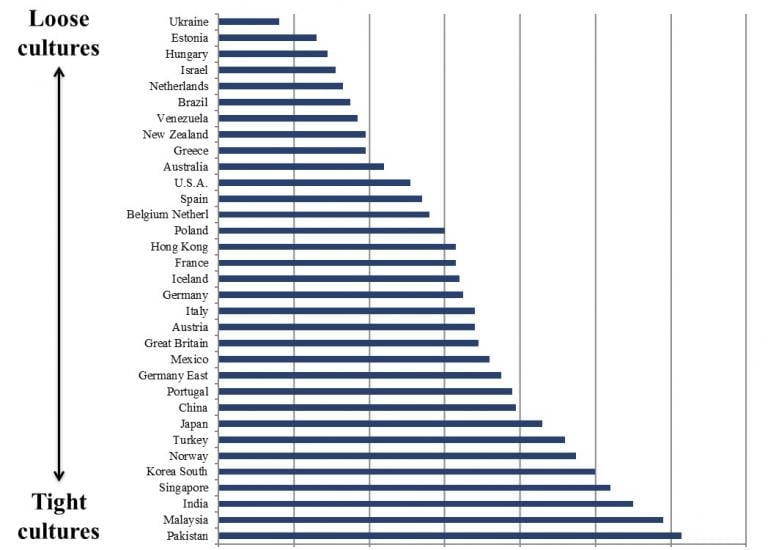 Globally, Israel, Netherlands, Brazil, and New Zealand are a few of the loosest countries in the world. The tightest nations include Pakistan, Malaysia, India, and Singapore. In the United States, New York, Massachusetts and California are a high degree of looseness. Alabama, Mississippi, Arkansas, and Oklahoma are among the tightness States.
Each mindset has pros and cons. People from loose cultures tend to show greater levels of creativity, more acceptance towards outsiders and are more open to change. Diversity and debate facilitate looseness. In an interview, Gelfand explains,
“Mobility is a really critical aspect of tight-loose in the sense that when you have lower mobility, you have less exposure to differences in opinions, differences in traditions, and it tends to promote tightness. It reinforces tightness.”
Tight cultures have less crime, lower debt levels, and individuals generally show a greater degree of self-control compared to those in loose cultures. Tighter contexts typically have more rules and more severe punishments for infractions. Such cultures also tend to be more religious.
From these positives, the downsides of each culture-type are predictable.
tightness-looseness = collectivist-individualist?
In a word, no. I will quote a succinct explanation from a recent dissertation.
[Triandis] distinguished tightness-looseness from the oft confounded construct of collectivism-individualism, which describes the degree to which individuals are considered interdependent with or independent from an ingroup, the extent to which their self-identity incorporates members of that ingroup, and the predominance of individual versus ingroup goals.
While highly interdependent and collectivistic societies commonly foster stronger social norms, greater mutual obligations, and are often relatively tighter than individualistic societies—hence the confusion—strong norms can also exist in individualistic societies (e.g., Germany) or be lacking in collectivistic societies (e.g., Brazil).
[Various studies have] empirically confirmed that tightness-looseness is distinct from other notable cultural dimensions, including power distance, uncertainty avoidance, masculinity-femininity, and long-term orientation.[1]
Gelfand and her colleagues explain:
Collectivism is concerned with the emphasis placed by societies on fulfilling duties and obligations to one’s group versus being independently oriented; it does not refer to the importance of social order, which is the core element of tightness.[2]
Nevertheless, from the data I’ve seen, there seems to be a broad tendency for collectivist cultures to veer tight (see the graph below), but there is no definite correlation.
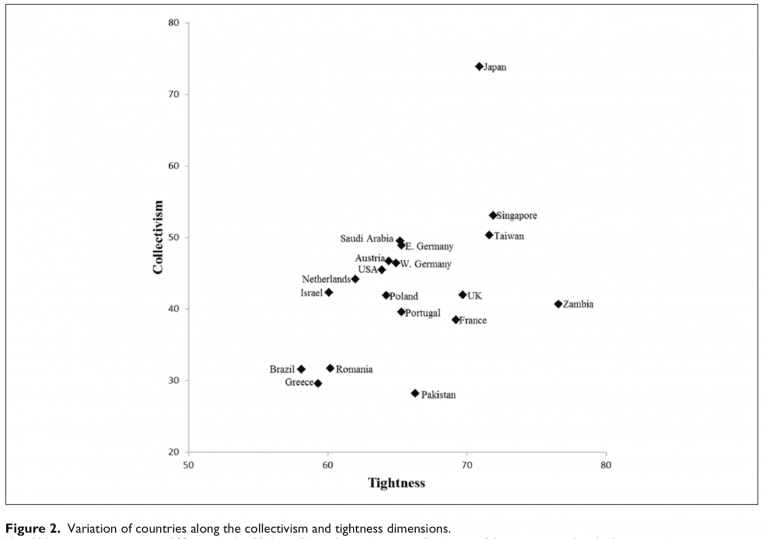
Credit: Figure 2 from Eftychia Stamkou et al. “Cultural Collectivism and Tightness Moderate Responses to Norm Violators: Effect on Power Perception, Moral Emotion, and Leader Support.” Psychology and Social Psychology Bulletin (Nov 2018): 4.
What makes a culture “tight” or “loose”?
Social scientists are hesitant to isolate a single cause to cultural dynamics like those that make up tight and loose cultures. “Correlation, not causation” is an oft-heard standard mantra. In this instance, at least one factor causes strongly influences whether a culture is tight or loose.
Threats. Groups and countries that experience more threats become tighter with time. A “threat” could include things like natural disasters, scarcity of resources, or military invasion. What counts as a “threat” is a subjective judgment. Threats might include anything from the election of a President, appointment of a Supreme Court judge, and increased government regulations to certain sexual behaviors and the use of gendered pronouns.
She uses Singapore as an example to illustrate how threats increased tightness:
Take the fact that if you are caught importing gum into Singapore you may face a fine of up to $100,000 and/or jail time of up to two years. Many Americans would be very puzzled by this behavior. Why can’t they bring in something as innocuous as gum!? But the country’s extreme population density suggests why this ban makes sense.
During the 1980s, city workers struggled to keep up with cleaning chewing gum waste, which became a public crisis. The sticky wads gummed up mailboxes and elevator buttons, and even jammed apartment keyholes and the sensors on subway system doors, causing frequent malfunctions. In a place with so many mouths per square mile, the solution was simple: get rid of the temptation.
By 1992, the sale of gum was prohibited in Singapore, and people caught selling the chewy treat faced hefty fines. The ban led to some frustration at first, but today it’s widely upheld. And if you lived among more than 20,000 people per square mile, chances are that you’d support it, too.
Having introduced the basic ideas related to tightness and looseness, I leave it to you to dig deeper into her work (whether her book or on her site). In the next few posts, we’ll explore possible implications for contextualization.
[1] Jesses Harrington. “Worlds unto Themselves: Tightness-Looseness and Social Class.” PhD Dissertation. University of Maryland, College Park. 2017, pp. 7-8.
[2] Eftychia Stamkou et al. “Cultural Collectivism and Tightness Moderate Responses to Norm Violators: Effect on Power Perception, Moral Emotion, and Leader Support.” Psychology and Social Psychology Bulletin (Nov 2018): 4
Previous Post

July 3, 2019
The 5 Most Pressing Needs of the Chinese Church
Next Post
July 17, 2019 Honor, Shame, and Guilt within Tight and Loose Cultures
Browse Our Archives
Select a Category Atonement Biblical Theology Book Reviews China Chinese Church Chinese Culture Chinese Language Collectivism Contextualization Culture (General) Ecclesiology Evangelism Gospel Honor & Shame (Face) Interpretation/Exegesis Justification/Righteousness Missiology Mission Methods One Gospel for All Nations Other Practical Contextualization Reading Romans with Eastern Eyes Resources Romans Salvation (General) Saving God's Face Seeking God's Face The Cross in Context Theological Contextualization Theological Education Theology Uncategorized
Select a Month October 2026 September 2026 August 2026 July 2026 June 2026 May 2026 April 2026 March 2026 February 2026 January 2026 December 2025 November 2025 October 2025 September 2025 August 2025 July 2025 June 2025 May 2025 April 2025 March 2025 February 2025 January 2025 December 2024 November 2024 October 2024 September 2024 August 2024 July 2024 June 2024 May 2024 April 2024 March 2024 February 2024 January 2024 December 2023 November 2023 October 2023 September 2023 August 2023 July 2023 June 2023 May 2023 April 2023 March 2023 February 2023 January 2023 December 2022 November 2022 October 2022 September 2022 August 2022 July 2022 June 2022 May 2022 April 2022 March 2022 February 2022 January 2022 December 2021 November 2021 October 2021 September 2021 August 2021 July 2021 June 2021 May 2021 April 2021 March 2021 February 2021 January 2021 December 2020 November 2020 October 2020 September 2020 August 2020 July 2020 June 2020 May 2020 April 2020 March 2020 February 2020 January 2020 December 2019 November 2019 October 2019 September 2019 August 2019 July 2019 June 2019 May 2019 April 2019 March 2019 February 2019 January 2019 December 2018 November 2018 October 2018 September 2018 August 2018 July 2018 June 2018 May 2018 April 2018 March 2018 February 2018 January 2018 December 2017 November 2017 October 2017 September 2017 August 2017 July 2017 June 2017 May 2017 April 2017 March 2017 February 2017 January 2017 December 2016 November 2016 October 2016 September 2016 August 2016 July 2016 June 2016 May 2016 April 2016 March 2016 February 2016 January 2016 December 2015 November 2015 October 2015 September 2015 August 2015 July 2015 June 2015 May 2015 April 2015 March 2015 February 2015 January 2015 December 2014 November 2014 October 2014 September 2014 August 2014 July 2014 June 2014 May 2014 April 2014 March 2014 February 2014 January 2014 December 2013 November 2013 October 2013 September 2013 August 2013 July 2013 June 2013 May 2013 April 2013 March 2013 February 2013 January 2013 December 2012 November 2012
Follow Us!
TAKE THE
Religious Wisdom Quiz
Who was told to prophesy to the mountains and valleys of Israel?
Select your answer to see how you score.
Hosea Daniel Micah Ezekiel
Books by This Author Books by Brad Vaughn
Related posts from Saving God's Face

The Real Crisis Beneath America’s Social Crises (Part...

America’s Crisis Is Deeper Than Politics

Independent Thinking Isn’t What You Think

The Gulag Theology of One Day in the...
TRENDING AT PATHEOS Evangelical

The Sermon on the Mount, Part I: Matthew...
The Sermon on the Mount, Part I (Matthew 4:12-5:12) St. Matthew moves...

What's up from Crossway: Reviewing some of their latest A few weeks...

Janie Learns the Way of the Cross: A...
Teaching children about Jesus' Passion can be challenging. Many parents and educators...

Looking For Good Catholic Writing - October 2026
He alone extends the heavens, and he walks upon the waves of...

In "Irreplaceable," our book on vocation and technology, Trevor Sutton and I...

I was strolling through the top floor of the brand new Parthenon...
view all Evangelical blogs
Ad-Free & Subscriber Log-In Subscription Support
- About Us
- 2026 Calendar
- Videos
- Podcasts
- Library of World Religions
- Faith In Media Tracker
- Advertise With Us
- Write for Us
- Privacy Policy
- Terms of Service
- Do Not Sell My Data
- Contact Us
- Radiant Digital
- Manage Newsletter Subscriptions
- Unsubscribe From Notifications
- Sitemap
Copyright 2008-2026, Patheos. All rights reserved.
Subscription Support Ad-Free & Subscriber Log-In
Follow Patheos