
BuddhistCatholicContemplativeEvangelicalGeneral ChristianHinduJewishLatter-day SaintMuslimNew VisionsProgressive Christian
Beliefs
- Buddhist
- Catholic
- Contemplative
- Evangelical
- General Christian
- Hindu
- Jewish
- Latter-day Saint
- More Voices
- Muslim
- New Visions
- Pagan
- Progressive Christian
Topics
- Religion News
- Food and Religion
- Sports and Religion
- Religious Art
- Religious Music and Entertainment
- Religious Events
- History and Religion
- Style and Religion
- Politics and Religion
- Women in Religion
- Recreation Outdoors and Religion
- Business Finance and Religion
- Careers Workplace and Religion
- Education and Religion
- Family Parenting and Religion
- Health Fitness and Religion
- Home and Religion
- Relationships and Religion
- Technology and Religion
- Travel and Religion
Columnists
- Buddhist Columnists
- Business Finance and Religion Columnists
- Careers Workplace and Religion Columnists
- Catholic Columnists
- Contemplative Columnists
- Education and Religion Columnists
- Evangelists Columnists
- Family Parenting and Religion Columnists
- General Christian Columnists
- Health Fitness and Religion Columnists
- Hindu Columnists
- History and Religion Columnists
- Home and Religion Columnists
- Jewish Columnists
- More Voices Columnists
- Latter Day Columnists
- Muslim Columnists
- New Visions Columnists
- Nonreligious Columnists
- Pagan Columnists
- Politics and Religion Columnists
- Progressive Columnists
- Recreation Outdoors and Religion Columnists
- Relationships and Religion Columnists
- Religion News Columnists
- Religious Art Columnists
- Religious Events Columnists
- Religious Music and Entertainment Columnists
- Sports and Religion Columnists
- Style and Religion Columnists
- Technology and Religion Columnists
- Travel and Religion Columnists
- Women in Religion Columnists
Resource Library
- 2026 Calendar
- Library of World Religions
- The 100 Most Holy Places on Earth
- Patheos Answers
- Podcasts
- Videos
- Faith Leaders Database
- Anglican Episcopalian
- Bahai
- Baptist
- Buddhism
- Christianity
- Confucianism
- Eastern Orthodoxy
- Hinduism
- Holiness and Pentecostal
- ISKCON
- Islam
- Judaism
- Lutheran
- Methodist
- The Church of Jesus Christ of Latter-day Saints
- New Age
- Paganism
- Presbytarian and Reformed
- Protestantism
- Religion Behind the Scenes
- Roman Catholic
- Scientology
- Shia Islam
- Sikhism
- Sufism
- Sunni Islam
- Taoism
- Zen
- See all religions
Research Tools
 Ad-Free & Subscriber Log-In Subscription Support
Ad-Free & Subscriber Log-In Subscription Support
Follow Patheos 

- Trending:
- Forgiveness
- |
- Marriage
- |
- Consciousness
- |
- Death Penalty
- |
- Election
- |
- Halloween

-
Tools
-
Support the Work
- Home
- Evangelical
- 7 Dangers for Missionaries from Guilt-Innocence Cultures
7 Dangers for Missionaries from Guilt-Innocence Cultures
Last updated on: January 12, 2022 at 3:58 am by Brad Vaughn
7 Dangers for Missionaries from Guilt-Innocence Cultures 2022-01-12T03:58:42-07:00 Brad Vaughn
Patheos Explore the world's faith through different perspectives on religion and spirituality! Patheos has the views of the prevalent religions and spiritualities of the world.
Public Domain
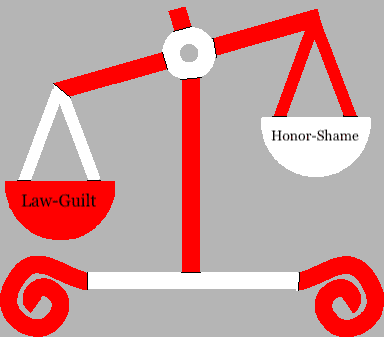
A recent post on TGC warns against the dangers of becoming imbalanced when serving in honor-shame cultures. Jayson Georges’ exceptional response is a must-read.
He replies via three main points:
- He poses the question, “In reality, who is unbalanced?”
- The imbalance among honor-shame proponents is hypothetical, not real.
- The reaction against honor-shame misrepresents the topic.
If you have not seen Jayson’s post, it’s worth reading just for the sake of the comic he uses.
Are Westerners Guilty of Under Correction?
The TGC writer, Elliot Clark, lists “5 Dangers for Missionaries in Honor-Shame Contexts.” His purpose is to “protect us from unhelpful overcorrection.” He worries “the proverbial pendulum can swing too far” towards honor-shame thinking. Jayson’s post aptly addresses these concerns, so I will offer a different approach.
In the interest of “balance,” I will offer seven dangers for missionaries from guilt-innocence cultures. They will loosely correspond to Clark’s “5 dangers.”
-
Disconnect Honor from Disobedience
Western missionaries routinely miss a fundamental aspect of sin. At its core, sin is a failure to honor God, i.e., reflect his worth. Writers use numerous metaphors to describe sin.
Clark rightly states that the Bible uses the law metaphor to discuss sin. He overstates the case when he says, “John succinctly defines sin as lawlessness.” First John 3:4 says, “sin is lawlessness.” If I say, “Sarah is a mother,” I have not defined “Sarah.” I have described one aspect of her identity. Likewise, “lawlessness” is only one way of describing sin.
Clark says, “When Adam failed to honor God, he transgressed the law. We dishonor by disobeying.” No and Yes. Clark’s statement muddies the mental waters. First of all, the latter is true: “We dishonor by disobeying.” This is precisely what we find in Rom 2:23–24, where Paul writes,
You who boast in the law dishonor God by breaking the law. For, as it is written, “The name of God is blasphemed among the Gentiles because of you.”
Clark unwittingly concedes a critical point. The clause “by disobeying” is not the essence of the problem… dishonoring God is the core problem. The means or way someone can dishonor God is through disobeying him.
Even John Piper, a founding leader of TGC, routinely explains sin in terms of glory and honor. For instance, in a long list of descriptions, he says sin is where “the glory of God [is] not honored”[1]
Can people “obey the law” yet sin? Piper considers the case where someone obeys the commandment against adultery.
If not committing adultery comes from a heart that has no love for God and treasures many things more than God, that act of chastity is not an expression of love to God. It’s not a way of expressing his value. And so it is a dishonor to God. He is neglected, ignored, not a decisive factor, and in that sense the fruit of that heart is not good.[2]
-
Confuse Disobedience and Breaking Laws
This leads us to consider the problem with his first comment, “When Adam failed to honor God, he transgressed the law.” Western missionaries are prone to read the word “law” into every context where disobedience is mentioned. The problem here is layered.
First, did Adam break God’s “law”? The text of Genesis never explicitly uses legal language concerning Adam. In the Old Testament, “the law” refers to capital-L “Law,” i.e., the Mosaic covenant, which did not exist during the time of Adam. Obviously, Adam could not have “transgressed the law.” We can only say Adam broke God’s law if we read legal language back into the text.
Laws are rules, but rules are not necessarily laws.

Credit: Flickr/strupler
The Bible uses multiple metaphors for God. Various metaphors are simultaneously correct. However, how we speak of God and “sin” depends on the metaphors we use.
What if we used the metaphor of “father” to describe God in Genesis text? In the family context, one does not say a child “broke the law” of the family. The child disobeyed, but we only use “law” language in a public, legal context. In Genesis, “Father” language is every bit as legitimate a legal language (cf. Acts 17:24–29).
While never setting metaphors against one another, we should not exclude a legitimate biblical metaphor.
-
Ignore the Biblical (Eastern) Roots of Law
Western missionaries often forget (or never learn) that the Mosaic Law was Ancient Near Eastern covenant Law. It was not a law in the modern sense of the term. Covenants served diverse functions, such as defining the identity of a people and the obligations of those making covenant. Covenants are highly contextual; they are not timeless, abstract laws.
Yet when people forget this observation, Westerners are likely to reduce God to the role of “judge” and under stress that God is king. Remember, a king is a judge, but a judge is not necessarily a king.
-
Make the Mistake They Wish to Correct
Clark and others want us to remain balanced in our theology and practice. So do I! Clark says,
Just as the West has been blind in many ways to the significance of honor and shame in Scripture, we can make a similarly egregious error in Eastern cultures if we ignore concepts of law and guilt.
I would be curious who Clark has in mind. Who suggests we ignore law and guilt? I imagine he simply wants to remind us not to ignore law and guilt lest we lose balance. Yet, in trying to preserve balance, writers can perpetuate the imbalance in favor of guilt-law to the neglect of honor-shame.

flickr/gogri
Rather than get nervous about our blind spots, we need to look directly at them to gain a well-rounded picture of the world.
-
Allow Culture, Not Scripture, to Be Normative
I agree with Clark–– we don’t want any particular set of cultural values to trump Scripture. That is called “cultural syncretism.” Whereas Westerners tend to worry most about syncretism with “Asian,” “African,” or “Indian” cultures, they rarely seriously reflect on ways that our theology is influenced by Western culture. How might our thinking veer towards syncretism?
Likewise, we must also guard against the dangers of theological syncretism. By this, I refer to the kind of syncretism that occurs when we let our denominational subculture trump the biblical message. This happens when our church subculture mutes certain parts of Scripture or filters its interpretation through a strict grid of its own history.
Does this happen in Western Christianity?
-
Compromises Biblical Discipleship
Clark argues that “guilt-innocence paradigms…have a place in our discipleship.” I agree! However, he risks compromising a robust view of discipleship by settling for a merely true fact.
Yes, we should include guilt-innocence concepts. Guilt concerns right and wrong actions. On the other hand, honor and shame involve our identity, not merely one’s actions. While our actions shape our identity, they are not the only factors determining who we are.
Being a disciple is about identity. It concerns our being in Christ, having a relationship with God, belonging to the Church, God’s family from among all nations. If we ignore honor and shame, we misrepresent and compromise biblical discipleship.
-
Misrepresent Other Cultures
Finally, Clark says,
We must never downplay the law of Christ or the centrality of obedience as his disciple. If a host culture diminishes disobedience or lacks categories for transgression, the solution isn’t to sidestep the issue. It’s to teach believers that to honor the Master means to follow in his steps.
Again, I agree. But does Clark unwittingly succumb to a frequent caricature of honor-shame thinking? He warns that honor-shame cultures might “diminish disobedience or lacks categories for transgression.” All cultures have rules and laws that people are expected to keep. In practice, people from guilt-innocence cultures transgress their laws as much as honor-shame cultures transgress their boundaries.
We ought not to forget that people from all cultures dishonor God and fall short of the glory of God.
[1]https://www.desiringgod.org/messages/what-is-sin-the-essence-and-root-of-all-sinning
[2]https://www.desiringgod.org/messages/what-is-sin-the-essence-and-root-of-all-sinning
Previous Post

July 11, 2018
Train Up a Child …But How?
Next Post

July 25, 2018 Why Honor Matters is a must read. Here’s why.
Browse Our Archives
Select a Category Atonement Biblical Theology Book Reviews China Chinese Church Chinese Culture Chinese Language Collectivism Contextualization Culture (General) Ecclesiology Evangelism Gospel Honor & Shame (Face) Interpretation/Exegesis Justification/Righteousness Missiology Mission Methods One Gospel for All Nations Other Practical Contextualization Reading Romans with Eastern Eyes Resources Romans Salvation (General) Saving God's Face Seeking God's Face The Cross in Context Theological Contextualization Theological Education Theology Uncategorized
Select a Month October 2026 September 2026 August 2026 July 2026 June 2026 May 2026 April 2026 March 2026 February 2026 January 2026 December 2025 November 2025 October 2025 September 2025 August 2025 July 2025 June 2025 May 2025 April 2025 March 2025 February 2025 January 2025 December 2024 November 2024 October 2024 September 2024 August 2024 July 2024 June 2024 May 2024 April 2024 March 2024 February 2024 January 2024 December 2023 November 2023 October 2023 September 2023 August 2023 July 2023 June 2023 May 2023 April 2023 March 2023 February 2023 January 2023 December 2022 November 2022 October 2022 September 2022 August 2022 July 2022 June 2022 May 2022 April 2022 March 2022 February 2022 January 2022 December 2021 November 2021 October 2021 September 2021 August 2021 July 2021 June 2021 May 2021 April 2021 March 2021 February 2021 January 2021 December 2020 November 2020 October 2020 September 2020 August 2020 July 2020 June 2020 May 2020 April 2020 March 2020 February 2020 January 2020 December 2019 November 2019 October 2019 September 2019 August 2019 July 2019 June 2019 May 2019 April 2019 March 2019 February 2019 January 2019 December 2018 November 2018 October 2018 September 2018 August 2018 July 2018 June 2018 May 2018 April 2018 March 2018 February 2018 January 2018 December 2017 November 2017 October 2017 September 2017 August 2017 July 2017 June 2017 May 2017 April 2017 March 2017 February 2017 January 2017 December 2016 November 2016 October 2016 September 2016 August 2016 July 2016 June 2016 May 2016 April 2016 March 2016 February 2016 January 2016 December 2015 November 2015 October 2015 September 2015 August 2015 July 2015 June 2015 May 2015 April 2015 March 2015 February 2015 January 2015 December 2014 November 2014 October 2014 September 2014 August 2014 July 2014 June 2014 May 2014 April 2014 March 2014 February 2014 January 2014 December 2013 November 2013 October 2013 September 2013 August 2013 July 2013 June 2013 May 2013 April 2013 March 2013 February 2013 January 2013 December 2012 November 2012
Follow Us!
TAKE THE
Religious Wisdom Quiz
The Old Testament prophet Joel spoke of "wonders in the heavens and the earth, blood, fire, and pillars of smoke before the great and terrible day of the Lord." (Joel 2:30) Which one of the disciples quoted him in the book of Acts?
Select your answer to see how you score.
John James Peter Andrew
Books by This Author Books by Brad Vaughn
Related posts from Saving God's Face

No King forgets his crown. Why do we?

Recovering Moral Vision Between Shame and Shamelessness

Refuge, Confession, and the End of Shame

Psalm 25 and the Fear of Being Put...
TRENDING AT PATHEOS Evangelical

Emotion in Early Christianity by Andrew Crislip
Andrew Crislip’s Emotion in Early Christianity examines an often overlooked dimension of...

16 Spiritual Touchstones for a More Grounded Life
After decades of spiritual study, here are 16 principles I try...

Catholic Evangelization: Sharing Your Faith Every Day
Welcome back to the Graceful Awakening mini-series called, “From Faith to Mission.” ...

The Pillar of the Boatmen: the Ancient Monument...
The Pillar of the Boatmen is a Romano-Gaulish sculpture that dates from...

In one sense walking into Westminster Abbey is like walking down the...

'Super Scam Me' Exposes AI Jon Bon Jovi...
Leslie Pickett believed she was in a relationship with Jon Bon Jovi....
view all Evangelical blogs
Ad-Free & Subscriber Log-In Subscription Support
- About Us
- 2026 Calendar
- Videos
- Podcasts
- Library of World Religions
- Faith In Media Tracker
- Advertise With Us
- Write for Us
- Privacy Policy
- Terms of Service
- Do Not Sell My Data
- Contact Us
- Radiant Digital
- Manage Newsletter Subscriptions
- Unsubscribe From Notifications
- Sitemap
Copyright 2008-2026, Patheos. All rights reserved.
Subscription Support Ad-Free & Subscriber Log-In
Follow Patheos