
BuddhistCatholicContemplativeEvangelicalGeneral ChristianHinduJewishLatter-day SaintMuslimNew VisionsProgressive Christian
Beliefs
- Buddhist
- Catholic
- Contemplative
- Evangelical
- General Christian
- Hindu
- Jewish
- Latter-day Saint
- More Voices
- Muslim
- New Visions
- Pagan
- Progressive Christian
Topics
- Religion News
- Food and Religion
- Sports and Religion
- Religious Art
- Religious Music and Entertainment
- Religious Events
- History and Religion
- Style and Religion
- Politics and Religion
- Women in Religion
- Recreation Outdoors and Religion
- Business Finance and Religion
- Careers Workplace and Religion
- Education and Religion
- Family Parenting and Religion
- Health Fitness and Religion
- Home and Religion
- Relationships and Religion
- Technology and Religion
- Travel and Religion
Columnists
- Buddhist Columnists
- Business Finance and Religion Columnists
- Careers Workplace and Religion Columnists
- Catholic Columnists
- Contemplative Columnists
- Education and Religion Columnists
- Evangelists Columnists
- Family Parenting and Religion Columnists
- General Christian Columnists
- Health Fitness and Religion Columnists
- Hindu Columnists
- History and Religion Columnists
- Home and Religion Columnists
- Jewish Columnists
- More Voices Columnists
- Latter Day Columnists
- Muslim Columnists
- New Visions Columnists
- Nonreligious Columnists
- Pagan Columnists
- Politics and Religion Columnists
- Progressive Columnists
- Recreation Outdoors and Religion Columnists
- Relationships and Religion Columnists
- Religion News Columnists
- Religious Art Columnists
- Religious Events Columnists
- Religious Music and Entertainment Columnists
- Sports and Religion Columnists
- Style and Religion Columnists
- Technology and Religion Columnists
- Travel and Religion Columnists
- Women in Religion Columnists
Resource Library
- 2026 Calendar
- Library of World Religions
- The 100 Most Holy Places on Earth
- Patheos Answers
- Podcasts
- Videos
- Faith Leaders Database
- Anglican Episcopalian
- Bahai
- Baptist
- Buddhism
- Christianity
- Confucianism
- Eastern Orthodoxy
- Hinduism
- Holiness and Pentecostal
- ISKCON
- Islam
- Judaism
- Lutheran
- Methodist
- The Church of Jesus Christ of Latter-day Saints
- New Age
- Paganism
- Presbytarian and Reformed
- Protestantism
- Religion Behind the Scenes
- Roman Catholic
- Scientology
- Shia Islam
- Sikhism
- Sufism
- Sunni Islam
- Taoism
- Zen
- See all religions
Research Tools
 Ad-Free & Subscriber Log-In Subscription Support
Ad-Free & Subscriber Log-In Subscription Support
Follow Patheos 

- Trending:
- Forgiveness
- |
- Marriage
- |
- Consciousness
- |
- Death Penalty
- |
- Election
- |
- Halloween

-
Tools
-
Support the Work
- Home
- Evangelical
- Polity and Patronage in Chinese Churches
Polity and Patronage in Chinese Churches
Last updated on: June 6, 2018 at 12:30 am by Brad Vaughn
Polity and Patronage in Chinese Churches 2018-05-16T11:36:39-07:00 Brad Vaughn
Patheos Explore the world's faith through different perspectives on religion and spirituality! Patheos has the views of the prevalent religions and spiritualities of the world.
How do Chinese churches organize themselves? How does Chinese culture influence church structure? What are the implications?
Networks, not Denominations
Protestant Chinese house churches organize themselves as “networks” (团队) rather than “denominations” (宗派). Arguably, they look similar to Western denominations. However, a few distinctions are noteworthy.
First, most networks do not formally originate from traditional Western denominations. Certain church networks are influenced by a given tradition (T). Yet, churches are not necessarily planted from T-denomination. Nor do they identify themselves with T-denomination.
Denominations traditionally are defined theologically, according to some set of doctrines. By contrast, Chinese church networks share regional and relational affinities. They expand along relational networks. As a result, church networks are rooted particular regions (though they will spread to other locations). To belong to Y-network likely entails adopting a personality or view typical of people from Y-region.
The Structure of the Chinese Church
A network branches out like a system of tree roots, akin to the structure of “Amway.” See the diagram below.
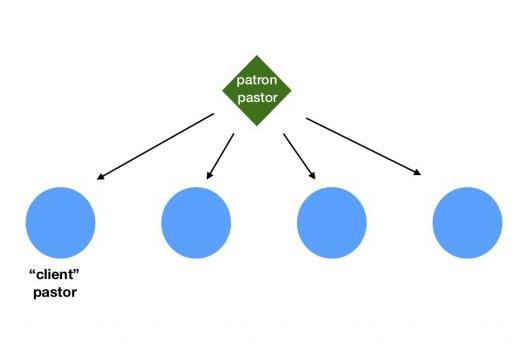 One pastor (Pastor C) could have 4-5 other pastors under him or her (and thus the churches they shepherd). One of those pastors (Pastor H) might lead another 2-3 pastors (each with their own church(es)). Pastors on the same level in the hierarchy often function as an advisory council for one another. This group does not serve as a presbytery.
A variation on this model is also common. Instead of each church having one pastor, a group of pastors might rotate among a group of churches. Thus, 4 pastors might regularly rotate in preaching to 7-8 different churches.
Pastors as Patrons
The upcoming Patronage Symposium has spurred me to reflect on ways patronage, reciprocity, etc. influences the Chinese church. This requires thinking about how the church organizes itself.
For our purposes only, I’ve used patronage language to clarify the function of the above pastoral relationships. (Chinese Christians don’t use explicit patronage terminology). Below, church leaders who are higher in the hierarchy will be called “patrons.” Pastors lower in the hierarchy are called “clients.”
To read about leadership in collectivistic churches, click here.

The patron chooses the pastors under his supervision. He provides them with various kinds of help. Besides training and encouragement, the patron offers financial support. A pastor wishing to plant a church depends on the generosity of the patron for counsel and financial backing.
The patron can also choose to ordain a client. Ordination in Chinese churches is required for someone to be reckoned a “pastor.” Prior to ordination, (s)he is considered a 传道 (perhaps translated “preacher”). The patron will provide endorsements (e.g., when one wants to attend seminary). He lends credibility to the client in the eyes of others. He introduces “clients” to contacts who can offer practical assistance in a given area (e.g., training, resources, skills, etc.). In effect, the client inherits the patron’s relational network (guanxi wang).
Networks (and sub-networks) have different ways of managing funds and thus regulating how patrons influence clients. In one approach, churches under his supervision pool their money, which a patron then distributes as (s)he decides. Alternatively, some churches give the patron a portion of the tithes received. Patrons draw on their experience and inside knowledge to allocate resources as they think best.
A Fusion of Faith Traditions
Chinese ecclesiology is a blend of multiple theological traditions. A group meeting at a single location is just as likely to be called a “church” as would a large group of churches. Accordingly, a Chinese Christian might say Pastor C’s church has 40 people (at a single location), 130 people (at multiple locations where he preaches), or 4,000 people (counting all the locations led by pastors under his supervision). A Westerner might call the latter a “network,” whereas Chinese simply call it a “church.”

Structurally, Protestant Chinese house churches resemble the Anglican church more closely than other denominations. This organization is more pragmatic than theologically driven. Almost all these churches practice credo-baptism. A large number (most?) churches have a singular pastor/elder who serves as the spiritual leader. In some cases, another person is recognized as a “pastor/elder” yet only provides financial support for the church. He who pays has a say.
In recent years, people have reported of the growth of “reformed” theology among Chinese Christians. This statement needs qualification. Increasing numbers of Chinese churches have a reformed soteriology. Such churches could be described as “reformed Baptist” churches. Very few Protestant churches in China practice infant baptism. Thus, churches increase in size by baptizing new believers.
The form and function of church polity depend more on personal relationships than external criteria, whether theological creeds or a formalized system. What does this approach mean for pastors? They must pay close attention to maintaining quality relationships with other pastors.
It also creates a range of challenges and opportunities. A “client” pastor must ensure he doesn’t transgress his patron’s theological boundaries. Naturally, one must consider how and where (s)he gains theological training. After all, clients want to make certain the patron pastor approves.
To read about pastor-centered Chinese churches, click here
A Few Implications
I’ll mention a couple of implications. Others no doubt exist.
-
Evangelism and Missions
A church’s strategy and ministry priorities can be subject to the patron’s approval, regardless of client or congregation’s will. For instance, if a local church wants to send missionaries to another country or people group, the patron pastor needs to approve the initiative as well as the mission candidates. Likewise, a church planting strategy or evangelistic methods should suit the patron’s liking.
-
Church Discipline
Because churches are tied by pastoral relationships, they approach to internal discipline differs from churches in other cultures. We should first recognize that church discipline is extremely rare, especially given the importance of harmonious relationships in China. Nevertheless, where the situation occurs, individual congregations have little if any authority. Congregations cannot remove a pastor. Only a patron pastor disciplines a client pastor. If a new pastor is needed, the patron will assign one to the local church under him.
Bible + Culture = Theology
Depending on a person’s theological persuasion, one will either say Chinese ecclesiology is biblically sound or culturally syncretistic. Chinese churches certainly represent an amalgamation of theological views. Whatever one’s judgment on the particulars, we would do well to recognize a simple fact; namely, our cultures, sub-cultures, and personal backgrounds invariably influence our theologies, including our ecclesiology.
That statement is no criticism of theology in general nor any specific tradition. It’s the nature of contextualization. “All theology is contextualized” goes the saying. I hope these observations foster humility to learn from one another and examine the Bible with fresh eyes.
Previous Post

May 23, 2018
Paige Patterson is ousted as seminary president
Next Post

June 13, 2018 The Message of Genesis 1 in a Single Picture
Browse Our Archives
Select a Category Atonement Biblical Theology Book Reviews China Chinese Church Chinese Culture Chinese Language Collectivism Contextualization Culture (General) Ecclesiology Evangelism Gospel Honor & Shame (Face) Interpretation/Exegesis Justification/Righteousness Missiology Mission Methods One Gospel for All Nations Other Practical Contextualization Reading Romans with Eastern Eyes Resources Romans Salvation (General) Saving God's Face Seeking God's Face The Cross in Context Theological Contextualization Theological Education Theology Uncategorized
Select a Month October 2026 September 2026 August 2026 July 2026 June 2026 May 2026 April 2026 March 2026 February 2026 January 2026 December 2025 November 2025 October 2025 September 2025 August 2025 July 2025 June 2025 May 2025 April 2025 March 2025 February 2025 January 2025 December 2024 November 2024 October 2024 September 2024 August 2024 July 2024 June 2024 May 2024 April 2024 March 2024 February 2024 January 2024 December 2023 November 2023 October 2023 September 2023 August 2023 July 2023 June 2023 May 2023 April 2023 March 2023 February 2023 January 2023 December 2022 November 2022 October 2022 September 2022 August 2022 July 2022 June 2022 May 2022 April 2022 March 2022 February 2022 January 2022 December 2021 November 2021 October 2021 September 2021 August 2021 July 2021 June 2021 May 2021 April 2021 March 2021 February 2021 January 2021 December 2020 November 2020 October 2020 September 2020 August 2020 July 2020 June 2020 May 2020 April 2020 March 2020 February 2020 January 2020 December 2019 November 2019 October 2019 September 2019 August 2019 July 2019 June 2019 May 2019 April 2019 March 2019 February 2019 January 2019 December 2018 November 2018 October 2018 September 2018 August 2018 July 2018 June 2018 May 2018 April 2018 March 2018 February 2018 January 2018 December 2017 November 2017 October 2017 September 2017 August 2017 July 2017 June 2017 May 2017 April 2017 March 2017 February 2017 January 2017 December 2016 November 2016 October 2016 September 2016 August 2016 July 2016 June 2016 May 2016 April 2016 March 2016 February 2016 January 2016 December 2015 November 2015 October 2015 September 2015 August 2015 July 2015 June 2015 May 2015 April 2015 March 2015 February 2015 January 2015 December 2014 November 2014 October 2014 September 2014 August 2014 July 2014 June 2014 May 2014 April 2014 March 2014 February 2014 January 2014 December 2013 November 2013 October 2013 September 2013 August 2013 July 2013 June 2013 May 2013 April 2013 March 2013 February 2013 January 2013 December 2012 November 2012
Follow Us!
TAKE THE
Religious Wisdom Quiz
What was the rainbow a sign of in the flood story?
Select your answer to see how you score.
War Famine Danger God's promise
Books by This Author Books by Brad Vaughn
Related posts from Saving God's Face

Why Christianity Needs Individuals but Rejects Individualism

Americans, not Asians, have Positive Illusions

The Psychology of Broad and Eastern Thinking

Chinese Christians Have Faith in the Wilderness. Will...
TRENDING AT PATHEOS Evangelical

57th Dove Awards Honor Dolly Parton, Crown New...
On gospel music’s biggest night, the 57th annual GMA Dove Awards honored...

The First Eucharistic Controversy: Christ’s Real Presence
For Catholics, the Eucharist is the source and summit of the Christian...

What a Stop Sign Can Teach Us About...
How to Make a Decision When You Can't Hear God Main point:...

Archdiocese Hosts Military Marriage Retreat in Germany
RASTATT, Germany — The transient military lifestyle, with its frequent deployments and...

Nearly every morning, I make the drive to Detroit with my high-school-age...

The Real AI Story Is Adoption Without Trust
Artificial intelligence has crossed a political threshold. It is no longer a...
view all Evangelical blogs
Ad-Free & Subscriber Log-In Subscription Support
- About Us
- 2026 Calendar
- Videos
- Podcasts
- Library of World Religions
- Faith In Media Tracker
- Advertise With Us
- Write for Us
- Privacy Policy
- Terms of Service
- Do Not Sell My Data
- Contact Us
- Radiant Digital
- Manage Newsletter Subscriptions
- Unsubscribe From Notifications
- Sitemap
Copyright 2008-2026, Patheos. All rights reserved.
Subscription Support Ad-Free & Subscriber Log-In
Follow Patheos