
BuddhistCatholicContemplativeEvangelicalGeneral ChristianHinduJewishLatter-day SaintMuslimNew VisionsProgressive Christian
Beliefs
- Buddhist
- Catholic
- Contemplative
- Evangelical
- General Christian
- Hindu
- Jewish
- Latter-day Saint
- More Voices
- Muslim
- New Visions
- Pagan
- Progressive Christian
Topics
- Religion News
- Food and Religion
- Sports and Religion
- Religious Art
- Religious Music and Entertainment
- Religious Events
- History and Religion
- Style and Religion
- Politics and Religion
- Women in Religion
- Recreation Outdoors and Religion
- Business Finance and Religion
- Careers Workplace and Religion
- Education and Religion
- Family Parenting and Religion
- Health Fitness and Religion
- Home and Religion
- Relationships and Religion
- Technology and Religion
- Travel and Religion
Columnists
- Buddhist Columnists
- Business Finance and Religion Columnists
- Careers Workplace and Religion Columnists
- Catholic Columnists
- Contemplative Columnists
- Education and Religion Columnists
- Evangelists Columnists
- Family Parenting and Religion Columnists
- General Christian Columnists
- Health Fitness and Religion Columnists
- Hindu Columnists
- History and Religion Columnists
- Home and Religion Columnists
- Jewish Columnists
- More Voices Columnists
- Latter Day Columnists
- Muslim Columnists
- New Visions Columnists
- Nonreligious Columnists
- Pagan Columnists
- Politics and Religion Columnists
- Progressive Columnists
- Recreation Outdoors and Religion Columnists
- Relationships and Religion Columnists
- Religion News Columnists
- Religious Art Columnists
- Religious Events Columnists
- Religious Music and Entertainment Columnists
- Sports and Religion Columnists
- Style and Religion Columnists
- Technology and Religion Columnists
- Travel and Religion Columnists
- Women in Religion Columnists
Resource Library
- 2026 Calendar
- Library of World Religions
- The 100 Most Holy Places on Earth
- Patheos Answers
- Podcasts
- Videos
- Faith Leaders Database
- Anglican Episcopalian
- Bahai
- Baptist
- Buddhism
- Christianity
- Confucianism
- Eastern Orthodoxy
- Hinduism
- Holiness and Pentecostal
- ISKCON
- Islam
- Judaism
- Lutheran
- Methodist
- The Church of Jesus Christ of Latter-day Saints
- New Age
- Paganism
- Presbytarian and Reformed
- Protestantism
- Religion Behind the Scenes
- Roman Catholic
- Scientology
- Shia Islam
- Sikhism
- Sufism
- Sunni Islam
- Taoism
- Zen
- See all religions
Research Tools
 Ad-Free & Subscriber Log-In Subscription Support
Ad-Free & Subscriber Log-In Subscription Support
Follow Patheos 

- Trending:
- Forgiveness
- |
- Marriage
- |
- Consciousness
- |
- Death Penalty
- |
- Election
- |
- Halloween

-
Tools
-
Support the Work
- Home
- Evangelical
- Clothing the Grand Biblical Story with Honor and Shame
Clothing the Grand Biblical Story with Honor and Shame
Last updated on: May 16, 2018 at 11:36 am by Brad Vaughn
Clothing the Grand Biblical Story with Honor and Shame 2018-05-16T11:36:00-07:00 Brad Vaughn
Patheos Explore the world's faith through different perspectives on religion and spirituality! Patheos has the views of the prevalent religions and spiritualities of the world.
In a recent training on narrative theology, I assigned participants the task of crafting stories that reflect the grand narrative in a biblically faithful and culturally meaningful way. The stories should do two things:
1) preserve the inherent structure of the Story
2) consider significant themes or motifs for their context
One group presented the following idea, which I develop a bit for clarity. I (and they) would be interested in your feedback.
Clothed with Honor and Shame
A student working with Muslims wanted to develop a story that takes honor and shame seriously. As a motif, he explored the link between clothing and honor-shame. After verbally sketching several passages that use clothing in this way, I encouraged him to try it out.
His group decided to craft the story using a chiastic structure. A chiasm has the basic form A, B, C, B’, A’, which A/A’ and B/B’ have some corresponding relationship. The middle line, C, is the central idea of the chiasm. This structure is pervasive in ancient literature and in oral cultures throughout history. (Previously, I suggested the grand biblical narrative fits within a natural chiasm.)
Here is what they came up with.
 Story Point A
Genesis 2–3 uses a few related images to contrast Adam and Eve condition before and after their sin. Prior to the fall, they were naked and without shame. After eating the forbidden fruit, they not only hide but also cover themselves with fig leaves. God eventually gives them clothing made from animal skin.
Story Point B
The group made an interesting choice for the second plot movement in their story. They recounted the Joseph story, focusing on the coat given to him by his father, Israel. While Joseph might not be as fundamental a character to the overall narrative as others, his account conveniently links the stories of Abraham and the Exodus. One makes this connection primarily during story transitions.
The coat in Joseph’s narrative is replete with meaning. Not only does it signify his favored status among Israel’s sons; it is the bloody testimony given to his father, suggesting Joseph has died. As we know, he eventually puts on royal attire while serving in Pharaoh’s house. Joseph saves his family from famine, moving them to Egypt, where they will become a great nation whom God rescues from slavery.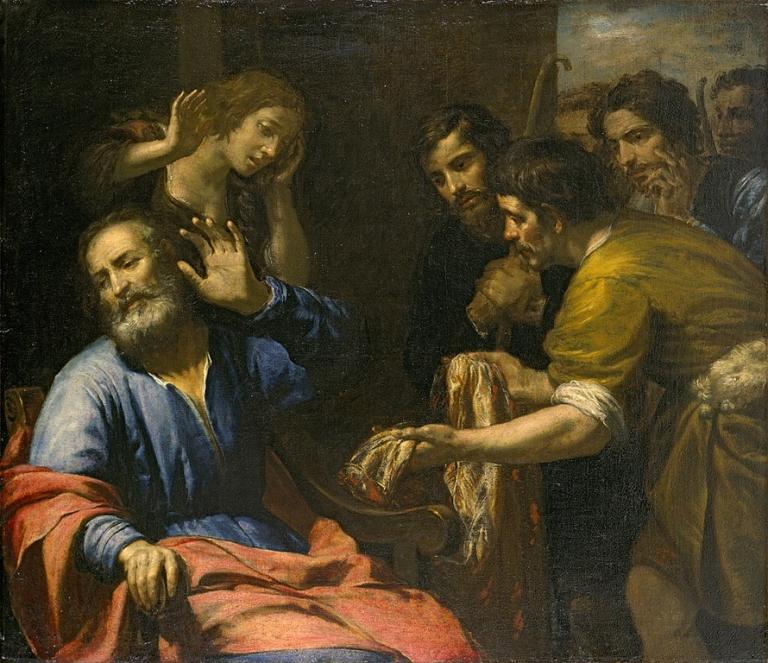
Story Point C
The next scene in the story is no less creative. They recount the Exodus and Israel’s movement into the promised land by focusing on Israel’s call to be a “kingdom of priests.” A number of smaller episodes can be used to explain how Israel’s priests were set apart ….
Story Point D
Next, we come to a passage prophesying the coming Davidic king. In Zech 3:1-8, the prophet writes,
Then he showed me Joshua the high priest standing before the angel of the Lord, and Satan standing at his right hand to accuse him. 2 And the Lord said to Satan, “The Lord rebuke you, O Satan! The Lord who has chosen Jerusalem rebuke you! Is not this a brand plucked from the fire?” 3 Now Joshua was standing before the angel, clothed with filthy garments. 4 And the angel said to those who were standing before him, “Remove the filthy garments from him.” And to him he said, “Behold, I have taken your iniquity away from you, and I will clothe you with pure vestments.” 5 And I said, “Let them put a clean turban on his head.” So they put a clean turban on his head and clothed him with garments. And the angel of the Lord was standing by.
6 And the angel of the Lord solemnly assured Joshua, 7 “Thus says the Lord of hosts: If you will walk in my ways and keep my charge, then you shall rule my house and have charge of my courts, and I will give you the right of access among those who are standing here. 8 Hear now, O Joshua the high priest, you and your friends who sit before you, for they are men who are a sign: behold, I will bring my servant the Branch.
The combination of the clothing motif with the priesthood them naturally connects with the prior story points. However, for this passage to work well, the storyteller will need to spend more time explaining (1) the promise God made to David about a coming king, and (2) Israel’s historical context such that this prophecy ever emerges. If done well, one does not need to linger on this passage but can let it simply serve (a) as a connective framework for the larger story, and (b) to continue the clothing imagery.
The Climax of the Chiasm
Story Point E
Christ is the centerpiece of the chiasm because he is central to the grand biblical story. Of the many possible stories to choose from, the group chose John 19 for two reasons.
First, John 19 gives an ironic depiction of Christ as king.
[19:2] And the soldiers twisted together a crown of thorns and put it on his head and arrayed him in a purple robe. [3] They came up to him, saying, “Hail, King of the Jews!” and struck him with their hands. [4] Pilate went out again and said to them, “See, I am bringing him out to you that you may know that I find no guilt in him.” [5] So Jesus came out, wearing the crown of thorns and the purple robe. … [15] Pilate said to them, “Shall I crucify your King?” The chief priests answered, “We have no king but Caesar.”
The scene is powerful and provocative. I especially like the fact it focuses in on Christ’s kingship. As I’ve explained on this site and in One Gospel for All Nations, “kingdom” is (one of) the fundamental framework of the biblical gospel. The gospel is a royal declaration first and foremost.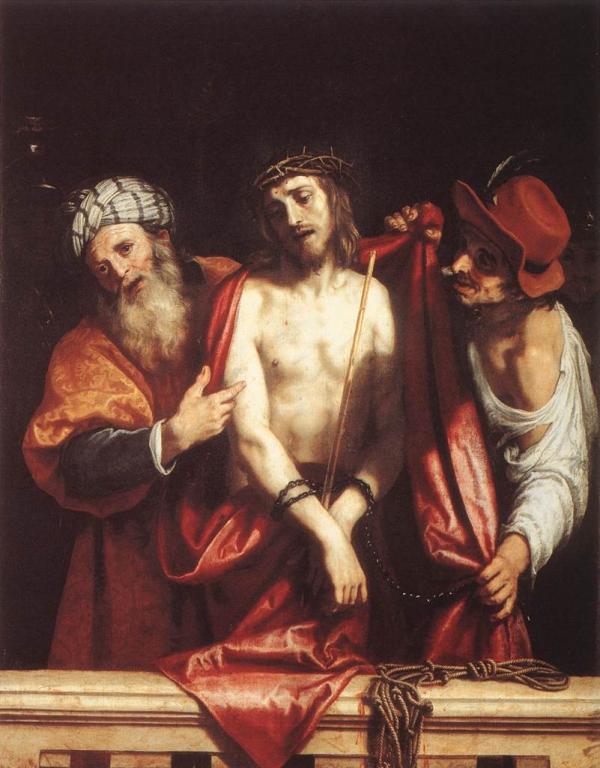
A second reason for using John 19 comes in vv. 21–24.
So the chief priests of the Jews said to Pilate, “Do not write, ‘The King of the Jews,’ but rather, ‘This man said, I am King of the Jews.’” 22 Pilate answered, “What I have written I have written.”
23 When the soldiers had crucified Jesus, they took his garments and divided them into four parts, one part for each soldier; also his tunic. But the tunic was seamless, woven in one piece from top to bottom, 24 so they said to one another, “Let us not tear it, but cast lots for it to see whose it shall be.” This was to fulfill the Scripture which says, “They divided my garments among them, and for my clothing they cast lots.”
The dividing of his garments is a poignant illustration of the shame Christ endures, despite his being king.
Clothed in Glory
Story Point D’
At this point, I would probably deviate from the proposal of the students. I’ll first explain their proposal, then give mine. The students suggest using Luke 9 (the transfiguration) and John 17:22 (Christ’s high priestly prayer).
Luke 9:29–31, 35 states,
“And as he was praying, the appearance of his face was altered, and his clothing became dazzling white. [30] And behold, two men were talking with him, Moses and Elijah, [31] who appeared in glory and spoke of his departure, which he was about to accomplish at Jerusalem. … [35] And a voice came out of the cloud, saying, “This is my Son, my Chosen One; listen to him!”
John 17:22, says,
“The glory that you have given me I have given to them, that they may be one even as we are one.”
These passages well fit the imagery of the overall presentation. My uncertainty about using them stems from 2 concerns.
1) These passages turn the narrative back in time
2) We forfeit the best opportunity to highlight the resurrection, which is an essential aspect of a full gospel proclamation.
Naturally, then, I’d prefer focusing on the resurrection. Several texts refer to the resurrection as Christ’s glorification (e.g., John 12:16; Acts 3:13; 1 Cor 15:43; cf. Col 3:1–4).
Furthermore, one need not entirely set aside the clothing motif (though we should never let literary images get in the way of preaching the resurrection). Multiple texts link resurrection with our “putting on” of some glorious aspect of salvation.
Story Point C’
In fact, a few of these passages are mentioned in the next point in the chiasm concerning the church. Here are several supporting verses:
1 Cor 15:53,
“this perishable body must put on the imperishable, and this mortal body must put on immortality”
2 Cor 5:3–4,
“For in this tent we groan, longing to put on our heavenly dwelling, 3 if indeed by putting it on we may not be found naked. 4 For while we are still in this tent, we groan, being burdened—not that we would be unclothed, but that we would be further clothed, so that what is mortal may be swallowed up by life.”
Col 3:3–4, 9–10,
“For you have died, and your life is hidden with Christ in God. 4 When Christ who is your life appears, then you also will appear with him in glory.… 9 Do not lie to one another, seeing that you have put off the old self with its practices 10 and have put on the new self, which is being renewed in knowledge after the image of its creator.”
Given the last phrase, I might add Rom 8:28-30. Also, since baptism is a visual reenactment of Christ’s death and resurrection, I include Gal 3:27, “For as many of you as were baptized into Christ have put on Christ.”
Garments for the Ultimate Banquet
Story Point B’, A’
The final two points in their chiasm both cite Revelation.
Christ’s Return Rev 1:12-16; 19:11-13, 16(// Joseph’s royal garments, Gen 41:39-42)
New Jerusalem (Rev 21: 3-4; 22: 10-11, 14; Banquet of Lamb, Rev 19: 5-8)
I’d prefer they use only one of the two, not both. Here’s why. First, one is prone to leave the narrative and just start teaching doctrinal points of eschatology. Second, the two scenes are less distinct in that Christ’s return immediately precedes the final banquet of the Lamb.
They seem to have the Joseph story in mind, which I like since it builds on and reinforces the prior episode.
In short, I think this story flow and structure has tremendous merit, but I also see room for improvement. What would you keep or adapt?
Previous Post

April 30, 2018
The subtle syncretism of Andy Stanley against “theological correctness”
Next Post
May 8, 2018 Want Trump as a patron? Give thanks
Browse Our Archives
Select a Category Atonement Biblical Theology Book Reviews China Chinese Church Chinese Culture Chinese Language Collectivism Contextualization Culture (General) Ecclesiology Evangelism Gospel Honor & Shame (Face) Interpretation/Exegesis Justification/Righteousness Missiology Mission Methods One Gospel for All Nations Other Practical Contextualization Reading Romans with Eastern Eyes Resources Romans Salvation (General) Saving God's Face Seeking God's Face The Cross in Context Theological Contextualization Theological Education Theology Uncategorized
Select a Month October 2026 September 2026 August 2026 July 2026 June 2026 May 2026 April 2026 March 2026 February 2026 January 2026 December 2025 November 2025 October 2025 September 2025 August 2025 July 2025 June 2025 May 2025 April 2025 March 2025 February 2025 January 2025 December 2024 November 2024 October 2024 September 2024 August 2024 July 2024 June 2024 May 2024 April 2024 March 2024 February 2024 January 2024 December 2023 November 2023 October 2023 September 2023 August 2023 July 2023 June 2023 May 2023 April 2023 March 2023 February 2023 January 2023 December 2022 November 2022 October 2022 September 2022 August 2022 July 2022 June 2022 May 2022 April 2022 March 2022 February 2022 January 2022 December 2021 November 2021 October 2021 September 2021 August 2021 July 2021 June 2021 May 2021 April 2021 March 2021 February 2021 January 2021 December 2020 November 2020 October 2020 September 2020 August 2020 July 2020 June 2020 May 2020 April 2020 March 2020 February 2020 January 2020 December 2019 November 2019 October 2019 September 2019 August 2019 July 2019 June 2019 May 2019 April 2019 March 2019 February 2019 January 2019 December 2018 November 2018 October 2018 September 2018 August 2018 July 2018 June 2018 May 2018 April 2018 March 2018 February 2018 January 2018 December 2017 November 2017 October 2017 September 2017 August 2017 July 2017 June 2017 May 2017 April 2017 March 2017 February 2017 January 2017 December 2016 November 2016 October 2016 September 2016 August 2016 July 2016 June 2016 May 2016 April 2016 March 2016 February 2016 January 2016 December 2015 November 2015 October 2015 September 2015 August 2015 July 2015 June 2015 May 2015 April 2015 March 2015 February 2015 January 2015 December 2014 November 2014 October 2014 September 2014 August 2014 July 2014 June 2014 May 2014 April 2014 March 2014 February 2014 January 2014 December 2013 November 2013 October 2013 September 2013 August 2013 July 2013 June 2013 May 2013 April 2013 March 2013 February 2013 January 2013 December 2012 November 2012
Follow Us!
TAKE THE
Religious Wisdom Quiz
How many brothers did Joseph have?
Select your answer to see how you score.
Five One Eleven Two
Books by This Author Books by Brad Vaughn
Related posts from Saving God's Face

No King forgets his crown. Why do we?

Recovering Moral Vision Between Shame and Shamelessness

Refuge, Confession, and the End of Shame

Psalm 25 and the Fear of Being Put...
TRENDING AT PATHEOS Evangelical

The Problem with False Prophets
Miller’s Station UMC| 10/18/26| Anchor Verse: Jeremiah 23: 1, 9-23 I...

Emotion in Early Christianity by Andrew Crislip
Andrew Crislip’s Emotion in Early Christianity examines an often overlooked dimension of...

16 Spiritual Touchstones for a More Grounded Life
After decades of spiritual study, here are 16 principles I try...

Catholic Evangelization: Sharing Your Faith Every Day
Welcome back to the Graceful Awakening mini-series called, “From Faith to Mission.” ...

The Pillar of the Boatmen: the Ancient Monument...
The Pillar of the Boatmen is a Romano-Gaulish sculpture that dates from...

In one sense walking into Westminster Abbey is like walking down the...
view all Evangelical blogs
Ad-Free & Subscriber Log-In Subscription Support
- About Us
- 2026 Calendar
- Videos
- Podcasts
- Library of World Religions
- Faith In Media Tracker
- Advertise With Us
- Write for Us
- Privacy Policy
- Terms of Service
- Do Not Sell My Data
- Contact Us
- Radiant Digital
- Manage Newsletter Subscriptions
- Unsubscribe From Notifications
- Sitemap
Copyright 2008-2026, Patheos. All rights reserved.
Subscription Support Ad-Free & Subscriber Log-In
Follow Patheos