
BuddhistCatholicContemplativeEvangelicalGeneral ChristianHinduJewishLatter-day SaintMuslimNew VisionsProgressive Christian
Beliefs
- Buddhist
- Catholic
- Contemplative
- Evangelical
- General Christian
- Hindu
- Jewish
- Latter-day Saint
- More Voices
- Muslim
- New Visions
- Pagan
- Progressive Christian
Topics
- Religion News
- Food and Religion
- Sports and Religion
- Religious Art
- Religious Music and Entertainment
- Religious Events
- History and Religion
- Style and Religion
- Politics and Religion
- Women in Religion
- Recreation Outdoors and Religion
- Business Finance and Religion
- Careers Workplace and Religion
- Education and Religion
- Family Parenting and Religion
- Health Fitness and Religion
- Home and Religion
- Relationships and Religion
- Technology and Religion
- Travel and Religion
Columnists
- Buddhist Columnists
- Business Finance and Religion Columnists
- Careers Workplace and Religion Columnists
- Catholic Columnists
- Contemplative Columnists
- Education and Religion Columnists
- Evangelists Columnists
- Family Parenting and Religion Columnists
- General Christian Columnists
- Health Fitness and Religion Columnists
- Hindu Columnists
- History and Religion Columnists
- Home and Religion Columnists
- Jewish Columnists
- More Voices Columnists
- Latter Day Columnists
- Muslim Columnists
- New Visions Columnists
- Nonreligious Columnists
- Pagan Columnists
- Politics and Religion Columnists
- Progressive Columnists
- Recreation Outdoors and Religion Columnists
- Relationships and Religion Columnists
- Religion News Columnists
- Religious Art Columnists
- Religious Events Columnists
- Religious Music and Entertainment Columnists
- Sports and Religion Columnists
- Style and Religion Columnists
- Technology and Religion Columnists
- Travel and Religion Columnists
- Women in Religion Columnists
Resource Library
- 2026 Calendar
- Library of World Religions
- The 100 Most Holy Places on Earth
- Patheos Answers
- Podcasts
- Videos
- Faith Leaders Database
- Anglican Episcopalian
- Bahai
- Baptist
- Buddhism
- Christianity
- Confucianism
- Eastern Orthodoxy
- Hinduism
- Holiness and Pentecostal
- ISKCON
- Islam
- Judaism
- Lutheran
- Methodist
- The Church of Jesus Christ of Latter-day Saints
- New Age
- Paganism
- Presbytarian and Reformed
- Protestantism
- Religion Behind the Scenes
- Roman Catholic
- Scientology
- Shia Islam
- Sikhism
- Sufism
- Sunni Islam
- Taoism
- Zen
- See all religions
Research Tools
 Ad-Free & Subscriber Log-In Subscription Support
Follow Patheos 

- Trending:
- Advent
- |
- Forgiveness
- |
- Thanksgiving
- |
- Election
- |
- Seasonal Holidays
- |
- Marriage

-
Tools
-
Support the Work
- Home
- Evangelical
- Identifying God’s Enemies and Ours
Identifying God’s Enemies and Ours
Last updated on: September 25, 2017 at 6:33 pm by Brad Vaughn
Identifying God’s Enemies and Ours 2017-09-25T18:33:10-07:00 Brad Vaughn
Patheos Explore the world's faith through different perspectives on religion and spirituality! Patheos has the views of the prevalent religions and spiritualities of the world.
Why does the Bible say we are “God’s enemies”?[1] The reason is less obvious as some think.
Atonement and God’s Enemies
Debates about atonement eventually come to this point. Compare a few common ideas.
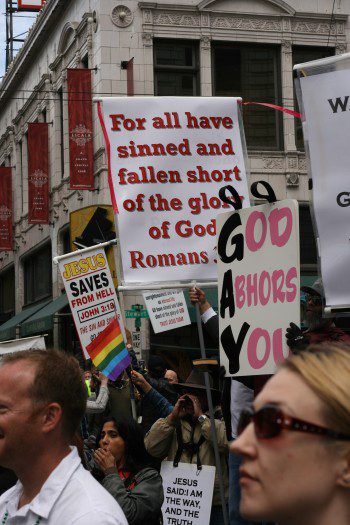
Public Domain CC 2.0
1) God sees people as enemies
Those affirming penal substitution say: Because we sin, we are God’s enemies. Therefore, he will pour his wrath on us unless Jesus is punished in our place. This camp emphasizes God’s enmity towards sinners; i.e. God regards us as enemies (even while loving us).
2) People see God as enemies
Those opposing penal substitution argue that penal substitution directly contradicts Jesus’ command to love your enemies. This group suggests that people regard God as their enemy (not vice versa).
3) Both
Others throw their hands in the air (in my opinion) and simply assert, “It’s both”, with little or no defense from Scripture. Commenting on Rom 5:10, N.T. Wright says,
“We should not, I think, cut the knot and suggest that the enmity was on our side only. God’s settled and sorrowful opposition to all that is evil included enmity against sinners.”[2]
Though Wright says this, some people worry about his emphasis on “Christus Victor.” According to this theory of atonement, Christ on the cross defeats sin, death, and demons. In this way, he frees us. According to many contemporary versions of “Christus Victor,” God regards Sin, death, and demons as enemies, but not us.
Naturally, some might wonder whether Christus Victor undermine the Bible’s teaching that we are God’s enemies?
Who is whose enemy?
Let’s first note the passages that describe people as God’s “enemies.”
For if while we were enemies we were reconciled to God by the death of his Son, much more, now that we are reconciled, shall we be saved by his life. (Rom 5:10)
For many, of whom I have often told you and now tell you even with tears, walk as enemies of the cross of Christ. (Phil 3:18)
Also, Col 1:21 (cf. Rom 1:30; 8:7).
I suggest we rethink a common assumption held by conservatives. Conservatives generally suppose we deny God’s wrath against sin if we don’t interpret being God’s “enemies” as “God regarded us as enemies,” i.e. had enmity towards us.
This is not true.
What do “enemies” do?
Allow Scripture to interpret Scripture. In the famous “love your enemy” passages, what do enemies do?
You have heard that it was said, “You shall love your neighbor and hate your enemy.” But I say to you, Love your enemies and pray for those who persecute you. (Matt 5:43–44)
But I say to you who hear, Love your enemies, do good to those who hate you, bless those who curse you, pray for those who abuse you. To one who strikes you on the cheek, offer the other also, and from one who takes away your cloak do not withhold your tunic either… (Luke 6:27–29)
What pattern do we see? Enemies seek our harm; they do not seek our good. What do we not see? Enemies are not (necessarily) people we hate.
Our feelings toward others do not determine whether they are “enemies.” Enemies decide whether they are enemies.
Elsewhere in the New Testament?
How does the New Testament describe enemies? Compare James 4:4.
You adulterous people! Do you not know that friendship with the world is enmity with God? Therefore whoever wishes to be a friend of the world makes himself an enemy of God.
Verse 4a explains v. 4b. “Enmity with God” is equivalent to what? “friendship with the world.” Who has a friendship with the world? People. So, it is the individual who has enmity making him an enemy of God.

Flickr/Dennis Skley
In summary, saying “we are God’s enemies” means “we see God as an enemy.”
Here are other passages that reinforce the point.
- “Have I then become your enemy by telling you the truth?” (Paul in Gal 4:16)
- “you enemy of all righteousness…” (Acts 13:10; Paul to Elymas)
- “…that we should be saved from our enemies and from the hand of all who hate us;” (Zechariah prophesies in Luke 1:71)
Cf. Matt 13:25, 28; Luke 19:27, 43.
“Enemies” are defined as those who hate us. This is essential; it’s not (necessarily) true that enemies are “those we hate.”[3]
What about God’s wrath?
Some people might hesitate to accept these observations. They fear we might subtly deny God’s wrath against sinners. That conclusion, however, is impossible for anyone reading the Bible.
The Bible is replete with references to God’s wrath. In fact, just before Paul calls people God’s “enemies” in Rom 5:10, he says,
“Since, therefore, we have now been justified by his blood, much more shall we be saved by him from the wrath of God” (5:9).
With a few possible exceptions, the New Testament routinely describes God’s wrath as something in the future. Yes, God’s wrath comes upon all who ultimately reject him. By contrast, Jesus “delivers us from the wrath to come” (1 Thess 1:10).
The New Testament does not depict God as one who simultaneously loves those he hates.
Perhaps, someone might deduce that idea via systematizing; namely, claiming God loves everyone then citing OT passages where God hates people (Ps 5:5; 11:5). However, doing so requires we strip verses from their context, assume highly debatable interpretations of certain passages, and basically treat the Bible as a systematic theology book and not a text to be understood within context.
Who is our “enemy”?
Who is “our enemy”? What does it mean to love our enemy?

Public Domain CC 2.0
Jesus’ command to love our enemy does not mean we should love people reluctantly despite the fact we actually hate them. While pastors would not put it so directly, this “grit and bear it” attitude is precisely how people talk about Jesus’ commands.
The problem with that common impression is obvious. If “love your enemies” means “love those you hate”, we have a contradiction unless we do some verbal gymnastics.
One reason this insight matters is this: we ought not assume Christians will hate people but can simply “love them,” whether by tolerating them or doing good things for them. Jesus does not command us to act despite our feelings; rather, we are supposed to have changed feelings.
Biblically speaking, loving enemies means loving those who are against us.
In the present, God’s “enemy” is not someone towards whom He feel wrath. Instead, God’s enemy feels wrath against Him. Likewise, my “enemy” is not necessarily someone towards whom I feel wrath. Instead, my enemy has wrath against me.
[1] Rom 5:10; Phil 3:18. Also, cf. Rom 1:30; 8:7; Col 1:21.
[2] N. T. Wright, “Romans,” p. 520; cf. Colin Kruse, Romans, p. 237.
[3] After all, a person might respond back with hatred, but this is not necessary for them to be counted as enemies.
Save
Save
Previous Post

September 13, 2017
U.S. military as Onramp for Understanding Honor-Shame Cultures
Next Post
September 27, 2017 6 Ways Honor and Shame Make Disciples (Not Converts)
Browse Our Archives
Select a Category Atonement Biblical Theology Book Reviews China Chinese Church Chinese Culture Chinese Language Collectivism Contextualization Culture (General) Ecclesiology Evangelism Gospel Honor & Shame (Face) Interpretation/Exegesis Justification/Righteousness Missiology Mission Methods One Gospel for All Nations Other Practical Contextualization Reading Romans with Eastern Eyes Resources Romans Salvation (General) Saving God's Face Seeking God's Face The Cross in Context Theological Contextualization Theological Education Theology Uncategorized
Select a Month November 2026 October 2026 September 2026 August 2026 July 2026 June 2026 May 2026 April 2026 March 2026 February 2026 January 2026 December 2025 November 2025 October 2025 September 2025 August 2025 July 2025 June 2025 May 2025 April 2025 March 2025 February 2025 January 2025 December 2024 November 2024 October 2024 September 2024 August 2024 July 2024 June 2024 May 2024 April 2024 March 2024 February 2024 January 2024 December 2023 November 2023 October 2023 September 2023 August 2023 July 2023 June 2023 May 2023 April 2023 March 2023 February 2023 January 2023 December 2022 November 2022 October 2022 September 2022 August 2022 July 2022 June 2022 May 2022 April 2022 March 2022 February 2022 January 2022 December 2021 November 2021 October 2021 September 2021 August 2021 July 2021 June 2021 May 2021 April 2021 March 2021 February 2021 January 2021 December 2020 November 2020 October 2020 September 2020 August 2020 July 2020 June 2020 May 2020 April 2020 March 2020 February 2020 January 2020 December 2019 November 2019 October 2019 September 2019 August 2019 July 2019 June 2019 May 2019 April 2019 March 2019 February 2019 January 2019 December 2018 November 2018 October 2018 September 2018 August 2018 July 2018 June 2018 May 2018 April 2018 March 2018 February 2018 January 2018 December 2017 November 2017 October 2017 September 2017 August 2017 July 2017 June 2017 May 2017 April 2017 March 2017 February 2017 January 2017 December 2016 November 2016 October 2016 September 2016 August 2016 July 2016 June 2016 May 2016 April 2016 March 2016 February 2016 January 2016 December 2015 November 2015 October 2015 September 2015 August 2015 July 2015 June 2015 May 2015 April 2015 March 2015 February 2015 January 2015 December 2014 November 2014 October 2014 September 2014 August 2014 July 2014 June 2014 May 2014 April 2014 March 2014 February 2014 January 2014 December 2013 November 2013 October 2013 September 2013 August 2013 July 2013 June 2013 May 2013 April 2013 March 2013 February 2013 January 2013 December 2012 November 2012
Follow Us!
TAKE THE
Religious Wisdom Quiz
True or False: The Israelites were commanded to observe the Day of Atonement once a year.
Select your answer to see how you score.
FALSE TRUE
Books by This Author Books by Brad Vaughn
Related posts from Saving God's Face


Should We Emphasize Jesus as King to People...

Why Egalitarians Can Stay in a Complementarian Church

"Why Have You Forsaken Me?” and the Problem...
TRENDING AT PATHEOS Evangelical

In 1939, President Franklin D. Roosevelt moved Thanksgiving from November 30 to...

Reasons for Restraint: Ricardo Gonzalez, Florida and Dec...
The Morning of January 3 I begin with the dead. On the...

I published this column for Thanksgiving 2012 in the Deseret News....

For many years, Catholicism has been caught up in division over the...

'Statements of Faith' never get shorter
Nothing demonstrates a conservative commitment to faith and faithfulness like a "statement...

Michele's Reviews - Future Grace by John Piper
In God's Place, at God's Pace, by Future Grace Impatience is...
view all Evangelical blogs
Ad-Free & Subscriber Log-In Subscription Support
- About Us
- 2026 Calendar
- Videos
- Podcasts
- Library of World Religions
- Faith In Media Tracker
- Advertise With Us
- Write for Us
- Privacy Policy
- Terms of Service
- Do Not Sell My Data
- Contact Us
- Radiant Digital
- Manage Newsletter Subscriptions
- Unsubscribe From Notifications
- Sitemap
Copyright 2008-2026, Patheos, part of the Radiant Digital network of media brands. All rights reserved.
Subscription Support Ad-Free & Subscriber Log-In
Follow Patheos