
BuddhistCatholicContemplativeEvangelicalGeneral ChristianHinduJewishLatter-day SaintMuslimNew VisionsProgressive Christian
Beliefs
- Buddhist
- Catholic
- Contemplative
- Evangelical
- General Christian
- Hindu
- Jewish
- Latter-day Saint
- More Voices
- Muslim
- New Visions
- Pagan
- Progressive Christian
Topics
- Religion News
- Food and Religion
- Sports and Religion
- Religious Art
- Religious Music and Entertainment
- Religious Events
- History and Religion
- Style and Religion
- Politics and Religion
- Women in Religion
- Recreation Outdoors and Religion
- Business Finance and Religion
- Careers Workplace and Religion
- Education and Religion
- Family Parenting and Religion
- Health Fitness and Religion
- Home and Religion
- Relationships and Religion
- Technology and Religion
- Travel and Religion
Columnists
- Buddhist Columnists
- Business Finance and Religion Columnists
- Careers Workplace and Religion Columnists
- Catholic Columnists
- Contemplative Columnists
- Education and Religion Columnists
- Evangelists Columnists
- Family Parenting and Religion Columnists
- General Christian Columnists
- Health Fitness and Religion Columnists
- Hindu Columnists
- History and Religion Columnists
- Home and Religion Columnists
- Jewish Columnists
- More Voices Columnists
- Latter Day Columnists
- Muslim Columnists
- New Visions Columnists
- Nonreligious Columnists
- Pagan Columnists
- Politics and Religion Columnists
- Progressive Columnists
- Recreation Outdoors and Religion Columnists
- Relationships and Religion Columnists
- Religion News Columnists
- Religious Art Columnists
- Religious Events Columnists
- Religious Music and Entertainment Columnists
- Sports and Religion Columnists
- Style and Religion Columnists
- Technology and Religion Columnists
- Travel and Religion Columnists
- Women in Religion Columnists
Resource Library
- 2026 Calendar
- Library of World Religions
- The 100 Most Holy Places on Earth
- Patheos Answers
- Podcasts
- Videos
- Faith Leaders Database
- Anglican Episcopalian
- Bahai
- Baptist
- Buddhism
- Christianity
- Confucianism
- Eastern Orthodoxy
- Hinduism
- Holiness and Pentecostal
- ISKCON
- Islam
- Judaism
- Lutheran
- Methodist
- The Church of Jesus Christ of Latter-day Saints
- New Age
- Paganism
- Presbytarian and Reformed
- Protestantism
- Religion Behind the Scenes
- Roman Catholic
- Scientology
- Shia Islam
- Sikhism
- Sufism
- Sunni Islam
- Taoism
- Zen
- See all religions
Research Tools
 Ad-Free & Subscriber Log-In Subscription Support
Ad-Free & Subscriber Log-In Subscription Support
Follow Patheos 

- Trending:
- Forgiveness
- |
- Marriage
- |
- Consciousness
- |
- Death Penalty
- |
- Election
- |
- Halloween

-
Tools
-
Support the Work
- Home
- Evangelical
- How to Assess Theological Arguments
How to Assess Theological Arguments
Last updated on: August 30, 2017 at 7:42 am by Brad Vaughn
How to Assess Theological Arguments 2017-08-08T05:20:57-07:00 Brad Vaughn
Patheos Explore the world's faith through different perspectives on religion and spirituality! Patheos has the views of the prevalent religions and spiritualities of the world.
As my students and I debated during a Systematic Theology I course, it realized how little people are trained to assess the relative strength of theological arguments.
Consider the typical back and forth of theological discussions. Both sides present Bible verses to support their respective positions. Appeals are made to scholars, past and present, who agree with “us.” And, of course, the others’ view is minimized as “not necessarily true.” Perhaps, one uses a more sophisticated approach in accusing the person of “having assumptions.”
The Complexity of Theological Ideas
Assessing a theological argument is not so straightforward.
We cannot simply look at the text, interpret it, then reach a conclusion. Interpretation of specific passages is foundation, for sure, but exegesis is often intertwined with prior theological convictions. Also, the meaning of a passage might be disputed. We have to decide on the relative strength of various points that could involve the historical and literary context, the grammar and syntax of the passage, among other factors.
With theological arguments, one must synthesize our observations from a range of texts, each presenting its own interpretative challenges. The context of the passages could vary widely. Theological synthesis requires careful use of logic and is influenced by various philosophical ideas.
Theological arguments can be complex. So what are we to do? How can we and those we train assess theological ideas?
A “Rubric” for Assessing Theological Arguments
BIBLE
First, we must go to the Bible. We pose a few basic questions, which do not always have simple answers. The meaning of the first two questions is less obvious than you might think. Regarding a given theological idea, we ask:
1. Is it compatible with the biblical context (of a text or set of passages)? Both the near context and the context of the entire biblical Story?
2. Is the idea consistent with our understanding of the biblical languages (e.g., syntax, grammar, etc.)?
You might think these questions in fact are the whole of the process. Not true. Our temptation is to simply write off ideas we first believe are unbiblical (i.e., answering question #1). But this not only begs the question; we would miss the point.
The words “compatible” and “consistent” remind us that we are considering disputed ideas. We simply want to know whether a theological idea is remotely possible, even if we presently think it unlikely. Within a given passage, would a certain theological idea have at least some significance to the surrounding context? This naturally leads to a third question.
3. Does the theological argument directly contradict other biblical doctrines?
Credit: Public Domain
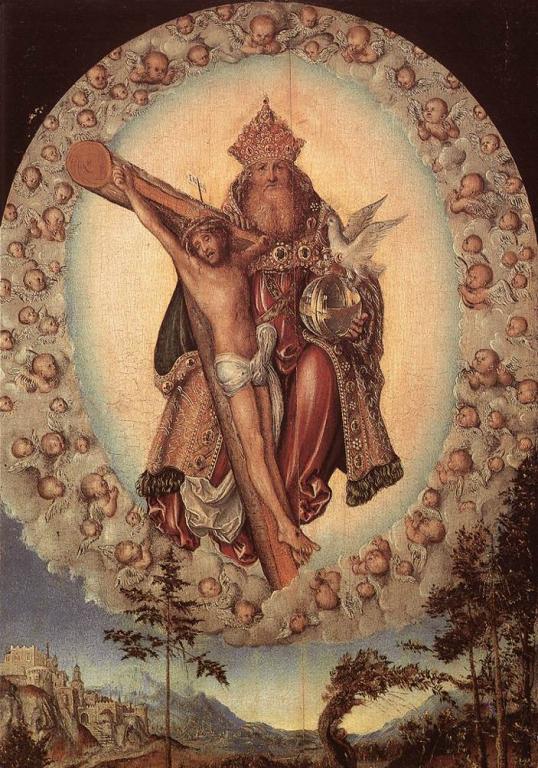
One should distinguish a “contradiction” and “tension.” Two ideas might be difficult to reconcile or to relate; yet, such tension does not necessarily imply a contradiction. Historically, Christ’s deity/humanity and the Trinity are familiar examples.
The presence of a contradiction, or even strong tension, might indicate a problem with the (new?) theological argument under consideration. On the other hand, it might expose a problem with one of our prior beliefs. Don’t forget that we might need to adjust our understanding of certain long-held doctrines. I don’t suggest you’ll completely throw out some teaching; rather, you might simply need to adjust certain aspects of a doctrine or what is emphasized.
In other words, let’s not assume that we are only ever assessing one single theological idea at a time. Doctrines are interconnected. We can’t regard previously held ideas as mere “givens.”
4. Distinguish the weight given to various texts
Explore how the argument applies the many relevant passages. On a given subject, not all texts are as clear and significant. We should not hold so firm to a doctrine that is based on thin evidence or unclear texts. A theological argument is as strong as the clarity and comprehensiveness of the passages it is based on.
BACKGROUND
Next, we consider the Bible’s historical and cultural context. Ask, “Does this theological teaching fit the historical and cultural background in which it was first given?”
Don’t assume the biblical writers are asking our questions.
In broadest terms, biblical theology begins with the writers’ questions; systematic theology is shaped by our questions (e.g., What is the church? What does the Bible say about X?). As a result, we can subtly press the Bible to answer questions that never occurred to the original writers and readers. Even if we can deduce reasonable answers, we will undermine the actual message and emphasis of the text.
Does the doctrine use metaphors and share a view of the world that would at all be recognizable to the original readers?
So we need to explore whether a theological argument addresses issues or questions that fit the Bible’s original context. This step requires tremendous humility, patience, and careful thinking. It requires a healthy skepticism of my beliefs and conventional teachings.
LOGIC
Logic is an indispensable part of the theological process. For example, a doctrine should be coherent and not self-contradictory. Furthermore, the stronger the argument, the more comprehensive it will be. That is, it has explanatory power. It can address many facets of of a topic.

Credit: flickr/theihno
The strongest arguments will also have diverse types of evidence. Not only will it draw from many passages; it will find confirming or at least suggestive support from other other disciplines, such as history, anthropology, literary studies, etc. Of course, we would hope to see similar ideas taught by theologians from other ages and cultures.
Not all evidence deserves equal weight. The fact that Protestant Reformers taught an idea does not automatically trump evidence showing that people from ancient biblical cultures understood a given concept in very contrary ways. The latter must be taken seriously.
Also, we will find support that is suggestive, not conclusive. In that case, one needs a lot of it. If we have a lot of suggestive evidence, we cannot treat it lightly.
SUBJECTIVE AND SUBTLE QUESTIONS
A few other habits of thinking get in the way of assessing theological ideas. For example, people fail to do the following:
Distinguish what is possible and what is definite or probable.
What is possible is not necessarily probable. Why say what is obvious? In theological discussions, I routinely hear people attempt to refute an argument simply by highlighting a mere possibility.
The objection typically begins, “Not necessarily.” When it comes to interpretation and theological synthesis, we logically could say “not necessarily” to countless true ideas. All the while, these objectors often refuse to address the weight and diversity of evidence for the teaching that attempt to counter.
Similarly, one ought to discern what is probable from what is most probable. This again requires we seriously consider the weight we give to various points. Thus, the evidence of two clear and comprehensive passages is stronger that 6 points from anthropology and history that merely highlight potential lines of thinking.
Don’t confuse silence with a denial.
Particularly in conversation or when comparing views, people have a bad habit. They suppose that not talking about an idea implies you deny that idea. Accordingly, if I say doctrine A concerns topic B, people wrongly assume I deny that doctrine A also involves topic C.
Here’s a specific example:
Some theologians reject double-imputation, specifically that Christ’s righteousness is imputed to Christians. On the surface, it appears they think individuals can establish their own righteousness, e.g. via works. However, many– if not most– of those theologians utterly reject works-righteousness. They fully affirm that our righteousness is due to Christ; however, they think this works in a different way, such as through union with Christ. They regard the traditional imputation concept as an analogy but not Paul’s explicit meaning.
Unless a theologian explicitly denies a truth, don’t assume he rejects that idea. No one can say everything all the time.
Finally, let’s talk about fear.
Some perspectives are hard to let go of. We fear accepting new ideas. What might this or that way of thinking lead to? What if you (or someone else) see that a certain teaching has a lot of merit and satisfies many of the above criteria, yet you (or they) are still reluctant?
Honestly ask yourself, “What motivates your insistence to hold on to your previously held but weaker point of view?” Might you be allowing friends or peers to assert more authority than Scripture? Theologizing concerns the heart as much as the mind.
In the next post, I will continue by asking, “What about historical theology? How should historical theologians influence the way we assess theological arguments?”
Save
Previous Post

August 24, 2017
Does Myers-Briggs type affect how you experience shame?
Next Post

September 6, 2017 Assessing Theology from a Historical Perspective
Browse Our Archives
Select a Category Atonement Biblical Theology Book Reviews China Chinese Church Chinese Culture Chinese Language Collectivism Contextualization Culture (General) Ecclesiology Evangelism Gospel Honor & Shame (Face) Interpretation/Exegesis Justification/Righteousness Missiology Mission Methods One Gospel for All Nations Other Practical Contextualization Reading Romans with Eastern Eyes Resources Romans Salvation (General) Saving God's Face Seeking God's Face The Cross in Context Theological Contextualization Theological Education Theology Uncategorized
Select a Month October 2026 September 2026 August 2026 July 2026 June 2026 May 2026 April 2026 March 2026 February 2026 January 2026 December 2025 November 2025 October 2025 September 2025 August 2025 July 2025 June 2025 May 2025 April 2025 March 2025 February 2025 January 2025 December 2024 November 2024 October 2024 September 2024 August 2024 July 2024 June 2024 May 2024 April 2024 March 2024 February 2024 January 2024 December 2023 November 2023 October 2023 September 2023 August 2023 July 2023 June 2023 May 2023 April 2023 March 2023 February 2023 January 2023 December 2022 November 2022 October 2022 September 2022 August 2022 July 2022 June 2022 May 2022 April 2022 March 2022 February 2022 January 2022 December 2021 November 2021 October 2021 September 2021 August 2021 July 2021 June 2021 May 2021 April 2021 March 2021 February 2021 January 2021 December 2020 November 2020 October 2020 September 2020 August 2020 July 2020 June 2020 May 2020 April 2020 March 2020 February 2020 January 2020 December 2019 November 2019 October 2019 September 2019 August 2019 July 2019 June 2019 May 2019 April 2019 March 2019 February 2019 January 2019 December 2018 November 2018 October 2018 September 2018 August 2018 July 2018 June 2018 May 2018 April 2018 March 2018 February 2018 January 2018 December 2017 November 2017 October 2017 September 2017 August 2017 July 2017 June 2017 May 2017 April 2017 March 2017 February 2017 January 2017 December 2016 November 2016 October 2016 September 2016 August 2016 July 2016 June 2016 May 2016 April 2016 March 2016 February 2016 January 2016 December 2015 November 2015 October 2015 September 2015 August 2015 July 2015 June 2015 May 2015 April 2015 March 2015 February 2015 January 2015 December 2014 November 2014 October 2014 September 2014 August 2014 July 2014 June 2014 May 2014 April 2014 March 2014 February 2014 January 2014 December 2013 November 2013 October 2013 September 2013 August 2013 July 2013 June 2013 May 2013 April 2013 March 2013 February 2013 January 2013 December 2012 November 2012
Follow Us!
TAKE THE
Religious Wisdom Quiz
Who is the coauthor of some of Paul's epistles and delivered them to churches?
Select your answer to see how you score.
Silas Barnabas Andrew Timothy
Books by This Author Books by Brad Vaughn
Related posts from Saving God's Face

Should We Emphasize Jesus as King to People...

Why Egalitarians Can Stay in a Complementarian Church

"Why Have You Forsaken Me?” and the Problem...

What motivates obedience when I don’t want to...
TRENDING AT PATHEOS Evangelical

The First Eucharistic Controversy: Christ’s Real Presence
For Catholics, the Eucharist is the source and summit of the Christian...

What a Stop Sign Can Teach Us About...
How to Make a Decision When You Can't Hear God Main point:...

Archdiocese Hosts Military Marriage Retreat in Germany
RASTATT, Germany — The transient military lifestyle, with its frequent deployments and...

Nearly every morning, I make the drive to Detroit with my high-school-age...

The Real AI Story Is Adoption Without Trust
Artificial intelligence has crossed a political threshold. It is no longer a...

A new article, written by Jeff Lindsay and Gale L. Pooley,...
view all Evangelical blogs
Ad-Free & Subscriber Log-In Subscription Support
- About Us
- 2026 Calendar
- Videos
- Podcasts
- Library of World Religions
- Faith In Media Tracker
- Advertise With Us
- Write for Us
- Privacy Policy
- Terms of Service
- Do Not Sell My Data
- Contact Us
- Radiant Digital
- Manage Newsletter Subscriptions
- Unsubscribe From Notifications
- Sitemap
Copyright 2008-2026, Patheos. All rights reserved.
Subscription Support Ad-Free & Subscriber Log-In
Follow Patheos