
BuddhistCatholicContemplativeEvangelicalGeneral ChristianHinduJewishLatter-day SaintMuslimNew VisionsProgressive Christian
Beliefs
- Buddhist
- Catholic
- Contemplative
- Evangelical
- General Christian
- Hindu
- Jewish
- Latter-day Saint
- More Voices
- Muslim
- New Visions
- Pagan
- Progressive Christian
Topics
- Religion News
- Food and Religion
- Sports and Religion
- Religious Art
- Religious Music and Entertainment
- Religious Events
- History and Religion
- Style and Religion
- Politics and Religion
- Women in Religion
- Recreation Outdoors and Religion
- Business Finance and Religion
- Careers Workplace and Religion
- Education and Religion
- Family Parenting and Religion
- Health Fitness and Religion
- Home and Religion
- Relationships and Religion
- Technology and Religion
- Travel and Religion
Columnists
- Buddhist Columnists
- Business Finance and Religion Columnists
- Careers Workplace and Religion Columnists
- Catholic Columnists
- Contemplative Columnists
- Education and Religion Columnists
- Evangelists Columnists
- Family Parenting and Religion Columnists
- General Christian Columnists
- Health Fitness and Religion Columnists
- Hindu Columnists
- History and Religion Columnists
- Home and Religion Columnists
- Jewish Columnists
- More Voices Columnists
- Latter Day Columnists
- Muslim Columnists
- New Visions Columnists
- Nonreligious Columnists
- Pagan Columnists
- Politics and Religion Columnists
- Progressive Columnists
- Recreation Outdoors and Religion Columnists
- Relationships and Religion Columnists
- Religion News Columnists
- Religious Art Columnists
- Religious Events Columnists
- Religious Music and Entertainment Columnists
- Sports and Religion Columnists
- Style and Religion Columnists
- Technology and Religion Columnists
- Travel and Religion Columnists
- Women in Religion Columnists
Resource Library
- 2026 Calendar
- Library of World Religions
- The 100 Most Holy Places on Earth
- Patheos Answers
- Podcasts
- Videos
- Faith Leaders Database
- Anglican Episcopalian
- Bahai
- Baptist
- Buddhism
- Christianity
- Confucianism
- Eastern Orthodoxy
- Hinduism
- Holiness and Pentecostal
- ISKCON
- Islam
- Judaism
- Lutheran
- Methodist
- The Church of Jesus Christ of Latter-day Saints
- New Age
- Paganism
- Presbytarian and Reformed
- Protestantism
- Religion Behind the Scenes
- Roman Catholic
- Scientology
- Shia Islam
- Sikhism
- Sufism
- Sunni Islam
- Taoism
- Zen
- See all religions
Research Tools
 Ad-Free & Subscriber Log-In Subscription Support
Ad-Free & Subscriber Log-In Subscription Support
Follow Patheos 

- Trending:
- Forgiveness
- |
- Marriage
- |
- Consciousness
- |
- Death Penalty
- |
- Election
- |
- Halloween

-
Tools
-
Support the Work
- Home
- Evangelical
- A Balanced Critique of Popular Missiological Methods
A Balanced Critique of Popular Missiological Methods
Last updated on: August 16, 2017 at 6:45 am by Brad Vaughn
A Balanced Critique of Popular Missiological Methods 2017-08-13T18:21:52-07:00 Brad Vaughn
Patheos Explore the world's faith through different perspectives on religion and spirituality! Patheos has the views of the prevalent religions and spiritualities of the world.
Few recent missiological articles are as practical and pleasurable as is George Terry’s “A Missiology of Excluded Middles: An Analysis of the T4T Scheme for Evangelism and Discipleship” (Themelios, Aug 2017). I would be hard pressed to improve upon Terry’s own summary. He writes,
This article analyzes the theological premises of the popular T4T model for evangelism and discipleship.
The analysis argues that the T4T scheme largely depends on several false dichotomies that do not engage the Scriptures except in order to proof text and it regularly excludes the middle area that conveys the biblical balance.
The result is an overly rigid methodology that undervalues the influence of context in cross-cultural communication. Rather than a theological vision that holds in biblical tension both truth and context, T4T sanctions an inflexible evangelism scheme that is more conducive to receptive audiences and a discipleship model that is more conversant with what is expedient than what is biblical.
He delivers on the promise made in the article abstract.
Characteristic Features of T4T
Whereas I’ve critiqued the use of Scripture in T4T (& similar methods), Terry provides a theological analysis; yet, his article differs markedly from others.
First, his comments are specific and shrewdly focused. They target the most significant aspects of T4T, without which T4T and similar methods cease to exist. Accordingly, he challenges four of T4T’s core values:
- broad and indiscriminate seed sowing,
- the gospel as the filter for finding receptivity,
- obedience-based discipleship, and
- the ministry of the Spirit as Teacher
Although T4T advocates have the rhetorical advantage (who does not think disciples should be obedient?), Terry exposes the reality: “T4T is dependent on a series of dichotomies that do not accurately portray the fuller biblical picture” (p. 350).[1]
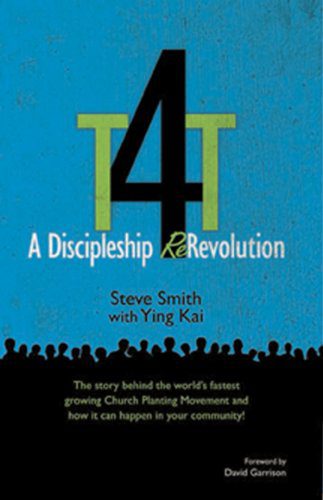 For example, T4T advocates dependence on the Spirit by fostering “antipathy toward knowledge or expertise” (350). Likewise, T4T suggest disciples either seek indiscriminate evangelism and rapid church planting or they are passive and disobedient (cf. 341, 347–48).
Perhaps most difficult to understand is why T4T dichotomizes life with the Spirit and having Jesus’ presence (349). The latter is seemingly equated with merely “learning the theological content or the rationale of Christian faith” (349).
Not only does Terry carefully support his claims with citations, he astutely highlights many non-sequiturs that plague T4T-like schemes. For instance, “the fact of the unpredictability of the Spirit does not logically infer the need for indiscriminate evangelism” (338).
Indifference to Culture and Contextualization
Second, few critiques of T4T-schemes consistently and thoroughly explore implications for contextualization. In a word, Terry writes, “T4T’s strong emphasis on indiscriminate evangelism devalues the need for establishing trust and for learning how to communicate effectively in cross-cultural situations” (341).
He reflects on why some people reject gospel presentations. They either do not understand the message or lack the necessary biblical and relational context. Terry says,
“[Steve] Smith affirms addressing the basic worldview of the context, but he oversimplifies it. T4T unintentionally discounts the reality that some people who reject an abrupt and uniform presentation of the gospel may nevertheless be open to the gospel when it is conveyed in a more culturally informed manner and in the context of a relationship of trust.” (342)
T4T’s blatant disregard to contextualization is most evident in its advocating a single evangelistic methodology. Thus, “…the T4T approach portrays evangelism as a methodologically unvarying endeavor and insufficiently recognizes the importance for contextual diversification” (342).
Furthermore, Terry illustrates a point I often harp on: contextualization begins with interpretation. In T4T, Smith translates “all nations” (in Matt 28:19) with a gloss “everyone.” Therefore, readers miss a fundamental part of the vision found in the Great Commission (e.g., “the worldwide scope of the church’s mission” and its basis in the Abrahamic covenant).
Terry adds,
“The commission is concentrated on people as part of the nations, not as isolated individuals. This is not to say we are not concerned for individuals; rather, our concern for individuals recognizes their unique history and context…. Since the ethnicities define the scope of God for the establishment of his kingdom, evangelism should be anything but indiscriminate” (340).
One must appreciate how Terry helpfully demonstrates the way various issues are intertwined.
Consider the Consequences
Third and finally, readers consider the unintentional consequences of using T4T and similar approaches. Terry sprinkles examples throughout his article.
For instance, T4T trainees implicitly learn to devalue any biblical instruction that does not lend itself to immediate application. T4T seems to suggest that new believers do not need “hard to understand” instruction (cf. 2 Pet 3:16) in order to understand the deep truths of God and apply ancient Scripture to contemporary situations.
As suggested above, a lack of contextualization can lead to people rejecting the message they hear due to its incomprehensibility. On this point, I’ll close with one of my favorite quotes from the article:
This T4T premise underestimates the formative influence of worldview and discounts a major anthropological factor related to decision-making.…
People do not make decisions, especially life changing ones, in a vacuum, as isolated individuals, completely disconnected from the sociology of their environment. Choices people make are filtered through the network of all the informative presuppositions, beliefs, and values of a worldview that has been shaped by life experience, by culture, and by their social context. Life changing decisions normally occur in the context of relationships of trust. (343)
Read the entire article and tell me what you think. Any of this resonate with your own experience with various church planting methods?
[1] Hence, the “excluded middle” referenced in the article’s title.
Previous Post

August 9, 2017
The Power of “Popularity” in the Church
Next Post

August 17, 2017 Interesting Stuff in Themelios (August, 2017)
Browse Our Archives
Select a Category Atonement Biblical Theology Book Reviews China Chinese Church Chinese Culture Chinese Language Collectivism Contextualization Culture (General) Ecclesiology Evangelism Gospel Honor & Shame (Face) Interpretation/Exegesis Justification/Righteousness Missiology Mission Methods One Gospel for All Nations Other Practical Contextualization Reading Romans with Eastern Eyes Resources Romans Salvation (General) Saving God's Face Seeking God's Face The Cross in Context Theological Contextualization Theological Education Theology Uncategorized
Select a Month October 2026 September 2026 August 2026 July 2026 June 2026 May 2026 April 2026 March 2026 February 2026 January 2026 December 2025 November 2025 October 2025 September 2025 August 2025 July 2025 June 2025 May 2025 April 2025 March 2025 February 2025 January 2025 December 2024 November 2024 October 2024 September 2024 August 2024 July 2024 June 2024 May 2024 April 2024 March 2024 February 2024 January 2024 December 2023 November 2023 October 2023 September 2023 August 2023 July 2023 June 2023 May 2023 April 2023 March 2023 February 2023 January 2023 December 2022 November 2022 October 2022 September 2022 August 2022 July 2022 June 2022 May 2022 April 2022 March 2022 February 2022 January 2022 December 2021 November 2021 October 2021 September 2021 August 2021 July 2021 June 2021 May 2021 April 2021 March 2021 February 2021 January 2021 December 2020 November 2020 October 2020 September 2020 August 2020 July 2020 June 2020 May 2020 April 2020 March 2020 February 2020 January 2020 December 2019 November 2019 October 2019 September 2019 August 2019 July 2019 June 2019 May 2019 April 2019 March 2019 February 2019 January 2019 December 2018 November 2018 October 2018 September 2018 August 2018 July 2018 June 2018 May 2018 April 2018 March 2018 February 2018 January 2018 December 2017 November 2017 October 2017 September 2017 August 2017 July 2017 June 2017 May 2017 April 2017 March 2017 February 2017 January 2017 December 2016 November 2016 October 2016 September 2016 August 2016 July 2016 June 2016 May 2016 April 2016 March 2016 February 2016 January 2016 December 2015 November 2015 October 2015 September 2015 August 2015 July 2015 June 2015 May 2015 April 2015 March 2015 February 2015 January 2015 December 2014 November 2014 October 2014 September 2014 August 2014 July 2014 June 2014 May 2014 April 2014 March 2014 February 2014 January 2014 December 2013 November 2013 October 2013 September 2013 August 2013 July 2013 June 2013 May 2013 April 2013 March 2013 February 2013 January 2013 December 2012 November 2012
Follow Us!
TAKE THE
Religious Wisdom Quiz
"Train up a child in the way he should go" is found in which book?
Select your answer to see how you score.
Matthew Job Jonah Proverbs
Books by This Author Books by Brad Vaughn
Related posts from Saving God's Face

Why Christianity Needs Individuals but Rejects Individualism

What motivates obedience when I don’t want to...
How Technique Undermines Mission
God both exceeds and undermines our expectations
TRENDING AT PATHEOS Evangelical

How to Make a Decision When You Can't...
Main point: It’s much more valuable to stay close to God so...

Archdiocese Hosts Military Marriage Retreat in Germany
RASTATT, Germany — The transient military lifestyle, with its frequent deployments and...

Nearly every morning, I make the drive to Detroit with my high-school-age...

The Real AI Story Is Adoption Without Trust
Artificial intelligence has crossed a political threshold. It is no longer a...

A new article, written by Jeff Lindsay and Gale L. Pooley,...

Swimfan: Forgotten Aughts Pleasures
This is a recovery effort. In 2002, My Big Fat Greek Wedding...
view all Evangelical blogs
Ad-Free & Subscriber Log-In Subscription Support
- About Us
- 2026 Calendar
- Videos
- Podcasts
- Library of World Religions
- Faith In Media Tracker
- Advertise With Us
- Write for Us
- Privacy Policy
- Terms of Service
- Do Not Sell My Data
- Contact Us
- Radiant Digital
- Manage Newsletter Subscriptions
- Unsubscribe From Notifications
- Sitemap
Copyright 2008-2026, Patheos. All rights reserved.
Subscription Support Ad-Free & Subscriber Log-In
Follow Patheos