
BuddhistCatholicContemplativeEvangelicalGeneral ChristianHinduJewishLatter-day SaintMuslimNew VisionsProgressive Christian
Beliefs
- Buddhist
- Catholic
- Contemplative
- Evangelical
- General Christian
- Hindu
- Jewish
- Latter-day Saint
- More Voices
- Muslim
- New Visions
- Pagan
- Progressive Christian
Topics
- Religion News
- Food and Religion
- Sports and Religion
- Religious Art
- Religious Music and Entertainment
- Religious Events
- History and Religion
- Style and Religion
- Politics and Religion
- Women in Religion
- Recreation Outdoors and Religion
- Business Finance and Religion
- Careers Workplace and Religion
- Education and Religion
- Family Parenting and Religion
- Health Fitness and Religion
- Home and Religion
- Relationships and Religion
- Technology and Religion
- Travel and Religion
Columnists
- Buddhist Columnists
- Business Finance and Religion Columnists
- Careers Workplace and Religion Columnists
- Catholic Columnists
- Contemplative Columnists
- Education and Religion Columnists
- Evangelists Columnists
- Family Parenting and Religion Columnists
- General Christian Columnists
- Health Fitness and Religion Columnists
- Hindu Columnists
- History and Religion Columnists
- Home and Religion Columnists
- Jewish Columnists
- More Voices Columnists
- Latter Day Columnists
- Muslim Columnists
- New Visions Columnists
- Nonreligious Columnists
- Pagan Columnists
- Politics and Religion Columnists
- Progressive Columnists
- Recreation Outdoors and Religion Columnists
- Relationships and Religion Columnists
- Religion News Columnists
- Religious Art Columnists
- Religious Events Columnists
- Religious Music and Entertainment Columnists
- Sports and Religion Columnists
- Style and Religion Columnists
- Technology and Religion Columnists
- Travel and Religion Columnists
- Women in Religion Columnists
Resource Library
- 2026 Calendar
- Library of World Religions
- The 100 Most Holy Places on Earth
- Patheos Answers
- Podcasts
- Videos
- Faith Leaders Database
- Anglican Episcopalian
- Bahai
- Baptist
- Buddhism
- Christianity
- Confucianism
- Eastern Orthodoxy
- Hinduism
- Holiness and Pentecostal
- ISKCON
- Islam
- Judaism
- Lutheran
- Methodist
- The Church of Jesus Christ of Latter-day Saints
- New Age
- Paganism
- Presbytarian and Reformed
- Protestantism
- Religion Behind the Scenes
- Roman Catholic
- Scientology
- Shia Islam
- Sikhism
- Sufism
- Sunni Islam
- Taoism
- Zen
- See all religions
Research Tools
 Ad-Free & Subscriber Log-In Subscription Support
Follow Patheos 

- Trending:
- Advent
- |
- Forgiveness
- |
- Thanksgiving
- |
- Election
- |
- Seasonal Holidays
- |
- Marriage

-
Tools
-
Support the Work
- Home
- Evangelical
- Chiasm, Oral Peoples, and the Grand Biblical Story
Chiasm, Oral Peoples, and the Grand Biblical Story
Last updated on: April 14, 2018 at 11:58 am by Brad Vaughn
Chiasm, Oral Peoples, and the Grand Biblical Story 2018-04-14T11:58:07-07:00 Brad Vaughn
Patheos Explore the world's faith through different perspectives on religion and spirituality! Patheos has the views of the prevalent religions and spiritualities of the world.
Chiasm is one of the most common memory devices in history and across the world. Yet, I find few people today use it or appreciate how chiasm works within an oral culture. For years, I’ve been one of those people.
If ancient oral cultures use chiasm as a mnemonic tool, might there be something about it that we can still use today? Some scholars claim chiastic structures are “circular” and so don’t reflect the “linear” narrative of the Bible. Is that true?

Photo credit: Wikipedia
I recently had a breakthrough in grasping how a chiasm can work and thus how useful it can be for us. I’d love your feedback.
This insight might help us “memorize” more information with greater ease and fluency. As a result, we can more effectively communicate the grand biblical narrative.
What is a Chiasm?
Every definition of a “chiasm” is awkward and hard to understand. We have to see one to understand it. A chiasm resembles the ABCB’A’ structure below.
A
B
C
B’
A’
A chiasm uses parallel lines or ideas (A, A’ and B, B’) that frame a central emphasis (C). From A to C, the logic or narrative tends to be progressive but digress from C to A’. Many ancient and biblical chiasms are breathtakingly long and complicated.[1] Typically, the parallel lines are tied together by a key word (or a synonym).
Here are a few simple biblical examples.
Gen 12:3
A I will bless those who bless you,
B and him who dishonors you I will curse,
A’ and in you all the families of the earth shall be blessed.”
Matt 11:28–30
A Come to Me, all you who labor and are heavy laden, (28a)
B and I will give you rest. Take My yoke upon you (28b, 29a)
C and learn from Me, for I am gentle and lowly in heart, (29b)
B′ and you will find rest for your souls. For My yoke is easy (29c, 30a)
A′ and My burden is light. (30b)
1 John 3:9
A whoever has been born of God
B does not sin
C for His seed remains in him
B’ and he cannot sin
A’ because he has been born of God
Aren’t chiasms too complex?
A chiasm seems far too complex. Imagine trying to recall something longer (like below) where else letter represents a long phrase, a sentence, or sometimes more!
A ……
D……
F
D’……
A ……
By the time we get back to C’ and B’, how do we remember what we said at B and C? How can we expect listeners to discern our emphasis at F? Even within written texts, which we see and can review patiently, a chiasm is difficult to identify. So, I repeat, how can oral people expect either to remember or recognize a chiastic structure?
I’ve read and heard people assert that the most natural way to tell a story is linearly. Among Christians, the claim is bolstered by the claim that the biblical narrative is linear. Why then do we find that ancient and oral cultures stories routinely use non-linear methods of storytelling?
Before we go further, keep in mind a few characteristic features of oral cultures and storytelling.
** repetition is essential*
** stories are more additive (A+B+C….) than logically progressive (A, B, thus C)*
** oral “texts” are often organized thematically and use key words or rhetorical devices*
** since such narratives frequently reinforce a group’s history or worldview, they are not utterly indifferent to the linearity of historical events*
A different perspective on chiasms
As I examined the extensive use of chiasm within long narratives, I suspected we might find some sort of linear progression (if we just looked hard enough). I previously read an article about how Americans and Chinese interpret pictures and writing differently if they are oriented vertically not horizontally.
So, what if we rotate the chiastic structures above 90 degrees? We get the following.
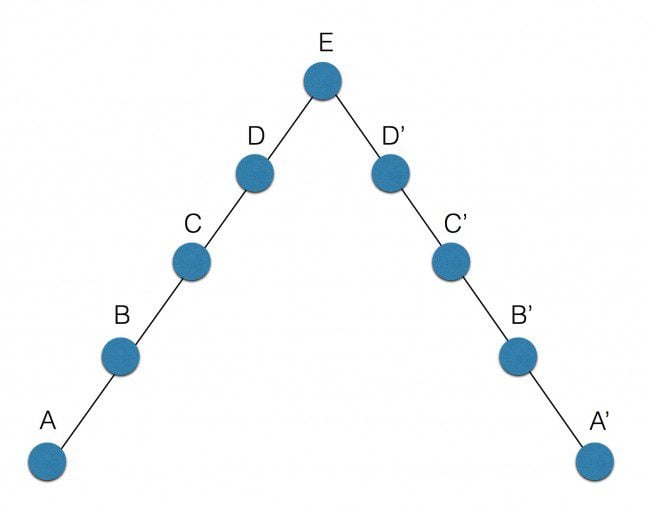
Now compare how this image compares to a conventional “plot structure” (below). The progression is familiar: introduction of main characters, then inciting event, followed by complication(s), finally the story’s climax and resolution.
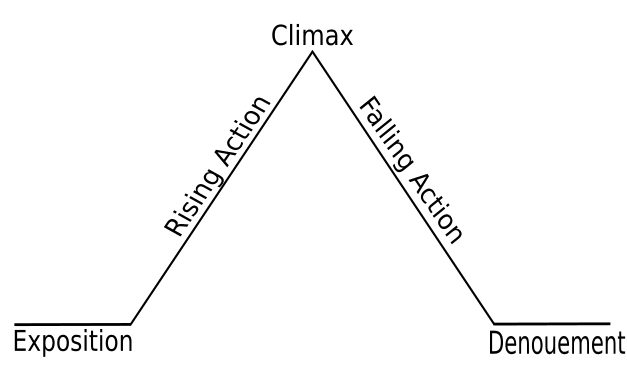
Freytags_pyramid (public domain)
These two diagrams resemble one another. A progression of events or ideas culminates at a point emphasized by the narrator/speaker. After the climactic turning point, the major plot points are brought to a close.
Note a common structure of arguments:
Problem 1
Problem 2
Problem 3
Overall solution
Resolves 3
Resolves 2
Resolves 1
Using Chiasm for Tell the Grand Biblical Story
Many attempts to share the grand biblical story essentially are tradition systematized gospel presentations that simply wear the clothing of a story. Christians often condense the grand biblical narrative in four movements: Creation, covenant, redemption, and consummation (or restoration). I’ve been critical of this summary, not because it’s “wrong”; rather, it grossly truncates the grand Story, especially everything from Genesis 3 until the latter portion of the Gospels. Other tools, like C2C, make a good effort but do not reflect the inherent narrative plotline.
By contrast, consider how the New Testament writers recall the gospel within the context of Israel’s story. They routinely highlight the same set of episodes or themes. These include creation, the Abrahamic promises, the exodus and receiving the Law, and God’s covenant with David. Christ is the climactic turning point of the Story.

In fact, the very way in which God achieves his purposes in Christ is a chiastic reflection of the Old Testament account. The second part of the chiasm reflects how the writers depicts God’s working in history through Christ’s ministry.
First of all, they announce Christ’s kingship (ascended to the throne, sitting at God’s side), His fulfilling of the Law and creating a royal priesthood for His name’s sake, the inclusion of the Gentiles, and the consummation of God’s creation purposes.
Whether consciously or otherwise, the writers present biblical history in a chiastic fashion. How easy it would be for them and us to recall this Story.
A few notes about the chiasm above:
- The period from David to Christ includes the exile, which was a major marker in the thinking of ancient Jews during the Second Temple period. As N. T. Wright argues convincingly, Christ is depicted as the one who ultimately brings Israel’ out of exile (not merely back to the land).
- “Pentecost” is simply a representative place marker for God’s creating the people whom national Israel merely foreshadowed. The gathering of the Twelve simultaneously is the restoration of Israel and thus the creation of the Church.
Using Chiasm Today?
It is worthwhile for us to rethink the value of chiasm for our ministry today.
It’s a proven memory device and, as we’ve seen, does not sacrifice linear story progression. It also helps capture the biblical Story in a way that reflects the Bible’s own rendering of the grand narrative. In other words, it highlights then reinforces what the Bible emphasizes.
Certainly, we can find other ways to utilize chiasm among oral peoples or even to organize our presentations.
What are your thoughts and suggestions for improving and using chiasm?
[1] For example, one can read the vast scholarship on the Iliad, which is replete with chiastic structures.
Previous Post

July 18, 2017
Does God Love Black People More Than the Church?
Next Post
August 2, 2017 How does the Bible explain the gospel? (Session 3 Training Video)
Browse Our Archives
Select a Category Atonement Biblical Theology Book Reviews China Chinese Church Chinese Culture Chinese Language Collectivism Contextualization Culture (General) Ecclesiology Evangelism Gospel Honor & Shame (Face) Interpretation/Exegesis Justification/Righteousness Missiology Mission Methods One Gospel for All Nations Other Practical Contextualization Reading Romans with Eastern Eyes Resources Romans Salvation (General) Saving God's Face Seeking God's Face The Cross in Context Theological Contextualization Theological Education Theology Uncategorized
Select a Month November 2026 October 2026 September 2026 August 2026 July 2026 June 2026 May 2026 April 2026 March 2026 February 2026 January 2026 December 2025 November 2025 October 2025 September 2025 August 2025 July 2025 June 2025 May 2025 April 2025 March 2025 February 2025 January 2025 December 2024 November 2024 October 2024 September 2024 August 2024 July 2024 June 2024 May 2024 April 2024 March 2024 February 2024 January 2024 December 2023 November 2023 October 2023 September 2023 August 2023 July 2023 June 2023 May 2023 April 2023 March 2023 February 2023 January 2023 December 2022 November 2022 October 2022 September 2022 August 2022 July 2022 June 2022 May 2022 April 2022 March 2022 February 2022 January 2022 December 2021 November 2021 October 2021 September 2021 August 2021 July 2021 June 2021 May 2021 April 2021 March 2021 February 2021 January 2021 December 2020 November 2020 October 2020 September 2020 August 2020 July 2020 June 2020 May 2020 April 2020 March 2020 February 2020 January 2020 December 2019 November 2019 October 2019 September 2019 August 2019 July 2019 June 2019 May 2019 April 2019 March 2019 February 2019 January 2019 December 2018 November 2018 October 2018 September 2018 August 2018 July 2018 June 2018 May 2018 April 2018 March 2018 February 2018 January 2018 December 2017 November 2017 October 2017 September 2017 August 2017 July 2017 June 2017 May 2017 April 2017 March 2017 February 2017 January 2017 December 2016 November 2016 October 2016 September 2016 August 2016 July 2016 June 2016 May 2016 April 2016 March 2016 February 2016 January 2016 December 2015 November 2015 October 2015 September 2015 August 2015 July 2015 June 2015 May 2015 April 2015 March 2015 February 2015 January 2015 December 2014 November 2014 October 2014 September 2014 August 2014 July 2014 June 2014 May 2014 April 2014 March 2014 February 2014 January 2014 December 2013 November 2013 October 2013 September 2013 August 2013 July 2013 June 2013 May 2013 April 2013 March 2013 February 2013 January 2013 December 2012 November 2012
Follow Us!
TAKE THE
Religious Wisdom Quiz
Who said, "Whom shall I send, and who will go for us?"
Select your answer to see how you score.
Isaiah Jesus God Moses
Books by This Author Books by Brad Vaughn
Related posts from Saving God's Face

Bathsheba, #MeToo, and Eisegesis

I'm launching 3 online courses!
What's your political denomination?

Think Broadly on Contextualization and Biblical Theology
TRENDING AT PATHEOS Evangelical

Reflections on the Evangelical Theological Society
As I mentioned before, this year, for the first time since 2005,...

Demmed if it do and demmed if it...
"First Presidency Announces Salt Lake Temple Rededication Date" Apropos of that,...

Stop Making Thanksgiving Problematic And Just Give Thanks
“What if, today, we were grateful for everything?” –Charlie Brown I...

Sunday Readings: Stay Awake and Hope
The First Sunday of Advent begins a new liturgical year, and the...

Are You a Scrooge or an Ebenezer?
A Call to Remember As the Christmas season begins, will we remember...

Noah’s Ark Archaeologists: Gopher Wood or Should We...
Ancient wood, a boat-shaped formation and dates that invite a second look:...
view all Evangelical blogs
Ad-Free & Subscriber Log-In Subscription Support
- About Us
- 2026 Calendar
- Videos
- Podcasts
- Library of World Religions
- Faith In Media Tracker
- Advertise With Us
- Write for Us
- Privacy Policy
- Terms of Service
- Do Not Sell My Data
- Contact Us
- Radiant Digital
- Manage Newsletter Subscriptions
- Unsubscribe From Notifications
- Sitemap
Copyright 2008-2026, Patheos, part of the Radiant Digital network of media brands. All rights reserved.
Subscription Support Ad-Free & Subscriber Log-In
Follow Patheos