
BuddhistCatholicContemplativeEvangelicalGeneral ChristianHinduJewishLatter-day SaintMuslimNew VisionsProgressive Christian
Beliefs
- Buddhist
- Catholic
- Contemplative
- Evangelical
- General Christian
- Hindu
- Jewish
- Latter-day Saint
- More Voices
- Muslim
- New Visions
- Pagan
- Progressive Christian
Topics
- Religion News
- Food and Religion
- Sports and Religion
- Religious Art
- Religious Music and Entertainment
- Religious Events
- History and Religion
- Style and Religion
- Politics and Religion
- Women in Religion
- Recreation Outdoors and Religion
- Business Finance and Religion
- Careers Workplace and Religion
- Education and Religion
- Family Parenting and Religion
- Health Fitness and Religion
- Home and Religion
- Relationships and Religion
- Technology and Religion
- Travel and Religion
Columnists
- Buddhist Columnists
- Business Finance and Religion Columnists
- Careers Workplace and Religion Columnists
- Catholic Columnists
- Contemplative Columnists
- Education and Religion Columnists
- Evangelists Columnists
- Family Parenting and Religion Columnists
- General Christian Columnists
- Health Fitness and Religion Columnists
- Hindu Columnists
- History and Religion Columnists
- Home and Religion Columnists
- Jewish Columnists
- More Voices Columnists
- Latter Day Columnists
- Muslim Columnists
- New Visions Columnists
- Nonreligious Columnists
- Pagan Columnists
- Politics and Religion Columnists
- Progressive Columnists
- Recreation Outdoors and Religion Columnists
- Relationships and Religion Columnists
- Religion News Columnists
- Religious Art Columnists
- Religious Events Columnists
- Religious Music and Entertainment Columnists
- Sports and Religion Columnists
- Style and Religion Columnists
- Technology and Religion Columnists
- Travel and Religion Columnists
- Women in Religion Columnists
Resource Library
- 2026 Calendar
- Library of World Religions
- The 100 Most Holy Places on Earth
- Patheos Answers
- Podcasts
- Videos
- Faith Leaders Database
- Anglican Episcopalian
- Bahai
- Baptist
- Buddhism
- Christianity
- Confucianism
- Eastern Orthodoxy
- Hinduism
- Holiness and Pentecostal
- ISKCON
- Islam
- Judaism
- Lutheran
- Methodist
- The Church of Jesus Christ of Latter-day Saints
- New Age
- Paganism
- Presbytarian and Reformed
- Protestantism
- Religion Behind the Scenes
- Roman Catholic
- Scientology
- Shia Islam
- Sikhism
- Sufism
- Sunni Islam
- Taoism
- Zen
- See all religions
Research Tools
 Ad-Free & Subscriber Log-In Subscription Support
Ad-Free & Subscriber Log-In Subscription Support
Follow Patheos 

- Trending:
- Forgiveness
- |
- Marriage
- |
- Consciousness
- |
- Death Penalty
- |
- Election
- |
- Halloween

-
Tools
-
Support the Work
- Home
- Evangelical
- Is Western Culture Dystopian?
Is Western Culture Dystopian?
Last updated on: June 20, 2017 at 7:30 pm by Brad Vaughn
Is Western Culture Dystopian? 2017-05-26T17:10:54-07:00 Brad Vaughn
Patheos Explore the world's faith through different perspectives on religion and spirituality! Patheos has the views of the prevalent religions and spiritualities of the world.
Dystopia is a distinctly Western genre. It also is one of the most popular story genres of our day. The explosive growth of dystopian stories is no accident.

Credit: Deposit Photos
In effect, they contextualize a worldview perspective that is prevalent in Western culture. I am convinced of at least three benefits to understanding dystopian thinking.
- By seeing dystopian narratives as a form of contextualization, we gain insight concerning the underlying assumptions and concerns that mark Western society.
- Inasmuch as Western culture influences the missionary movement, we can foresee problems that potentially creep into the church around the world.
- I propose one more counter-intuitive idea––understanding dystopian stories can help us understand the Bible. This requires more explanation.
Before we consider the significance of dystopian stories, let’s consider a few key aspects of dystopia.
Distinctive Features of Dystopian Stories
Recall some popular dystopian movies, shows and books since the year 2000.

The Hunger Games (series), Divergent (series), Maze Runner (series), Black Mirror, The Uglies (series), Feed, The Minority Report, Station Eleven, Delirium (series), Matched (series), ….
Classic dystopian examples in literature include:
1984, Brave New World, The Giver, Do Androids Dream of Electric Sheep? [the basis for the movie Blade Runner], A Clockwork Orange, Fahrenheit 451, The Handmaid’s Tale, Lord of the Flies, The Chrysalids, …
For an excellent course on dystopian literature, available through Audible, click here. You can find a lot of details there. For now, here are a few broad characteristic features of dystopian stories.
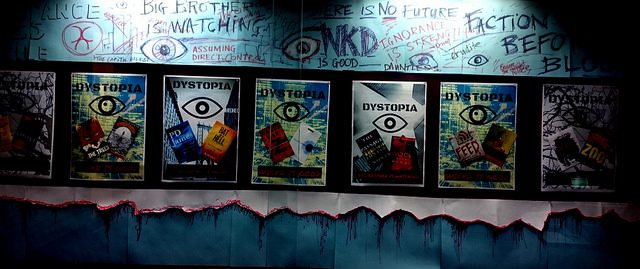
Flickr:MosmanLibrary
1. Conformity vs. Individualism
Dystopias highlight the tension between conforming to social norms and maintaining individuality. The family is major causality in this conflict between communal and individual identity. A key mantra of Divergent is “faction before blood.” Though lengthy, the following quote is an amazingly rich summary of a key point I will focus on momentarily.
Families were portrayed as taboo in all three of these novels [Brave New World, 1984, Anthem]. Even in 1984 where families were depicted as an unfortunate necessity, children were conditioned from an early age to be spies and were encouraged to turn on their parents, thus destroying the sacred familial bond.
Along with questions of personal identity and purpose, the loss of family and personal history is ubiquitous throughout dystopian fiction. The family is genetic memory. It situates one in space and time; history and biology. It is family that gives us our uniqueness, our separate identity, and our differentiated tribe, regardless of how small it might be. The loss and destruction of the family means to symbolically destroy one’s connection to history. Part of what makes a dystopia so disturbing is its lack of context.…
In modern dystopian literature the identity of the self and the continuity of the family are consciously and systematically destroyed by the ruling factions of the society. However, as we start to move into the post-modern, questions regarding origin, identity and self, become far more elusive. Dystopian portrayals of origins move from a highly regulated and oppressive system, to one that questions origins themselves. The destruction of identity is not explicit in post-modern dystopias, but implicit in its entire fabrication.[1]
The quote beautifully captures the angst of Western individuals (and, if we are not careful, an increasing number of Christians).
2. Language Manipulation
Dystopias typically highlight the use and abuse of social power. George Orwell commentates on the relationship between language and social control. In his essay, Politics and the English Language, he writes
Political language has to consist largely of euphemism, question-begging and sheer cloudy vagueness.… But if thought corrupts language, language can also corrupt thought.
Power is secured by controlling or changing the meaning of words. This theme is at the forefront of 1984.
3. Security vs. Freedom
The supreme authorities in dystopia routinely justify their actions. Often in response to some calamity, an authoritarian regime provides security at the expense of freedom. Superficially, the central warning of dystopias is against the evils of conformity, group-think, and the suppression of individuals.
This picture only tells part of the story. But I’ll wait to say more below.
Is Western Culture Dystopian?
Why are people so fascinated with utopian/dystopian stories? Does Western culture have dystopian characteristics?
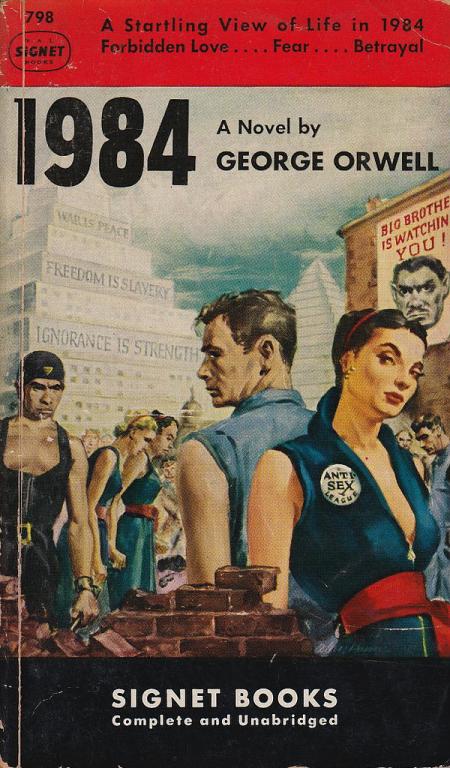
Credit: Public Domain
One common suggestion is that Westerners increasingly fear centralized, totalitarian authorities, who demand conformity and crush individuality. The anxiety spans the political spectrum. One might be afraid of the growth of communism. Likewise, many fear the trend among Western governments to consolidate power in the name of fighting terrorism. Dystopian writers certainly protest authoritarians who use power to oppress non-conforming individuals.
But what can go unnoticed is how social power is secured and protected. One could argue the underlying method of controlling society is hyper-individualism, via the dissolution of subcultures. Dystopian society restricts one’s ability to identify personally with others, even and especially one’s family.
Here is the irony–– Westerners create the dystopia they fear in response to perceived fears of totalitarianism. How so?
People are increasingly sensitive to the rights and plights of minorities. This itself is not a problem. However, overreactions, by definition, are a response to legitimate concerns.
Individualism is confused with individuality. Westerners are no longer content to protect individuality; they now militantly advocate for individualism for individualism’s sake. Socially speaking, individualism is mandated in the name of individuality.
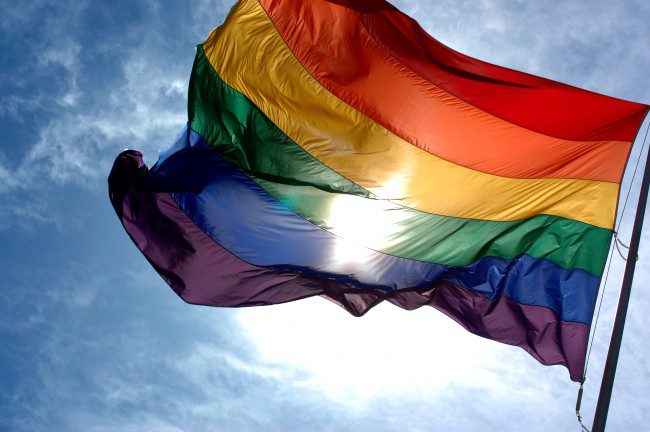
Disdain for authoritarianism has produced a tyranny of the minority. Minority groups simply need to cry “intolerance” and the majority must yield lest they face consequences. Diversity is celebrated above all else. One is supposed to be “proud” of being black, brown, female, Latino, gay, Jewish, etc.… On the other hand, a person would be insensitive and “bigoted” to celebrate being white, male, straight and/or Christian.
In dystopian books, “the state” usually plays the villain role. Rather than a formal authority like the state, social secularists now play the role of “big brother.” I suspect this is one reason why Christians fail to see the dystopian dynamics at play in Western society.

Credit: Public Domain
People must be “politically correct” lest they offend (the great “sin” of Western culture).
Many people think “political correctness” is a mere inconvenience, never suspecting it might be a subtle strategy akin to 1984’s “Newspeak.” So, Christians succumb to social pressure to play cultural language games.
The recent redefinition of marriage is a case-in-point. You show your cards simply by choosing to describe immigrants as either “illegal” or “undocumented.” Sportscasters once announce that an “African American” won a race because they didn’t know what to call a black, French runner. And now we find ourselves discussing the so-called differences between “gender” and “sex.” The dystopian instinct to resist conformity has led people even to reject nature.
The individualism produced by political correctness has the same alienating effect as any dystopian antagonist, whether “Big Brother,” “the Capital,” or the “faction system.” That is, both fictional dystopias and contemporary Western culture foster an extreme brand of individualism that ultimately undermines group identity. By dissolving collective bonds, individuals forfeit the support they otherwise would have from family and social tribe.
Credit: Wikipedia
Did Christendom birth dystopia?
Christians desperately need to distinguish individualism and individuality. Westerners legitimately reject attempts to eradicate individual distinctions. After all, Paul’s comparison of the church to a body presumes diverse functions and roles (cf. Rom 12; 1 Cor 12).
The rejection of Christianity and the growth of secularism corresponds to the emergence of dystopian writings. This is no coincidence.
Sadly, Western Christians’ abuse of power to force conformity has partially led to secular protest. Secularists fear Christians will use whatever power necessary to suppress “unacceptable differences.” Not long ago, gay men could be imprisoned or compelled to be sterilized. Christians have led the fight to prevent the building of mosques in local neighborhoods. They also have tried to legislate (Christian) prayer in schools. Countless stories could be told about Christians using power to oppress women, Chinese, and other minorities.
I don’t mention these things to condemn Christianity or religion; rather, we must acknowledge why people feel the way they do. We ought not be defensive and instead temporarily set aside debates of whether “they” are right or wrong.
Dystopia is a contextualization of Western concerns. The genre highlights legitimate concerns. Dystopias are a helpful tool. Superficially, they help us understand others’ thinking. However, I think a deeper understanding of the genre exposes the subtle ways that Westerners (and many Christians) unwittingly create the sort of dystopia they fear.
Another point is more significant and surprising. Dystopian stories provide a lens to read the Bible. Not that we should impose a dystopian template on Scripture. Instead, an awareness of dystopian concerns sheds light on the overarching biblical narrative.
And that will be the subject of my next post.
–––––––––––––––––––––––
What dystopian novels or movies are you most familiar with?
In what ways do you see dystopian concerns or characteristics manifest in Western culture?
[1] Riven Barton, “Dystopia and the Promethean Nightmare.” Pages 5–18 in The Age of Dystopia: One Genre, Our Fears and Our Future. Edited by Louisa MacKay Demerjian.
Previous Post
June 14, 2017
Reinterpreting Contextualization (Session 1 Training Video)
Next Post
June 27, 2017 The Bible Tells a Dystopian Story
Browse Our Archives
Select a Category Atonement Biblical Theology Book Reviews China Chinese Church Chinese Culture Chinese Language Collectivism Contextualization Culture (General) Ecclesiology Evangelism Gospel Honor & Shame (Face) Interpretation/Exegesis Justification/Righteousness Missiology Mission Methods One Gospel for All Nations Other Practical Contextualization Reading Romans with Eastern Eyes Resources Romans Salvation (General) Saving God's Face Seeking God's Face The Cross in Context Theological Contextualization Theological Education Theology Uncategorized
Select a Month October 2026 September 2026 August 2026 July 2026 June 2026 May 2026 April 2026 March 2026 February 2026 January 2026 December 2025 November 2025 October 2025 September 2025 August 2025 July 2025 June 2025 May 2025 April 2025 March 2025 February 2025 January 2025 December 2024 November 2024 October 2024 September 2024 August 2024 July 2024 June 2024 May 2024 April 2024 March 2024 February 2024 January 2024 December 2023 November 2023 October 2023 September 2023 August 2023 July 2023 June 2023 May 2023 April 2023 March 2023 February 2023 January 2023 December 2022 November 2022 October 2022 September 2022 August 2022 July 2022 June 2022 May 2022 April 2022 March 2022 February 2022 January 2022 December 2021 November 2021 October 2021 September 2021 August 2021 July 2021 June 2021 May 2021 April 2021 March 2021 February 2021 January 2021 December 2020 November 2020 October 2020 September 2020 August 2020 July 2020 June 2020 May 2020 April 2020 March 2020 February 2020 January 2020 December 2019 November 2019 October 2019 September 2019 August 2019 July 2019 June 2019 May 2019 April 2019 March 2019 February 2019 January 2019 December 2018 November 2018 October 2018 September 2018 August 2018 July 2018 June 2018 May 2018 April 2018 March 2018 February 2018 January 2018 December 2017 November 2017 October 2017 September 2017 August 2017 July 2017 June 2017 May 2017 April 2017 March 2017 February 2017 January 2017 December 2016 November 2016 October 2016 September 2016 August 2016 July 2016 June 2016 May 2016 April 2016 March 2016 February 2016 January 2016 December 2015 November 2015 October 2015 September 2015 August 2015 July 2015 June 2015 May 2015 April 2015 March 2015 February 2015 January 2015 December 2014 November 2014 October 2014 September 2014 August 2014 July 2014 June 2014 May 2014 April 2014 March 2014 February 2014 January 2014 December 2013 November 2013 October 2013 September 2013 August 2013 July 2013 June 2013 May 2013 April 2013 March 2013 February 2013 January 2013 December 2012 November 2012
Follow Us!
TAKE THE
Religious Wisdom Quiz
Who was the youngest friend who rebuked Job and the other friends?
Select your answer to see how you score.
Elihu Zophar Bildad Eliphaz
Books by This Author Books by Brad Vaughn
Related posts from Saving God's Face

Independent Thinking Isn’t What You Think

The Gulag Theology of One Day in the...
The Sin of Most Political Debates Isn’t What...

How Fear of AI Makes Us Worse Teachers
TRENDING AT PATHEOS Evangelical

Nearly every morning, I make the drive to Detroit with my high-school-age...

The Real AI Story Is Adoption Without Trust
Artificial intelligence has crossed a political threshold. It is no longer a...

A new article, written by Jeff Lindsay and Gale L. Pooley,...

Swimfan: Forgotten Aughts Pleasures
This is a recovery effort. In 2002, My Big Fat Greek Wedding...

Top Three Anti-Catholic Lies About Catholicism
This is my initial transcript for the video, "THE 3 WORST...

Pope Leo Celebrates Mass for Nurses & Docs...
I don't have any idea how he did it, but Pope Leo...
view all Evangelical blogs
Ad-Free & Subscriber Log-In Subscription Support
- About Us
- 2026 Calendar
- Videos
- Podcasts
- Library of World Religions
- Faith In Media Tracker
- Advertise With Us
- Write for Us
- Privacy Policy
- Terms of Service
- Do Not Sell My Data
- Contact Us
- Radiant Digital
- Manage Newsletter Subscriptions
- Unsubscribe From Notifications
- Sitemap
Copyright 2008-2026, Patheos. All rights reserved.
Subscription Support Ad-Free & Subscriber Log-In
Follow Patheos