
BuddhistCatholicContemplativeEvangelicalGeneral ChristianHinduJewishLatter-day SaintMuslimNew VisionsProgressive Christian
Beliefs
- Buddhist
- Catholic
- Contemplative
- Evangelical
- General Christian
- Hindu
- Jewish
- Latter-day Saint
- More Voices
- Muslim
- New Visions
- Pagan
- Progressive Christian
Topics
- Religion News
- Food and Religion
- Sports and Religion
- Religious Art
- Religious Music and Entertainment
- Religious Events
- History and Religion
- Style and Religion
- Politics and Religion
- Women in Religion
- Recreation Outdoors and Religion
- Business Finance and Religion
- Careers Workplace and Religion
- Education and Religion
- Family Parenting and Religion
- Health Fitness and Religion
- Home and Religion
- Relationships and Religion
- Technology and Religion
- Travel and Religion
Columnists
- Buddhist Columnists
- Business Finance and Religion Columnists
- Careers Workplace and Religion Columnists
- Catholic Columnists
- Contemplative Columnists
- Education and Religion Columnists
- Evangelists Columnists
- Family Parenting and Religion Columnists
- General Christian Columnists
- Health Fitness and Religion Columnists
- Hindu Columnists
- History and Religion Columnists
- Home and Religion Columnists
- Jewish Columnists
- More Voices Columnists
- Latter Day Columnists
- Muslim Columnists
- New Visions Columnists
- Nonreligious Columnists
- Pagan Columnists
- Politics and Religion Columnists
- Progressive Columnists
- Recreation Outdoors and Religion Columnists
- Relationships and Religion Columnists
- Religion News Columnists
- Religious Art Columnists
- Religious Events Columnists
- Religious Music and Entertainment Columnists
- Sports and Religion Columnists
- Style and Religion Columnists
- Technology and Religion Columnists
- Travel and Religion Columnists
- Women in Religion Columnists
Resource Library
- 2026 Calendar
- Library of World Religions
- The 100 Most Holy Places on Earth
- Patheos Answers
- Podcasts
- Videos
- Faith Leaders Database
- Anglican Episcopalian
- Bahai
- Baptist
- Buddhism
- Christianity
- Confucianism
- Eastern Orthodoxy
- Hinduism
- Holiness and Pentecostal
- ISKCON
- Islam
- Judaism
- Lutheran
- Methodist
- The Church of Jesus Christ of Latter-day Saints
- New Age
- Paganism
- Presbytarian and Reformed
- Protestantism
- Religion Behind the Scenes
- Roman Catholic
- Scientology
- Shia Islam
- Sikhism
- Sufism
- Sunni Islam
- Taoism
- Zen
- See all religions
Research Tools
 Ad-Free & Subscriber Log-In Subscription Support
Ad-Free & Subscriber Log-In Subscription Support
Follow Patheos 

- Trending:
- Forgiveness
- |
- Marriage
- |
- Consciousness
- |
- Death Penalty
- |
- Election
- |
- Halloween

-
Tools
-
Support the Work
- Home
- Evangelical
- Reflections on the Reformation 500 and the Gospel Conference
Reflections on the Reformation 500 and the Gospel Conference
Last updated on: May 31, 2017 at 7:30 am by Brad Vaughn
Reflections on the Reformation 500 and the Gospel Conference 2017-05-27T07:02:19-07:00 Brad Vaughn
Patheos Explore the world's faith through different perspectives on religion and spirituality! Patheos has the views of the prevalent religions and spiritualities of the world.
Over four-thousand Chinese leaders and mission workers from around the world recently met in Hong Kong for the “Reformation 500 and the Gospel” conference. I’ll offer an overview and commentary on the meeting.
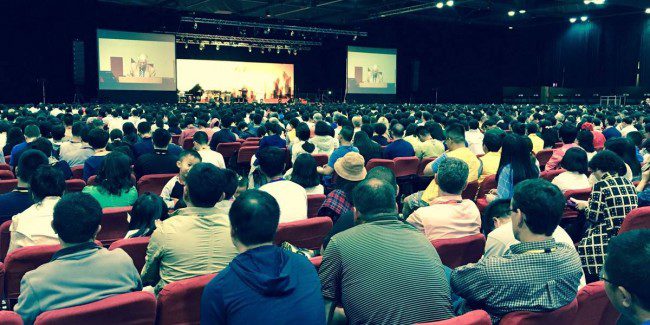
Credit: Joann Pittman
From the Main Stage
Three plenary speakers gave three talks, one-per-day.
John Piper
Chinese believers were introduced to vintage Piper. His opening message helpfully reminded people of the central (but oft overlooked) promise of the New Covenant––– new hearts. Salvation is more than forgiveness; it causes God’s people to delight in Christ above all things.
His final two talks were especially significant for the Chinese context. He challenged pastors not to accept the word of teachers and so-called experts, but rather to compared everything with what is found in the biblical text. This will require rigorous thinking (not mere information that’s been memorized).
Finally, Piper explained from John 11 and elsewhere why God most delights in his own glory and why this is tremendously loving to his people. Whether participants realize it or not, he was emphasizing the importance of God’s “face” (lian).
Paul Tripp
He observes that Christians normally relate the gospel either to the past (what we’re saved from) or to the future (i.e. eternal life). Therefore, he led participants to consider how the gospel addresses the here and now. In typical Paul Tripp fashion, his candid messages challenged pastors to do serious self-reflection.
Pulling no punches, he warned Chinese pastors of “identity amnesia”, whereby believers forget who they are in Christ. Many church leaders become proud, forgetting they are God’s children and Christ’s servants.
What’s more, Tripp reminded listeners that God uses people who are meek, who suffer, and don’t live in comfort. We have a choice–––seek the praise of people or of God. What’s the deeper desire of our hearts?
Richard Pratt
Pratt offered a change of pace from other speakers. Inserting humor and broken Chinese, he offered a broader perspective of the gospel. Focusing on the God’s kingdom, he drew from Genesis 1:26–28, Isaiah 52:3–10, and Matthew 5. The corrective from an individualistic gospel message is welcome.
From my interaction with others, Pratt’s second talk caused some confusion. Although saying the church is the true “Israel” of God, he seemly presented China as the next-in-line (after America and Europe) to bear Israel’s call as a light to the nations. Consequently, it’s difficult to discern the precise nature of the kingdom, as Pratt presents it. While avoiding overt political comments, the vagueness of his remarks likely spurs various questions that are tangential to his main points.

This critique aside, I applaud Pratt’s consistent emphasis on God’s kingdom as central to the gospel. In his concluding talk, he proclaimed “Heaven is not the goal of the kingdom of God…What is the goal? The earth!” In other words, God wants his will done on earth as in heaven. Biblically speaking, “heaven” refers to God’s throne room, not some far off otherworldly location. Thus, the gospel announces God in Christ will establish his throne in this world. This entails the resurrection of our bodies, a truth that Christians too frequently overlook.
Chinese Speakers
Although the 3 plenary speakers reside in America, the meeting was organized and led by Chinese church leaders. This observation alone was one of the greatest joys of attending the conference. Many Chinese talks were interspersed between the plenary speakers. These Chinese pastors addressed topics related to the Reformation, such as the five solas (e.g., grace alone, Scripture alone, etc.). Not all of these sessions were translated into English. The talks were more thematic rather than expositions concerning the Reformation itself.
A Few Final Comments
Conferences are always more than the speakers and scheduled activities. So, I’ll offer a few tidbits and lingering critiques.
1. What about the Reformation?
The conference did not focus on the Reformation as directly as one might expect. The messages were edifying and stem from Reformation thinking. However, I’d prefer the conference speak more directly to the Reformation’s ongoing relevance to the Chinese church. How might historical issues surrounding the Reformation relate to contemporary China?
2. “Reformed”?
As many in China know, numerous Christians lack the training to understand various nuances concerning church history, denominations, theological debates, etc. A de facto denomination system emerges. It is shaped by guanxi (relationships, networks) more than historical and perhaps theological conviction. Consequently, Chinese believers tend to be less nuanced in their theological views and instead rigidly see theological ideas as “package sets.” Just as one commonly hears someone say, “We Chinese all believe….”, in the same way, many believers will say, “All Reformed people…..” or “All charismatics…”, etc.

John Calvin (Photo credit: Wikipedia)
I mention this dynamic because I’ve heard the question asked, “Is this conference and its extended ministry pushing Reformed theology?” For multiple reasons, this is a natural question deserving attention.
First of all, the answer depends on what one means by “reformed.” If “reformed” means “Protestant”, then yes. More often, people have in mind either Calvinist soteriology or Presbyterian theology. Though some use the term, “pushing” is not a fair term. The conference speakers did not give sermons about TULIP. The leadership generally affirms a Calvinistic view of salvation; however, they don’t wave this banner above the gospel. The involvement of multiple baptist leaders is evidence the conference is not a “Presbyterian” movement.
I make these comments for a simple reason. Some people in China feel the need to “pick sides,” being wary of other theological camps. This attitude makes it difficult to facilitate church unity in China. One fruit of this conference is precisely that it brings together a spectrum of Chinese Christians and workers. Therefore, meetings like this one are a welcomed blessing.
3. Lost in Translation?
Very little of the conference was “contextualized” in a substantial or uniquely Chinese manner. This is not surprising since many (most?) of the speakers and organizers have ministries outside the Mainland. The messages, whether from Westerners or Chinese, resembled what one would hear at a conference sponsored by Desiring God Ministries or Together for the Gospel.
Is this a criticism? Not necessarily.
The talks were biblically substantial, filled with gospel truth. Nevertheless, I can’t help but wonder how the conference might have been different. Should such meetings be substantially indistinguishable from conferences held in America?
A few speakers said the church should “always be reforming.” If so, what does it mean for the Chinese church to reform itself where it has surrendered too much to tradition? Even if we affirm Reformation theology, at what point might we need to reconsider whether certain emphases and strands of Protestant teaching reflect historically Western questions? The Reformation was a particular response to specific historical problems. At a broad level, the church yielded too much authority to tradition.
Is it not possible we might repeat this mistake as the Christian movement continues spreading throughout Asia from the West? If so, we need a contextualized application of the Reformation for the Chinese church.
Overall, we have much reason to rejoice. Thousands of Chinese believers were united in spirit as we studied the truth. The conference successfully brought people together for the purpose of worshiping the one King of all nations.
This article was originally published on ChinaSource.org (May 26, 2017).
Save
Save
Previous Post

May 24, 2017
How Metaphors Make Us Moral
Next Post

June 1, 2017 True but Confusing Advice for Missionaries
Browse Our Archives
Select a Category Atonement Biblical Theology Book Reviews China Chinese Church Chinese Culture Chinese Language Collectivism Contextualization Culture (General) Ecclesiology Evangelism Gospel Honor & Shame (Face) Interpretation/Exegesis Justification/Righteousness Missiology Mission Methods One Gospel for All Nations Other Practical Contextualization Reading Romans with Eastern Eyes Resources Romans Salvation (General) Saving God's Face Seeking God's Face The Cross in Context Theological Contextualization Theological Education Theology Uncategorized
Select a Month October 2026 September 2026 August 2026 July 2026 June 2026 May 2026 April 2026 March 2026 February 2026 January 2026 December 2025 November 2025 October 2025 September 2025 August 2025 July 2025 June 2025 May 2025 April 2025 March 2025 February 2025 January 2025 December 2024 November 2024 October 2024 September 2024 August 2024 July 2024 June 2024 May 2024 April 2024 March 2024 February 2024 January 2024 December 2023 November 2023 October 2023 September 2023 August 2023 July 2023 June 2023 May 2023 April 2023 March 2023 February 2023 January 2023 December 2022 November 2022 October 2022 September 2022 August 2022 July 2022 June 2022 May 2022 April 2022 March 2022 February 2022 January 2022 December 2021 November 2021 October 2021 September 2021 August 2021 July 2021 June 2021 May 2021 April 2021 March 2021 February 2021 January 2021 December 2020 November 2020 October 2020 September 2020 August 2020 July 2020 June 2020 May 2020 April 2020 March 2020 February 2020 January 2020 December 2019 November 2019 October 2019 September 2019 August 2019 July 2019 June 2019 May 2019 April 2019 March 2019 February 2019 January 2019 December 2018 November 2018 October 2018 September 2018 August 2018 July 2018 June 2018 May 2018 April 2018 March 2018 February 2018 January 2018 December 2017 November 2017 October 2017 September 2017 August 2017 July 2017 June 2017 May 2017 April 2017 March 2017 February 2017 January 2017 December 2016 November 2016 October 2016 September 2016 August 2016 July 2016 June 2016 May 2016 April 2016 March 2016 February 2016 January 2016 December 2015 November 2015 October 2015 September 2015 August 2015 July 2015 June 2015 May 2015 April 2015 March 2015 February 2015 January 2015 December 2014 November 2014 October 2014 September 2014 August 2014 July 2014 June 2014 May 2014 April 2014 March 2014 February 2014 January 2014 December 2013 November 2013 October 2013 September 2013 August 2013 July 2013 June 2013 May 2013 April 2013 March 2013 February 2013 January 2013 December 2012 November 2012
Follow Us!
TAKE THE
Religious Wisdom Quiz
What mountain was the prophet Elijah hiding on when an earthquake, wind, fire, and then a whisper came?
Select your answer to see how you score.
Mount Gerizim Mount Horeb Mount Carmel Mount Moriah
Books by This Author Books by Brad Vaughn
Related posts from Saving God's Face

How Western Individualism Quietly Undermines the Solas

Why Christianity Needs Individuals but Rejects Individualism

Glory, Violence, and the Gospel of Peace
“I’ll be wherever you call me.”
TRENDING AT PATHEOS Evangelical

'Super Scam Me' Exposes AI Jon Bon Jovi...
Leslie Pickett believed she was in a relationship with Jon Bon Jovi....

The Brazilian Remake of Kendricks' 'Flywheel' Opens in...
“Flywheel,” the story that launched the Kendrick Brothers’ filmmaking career is getting...

The Dangers of Gradual Accommodation (Winking at Sin)
Recently, the “law of gradualness” resurfaced during the opening of a weeklong,...

The Iron Gates and the Lion of the...
Yesterday, I didn't finish my report about, well, yesterday. So I'll...

The Image: On the Horror of Capitalism and...
The Image Then went the Pharisees, and took counsel how they might...

We are approaching the date of our new American national holiday: October...
view all Evangelical blogs
Ad-Free & Subscriber Log-In Subscription Support
- About Us
- 2026 Calendar
- Videos
- Podcasts
- Library of World Religions
- Faith In Media Tracker
- Advertise With Us
- Write for Us
- Privacy Policy
- Terms of Service
- Do Not Sell My Data
- Contact Us
- Radiant Digital
- Manage Newsletter Subscriptions
- Unsubscribe From Notifications
- Sitemap
Copyright 2008-2026, Patheos. All rights reserved.
Subscription Support Ad-Free & Subscriber Log-In
Follow Patheos