
BuddhistCatholicContemplativeEvangelicalGeneral ChristianHinduJewishLatter-day SaintMuslimNew VisionsProgressive Christian
Beliefs
- Buddhist
- Catholic
- Contemplative
- Evangelical
- General Christian
- Hindu
- Jewish
- Latter-day Saint
- More Voices
- Muslim
- New Visions
- Pagan
- Progressive Christian
Topics
- Religion News
- Food and Religion
- Sports and Religion
- Religious Art
- Religious Music and Entertainment
- Religious Events
- History and Religion
- Style and Religion
- Politics and Religion
- Women in Religion
- Recreation Outdoors and Religion
- Business Finance and Religion
- Careers Workplace and Religion
- Education and Religion
- Family Parenting and Religion
- Health Fitness and Religion
- Home and Religion
- Relationships and Religion
- Technology and Religion
- Travel and Religion
Columnists
- Buddhist Columnists
- Business Finance and Religion Columnists
- Careers Workplace and Religion Columnists
- Catholic Columnists
- Contemplative Columnists
- Education and Religion Columnists
- Evangelists Columnists
- Family Parenting and Religion Columnists
- General Christian Columnists
- Health Fitness and Religion Columnists
- Hindu Columnists
- History and Religion Columnists
- Home and Religion Columnists
- Jewish Columnists
- More Voices Columnists
- Latter Day Columnists
- Muslim Columnists
- New Visions Columnists
- Nonreligious Columnists
- Pagan Columnists
- Politics and Religion Columnists
- Progressive Columnists
- Recreation Outdoors and Religion Columnists
- Relationships and Religion Columnists
- Religion News Columnists
- Religious Art Columnists
- Religious Events Columnists
- Religious Music and Entertainment Columnists
- Sports and Religion Columnists
- Style and Religion Columnists
- Technology and Religion Columnists
- Travel and Religion Columnists
- Women in Religion Columnists
Resource Library
- 2026 Calendar
- Library of World Religions
- The 100 Most Holy Places on Earth
- Patheos Answers
- Podcasts
- Videos
- Faith Leaders Database
- Anglican Episcopalian
- Bahai
- Baptist
- Buddhism
- Christianity
- Confucianism
- Eastern Orthodoxy
- Hinduism
- Holiness and Pentecostal
- ISKCON
- Islam
- Judaism
- Lutheran
- Methodist
- The Church of Jesus Christ of Latter-day Saints
- New Age
- Paganism
- Presbytarian and Reformed
- Protestantism
- Religion Behind the Scenes
- Roman Catholic
- Scientology
- Shia Islam
- Sikhism
- Sufism
- Sunni Islam
- Taoism
- Zen
- See all religions
Research Tools
 Ad-Free & Subscriber Log-In Subscription Support
Ad-Free & Subscriber Log-In Subscription Support
Follow Patheos 

- Trending:
- Forgiveness
- |
- Marriage
- |
- Consciousness
- |
- Death Penalty
- |
- Election
- |
- Halloween

-
Tools
-
Support the Work
- Home
- Evangelical
- Redefining “the elements of the world”
Redefining “the elements of the world”
Last updated on: March 22, 2017 at 7:30 am by Brad Vaughn
Redefining “the elements of the world” 2017-02-09T16:51:58-07:00 Brad Vaughn
Patheos Explore the world's faith through different perspectives on religion and spirituality! Patheos has the views of the prevalent religions and spiritualities of the world.
One of the most significant books I read in 2016 is Peter Leithart’s Delivered from the Elements of the World (IVP). It’s dense with substantial content. The book is comprehensive in scope, presenting an entire theological lens, not merely a study of a certain doctrine. Also, I was surprised to see how relevant it is for missiology and especially contextualization.
Therefore, in a few posts, I’ll explore a few ideas that are likely paradigm shifting if considered fully. I myself am in the middle of reflecting on their significance. We’ll begin in an unusual way––with a word study.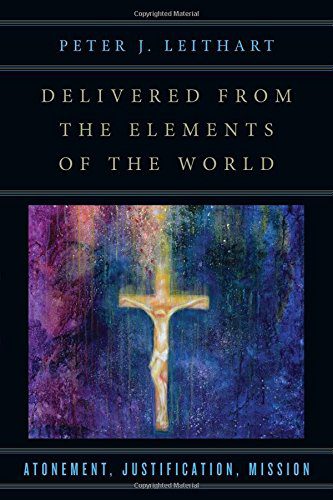
Leithart’s opening chapters are surprising but refreshing. Chapter one sets the context for the rest of the book:
…all religions have social aspects; they all are embedded in and rely on patterns of interaction among persons. Even the retreat of a solitary ascetic into the desert is a social act, since it is a retreat from social relation. And all religions deal with artifacts, symbols and rituals that might as well be called “cultural.” (p. 11)
I wonder how our theology and missiology would differ if we took this point more seriously, truly letting it permeate our thinking and strategy. He then lays down his thesis:
I will argue…the fundamental physics of every socioreligious, cultural-religious formation consists of practices concerning holiness, purity and sacrifice. Locate the sacred center of a group; its boundaries of tolerable and intolerable persons, objects and behavior; its rituals of sacrifice— discover all this and you have got down to the elementary particles that determine the group’s chemical composition. (p. 12)
Next, the surprising part comes in chapter two.
“Nature” and “Physics”

Credit: Public Domain
Leithart gives a novel interpretation of two influential words in the NT–– “nature” (physis) and “elements” (ta stoicheia).
These words do not appear frequently in the NT, but they do have a big effect on how people think about certain ideas.
How do readers normally understand these terms?
People understand the word “nature” (physis) to describe one’s biological nature or perhaps an innate characteristic. “The elements” (ta stoicheia) denote some negative power or rulers that threaten to take us captive (cf. Gal 4; Col 2).
At the bottom of this post, I’ve shown my work (so to speak) via a more detailed word study (illustrating my previous post about word studies). For now, I’ll jump to Leithart’s conclusions.
His view of “the elements” is tied up with his explanation of “nature” (which would take up too much space for this post). In short, he says “nature” (physis) in Paul routine includes the moral order and the basic structure of creation or perhaps culture (pp. 26, 30).
Nature is made up of various interconnected “elements” (stoicheia). He claims “the elements of the world” (Ta stoicheia tou kosmou) “means primarily the organized parts that constitute the system and order of the physical universe” (p. 36).
Social Physics?
Leithart applies this broad definition to the social context in the Bible. He writes,
Prior to the coming of Jesus, the social worlds of Jews and Gentiles were both organized by practices, structures and symbols to which Paul assigns the label “elements of the world.” Minimally, these involved distinctions between purity and impurity, between sacred and profane, and practices that both enforced those distinctions and, to some degree, provided sacrificial pathways of transfer from one to the other. My principal aim will be to show that Paul gives a socioreligious meaning to the phrase “elements of the world,” …Over the course of the book, we will find that, according to the apostle, Jesus delivered Jews and Gentiles from the elemental world into a new social world that operates by different sociophysical laws. (pp. 25–26)
By itself, the phrase “the elements” (ta stoicheia) is neutral. As you can see from the verses below, its precise meaning in context depends on how it is used. In Galatians and Colossians, Paul adds negative adjectives and modifies the noun with the phrase “of the world.” In Heb 5:12, ta stoicheia clearly has positive connotations.
The “elements of the world,” Leithart says, are binary in nature––dividing the world into two parts. The Law, given by God, also has this effect. He explains,
Stoicheic order is a divine-human construct. It is instituted by God but kept intact (or not) by human action. Sacred space, purity rules, sacrifice and priesthood thus constitute the foundational reality of religious and social life in the ancient world, both Jewish and Gentile. These practices and boundaries are stoicheia because they are arranged in ranks; they are stoicheia because they constitute the basics of religious and social life. They are very appropriately called “elements of the world,” and it is these that Paul says have now lost their force. (pp. 40–41)

Credit: US Public Domain
Therefore, we have a tension. The Law, which is a divine gift (something good), counts as “the elements of the world” (something bad).
The Law itself is not an evil; it is not “worldly.”
Rather, the problem consists in how people use the Law. Remember the “3 little pigs” story? Straw itself is not bad, but you don’t want to make your house out of it. This post cannot do justice to Leithart’s argument. So, don’t let the brevity of this summary cause you to miss the significance of his ideas.
As I’ll discuss in a future post, this perspective of “the elements” has implications for how we understand culture, contextualization, and even “the flesh.” Leithart gives us biblical language and a lens to assess culture in a more balance way, without hastily labeling everything “good” or “bad.”
For those interested, below are the main verses for our word study, with a few observations and key questions.
ta stoicheia in the New Testament
Even people who don’t know Greek can do this. However, if you only look at the Chinese Bible (和合本), this study is impossible because the translation is so compromised. In Chinese, I recommend translating ta stoicheia as 基础元素.
First, using various online resources, one finds “the elements” (ta stoicheia) appears 7 times in the NT. I bold the English word using Greek stoicheia below.
Gal 4:3, “In the same way we also, when we were children, were enslaved to the elementary principles of the world. […我们为孩童的时候,受管于世俗小学之下,也是如此]”
Gal 4:9, “But now that you have come to know God, or rather to be known by God, how can you turn back again to the weak and worthless elementary principles of the world, whose slaves you want to be once more […怎么还要归回那懦弱无用的小学,情愿再给他作奴仆呢]?”
Col 2:8, “See to it that no one takes you captive by philosophy and empty deceit, according to human tradition, according to the elemental spirits of the world [世上的小学] , and not according to Christ.”
Col 2:20, “If with Christ you died to the elemental spirits of the world [世上的小学], why, as if you were still alive in the world, do you submit to regulations—”
Heb 5:12, “For though by this time you ought to be teachers, you need someone to teach you again the basic principles of the oracles of God [….谁知还得有人将神圣言小学的开端另教导你们]. You need milk, not solid food,…”
NOTE: The Chinese Bible flips the word order. “Elements” [小学] should be object, not “the beginning” [开端]. Using the same words, the order should be: … 圣言基础的小学.
2 Peter 3:10, 12, “But the day of the Lord will come like a thief, and then the heavens will pass away with a roar, and the heavenly bodies [有形质的] will be burned up and dissolved, and the earth and the works that are done on it will be exposed… waiting for and hastening the coming of the day of God, because of which the heavens will be set on fire and dissolved, and the heavenly bodies [有形质的] will melt as they burn!”
Observations & Questions
On the one hand, “the elements” (ta stoicheia) in Galatians and Colossians seems to have a negative meaning.
In Gal 4, Paul clearly equates “the elements of the world” with the Mosaic Law. Colossians 2 also associates the two and seems to identify “the elements of the world” with tradition.
If we pause for a moment, this is troubling since Paul never says the Law is evil or sinful. In fact, Paul says quite the opposite in Romans, where he defends the Law (Rom 3:31; 7:7, 12, 14, 16, 22). Multiple times, Paul says the Law is something one can and should fulfill (Rom 13:8, 10; Gal 5:14; 6:2). This leads to our first big question.
Question #1: Why does Paul say the Law represents “the elements of the world”?
On the other hand, Heb 5:14 is unambiguously positive. The “basic principles” refer to the basic truths from God (i.e. “milk”) that believers should accept and follow.
Finally, the expression in 2 Peter is neutral, simply referring to the physical elements of the universe (which, by the way, fits a typical usage among ancient writers).
Question #2: How does “the elements” (ta stoicheia) have so many diverse connotations?
Furthermore, if you compare the verbal form στοιχεω, (Acts 21:24; Rom 4:12; Gal 4:25; 5:25; 6:16; Phil 3:16), you’ll all have to do with some standard of conformity.
Save
Save
Save
Save
Save
Previous Post

March 21, 2017
Check out "The Good News for Honor-Shame Cultures"
Next Post

March 23, 2017 Is the Chinese Church a Test-Case for “The Benedict Option”?
Browse Our Archives
Select a Category Atonement Biblical Theology Book Reviews China Chinese Church Chinese Culture Chinese Language Collectivism Contextualization Culture (General) Ecclesiology Evangelism Gospel Honor & Shame (Face) Interpretation/Exegesis Justification/Righteousness Missiology Mission Methods One Gospel for All Nations Other Practical Contextualization Reading Romans with Eastern Eyes Resources Romans Salvation (General) Saving God's Face Seeking God's Face The Cross in Context Theological Contextualization Theological Education Theology Uncategorized
Select a Month October 2026 September 2026 August 2026 July 2026 June 2026 May 2026 April 2026 March 2026 February 2026 January 2026 December 2025 November 2025 October 2025 September 2025 August 2025 July 2025 June 2025 May 2025 April 2025 March 2025 February 2025 January 2025 December 2024 November 2024 October 2024 September 2024 August 2024 July 2024 June 2024 May 2024 April 2024 March 2024 February 2024 January 2024 December 2023 November 2023 October 2023 September 2023 August 2023 July 2023 June 2023 May 2023 April 2023 March 2023 February 2023 January 2023 December 2022 November 2022 October 2022 September 2022 August 2022 July 2022 June 2022 May 2022 April 2022 March 2022 February 2022 January 2022 December 2021 November 2021 October 2021 September 2021 August 2021 July 2021 June 2021 May 2021 April 2021 March 2021 February 2021 January 2021 December 2020 November 2020 October 2020 September 2020 August 2020 July 2020 June 2020 May 2020 April 2020 March 2020 February 2020 January 2020 December 2019 November 2019 October 2019 September 2019 August 2019 July 2019 June 2019 May 2019 April 2019 March 2019 February 2019 January 2019 December 2018 November 2018 October 2018 September 2018 August 2018 July 2018 June 2018 May 2018 April 2018 March 2018 February 2018 January 2018 December 2017 November 2017 October 2017 September 2017 August 2017 July 2017 June 2017 May 2017 April 2017 March 2017 February 2017 January 2017 December 2016 November 2016 October 2016 September 2016 August 2016 July 2016 June 2016 May 2016 April 2016 March 2016 February 2016 January 2016 December 2015 November 2015 October 2015 September 2015 August 2015 July 2015 June 2015 May 2015 April 2015 March 2015 February 2015 January 2015 December 2014 November 2014 October 2014 September 2014 August 2014 July 2014 June 2014 May 2014 April 2014 March 2014 February 2014 January 2014 December 2013 November 2013 October 2013 September 2013 August 2013 July 2013 June 2013 May 2013 April 2013 March 2013 February 2013 January 2013 December 2012 November 2012
Follow Us!
TAKE THE
Religious Wisdom Quiz
Which book is famous for hundreds of short sayings about wise living?
Select your answer to see how you score.
Psalms Leviticus Proverbs Revelation
Books by This Author Books by Brad Vaughn
Related posts from Saving God's Face

Should We Emphasize Jesus as King to People...

Why Egalitarians Can Stay in a Complementarian Church
"Why Have You Forsaken Me?” and the Problem...

What motivates obedience when I don’t want to...
TRENDING AT PATHEOS Evangelical

The First Eucharistic Controversy: Christ’s Real Presence
For Catholics, the Eucharist is the source and summit of the Christian...

What a Stop Sign Can Teach Us About...
How to Make a Decision When You Can't Hear God Main point:...

Archdiocese Hosts Military Marriage Retreat in Germany
RASTATT, Germany — The transient military lifestyle, with its frequent deployments and...

Nearly every morning, I make the drive to Detroit with my high-school-age...

The Real AI Story Is Adoption Without Trust
Artificial intelligence has crossed a political threshold. It is no longer a...

A new article, written by Jeff Lindsay and Gale L. Pooley,...
view all Evangelical blogs
Ad-Free & Subscriber Log-In Subscription Support
- About Us
- 2026 Calendar
- Videos
- Podcasts
- Library of World Religions
- Faith In Media Tracker
- Advertise With Us
- Write for Us
- Privacy Policy
- Terms of Service
- Do Not Sell My Data
- Contact Us
- Radiant Digital
- Manage Newsletter Subscriptions
- Unsubscribe From Notifications
- Sitemap
Copyright 2008-2026, Patheos. All rights reserved.
Subscription Support Ad-Free & Subscriber Log-In
Follow Patheos