
BuddhistCatholicContemplativeEvangelicalGeneral ChristianHinduJewishLatter-day SaintMuslimNew VisionsProgressive Christian
Beliefs
- Buddhist
- Catholic
- Contemplative
- Evangelical
- General Christian
- Hindu
- Jewish
- Latter-day Saint
- More Voices
- Muslim
- New Visions
- Pagan
- Progressive Christian
Topics
- Religion News
- Food and Religion
- Sports and Religion
- Religious Art
- Religious Music and Entertainment
- Religious Events
- History and Religion
- Style and Religion
- Politics and Religion
- Women in Religion
- Recreation Outdoors and Religion
- Business Finance and Religion
- Careers Workplace and Religion
- Education and Religion
- Family Parenting and Religion
- Health Fitness and Religion
- Home and Religion
- Relationships and Religion
- Technology and Religion
- Travel and Religion
Columnists
- Buddhist Columnists
- Business Finance and Religion Columnists
- Careers Workplace and Religion Columnists
- Catholic Columnists
- Contemplative Columnists
- Education and Religion Columnists
- Evangelists Columnists
- Family Parenting and Religion Columnists
- General Christian Columnists
- Health Fitness and Religion Columnists
- Hindu Columnists
- History and Religion Columnists
- Home and Religion Columnists
- Jewish Columnists
- More Voices Columnists
- Latter Day Columnists
- Muslim Columnists
- New Visions Columnists
- Nonreligious Columnists
- Pagan Columnists
- Politics and Religion Columnists
- Progressive Columnists
- Recreation Outdoors and Religion Columnists
- Relationships and Religion Columnists
- Religion News Columnists
- Religious Art Columnists
- Religious Events Columnists
- Religious Music and Entertainment Columnists
- Sports and Religion Columnists
- Style and Religion Columnists
- Technology and Religion Columnists
- Travel and Religion Columnists
- Women in Religion Columnists
Resource Library
- 2026 Calendar
- Library of World Religions
- The 100 Most Holy Places on Earth
- Patheos Answers
- Podcasts
- Videos
- Faith Leaders Database
- Anglican Episcopalian
- Bahai
- Baptist
- Buddhism
- Christianity
- Confucianism
- Eastern Orthodoxy
- Hinduism
- Holiness and Pentecostal
- ISKCON
- Islam
- Judaism
- Lutheran
- Methodist
- The Church of Jesus Christ of Latter-day Saints
- New Age
- Paganism
- Presbytarian and Reformed
- Protestantism
- Religion Behind the Scenes
- Roman Catholic
- Scientology
- Shia Islam
- Sikhism
- Sufism
- Sunni Islam
- Taoism
- Zen
- See all religions
Research Tools
 Ad-Free & Subscriber Log-In Subscription Support
Ad-Free & Subscriber Log-In Subscription Support
Follow Patheos 

- Trending:
- Forgiveness
- |
- Marriage
- |
- Consciousness
- |
- Death Penalty
- |
- Election
- |
- Halloween

-
Tools
-
Support the Work
- Home
- Evangelical
- My most useful contextualization tool (Part 1)
My most useful contextualization tool (Part 1)
Last updated on: October 19, 2016 at 7:30 am by Brad Vaughn
My most useful contextualization tool (Part 1) 2016-09-28T09:47:40-07:00 Brad Vaughn
Patheos Explore the world's faith through different perspectives on religion and spirituality! Patheos has the views of the prevalent religions and spiritualities of the world.
I recently realized that I have never shared on this blog what is probably the most important tool included in One Gospel for All Nations (OGFAN). It is what enables us to contextualize the Bible in a faithful and meaningful way regardless of our cultural context.
Therefore, this post demonstrates how to apply the model of contextualization presented in OGFAN. In order to fully grasp the background that informs each stage of the model, you will need to check out the book.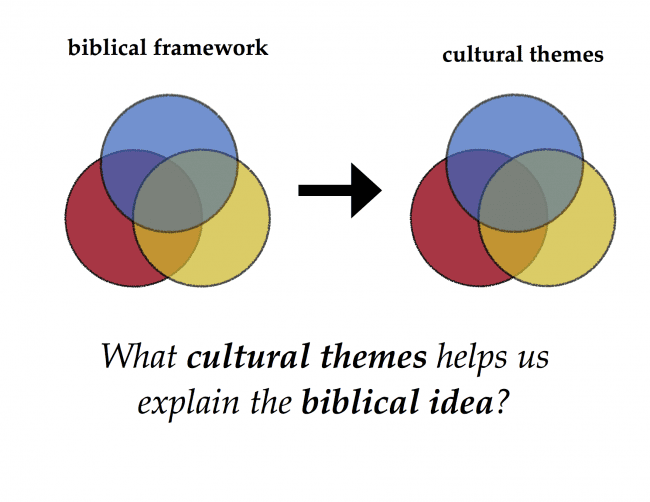 The first two stages in the model provide us with two figures, one representing the biblical text and the second reflecting a cultural context. I will use Chinese culture for the sake of illustration.
In Stage One, we discern the gospel’s framework themes and explanation themes. The figure below shows how I organize the explanation themes within the three framework themes of creation, covenant, and kingdom. Naturally, the primary significance of some themes cannot be categorized into one circle.
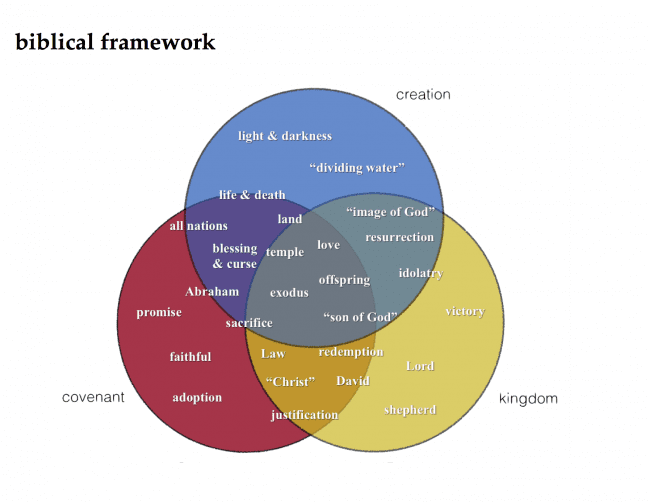
This figure gives us a biblical lens to examine and interpret the culture around us.
In Stage Two, we identify important themes within our cultural context. What are distinguishing features of the culture or aspects that characterize most people in your context? By looking at history, idioms and familiar stories, a number of themes will no doubt emerge. The figure below gives one example of how someone might depict Chinese culture. Certainly, other details could be added and not every point is unique to China.
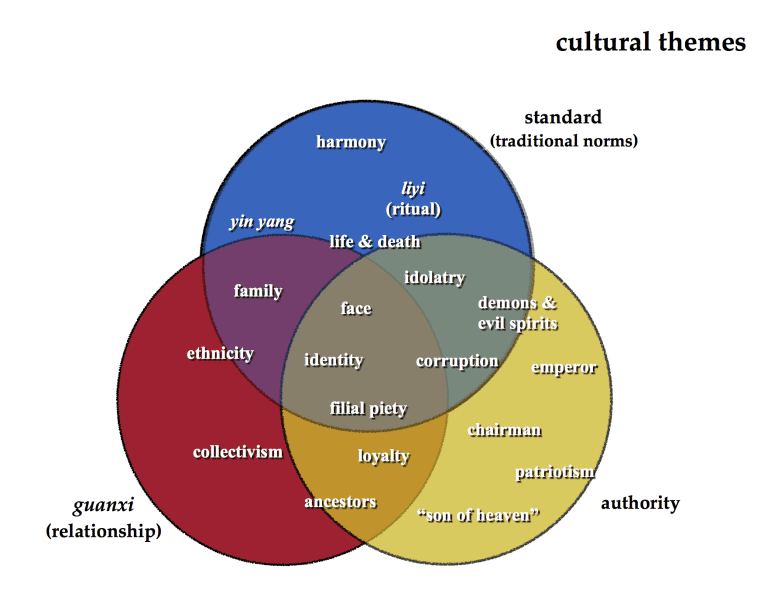
The above figure gives us a cultural lens that is fundamentally shaped by Scripture. Beneath covenant is the fundamental idea of “relationship” (guanxi). Authority is the underlying theme of kingdom. A variety of themes resemble ideas associated with creation narratives in the Bible. I have lumped them together under the wording of “standard”, by which I refer to traditional norms and basic assumptions about what is natural to the world.
Use Cultural Context to Explain Biblical Text
Today I will only address one application of the model: using a cultural context to explain the biblical text. In a coming post, I will move the other direction: from text to context.
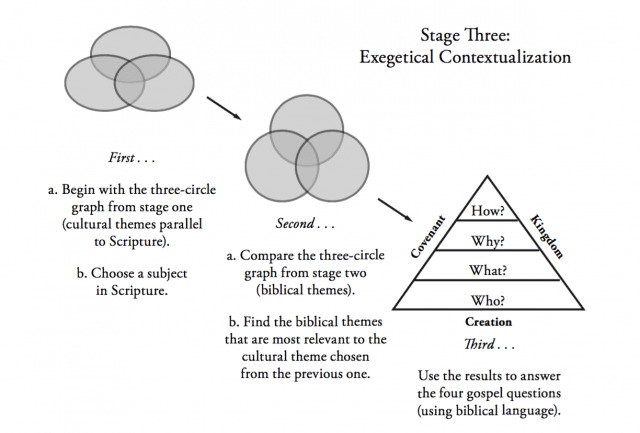
In Stage Three, use the lens from Stage Two to read the Bible. As a result, we are equipped to observe things that are actually in the Bible; yet the gospel’s framework helps is relate multiple facets of culture in a way that prioritizes the issues addressed by the gospel. We do not commit eisegesis, i.e. reading foreign ideas into the Bible.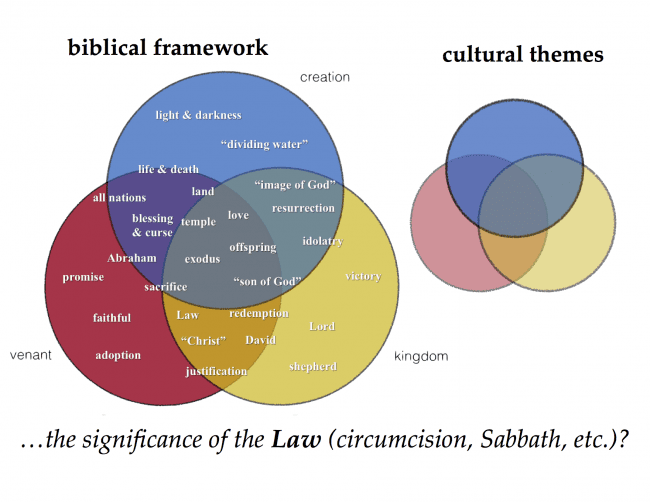 Assume you want to understand the Mosaic Law. Look at the Biblical Framework circles to identify a variety of related motifs, images, and stories. Recall that the graphic can be expanded far beyond what I’ve written.
The “Law” is found in the overlapping space between “kingdom” and “covenant.” Any of the ideas found in kingdom and covenant will likely be useful for developing a full-orbed understand of the Law. However, those explanation themes that also sit within both circles are probably even better starting points.
At first glance, we note the promise to David that his anointed offspring (i.e. “Christ”) would have an everlasting kingdom. We then recall that Israel’s redemption from Egypt marked God’s election of Israel whereby they would be a royal priesthood and a holy nation. Accordingly, we are reminded that the Law is a royal covenant, not merely a series of abstract Laws governing all humanity. It was a divine gift that distinguished Israel from the nations. Also, justification (as well as righteousness) are frequently associated with royal actions. Refer now to the circles representing cultural themes. A reader’s cultural perspective will invariably influence what he or she notices or overlooks. Every cultural lens has limits and advantages. Having admitted these limitations, we are able to be intentional about putting on another cultural vantage point.
A few themes jump out quickly when we look at the overlap between authority and guanxi (relationship).
For instance, identification to the group entails loyalty to the group head. Within the family, this is called filial piety. Collectivistic thinking extends across generations, such that ancestors and cultural traditions bear tremendous authority. One’s identity and “face” is intricately linked to how well a person plays his role within the whole, bringing honor to the group by adhering to insider norms.
Using a Chinese cultural lens, certain ideas become more prominent in our minds.
We are forced to take a second look at practices like circumcision, food restrictions, and Sabbath keeping. Israel’s leaders did not regard these aspects of the Law as mere symbolism; rather, they were judged with as much seriousness as anything that we today were normal see as “moral” in nature (e.g. stealing, murder, etc.).
Israel saw its national identity and well-being tied up in obeying God who gave the Law. Keeping the Law determined who was reckoned a Jew (or who would be cast out like a Gentile). Time and again, following the Law devolved into little more than maintaining cultural customs and honoring ancestral traditions.
Given Israel’s turbulent history and exile, the Law was an important means of protecting the nation’s purity, a way of expressing allegiance to God their true King. Their worship to God was simultaneously an act of rebellion against Caesars and all Gentile colonizers. Naturally, those who were loose with the Law would be viewed with suspicion by many Jews, who might take measures to shame wayward persons into conformity.
In One Gospel for All Nations, I call Stage Three “exegetical contextualization” because contextualization begins with interpreting the Bible.
All interpretation is an act of contextualization.
A Chinese Perspective on the Bible
The Bible is not inherently Chinese yet many Eastern ways of thinking resemble those found in the Bible. Using a Chinese lens, we can better appreciate the significance of debates in the NT concerning Abraham, Law-keeping, and the division between Jews and Gentiles.
Traditional Western readings tend to minimize underlying cultural dynamics and instead generalize the Mosaic Law as though it were a universal moral law. Interpreters then oversimplify the problem Paul addresses to that of mere legalism, trying to merit salvation via keeping God’s rules.
By using a view that is more East Asian than Western, we at least become aware of potential readings and issues that need further exploration. We recognize that the biblical teaching might not be as simple as we first thought. Not everyone else in the world asks our questions or has our struggles.
Instinctively, we all draw from our own experiences when reading ancient documents. Given the dangers of a mono-cultural worldview, reading the Bible through other cultural lenses gives us new access to topics and questions that are both global and potentially ancient.
In a coming post, I will show how to apply the model in the opposite direction, moving from the biblical text to cultural context.
Save
Save
Save
Previous Post
October 16, 2016
China is serious this time
Next Post

October 20, 2016 “White privilege” in missions. Really?
Browse Our Archives
Select a Category Atonement Biblical Theology Book Reviews China Chinese Church Chinese Culture Chinese Language Collectivism Contextualization Culture (General) Ecclesiology Evangelism Gospel Honor & Shame (Face) Interpretation/Exegesis Justification/Righteousness Missiology Mission Methods One Gospel for All Nations Other Practical Contextualization Reading Romans with Eastern Eyes Resources Romans Salvation (General) Saving God's Face Seeking God's Face The Cross in Context Theological Contextualization Theological Education Theology Uncategorized
Select a Month October 2026 September 2026 August 2026 July 2026 June 2026 May 2026 April 2026 March 2026 February 2026 January 2026 December 2025 November 2025 October 2025 September 2025 August 2025 July 2025 June 2025 May 2025 April 2025 March 2025 February 2025 January 2025 December 2024 November 2024 October 2024 September 2024 August 2024 July 2024 June 2024 May 2024 April 2024 March 2024 February 2024 January 2024 December 2023 November 2023 October 2023 September 2023 August 2023 July 2023 June 2023 May 2023 April 2023 March 2023 February 2023 January 2023 December 2022 November 2022 October 2022 September 2022 August 2022 July 2022 June 2022 May 2022 April 2022 March 2022 February 2022 January 2022 December 2021 November 2021 October 2021 September 2021 August 2021 July 2021 June 2021 May 2021 April 2021 March 2021 February 2021 January 2021 December 2020 November 2020 October 2020 September 2020 August 2020 July 2020 June 2020 May 2020 April 2020 March 2020 February 2020 January 2020 December 2019 November 2019 October 2019 September 2019 August 2019 July 2019 June 2019 May 2019 April 2019 March 2019 February 2019 January 2019 December 2018 November 2018 October 2018 September 2018 August 2018 July 2018 June 2018 May 2018 April 2018 March 2018 February 2018 January 2018 December 2017 November 2017 October 2017 September 2017 August 2017 July 2017 June 2017 May 2017 April 2017 March 2017 February 2017 January 2017 December 2016 November 2016 October 2016 September 2016 August 2016 July 2016 June 2016 May 2016 April 2016 March 2016 February 2016 January 2016 December 2015 November 2015 October 2015 September 2015 August 2015 July 2015 June 2015 May 2015 April 2015 March 2015 February 2015 January 2015 December 2014 November 2014 October 2014 September 2014 August 2014 July 2014 June 2014 May 2014 April 2014 March 2014 February 2014 January 2014 December 2013 November 2013 October 2013 September 2013 August 2013 July 2013 June 2013 May 2013 April 2013 March 2013 February 2013 January 2013 December 2012 November 2012
Follow Us!
TAKE THE
Religious Wisdom Quiz
Do not conform to the pattern of this world, but be transformed by the renewing of your ____.
Select your answer to see how you score.
Actions Heart Spirit Mind
Books by This Author Books by Brad Vaughn
Related posts from Saving God's Face

Bathsheba, #MeToo, and Eisegesis

I'm launching 3 online courses!
What's your political denomination?

Think Broadly on Contextualization and Biblical Theology
TRENDING AT PATHEOS Evangelical

57th Dove Awards Honor Dolly Parton, Crown New...
On gospel music’s biggest night, the 57th annual GMA Dove Awards honored...

The First Eucharistic Controversy: Christ’s Real Presence
For Catholics, the Eucharist is the source and summit of the Christian...

What a Stop Sign Can Teach Us About...
How to Make a Decision When You Can't Hear God Main point:...

Archdiocese Hosts Military Marriage Retreat in Germany
RASTATT, Germany — The transient military lifestyle, with its frequent deployments and...

Nearly every morning, I make the drive to Detroit with my high-school-age...

The Real AI Story Is Adoption Without Trust
Artificial intelligence has crossed a political threshold. It is no longer a...
view all Evangelical blogs
Ad-Free & Subscriber Log-In Subscription Support
- About Us
- 2026 Calendar
- Videos
- Podcasts
- Library of World Religions
- Faith In Media Tracker
- Advertise With Us
- Write for Us
- Privacy Policy
- Terms of Service
- Do Not Sell My Data
- Contact Us
- Radiant Digital
- Manage Newsletter Subscriptions
- Unsubscribe From Notifications
- Sitemap
Copyright 2008-2026, Patheos. All rights reserved.
Subscription Support Ad-Free & Subscriber Log-In
Follow Patheos